“Your mother's things are outside, Lena. Don't make this embarrassing.”
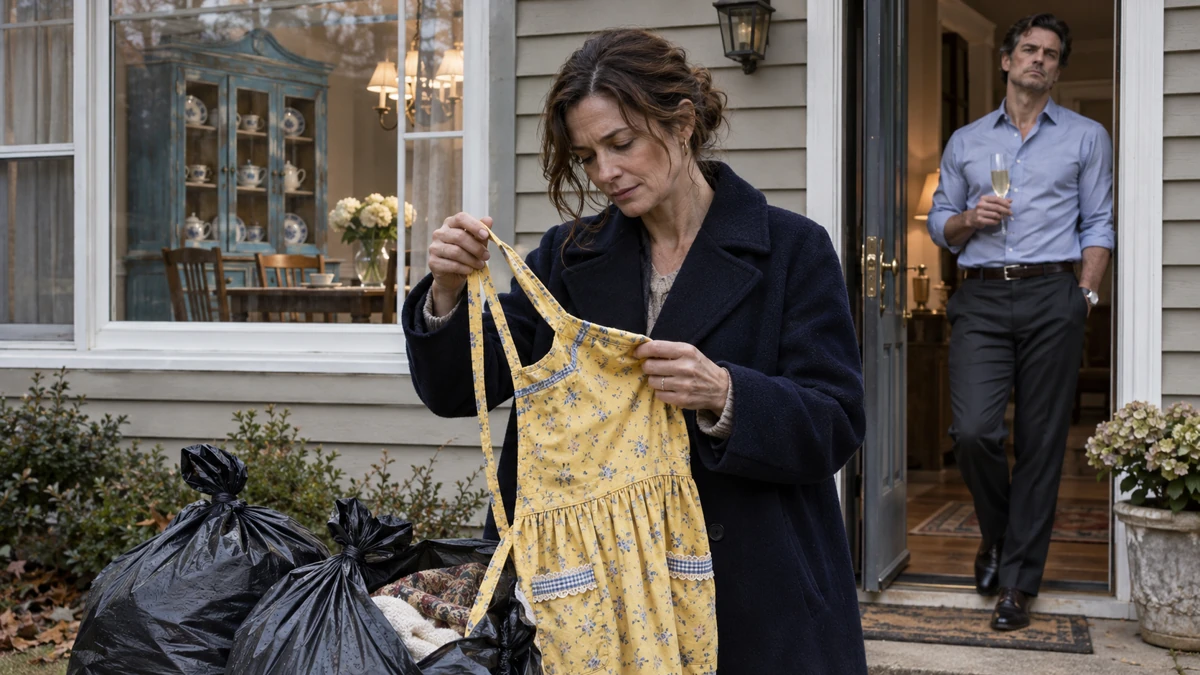
My brother stood in our mother's kitchen holding a champagne flute. Behind him, a woman measured the window for curtains. Mom had been buried seventeen days earlier.
I looked through the back door. Three black bags leaned against the dumpster. The corner of her yellow sewing apron stuck through a split in one of them.
“Those aren't things,” I said. “Those are the things she asked me to keep.”
“Then you should have come sooner.”
I had come every Tuesday during her final year. I changed the sheets, organized the medication list, and drove her to appointments while Paul sent messages about being essential at work. After the funeral, he told me he needed two weeks before anyone touched the house.
Now strangers were drinking in it.
The woman lowered her measuring tape. “We're only here about the furniture.”
Paul put down his glass. “The house has to be cleared before the estate sale.”
I asked who had approved an estate sale. We were both named to handle Mom's belongings together. He said someone had to make decisions while I was busy being emotional.
From the bags, I rescued the apron, two photograph albums, and a dented biscuit tin. The tin held Mom's sewing receipts. Underneath them was a folded delivery slip for a blue cabinet.
The cabinet still stood in her dining room. Paul had placed a red SOLD sticker across its glass.
I photographed the slip before I went back inside.
“Who bought that?”
“An auction house. Six hundred dollars. It smells like old clothes.”
Mom had kept it locked for thirty years. When I asked about it as a child, she always said, “Other people's Sundays.”
Paul laughed at my face. “Please don't tell me you want that too.”
I didn't answer. The name on the delivery slip wasn't Mom's. It was the name of a dressmaker whose embroidered label I had seen inside her wedding dress.
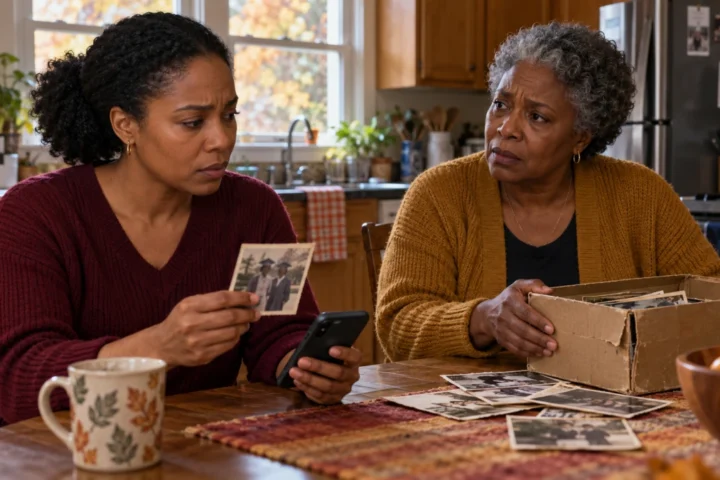
That evening I spread the rescued albums across my apartment floor. My daughter, Iris, dried the damp covers with paper towels. In the oldest album, Mom stood beside the blue cabinet in a shop window. Six women surrounded her, all wearing different versions of the same dress.
On the back she had written: First cooperative collection. Everybody paid. Everybody credited.
I had known Mom repaired clothes. I hadn't known she helped design them.
The next morning I called the auction house from the number on Paul's sale receipt. I explained that the cabinet belonged to an unsettled estate and I had not approved its sale. I offered to send the paperwork identifying both of us as responsible for the belongings.
The auctioneer, Mrs. Bell, asked me to email everything. She would pause collection while the situation was clarified.
Then she asked, “Do you know whether its contents are included?”
“What contents?”
“The seller described it as empty.”
I remembered the small key Mom wore on a ribbon when her hands grew too stiff for necklaces. At the hospital, a nurse had placed it in the biscuit tin with her wedding ring. I had thought it opened her desk.
I found it beneath a spool of white thread.
Paul refused to let me return alone. So I asked Mrs. Bell to meet us there, with our aunt Denise, who had witnessed Mom's instructions about dividing personal objects. I also sent Paul a written request not to dispose of anything else.
His reply came immediately: You have no idea what this house costs.
That was the first honest thing he'd said.
Before the meeting, Denise brought me a folder Mom had asked her to hold. It contained an inventory, photographs, and a letter addressed to both of us. The cabinet itself was ordinary. What mattered was the collection inside: original dress patterns, sample books, and correspondence documenting a small women's clothing cooperative that had supported six families after a factory closure.
Mom had arranged for a regional textile museum to assess the archive. The appointment had been postponed when she became ill.
She wanted us to donate the working records together. The museum had offered to cover transport and conservation if it accepted them. There was no secret fortune, only a part of our mother's life Paul had decided wasn't worth opening.
But the folder held something else: a list of household expenses Mom had paid during Paul's separation. Beside the final total, $8,400, she had written, Advance against Paul's share. Discuss with Lena.
I checked the bank statements available in the estate folder. The transfers matched.
At the house, Paul greeted Mrs. Bell with a smile meant for customers. He offered coffee. He told Denise the whole dispute was a misunderstanding over sentimental value.
I set the biscuit tin on the dining table.
“Then let's stop misunderstanding.”
I opened the cabinet. Inside were flat boxes wrapped in cotton, each labeled in Mom's careful hand. Mrs. Bell stepped closer, then stopped herself from touching anything.
“You told me there was nothing inside,” she said.
“I hadn't checked.”
“You signed a description saying you had.”
He looked at me. “You brought her here to humiliate me over sewing scraps?”
Denise took a sample book from the nearest box. “Your mother's rent came out of these scraps when your father lost his job.”
I laid out the museum correspondence, the inventory, and the transfer list. Then I showed the photographs of the bags beside the dumpster.
The woman who had been measuring curtains appeared in the doorway. She was an antiques dealer Paul had invited back for the remaining furniture. He had already taken deposits from three buyers.
“Were you authorized to sell any of this?” she asked.
Paul's smile disappeared.
He said the deposits had paid overdue utility bills. I asked for the bills. His silence lasted long enough for everyone to understand.
Finally he admitted he had used part of the money to secure an apartment. He had expected his estate share to cover it later. The blue cabinet had simply been the easiest thing to sell first.
Mrs. Bell canceled her purchase. The dealer requested her deposit back. Neither threatened him with theatrical consequences. They wanted their money and written confirmation that the sales were canceled.
I insisted we stop handling the remaining inventory ourselves. Over the next month, an independent estate professional cataloged it. The refunds came from Paul's funds, and the $8,400 advance was accounted for before the remaining proceeds were divided. Every payment appeared in the final statement we both received.
Paul complained about the professional's fee until she asked how many additional unrecorded sales needed reversing. After that, he answered her emails on time.
The museum accepted seven boxes. Denise and I went to the small exhibit opening the following spring. Paul was invited. He sent a brief message saying he couldn't come, but he did sign the donation forms without asking me to remove my name.
Under a photograph of six women in a shop window, a label listed every maker. Mom's name appeared third. She would have liked that they were alphabetical.
Iris held my arm while we looked at the dresses.
“Grandma made all this?”
“Grandma helped make all this.”
The blue cabinet came home with me. Its glass was cloudy and one foot needed a folded piece of cardboard. I put the yellow apron inside, hanging from a plain wooden hook.
On Sundays, Iris sits at my kitchen table while I teach her to mend a hem. Sometimes she asks about the women in the photograph. I tell her what we know, and we leave room for what we haven't learned yet.
The biscuit tin sits between us, full of thread. Nothing in it is waiting to be thrown away.
Fictional story.