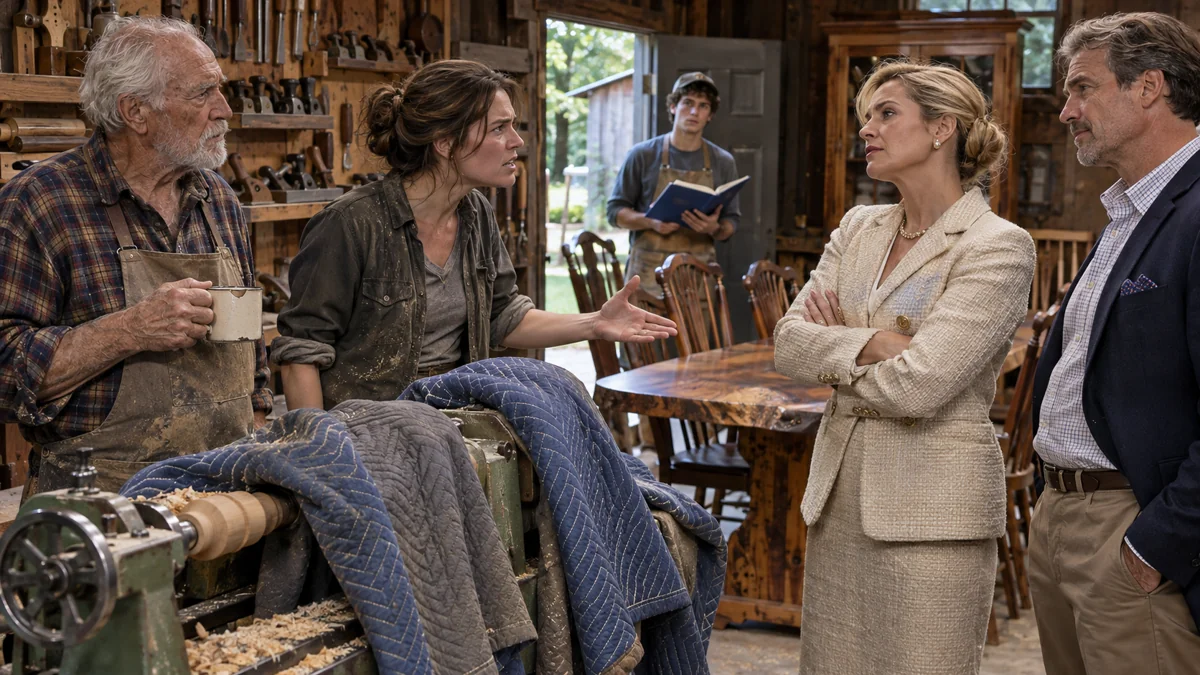
“Dad doesn't need to see this,” my sister said, covering the price on a lathe with her handbag. “It'll only upset him.”
Dad was in the next room, packing his own mugs.
The man beside her had brought a trailer. Two workers waited at the workshop door. On the bench where Dad had taught me to sand a chair rail, someone had placed a stack of moving blankets.
My sister, Vanessa, told me she was selling redundant equipment before Dad moved into his smaller apartment. The sale would help cover his expenses. She had arranged everything while I was away caring for my husband's mother.
“Has he agreed?” I asked.
“He asked me to simplify things.”
Dad appeared with a chipped mug in his hand. At seventy-six, he walked slowly because his knee hurt. There was nothing wrong with his hearing.
“I asked you to sell the spare drill press,” he said.
Vanessa turned toward him with the patient expression she used for difficult customers. “We discussed the whole workshop.”
“No,” he said. “You discussed it. I said I'd think.”
The buyer looked at his workers. One lowered his end of a blanket.
Then a bicycle bell sounded outside. Owen, Dad's former apprentice, came through the gate with a blue order book tucked beneath his jacket.
“I found the copy you wanted,” he said to Dad. “And you should know who's buying your name.”
Vanessa reached for the book before Dad did.
I moved between them.
Three years earlier, Dad had stopped accepting large commissions. Owen took over the rented storefront, with his own equipment and a new business name. Dad kept his home workshop and occasionally made small pieces for old clients. Vanessa managed his invoices because she said paperwork was the one thing he should retire from.
I had believed her. I paid his grocery account every month and trusted the spreadsheet she sent me. It showed modest income, expensive repairs, and a growing need to sell assets.
Owen's order book told a different story.
He had copied it when helping Dad quote a set of library tables. Dad had asked for it back after discovering that two customers were expecting furniture he didn't remember agreeing to make.
The buyer at our door introduced himself as Martin Cole. He owned a furniture resale shop. Vanessa had offered him the machines and a package she called “the remaining goodwill.” According to his emails, that included the right to market a retirement collection under Dad's name.
Dad set his mug on the bench.
“My name isn't retiring into your store.”
Martin opened the agreement on his phone. Dad's signature wasn't there. Vanessa's was, beside a sentence claiming she was authorized to sell on his behalf.
The workers went back to the trailer.
I asked Martin to email Dad the agreement and every inventory photograph. He did. We agreed nothing would leave that day. He wanted his deposit returned before he would discuss anything else.
Vanessa said I was turning an ordinary family arrangement into an attack.
“Then let Dad read it,” I said.
At the kitchen table, he put on his glasses. I waited while he worked through every page. He stopped twice to ask what a phrase meant. Each time Vanessa answered before I could.
Finally he lifted a hand.
“I asked her.”
We discovered that the sale price was $14,000. Vanessa had told him the spare drill press might bring $600. Martin had already paid a $4,000 deposit.
Where was it?
Vanessa said she'd combined it with his operating money. When Dad asked to see the account, she said the online banking was difficult to access on her phone.
He picked up his own phone and called the bank.
I drove him there the next morning. He requested his statements, removed Vanessa's account access, and asked the bank what additional steps he needed to take. I sat beside him while he spoke for himself.
The statements showed payments for her car repair and a commercial storage unit. They also showed customer deposits that never appeared on the spreadsheet she sent me.
The storage unit held chairs she had purchased for resale. Her side business was failing. She had been using Dad's small commission account to keep it running, expecting the workshop sale to erase the difference.
I printed my grocery transfers beside her reports. They were the reason Dad's personal bills had continued getting paid while she told him his workshop was losing money.
Before the meeting, Dad asked me to take him to the workshop alone. I thought he wanted to check what else was missing. Instead he pulled out a stool and asked me to sit.
“Did you think I couldn't read the papers?”
I wanted to answer quickly. His face stopped me.
“I thought Vanessa was helping you,” I said.
“So did I. But when you came in, you asked her what I'd agreed to. You could have asked me first.”
He was right. Even defending him, I had looked toward the person who claimed to speak for him. I apologized and asked what he wanted me to do next.
“Organize the copies. Let me ask the questions.”
We spent an hour at the bench sorting records into envelopes. He recognized customers by the furniture they had ordered twenty years earlier. A maple desk belonged to a boy who was now a school principal. A walnut cradle had come back for repairs before its third baby. Those weren't the memories of a man who had stopped understanding his own work.
He also told me something I hadn't known. He had planned to sell the lathe eventually, but he wanted Owen to have the first chance to buy it. He had offered a payment schedule that wouldn't put the younger man's business under pressure.
“It's my machine,” he said. “I can give somebody time.”
I wrote down the customers who still needed answers. Dad called each one himself. He didn't blame Vanessa in those first calls. He explained which orders he could complete, which he would not take, and when the deposits would be returned. One customer shouted. Dad listened, then repeated the actual refund date.
Afterward he sat very still, holding his mug between both hands.
“I hate that they have a reason to doubt me.”
I couldn't make that feeling disappear. I could make sure nobody else used it as proof he needed less control over his affairs.
We checked the refund receipts together when they arrived. Dad marked each customer paid in the blue order book. The task was slow, ordinary, and entirely his.
We arranged a meeting with Vanessa, Martin, Owen, and an accountant Dad had used before retirement. Dad wanted the facts settled in the room before anyone told the wider family a different version.
Vanessa arrived carrying pastries.
Nobody opened the box.
The accountant placed three columns in front of her: customer money received, Dad's actual expenses, and unrelated spending. She disputed a storage payment until Owen produced the message in which she'd asked him to deliver chairs to that exact unit.
“Those chairs were an investment for the family,” she said.
“Did you ask me to invest?” Dad asked.
She looked at Martin. “The sale would have covered everything.”
“You sold work I haven't made,” Dad said. “You sold machines I still use. And then you tried to sell my name.”
Martin slid his agreement across the table. “I want the deposit back. I'm not buying any of this.”
The accountant calculated $9,260 owed to Dad's account, including the deposit that now had to be returned to Martin. Two customer deposits also needed refunding because Dad declined those commissions. He wanted to finish moving, not work overtime to hide Vanessa's decisions.
She cried when he said that. He waited, then asked her to write down a realistic repayment proposal.
She sold the storage inventory at a loss, returned Martin's money, and signed an agreement for the remaining balance after getting her own advice. The accountant checked the payments monthly. Dad stopped letting her present herself as his business manager. He also told the relatives who had repeated her story that his memory was fine.
Vanessa didn't attend his first apartment dinner. For a while, she sent messages only about the balance. Dad answered them with the same simple courtesy he used with late customers. By autumn she had repaid most of it and asked whether they could have lunch without discussing money.
He said yes, at a restaurant, on a day he chose.
The workshop lease went to Owen after Dad decided to keep only a bench and two portable tools. It was his decision, made three months later with a written inventory and a price he negotiated himself.
On moving day, I found him wrapping the chipped mug in newspaper.
“You could buy a new one,” I said.
“I could.” He handed me a box. “I'm keeping this one.”
Above the little bench in his apartment, he hung a sign he lettered by hand: Small repairs. By appointment.
The first repair was my dining chair. He charged me twenty dollars and insisted on giving me a receipt. At the bottom, under his name, he wrote the date in his own steady handwriting.
Fictional story.