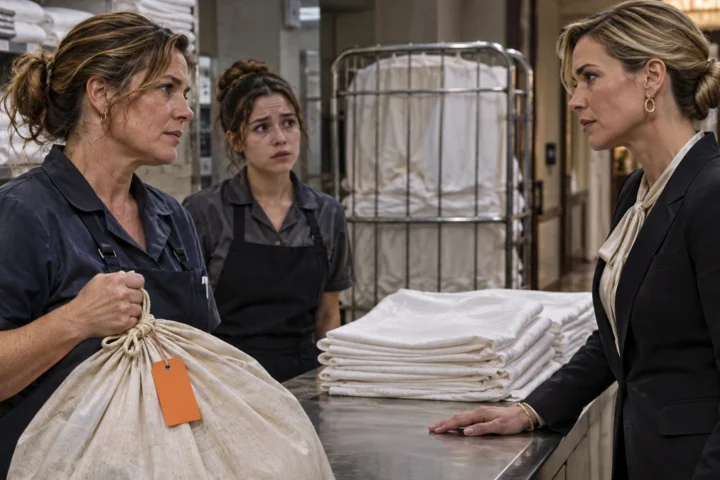
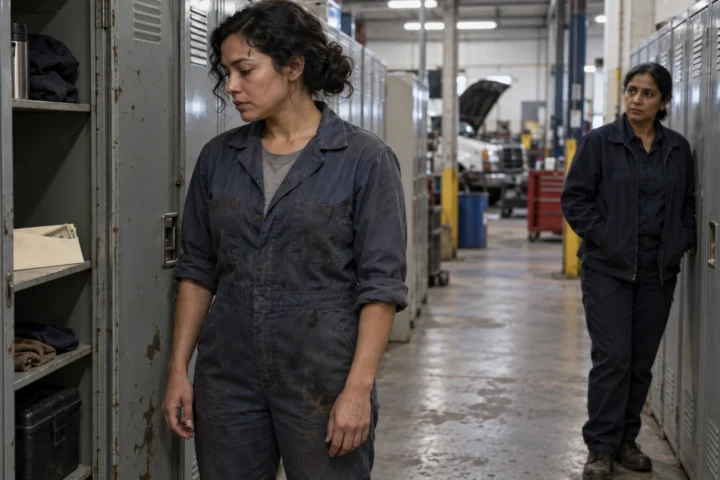
“Empty your bag, Rosa,” the events manager said. “We can do this quietly, or we can do it in front of security.”
My bag held my lunch container, a bus pass, and the cardigan I wore when the laundry room grew cold. Twenty feet behind me, wedding guests were drinking champagne.
I had worked at the hotel for eleven years. That morning I had counted 184 ivory tablecloths into the ballroom delivery. Now sixteen were missing, and Ms. Vale had decided the laundry supervisor must know where expensive fabric went.
I put my bag on the service counter but didn't open it.
“Please get the duty manager,” I said. “And bring the return sheets.”
She smiled toward the junior attendant beside me.
“You see how this becomes difficult?”
The attendant, Nia, looked down. I couldn't blame her. She had been there six weeks.
Ms. Vale pointed to an orange-tagged linen bag beneath the counter. She said it had been found near my locker. I recognized the tag immediately. It was from an outside rental company, not our stock.
“Read the number,” I said.
She reached for the tag, then stopped.
“Orange isn't proof of anything.”
“No,” I said. “That's why we keep the numbers.”
Every outside linen delivery received a tag and a signed intake sheet. Hotel linen was marked with a small blue stitch. Ms. Vale had ordered special ivory runners for the wedding, and our team had been told to keep them separate. I had emailed her two days earlier because the quantity on the delivery note didn't match what arrived.
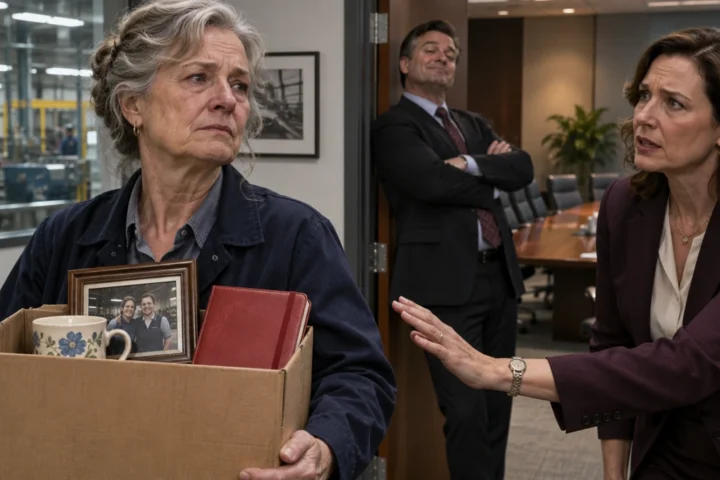
“Take these home before the visitors arrive,” my manager said, nudging the cardboard box with his shoe. “We don't want the place looking like a yard sale.”
Inside were a ceramic mug, three handwritten cards, and a framed photograph of the packaging team I had trained for twenty-three years.
It was my final Thursday at Halden Supply. I had planned to retire at the end of the month. My manager, Ross, had moved my last working day forward without discussing it, saying the handover was complete.
Across the room, a banner welcomed our largest client. Ross had put his own name on the presentation describing a new shipping system. I had designed its test procedure after two damaged deliveries the previous winter.
I picked up the box. Under the photograph lay my red notebook, the one where I recorded trial numbers before transferring them into the official log.
As I reached the door, the client's quality director stopped me.
“Evelyn? You're leaving before we review the cold test?”
Ross stepped between us.
“I approved everything. Evelyn's already enjoying retirement.”
The director frowned. “Then why does the report list her as the final sign-off?”
I set the box down.
“I haven't signed off a final cold test.”
Ross laughed too loudly. “She means the paperwork hasn't caught up.”
I knew exactly which test he meant. Three weeks earlier, a prototype container had failed after extended cold storage. I had recommended a different adhesive and a repeat trial before any production order. The revised test was scheduled for the following Monday, after my newly shortened last day.
Someone had put a fern where Owen kept the photograph of his father.
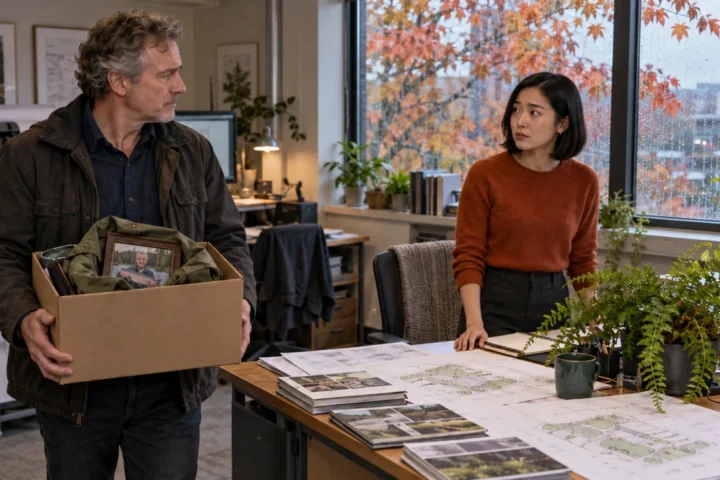
It was the first thing he noticed when he returned to the Portland office after eight weeks away. Not the new bid board or the stack of supplier catalogs. A fern, green and extravagantly alive, leaned across the window desk he had occupied for eleven years.
Behind it sat a young woman in a burnt-orange sweater.
"You must be Owen," she said, standing. "I'm Hannah. Paula said you'd be back today."
His father's photograph lay in a cardboard box beneath the coat hooks, wrapped in his old olive overshirt. The picture showed a man holding a salmon he had not caught; Owen had caught it, and his father had insisted on posing. During the last two months, Owen had helped that same man get from bed to bathroom without falling.
"That's my desk," he said.
Hannah looked at the fern, then at him. "Paula told me this was my permanent station."
Through the glass wall, their director lifted one finger to say she was on a call.
Owen stood holding the box. At fifty-two, he had expected returning to feel like stepping back into his own shoes. Instead, a twenty-seven-year-old stranger had her mug beside his window and a plan for the client account he knew best.
"I'm taking the Alder Commons tender through submission," Hannah said. "I was hoping we could review the drainage quantities."
Paula opened her door before he could answer.
"Wonderful. You've met. Owen, you'll be relieved Hannah kept everything moving."
He was not relieved. And the expression that crossed Hannah's face told him she had already understood that much.
The apology had no subject line. Rosa found it between a paper supplier's quote and a message about the church raffle, in the shared project mailbox Evan had asked her to cover while he took his mother to a medical appointment.
Malik, I should have stopped the meeting before they made you carry this.
She took her hand off the mouse. Behind her, the folding machine slapped another stack of Cleveland school calendars into neat thirds. It had made that same sound the afternoon Malik cleared out his locker.
Rosa had not gone looking for secrets. The draft sat under the school job number, where a purchase order should have been. She read three lines before she understood what it was, then closed it. But she could not close the sentence in her head.
One month earlier, eight hundred calendars had gone out with the wrong dismissal times. Malik, twenty-eight, had been the last person at the press. Evan had said he ignored the approved file. Rosa had watched Beena, the owner, remove his name from the production board.
And Rosa had remembered a different file arriving after lunch.
She had kept that memory small. An attachment nobody asked her about. A hurried instruction. A thing she could not prove without making trouble for the manager who had recommended her for a bonus.
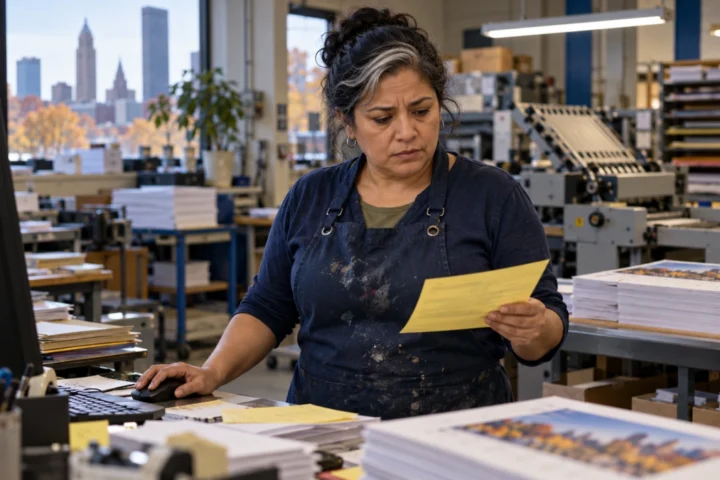
Now, at forty-six, with silver showing through the dark hair in her bun and ink on her navy apron, Rosa opened the job archive instead of the draft.
The first thing she found was her own handwriting on a yellow routing slip.
Use revised pages. Evan aware.
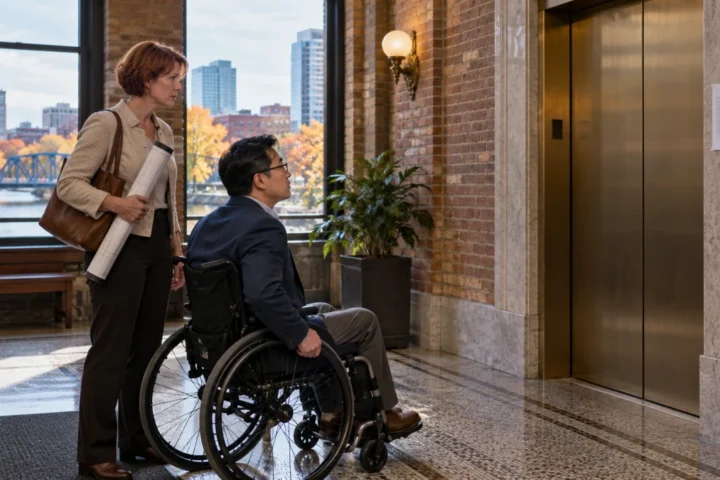
The elevator doors stayed closed while Beth Rowe explained that Miles Chen could still be part of the presentation from the bottom of the stairs.
“I'll put you on speaker,” she said. “You know I know the drawings.”
Miles looked from the small service notice to the presentation tube under her arm. Inside were the market forecourt plans he had spent three weeks revising. His name was on the drainage study. His measurements determined whether delivery trucks could turn without blocking the pedestrian route.
He had arrived twenty minutes early. Now there were twelve minutes before the Thursday pitch, and the meeting was three floors above him in an older Grand Rapids commercial building with one broken elevator.
“Where would I put the drawings?” he asked.
Beth glanced toward the narrow space beside the stairwell. She had not thought that far.
A building employee offered to find two strong people. Miles said no before the man finished. He would not be carried upstairs, and nobody would improvise a lifting arrangement with his wheelchair. The employee apologized and went to answer the desk phone.
Beth lowered her voice. “We can't lose this meeting.”
“Then we need a place where I can do it.”
His phone lit up with a message from Omar Velez, the client coordinating the proposal review. Were they in the building?
Miles typed yes, then paused. Beth was already reaching for the tube as though taking the drawings upstairs might save the morning.
He held it against his wheel.
“Don't take the work up without me,” he said.
Then he called Omar, not to ask permission to exist in the meeting, but to explain why the meeting needed to move.
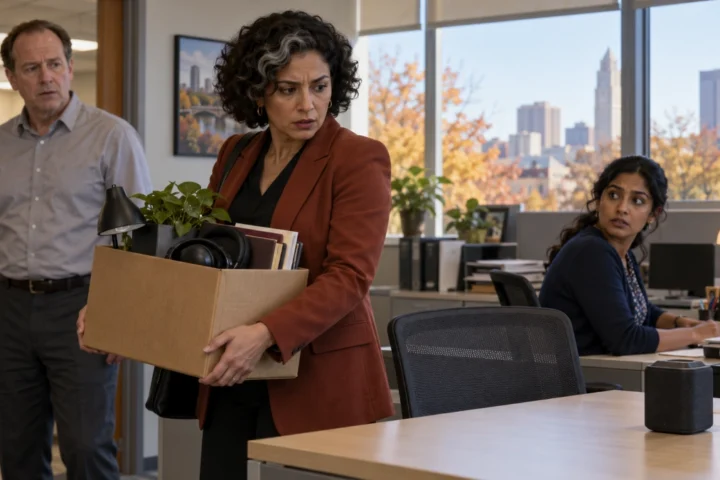
Farah Haddad was returning her headset when she heard herself offer to help a customer from the desk where she no longer worked.
Her cardboard box held a laptop, a charging cable, and the blue ceramic mug she had accidentally packed with company equipment. The mug was hers. Everything else had a yellow inventory sticker. After twelve years at the Columbus office, the distinction seemed almost funny.
Then the speaker said, in her voice, “Let's take this one step at a time.”
Farah stopped beside the empty desk. The little upward catch on “time” was hers too, a habit she had spent years trying to soften in recordings. Nobody was sitting behind the monitor.
Scott Avery came through the doorway carrying the equipment receipt. His pale gray shirt had a coffee stain near the pocket. He saw her looking at the speaker and stopped walking.
“That's the new assistant,” he said.
“I can hear that.”
Across the aisle, Priya Nair lowered her headset. Farah recognized the expression on her former coworker's face: the careful stillness people wore when they were being asked, without words, not to become witnesses.
Scott explained that the vendor had used the training library. Farah had recorded those examples herself. He had understood that the old recording permission covered the new system.
The assistant spoke again, describing a refund policy Farah had never read aloud.
She set the box down slowly. Her position had been eliminated on Friday. It was Tuesday morning, and apparently part of her had been given a new position without being asked.
“Turn that off while we talk,” she said.
Scott reached toward the speaker, then hesitated.
“I mean my voice,” Farah said. “Not just this speaker.”
I had come back for my socket set, not to hear my father become somebody else's father.
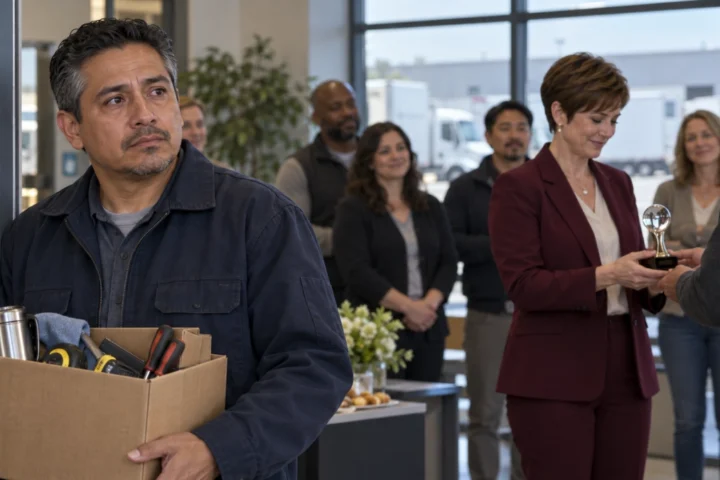
The security desk had already checked my name against the collection appointment. I stood at the edge of the lobby in my navy work jacket, holding a small cardboard box, while my former manager accepted a trophy beside the elevators.
Celeste Wynn's chestnut pixie cut caught the light. Her burgundy suit was the one she wore when visiting executives arrived. The trophy had no writing I could see, just a silver curve rising from a plain base.
“The idea came to me while caring for my father,” she said. “When someone you love can't tell you what they need, you learn to create a better signal.”
I knew the sentence because I had said it to her in a private meeting eight months earlier. My father could tell people what he needed. After his stroke, the words sometimes arrived late. That distinction had mattered when I explained why I wanted a predictable departure time.
Celeste had taken the sentence, removed the difficulty that made it true, and fitted it to her own mouth.
Behind her, Keiko Sato stopped clapping. Leon Ward looked down at his hands. They knew the dock readiness system on the display was not something Celeste had dreamed up alone. Keiko had tested the timing. Leon had found the flaw that could leave a driver waiting beside the wrong door.
My name appeared nowhere that I could see.
Then a communications employee lifted her phone to record the closing remarks. Celeste smiled toward the lens and began another sentence about the man who had raised her.
I put my box down before I could drop it.
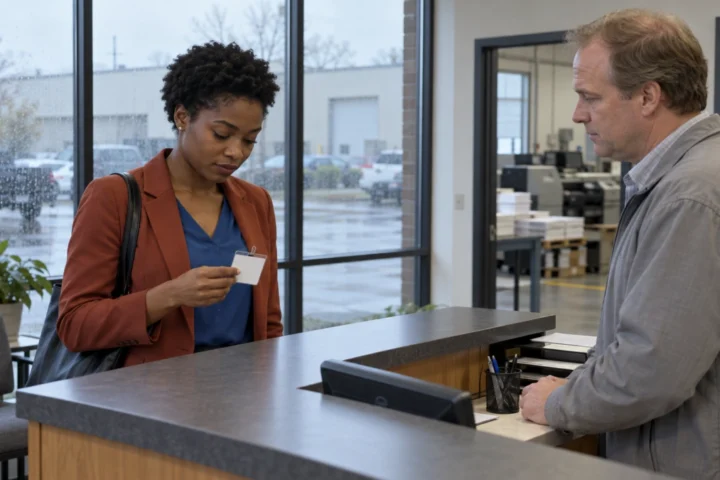
The badge Brent Keller handed me said visitor, although the job offer in my bag said employee.
There was no name on the little white rectangle. I stood at the plain reception counter in my rust blazer and blue blouse, rain cooling the back of my neck, and turned it over as if the other side might explain something.
“Everybody starts with one,” Brent said. His light gray jacket still had a store crease along the sleeve. “Agnes will get you settled.”
I had ironed that blouse at midnight. I had stopped applying for other jobs on Friday, after accepting his written offer for nineteen dollars an hour. At twenty nine, after four months without steady work, I had wanted one morning when I didn't have to introduce myself as available.
Behind the counter, Agnes Porter slid her green reading glasses down her nose. Her silver braid rested against a cardigan with a missing button.
“Did you bring lunch?” she asked.
It sounded like kindness. Later I would understand it was also a warning.
By noon I had corrected two delivery lists, answered calls, and arranged a replacement shipment for a customer whose funeral programs had gone to the wrong church. Brent stood beside my desk while I explained the mistake to a driver.
“That's the initiative we're looking for,” he said when I hung up.
Then he pushed a form toward me. Three trial days. No wages. No guarantee of employment.
I looked at the clock. Six hours since I had arrived. My sandwich was untouched.
“I already accepted the job,” I said.
Brent glanced toward Agnes, who had stopped sorting the mail.
“You accepted consideration,” he said. “Let's not get ahead of ourselves.”
The envelope was already inside Lena Ortiz's locker when she arrived for the early shift, resting between her spare gloves and the photograph of a dog she no longer owned.
It was cream, unsealed, and thick enough to lift the gloves at one corner. A folded edge of currency showed through its mouth. On the front, someone had written only her first name.
Lena stopped with her hand against the locker door.
At the Dayton maintenance shop, people left things for one another all the time: borrowed sockets, grocery coupons, a sandwich someone had forgotten in the refrigerator. They did not leave money. Especially not the week the contractor's internal auditors were coming to ask why the records for city vehicles looked cleaner than the vehicles themselves.
Behind her, an air compressor started. She could feel the vibration through her scuffed brown boots. Her slate-blue coveralls smelled faintly of yesterday's work, and one dark curl had escaped the low bun at her neck.
She had seen an invoice on Tuesday for a cooling-system repair that, as far as she knew, had never happened. Her supervisor, Frank Danner, had called it an administrative delay. Her mentor, Walt Mercer, had told her to give him a day.
Now there was cash beside her gloves.
Lena withdrew her hand and called Priya Shah from the parts desk. She asked her to come to the lockers, without touching anything on the way.
Priya stopped at the end of the empty aisle in her navy work jacket. She looked from Lena's face to the shelf.
"Do you know where it came from?"
"No."
"Then let's keep it that way until someone records it."
Before Lena could answer, Walt appeared beyond the doorway.
He saw the open locker, the envelope, and Priya standing there.
"Don't make a big thing of this," he said.
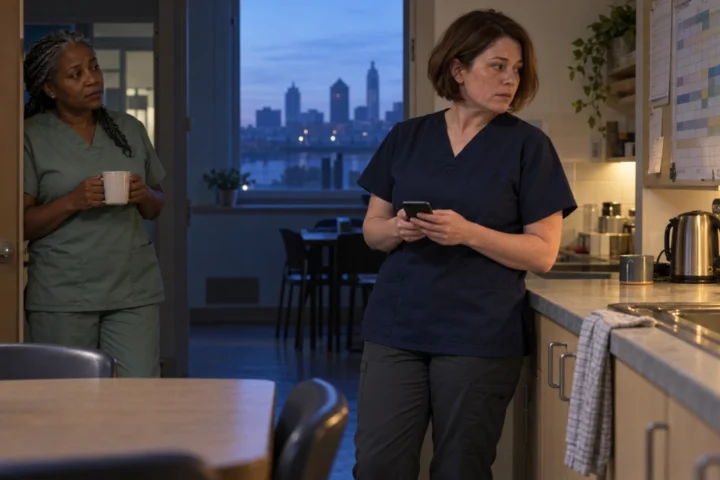
At five forty on Friday morning, Tessa Brooks found her own name printed across the day she had already been promised off.
The schedule hung beside the kettle in Linden House's staff kitchenette. Someone had circled the seven o'clock shift in red, hard enough to tear the paper. Outside the small window, Columbus was still blue with darkness. Tessa stood under the amber cupboard light in her navy scrubs, phone in one hand, the leave approval open on its screen.
She had come early to collect the thermos she had forgotten after Thursday's shift. At eight, movers would arrive at her mother's apartment. Ruth Brooks had waited nineteen months for a place without stairs. The elevator reservation, the truck deposit, the friend driving over from Newark: none could simply be moved to Saturday.
From the doorway, Celia Price watched her without drinking from her mug. Silver showed through the braids tied behind her head.
"Please tell me that's an old copy," Celia said.
Tessa touched the date. It was tomorrow's date crossed out, today's written above it. The names underneath were unchanged.
Her manager answered on the fourth call.
"You need to arrange your coverage," Denise said, before Tessa finished explaining.
"You approved this three weeks ago. I reminded you Tuesday."
"And you're physically there now. Let's not turn this into a refusal to work."
Across the hall, a radio played softly behind the closed office door. Celia had been awake all night. The residents were safe, but the next shift needed two people, and only one was coming.
Tessa looked at the forgotten thermos beside the sink. She had never felt so trapped by something she had not agreed to do.
Then Denise added, "If you walk out, I'll have to record what happened."
Tessa put the call on speaker and asked Celia to stay.