Original fiction
On this page
The Storage Unit Dad Paid For
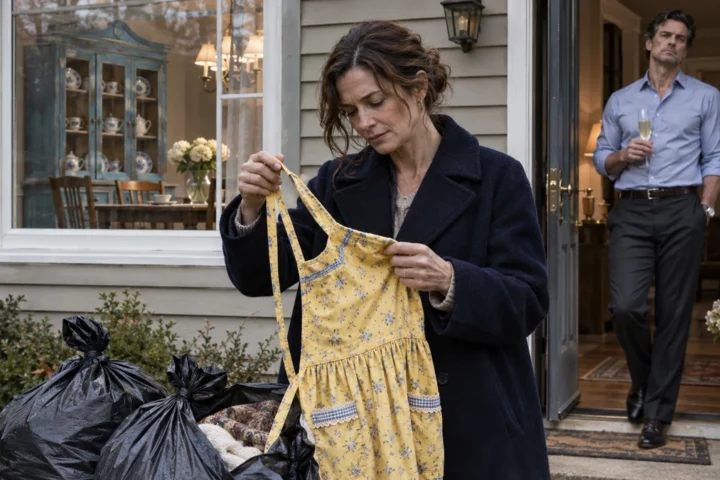
The storage manager handed Nora Bennett a pair of bolt cutters and asked whether she wanted to keep the wedding dress.
"What wedding dress?"
He checked the number on his clipboard. "Your father said the family was clearing everything today."
Nora looked at Russell. Her father stood beside the loading door with both hands buried in his brown jacket, although the Toledo morning was already warm. For eleven years, he had told her that unit forty-six held her brother's woodworking tools. For eleven years, she had pictured a table saw, the unfinished maple chair, the things Adam had left behind when a driver ran a red light.
She had come to help her father stop paying a hundred and eighteen dollars every month to keep grieving behind a padlock.
"We aren't cutting anything," Russell said.
The manager looked between them, set down the cutters, and went back inside.
Nora held out her hand. "You asked me to clear it today."
Her father took the key from his pocket.
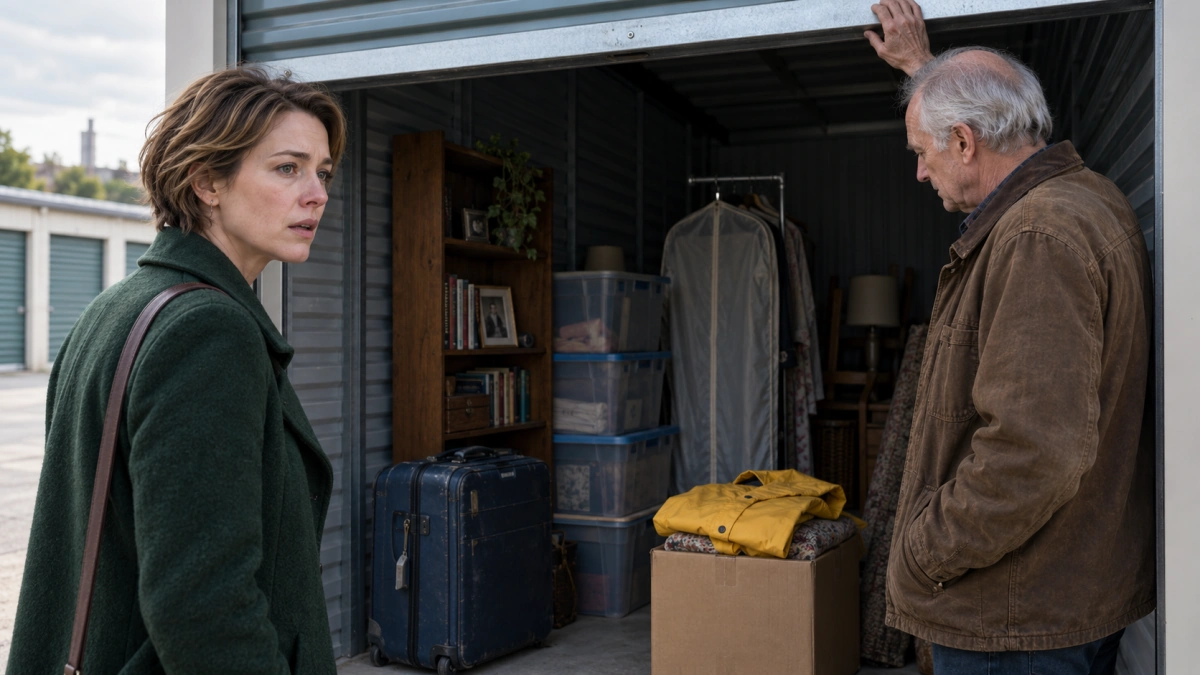
When the door rattled upward, the first thing she saw was a blue suitcase. Not a saw. Not a chair. Behind it stood a narrow bookcase, three plastic tubs, and a dress bag hanging from a garment rack. A woman's yellow raincoat lay folded on top of a cardboard box.
Nora knew that coat. She had given it to Tess the Christmas before Tess left Adam.
"Why do you have her things?"
Russell kept his hand against the door as if the whole mechanism might fall.
"Because your brother wouldn't give them back."
Nora turned toward him. There was no confusion in his face, no mistake she could help him correct.
"You let us say she abandoned everything."
Her father looked into the narrow room.
"Yes," he said. "I did."
Outside, a delivery truck backed toward the gate, its warning beeps filling the silence. Nora moved a bicycle tire away from the doorway before realizing she had no right to touch even that. Everything inside had an owner. The discovery was so simple that it made her ashamed of how quickly she had arrived carrying contractor bags.
"Does Tess know we're here?"
"No."
"Then close it."
Russell looked at the bagged dress. "I thought if I got you here, I could finally tell you."
"You brought me to throw her life away so you wouldn't have to say something at your kitchen table?"
"I wasn't going to throw it away."
"The man brought bolt cutters."
Her father let go of the door. He had a way of moving slowly when cornered, as though an argument were weather that might pass if he stood still. Nora used to admire that steadiness. Now she wanted to shake his sleeve until something honest fell out.
The manager returned with a cart. His name tag said Luis. Russell told him they needed to postpone the clearance. Luis listened without offering an opinion about the belongings or the family. The rented truck outside belonged to a hauling company Russell had booked for ten. They could cancel the labor, but there would still be a seventy dollar callout fee.
"That's fair," Russell said.
Nora waited until Luis left. "Was this really happening today?"
"I thought we'd sort it. Call her. Finish something."
"On your schedule. With a truck waiting."
"Yes."
The admission was quieter than an excuse and no more comfortable. Nora took one last look at the raincoat before Russell lowered the door. She remembered its ridiculous yellow buttons. Tess had worn it to a muddy October football game, laughing as rain ran off the hood. Nora had bought it at a department store sale because Tess walked to the library where she worked. Adam had called it a crossing guard costume. Everybody had laughed, including Nora.
In Russell's truck, neither of them reached for a seat belt. His dash smelled of peppermint and old dust. A folded budget lay beside the cup holder, covered with Nora's careful pencil marks. His pension and Social Security covered ordinary expenses, but the furnace repair had eaten the small cushion he trusted. She had crossed out the storage payment like a subscription nobody watched.
"I can still help with the bills," she said. "I'm not doing this part for you."
He nodded, staring through the windshield.
"When did you know?"
"Some of it before he died. Most afterward."
Adam had died eleven years earlier, at thirty. A driver rushing a light on Alexis Road had struck his car on his way home from the hardware store. There had been an investigation, an insurance settlement, casseroles balanced on every kitchen surface. None of that had anything to do with Tess leaving six months before. Nora knew the sequence. She had nevertheless spoken as though one event had invited the other.
Russell rubbed a pale mark on the steering wheel. "He told me she was spending money they didn't have. He asked me to hold a few things until she paid him back. Said she would sell them otherwise. I believed him."
"You took her things?"
"Helped him move them into my garage. I didn't know what was in every box. That's what I told myself later."
Tess had come to the garage one evening while Adam was still alive. She had asked for a sewing machine, her birth certificate, and the blue suitcase. Russell had called Adam before opening the door. His son had arrived furious, accusing Tess of trying to sneak around him. Russell remembered her looking at the ground while the two men talked about her. She had left without the suitcase.
"You never told me that."
"No."
"I asked you whether she'd taken his money. You said they had problems."
"I let that mean what you wanted it to mean."
Nora opened her door. She needed air that had not been breathed by him. On the pavement, a little puddle reflected the blank sky. She had imagined learning a family secret would feel like finding a missing piece. Instead, every familiar piece seemed to have sharp edges underneath.
Russell stayed in the truck until she came back. He did not follow her or tell her she was making herself sick. That restraint might once have won him her gratitude. Today it was simply the minimum.
After Adam died, he said, Tess had contacted him through the funeral home. She had not wanted to attend the service and be surrounded by the people who called her selfish. She wanted several documents and a box of photographs belonging to her mother. Russell had met her at a diner on Monroe Street. This time he had brought what she asked for.
"She had receipts for the sewing machine. Receipts, Nora. Like she was returning something to a store."
Her father had gone home and opened the remaining boxes. There were library training certificates, kitchen bowls wrapped in towels, a winter coat too small for Adam, and a folder of account statements. He had not read everything. He had read enough to see Tess's wages entering an account she could not freely use. Later she told him Adam kept the bank card and questioned grocery purchases while buying equipment for himself.
"She said he made her ask for bus fare. I told her Adam was careful with money. She said being careful didn't usually require hiding somebody else's shoes."
Nora thought of the spare boots she had once seen in Adam's locked workshop. She had assumed Tess had too many shoes. Memory was turning against her, not because it had changed, but because she had stopped supplying the kindest possible explanation for her brother.
Russell had returned the documents and machine. Tess was staying with a coworker then, in a room without much storage. She asked whether he could hold the rest until she had a stable place. When he moved from the house to his duplex that winter, he rented the unit. They agreed he would keep it for six months. After that, neither of them found the next conversation easy.
"Not eleven years easy," Nora said.
He shook his head. "No. Not that."
At first Tess collected a few things every several months. Then she moved to Bowling Green for a library circulation job, sharing a second floor apartment. Russell offered to keep what remained. A year became three. He renewed the offer whenever the subject came up, telling her the space was no trouble. Sometimes they exchanged only a holiday message. Once she said she might be ready to sort the wedding things, then stopped answering for a while. He never asked whether she wanted them discarded. He just paid.
"I thought I owed her one place where nobody took anything away."
"Then why didn't you tell her you couldn't afford it anymore?"
"Because it felt like asking her to forgive me."
Nora looked at the budget between them. He had made an apology into rent, something he could send without speaking. Tess had accepted room, not a lifelong arrangement she was forbidden to renegotiate. Both of them had been allowed to become different people while the boxes stayed the same.
"Call her," Nora said. "Tell her what actually happened today. Don't say I found the unit by accident."
He took out his phone, then lowered it. "Do you want to listen?"
"No. Ask her whether she wants me involved."
She waited outside while he made the call. By the time he rolled down the window, a gust had blown grit against her shoes. Tess had not answered. He had left a message saying he had planned to clear the unit with Nora, had stopped, and needed to discuss a reasonable end date. He had also said no belongings would move without her agreement.
"Did you tell her I know?"
"Yes."
On the drive back, he asked whether she remembered Adam fixing her first apartment window. Of course she remembered. He had driven across town at midnight with plywood after somebody broke the glass. He had stayed until morning and made burnt pancakes in her tiny kitchen. Nora hated that the memory still warmed her.
"He was good to you," Russell said.
"He was."
"I don't know what to do with both things."
"Maybe stop making Tess carry the bad one so we can keep the good one."
Her father made a small sound and kept driving. Nora did not mistake it for agreement that would last. She knew how easily sorrow rearranged itself into defense.
That evening she found the accusation in her own old messages. It was not vague. In a family group with her aunt Carol and two cousins, she had written that Tess cleaned out Adam's savings and vanished, leaving Russell to pick up the pieces. She had typed it five years after the funeral, when Carol asked why Tess's name was missing from a memorial donation notice. Three people had responded with angry little symbols. Nora had felt loyal.
She put her phone facedown and washed a clean mug. Then she washed it again. Her husband, Ian, stood in the kitchen doorway without asking the question his face already held. Nora told him about the suitcase, the bank card, and the sentence she had written. He listened while their refrigerator clicked on.
"Do you know she didn't take savings?" he asked.
"Dad says the account was his. Adam's. There wasn't some joint nest egg she emptied. Dad knew that. I never asked."
"Then correct that. You don't need her whole history to correct your own sentence."
Nora sat down. She wanted to explain how young she had been when Adam died, but she had been thirty two when she sent the message. Old enough to know grief was not a source she could cite.
She wrote to Russell first, asking about the account. He called instead of texting. The balance after Adam's death had passed through his estate; Tess had not withdrawn it. They had been divorced by then. Russell had handled his son's paperwork and still let the accusation stand. He did not offer documents for Nora to circulate. She did not ask.
The next morning, Tess sent a message through Russell: Nora could email, but please not call unexpectedly. There was an address and one further sentence. "I don't want this to become a meeting about whether Adam was really a good person."
Nora read it several times. She had already rehearsed saying he could be funny, generous, frightened, complicated. All true, all irrelevant to the person who had needed bus fare while her own wages sat behind a card she could not touch.
She emailed an apology for repeating that Tess stole the savings. She said she would correct the family group without describing Tess's marriage. She asked whether Tess wanted anything different about that plan. Before sending, she removed a paragraph explaining how devastated everyone had been. Tess knew. She had lost things too, without a receiving line and casseroles.
The answer came after lunch. "Correct it. Please don't tag me or forward me their responses. I can meet about my belongings Saturday. Just you first, if you're willing."
Saturday was four days away. Nora felt the childish urge to request something sooner, as though waiting were a punishment Tess had invented. Then she looked at the clock above her desk and went back to the dental office schedule she managed. People were allowed to be at work, eating lunch, or living lives that did not pivot around her new understanding.
At five she posted her correction. "I said Tess took Adam's savings when she left. That was false. I repeated an accusation without checking it, and I helped make her unwelcome. I'm sorry. Please don't repeat it. The details of their marriage aren't mine to share."
Carol called within two minutes. Nora let the call ring once, then answered. Her aunt sounded less angry than frightened.
"Your dad's been very upset lately. Is somebody taking advantage of that?"
"I'm correcting what I said, Aunt Carol."
"Well, none of us knew what went on in that house."
"That's right. We didn't."
"She left him."
"She left a marriage. She didn't cause a car accident."
There it was, spoken plainly in her kitchen with the dishwasher humming. Nora had not known she needed to say it until the words came out. Carol began crying. Nora stayed on the phone but did not replace her correction with comfort that contradicted it.
One cousin replied that he remembered the accusation and would stop repeating it. The other said nothing. There was no rush of family enlightenment, no chorus of apologies. By bedtime Nora understood that doing a thing correctly did not guarantee anyone would thank her for changing the story.
Russell came over on Thursday carrying a container of bean soup. It was the meal he made when conversation seemed likely to go badly. Nora took it, put it in the refrigerator, and asked him to sit. She did not want soup to become the reason they avoided speaking.
He had called Carol too. He told her he knew Tess had not taken the savings and should have said so years earlier. Carol asked why he had protected Tess in secret if he thought she deserved defending. Russell answered that he had been protecting himself in public. Nora almost reached across the table for his hand. She kept her own hands around her tea instead, letting him finish without rewarding each difficult sentence.
"Your mother knew I was keeping some things," he said. "Not why. She died thinking Tess had been cruel."
Their mother had died four years ago. Nora saw the danger in his face: another grief he could use to make confession impossible. She spoke gently, but not softly enough to disappear.
"You can't change what Mom heard. You can change what you say now."
"I liked being the father who didn't take sides."
"You took one. You just didn't announce it."
For a while they watched the window darken. Finally he asked what she would tell Tess on Saturday. Nora said she did not know, except she would not promise Tess that he had changed. That was his work to show.
Tess chose a coffee shop near the library in Bowling Green. Nora arrived early and picked a table away from the door, then wondered whether choosing the table was another small presumption. When Tess came in, she paused, saw Nora, and pointed toward a brighter table by the window. Nora carried her cup over.
At forty two, Tess had a dark curly bob threaded with a few pale strands. She wore a denim jacket and carried a canvas bag with a repaired handle. Nora remembered her as someone perpetually preparing to leave a room. This woman put her bag on an empty chair and took up the space she needed.
"I don't know whether you drink coffee," Nora said.
"I do. But I've bought it."
They smiled awkwardly. There was no embrace.
Nora apologized again, specifically, without asking Tess to agree that she had meant well. Tess looked outside while she listened. A man was trying to coax a reluctant terrier past the window.
"I was angry with you," Tess said. "Not every morning for eleven years. I had other mornings. But yes."
"I understand."
"I don't think you do yet. That's not an insult."
Nora sat with that. She wanted to tell Tess about the mug, the family messages, the sick feeling in the truck. Those were her discomforts. Tess had not traveled here to soothe them.
"What do you want to happen with the unit?" she asked.
Tess took a folded sheet from her bag. She had made a rough list from memory. The bookcase had been her grandmother's, but she did not want to keep it; her apartment had built in shelves. She wanted the blue suitcase, the photographs still there, two pottery bowls, and whatever remained of her sewing patterns. The dress could go to a textile donation program if it was usable. If not, she wanted to decide that herself.
"And the raincoat?"
Tess raised her eyes. "It's still there?"
"On a box."
"I'd like that. It has deep pockets."
Nora felt tears rise at the practical answer. She swallowed them before they became a demand on the table.
Tess explained that she had postponed sorting the remainder partly because there had always been something more urgent, partly because she dreaded seeing the dress, and partly because Russell insisted the rent was fine. Later she suspected it was not fine, but did not want another conversation in which accepting help meant tending his feelings. She had offered twice to contribute. He refused both times.
"I should have asked what he could actually manage," she said. "But I didn't sign up to be his conscience."
"No."
"I'm not helpless, Nora. I can rent a van. I can throw away a bowl. I just didn't want to do it while somebody explained your brother to me."
Nora looked down at the list. "Would you want me there?"
"To carry things, maybe. Not to translate between us. He needs to hear me himself."
They agreed to ask Russell about the following Saturday. Tess could get a van through a friend, paying the mileage and replacing the fuel. She would bring her coworker Lena, who could lift and would not have family memories about every object. Nora could help for two hours. Russell would unlock the unit, speak with Tess, and leave if she asked. Nothing would be donated before Tess sorted it.
The rent was paid through the end of the month. That gave them two Saturdays and a final weekday if the weather turned bad. If Tess needed longer, she would choose and pay for a smaller space herself; Russell would not quietly renew the old arrangement. These were not punishments or a test of gratitude. They were dates on which people could make actual plans.
Before they stood, Tess asked whether Nora still had Adam's wooden bird. He had carved it for her after she broke her ankle in college. Nora said it lived on her windowsill.
"You don't have to throw it out," Tess said.
"I wasn't going to ask you that."
"Good. People do. They want me to authorize their nice memories."
Nora nodded. For the first time she saw how reconciliation could become another kind of work handed to the person who had already carried too much. She thanked Tess for meeting her, not for forgiving her. Tess said they could email about Saturday.
On Friday, Russell asked Nora to come by after work. He had found a photograph in his kitchen drawer: Adam and Tess on a lakeside dock, both squinting, both apparently happy. He held it by the edges as though it were an answer he could not quite read.
"Was all of it bad?" he asked.
Nora did not take the photograph. "I don't know. Neither do you."
"I remember this day. He carried her sandals because she'd stepped on something."
"Then that happened too."
He sank into a chair. The kitchen clock ticked so loudly that Nora wondered whether it had always sounded broken. Russell laid the photograph flat beside his dinner plate.
"I keep looking for a moment when I could have stopped it."
"You had one. In the garage."
He flinched. She almost apologized, then recognized the old habit: they could discuss a terrible thing only if nobody felt terrible during the discussion. She pulled out the other chair and sat down instead.
"I had moments too," she said. "Not the same ones. I could have asked Tess why she stopped coming to Christmas. I could have called after he died without starting with what she owed us."
Russell looked at her. "You called?"
"Once. I left a message saying you deserved to hear from her. I didn't ask whether she was okay."
The memory had returned that afternoon while she was ordering appointment cards at work. Her own voice, brisk with righteousness, came back more clearly than any answer Tess might have given. There had been no answer. Nora had counted that as further evidence.
"I thought we were the people suffering," she said.
Russell pushed the photograph toward the drawer, then stopped. "Do you think she wants this?"
"Ask. Don't put it in her box like a lesson."
He sent a short message. Tess replied while they were eating reheated soup. She did not want the photograph. Russell put it in an envelope with his own photographs, not in the trash. Nora was relieved that he could accept a refusal without making destruction the only alternative.
After dinner they revised his budget. The storage payment would end; the furnace installment would not. He would still have to postpone replacing his truck tires until he had saved enough, and Nora insisted he have the worn front pair checked before the next cold spell. She could drive him if the truck needed to stay at the shop. They argued mildly about whether that was necessary. For once, the argument was actually about what they said it was about.
At the door, he asked whether keeping the unit had helped Tess at all.
"She said having her things safe mattered," Nora answered. "You don't have to turn that into nothing because the rest was wrong."
He leaned against the frame. "I want her to know I wasn't pretending about that."
"Then don't ask her to make you feel better about it tomorrow."
Driving home, Nora passed the turn for Adam's old street. She had avoided it for years, blaming traffic. Tonight she continued straight because that was her route home, not because the street had become forbidden or because she needed to prove she could bear it. At a red light, she checked the van pickup time Tess had emailed and put her phone away before the signal changed.
The retrieval morning was cold enough that Nora wore her forest green coat. Russell had arrived early and swept leaves away from the door. When Tess stepped out of the borrowed van, he put down the broom. Lena stayed near the van, checking the straps, while Nora waited several spaces away.
Russell said he was sorry for helping Adam keep her things, for calling him that evening instead of opening his garage, and for letting people say she had stolen money. He did not mention how much the storage had cost. He did not explain that losing a son could confuse a man.
Tess listened with her hands in her jacket pockets. "You should have called before booking that first truck, Russell," she said.
"I know. I paid the cancellation charge. That's mine."
"And no more promises you can't keep."
"No."
She asked him to stay long enough to move the bookcase, then let them sort without him. He agreed. Nora watched his face when Tess called Lena over. There was hurt in it, and perhaps relief, but neither became a reason to change the plan.
Inside, the unit smelled of cardboard warmed and cooled through eleven summers and winters. Tess opened the suitcase first. There were winter scarves, a recipe tin, and a pair of shoes wrapped in a grocery bag. She set the shoes aside for donation without ceremony. Then she found a chipped green bowl and held it up to the light.
"This was supposed to be a set," she told Lena. "I dropped the other one moving into my first place."
They laughed. Nora had imagined a room full of sacred objects. Here was a bowl somebody could remember breaking without the world stopping. Tess had that right too.
The bookcase went into the van for a charity shop that had agreed to accept it. Russell steadied it while Lena secured the strap. At the gate he turned back toward Tess as if he had forgotten something. Nora braced for an appeal. Instead he asked whether she wanted the key left on the cart.
"Yes," Tess said. "Thank you."
He left it there and drove away.
They sorted until noon. Nora carried empty boxes and listened when Tess identified an object, resisting the urge to turn every recognition into a memory of Adam. The sewing patterns were brittle but intact. Most of the photographs were of people Nora had never met. Tess chose a few and put the rest into a box to look through at home. Nothing required a final decision merely because Nora was present.
The dress had yellowed along one shoulder. Tess unzipped the bag, studied it, and zipped it again. She wanted to take it home rather than decide in the unit. Nora nodded and lifted the garment rack clear of the doorway. The dress was fabric, history, an expense, perhaps a future donation. It was not a verdict anyone else could deliver.
Near the end, Tess shook out the yellow raincoat. One button was loose. Nora remembered offering to sew it back after that football game, then never doing it. Tess slipped her hands into the pockets and found an old grocery list. She glanced at it, tore it once, and put it in the trash bag.
"Still fits," Lena said.
"It should. I bought boots big enough to wear with it, not the other way around."
The correction was small, almost playful. Nora smiled. Tess was not a woman preserved at thirty one inside a container. She had changed jobs, learned streets, repaired bags, and bought boots. The unit had waited; her life had not.
During that week, Nora's cousin called to ask whether he should apologize directly. She told him she could not offer Tess's number. He could write something short, and Nora would ask whether Tess wanted to receive it. He sounded disappointed, then admitted he had hoped she would arrange a call so he could explain himself. Nora knew the temptation. She suggested he start by not repeating the accusation at Thanksgiving.
He said he could do that. Afterward, she put the phone down without sending Tess another message. Not every improvement in their family needed to arrive on her doorstep. The cousin later corrected Carol himself, during an ordinary conversation about dinner. Nora heard about it from Russell and was grateful without treating the news as proof that their work was finished.
By the second Saturday, there were only flattened cartons and a broken lamp Tess had chosen to discard. She paid the disposal charge herself and handed Russell the receipt for the emptied space, not as proof she was grateful but because his name was on the rental. Luis inspected the floor, took the lock, and wished them a good weekend.
Russell offered lunch. Tess declined; she and Lena already had plans. He accepted that without making a joke about being rejected. Nora could see the effort it took. Effort mattered, but it did not purchase an invitation.
Two weeks later, Nora visited her father to help replace a porch bulb. Adam's photograph still stood on the mantel. She paused beside it, remembering his plywood, his pancakes, his beautiful bird. Then she remembered the locked garage. Neither memory excused the other. She did not turn the photograph facedown.
At supper Russell said Carol had called Tess difficult. He told her not to call Tess that in his house. His voice shook while he described it. Nora passed the bread and said she was glad he had said something. Then she asked whether he wanted another slice, letting dinner remain dinner.
That night Tess emailed a photograph of the raincoat hanging beside her own front door. No message about forgiveness, just a question about where Nora had bought the replacement buttons long ago. Nora sent the store name and said she was not sure it still carried them. She did not add a family invitation. Outside her kitchen window, the carved bird rested where it always had, and she let the reply end there.
Read next

My Father's Plus-One
The Recording Mom Asked Us to Erase
The Brother Outside the Picture
My Sister Gave Away Dad’s Workshop Before He Moved Out—Then His Apprentice Arrived with the Missing Order Book
Reading notes
A daughter finds her brother's former wife's belongings in her father's storage unit.
This is an original work of fiction. Characters and events are fictional. Explore public-domain books at Project Gutenberg or browse more stories on ReadStoryvia.