“You've had a cheap ride long enough,” the landlord's son said. “Empty the freezer and leave the keys by Friday.”
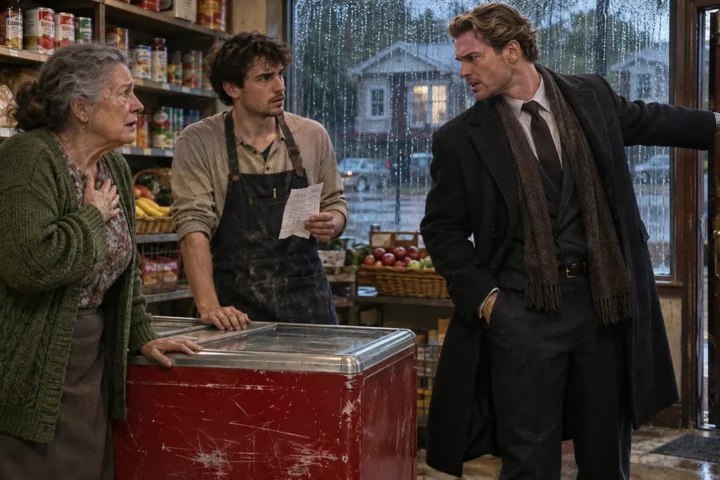
Mrs. Alvarez stood behind the counter in her green cardigan. She was seventy-two. Her grocery shop had occupied the corner of our street since before I was born.
Rain streaked the front window. On the scratched red freezer sat a tray of bread she'd set aside for customers who paid on pension day.
The young man, Grant, tapped the counter with a key ring.
“My father wants this finished.”
“Then your father can speak to me,” she said.
“He's recovering. I'm handling everything.”
I had come in for milk after work. Mrs. Alvarez looked at me, then at the receipt in her hand.
“Would you read something for me, June? The small print is getting difficult.”
Grant reached for it.
She folded it before he could touch the paper.
“Not you.”
After he left, she took a tin box from beneath the counter. Inside were rent receipts, repair invoices, and a faded agreement dated thirty-four years earlier. The receipt she'd been holding documented a payment toward the shop's electrical installation. It was signed by Grant's father, Walter.
Mrs. Alvarez had helped pay for improvements when Walter bought the building. Their written agreement described a rent credit and a renewal process. More recent papers showed she had renewed the shop lease through the following September.
Friday was five days away.
I'm a library assistant, not a lawyer. I could help organize papers and find qualified advice. I couldn't tell her what every old clause meant. I said that clearly, and she nodded.
“Take that through the back,” the fundraiser chair told my son. “The front tables are for sponsor-quality displays.”
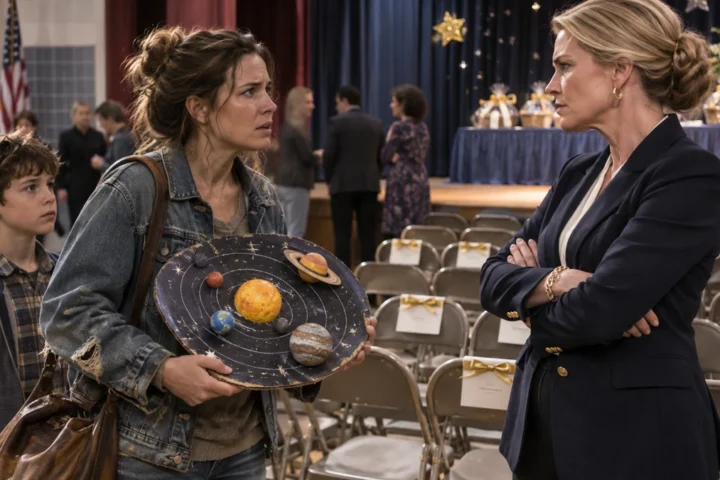
Eli stood under the auditorium lights holding a cardboard solar system. We'd painted Saturn's rings with the last of my gold nail polish because the craft store had closed.
He looked at the project, then at me.
Mrs. Harlow wore a blazer with the school foundation pin. She was a parent volunteer like me, but she had a headset and a clipboard, and everybody stepped aside when she walked past.
“My confirmation says table six,” I told her.
“That was before we finalized the program.”
At table six, a glossy display advertised her husband's tutoring center. Our school's science evening had somehow acquired a sales desk.
I took Eli to his teacher, who found a safe place for the project in her classroom while I asked about the change. I wouldn't make him stand in the doorway while adults discussed whether his work belonged.
Mrs. Harlow told me families who contributed should receive recognition.
“I did contribute. I designed the program.”
“You helped with a little formatting, Nina.”
I had spent fourteen evenings designing it after finishing shifts at a print shop. The written arrangement was simple: my design work would count as the family sponsorship contribution, and every approved student project would receive a numbered display place.
She had confirmed it by email.
Now she said there was no record.
The program printer was my colleague, Frank. I called to ask which version had gone to press. He said Mrs. Harlow had supplied a replacement after I signed off the original.
The woman I found picking tomatoes in the abandoned plot knew exactly which ones were ripe, and the man who supposedly owned it had never received my warning.
I learned the second part after I had already promised his garden to somebody else.
It was seven on a September morning in Sacramento. I had come to pull the little wooden marker from Plot Eighteen before the waiting family arrived. My spreadsheet called it inactive. The weeds along its edges agreed.
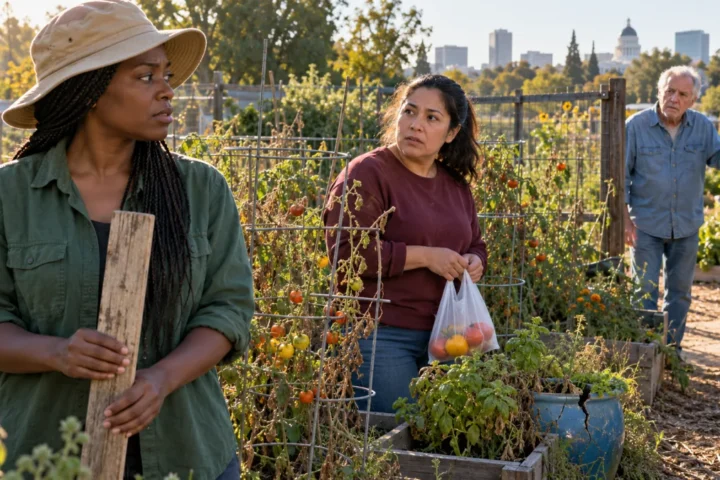
But a woman in a burgundy sweatshirt stood between the leaning cages, putting tomatoes into a grocery bag. She held one up when she saw me, as if I had come to help.
“The yellow ones split if you leave them another day.”
“Are you Walter Price?” I asked, although she plainly wasn't a seventy-four-year-old man.
She lowered the tomato.
My name was Amara Okafor. I was thirty-seven, three months into coordinating the garden, and determined to make its waiting list mean something. One family had waited an entire year. Meanwhile this plot had missed the spring workday, the summer cleanup, and every message I had sent.
“I'm Elena,” the woman said. “Ruth told me I could take what I needed.”
“Ruth Price died in January.”
“I know.”
Behind her, a tomato rolled from the bag and stopped against my shoe. I picked it up, feeling its sunless morning weight.
“Permission doesn't transfer the plot,” I said.
Elena looked toward the gate. A man with white hair and a faded denim shirt had stopped there, holding the fence instead of opening it.
“Nobody told me,” he said.
I still had the new family's name written on the back of Walter's marker.
The dog came into the laundry room carrying somebody else's sock, and by morning two strangers had thanked me for finding him.
Both knew the crescent of white fur under his chin. Both knew he hated the garbage truck and would eat a green bean only if you pretended it was yours. Both said the little terrier in my photograph belonged at home with them.
Arthur called him Scout. Vivian called him Pip.
I was thirty-one, the maintenance worker at a Spokane apartment building with unreliable gutters, not a person qualified to divide a living thing between two lonely people. But the rain was coming sideways that Thursday night, and the dog had followed me through the service entrance before I could shut it.
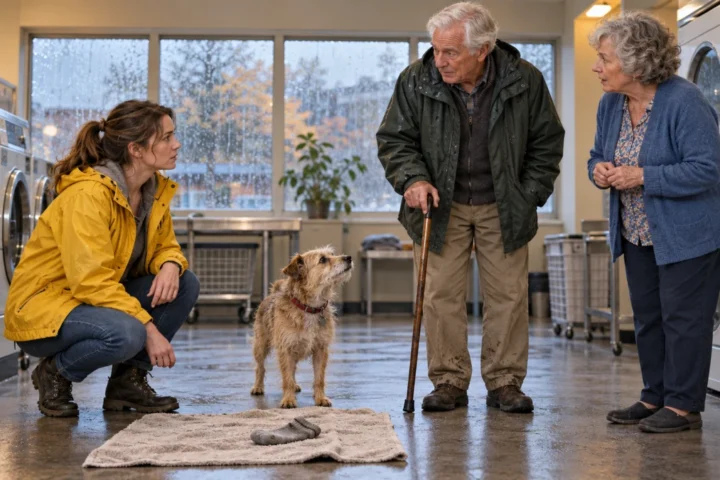
His red collar had no tag. His white muzzle smelled faintly of peanut butter. When I crouched to read the worn buckle, he put the stolen sock in my lap.
I posted a photograph in the neighborhood group and gave him water in a clean paint tray. By seven the next morning, Arthur had sent me a picture of the same dog asleep against a woman's blue slippers. Vivian sent a veterinary receipt dated three weeks earlier.
Then Arthur arrived with a cane and a dark green jacket darkened further by rain. A woman in a blue cardigan came through the other entrance carrying a familiar red leash.
The dog scrambled off his towel. He ran to Arthur, sneezed against his knee, then turned and pressed himself against Vivian's ankles.
Neither person looked relieved anymore.
“Your son said you didn't want him back,” Vivian said.
Arthur closed his hand around the handle of his cane.
“He told me you wouldn't answer,” he said.
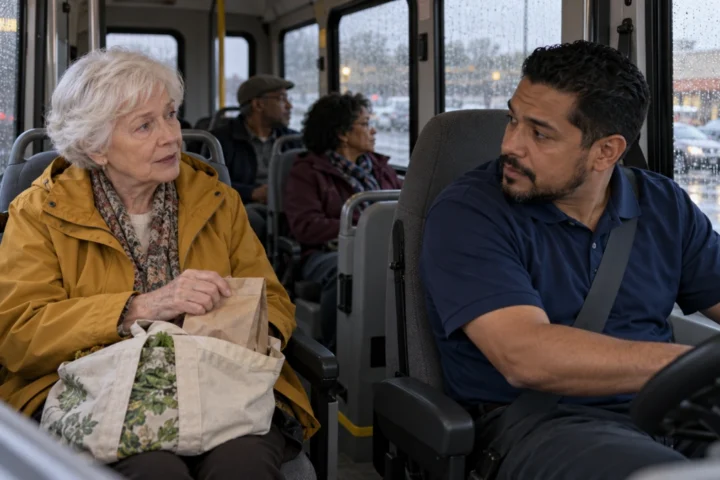
Irene Webb kept her paper bag as I closed the shuttle door.
Her grocery bags were zipped shut. Her cane was upright beside her knee. She had checked her receipt, tucked it into her wallet, and fastened every button on her ochre raincoat. There was nothing confused about the way she looked at me.
"We still have one stop," she said.
Behind her, Mr. Bell shifted the insulated bag containing his groceries. Across the aisle, Ruth pressed the button on her watch to check the time. I had three passengers left, a return sheet clipped beside the steering wheel, and a daughter who expected me at school at four.
"We're heading home now," I told Irene.
"After the cemetery."
The rain ticked against the windshield. We were parked outside the grocery store in Dayton, finishing the Tuesday shopping route. I was thirty-nine, a part-time community shuttle driver, and very good at noticing when a trip was about to become something that wasn't on my sheet.
Irene lifted a small paper bag off her lap. "I asked last week. I wrote it on the form."
"Did dispatch confirm it?"
"Nobody said no."
My name is Mateo Santos. There are things that sound easy until you're the person behind the wheel. One extra stop. Five little minutes. A road you've driven a hundred times.
Then Irene told me Tuesday would have been her wedding anniversary. Victor had died eighteen months earlier. She had brought a smooth stone from their garden, wrapped in a clean handkerchief.
I looked at the route again. No cemetery. No time set aside for a visit. No way to make the promise she thought we'd already made without breaking promises to people still sitting behind her.
The first woman who called to tell me Arthur Kemp was dead asked whether I had eaten anything.
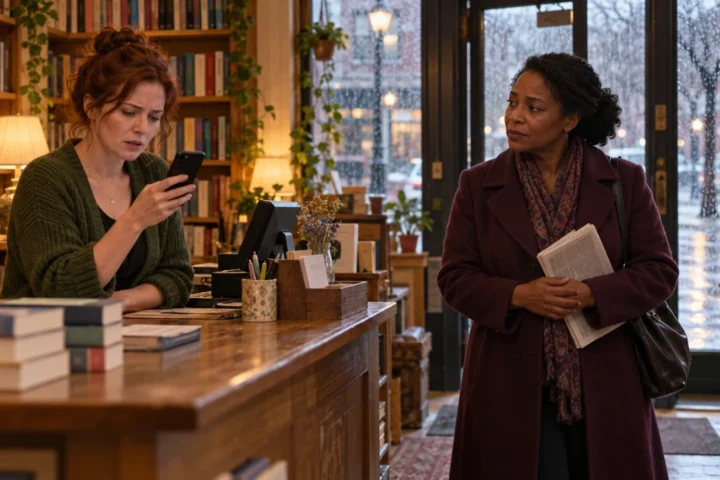
I was standing behind the register at the bookstore, trying to persuade a roll of receipt paper to fit. Rain slid down the front window. My coffee had gone cold beside a stack of used atlases.
"I'm sorry," I said. "Who are you trying to reach?"
She gave me a name I didn't know, then read my number back without my asking. I told her she had the wrong person. She apologized, but before hanging up she said, "Grief does that. You forget the smallest things."
By noon, six strangers had offered me food.
By three, a man wanted to know where to send flowers.
My name is Nell Foster. I was forty-one, I sold books in St. Paul, and the only Arthur I knew was a cat who belonged to the woman upstairs. I had not lost a father that morning. I had lost the ability to hear my phone without bracing myself.
Then someone sent me a photograph of an obituary.
Arthur Kemp had repaired school boilers, loved cribbage, and left behind a daughter named Beatrice. Near the bottom, beneath the memorial information, was my phone number.
I called the funeral organizer. His voicemail was full.
For the next caller, an older man who sounded frightened, I explained the error and read out the public memorial time. It seemed like the smallest decent thing to do.
An hour later, he called back.
"Wallace says you're handling everything now. Flowers, contributions. The family must be so grateful."
I looked at the obituary again. Somehow, without ever meeting the dead man, I had acquired a job in his funeral.
Bethany Wells was cutting the first cake when Zoe Fletcher asked why her name was on the announcement.
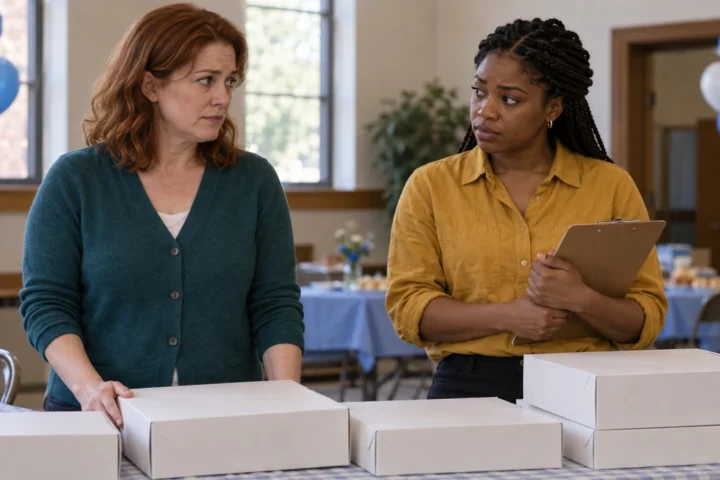
Not the cake boxes. Those were plain white, stacked on a folding table beneath the community center's basketball scoreboard. The name was in the fundraiser post everyone had been sharing since breakfast: Homemade cakes by Bethany Wells.
Bethany looked at the phone Zoe held above her plain clipboard. In the screen's reflection, her auburn hair seemed redder than usual, her teal cardigan almost gray.
"I didn't write that," she said.
"I know. I asked Martin to change it. He said you were fine with it."
Across the Milwaukee gym, Martin was arranging raffle baskets. Bethany had told him she was coordinating the cakes. She had also seen the draft announcement yesterday and postponed correcting it because the real explanation was difficult.
Now someone behind Zoe said, "Maybe ask her where the recipes came from."
The speaker was a volunteer named Paula. She had found a handwritten recipe card beside the cash envelope and decided that Zoe, who had brought neither cakes nor recipes, was selling somebody else's work under a false name. By noon, the story had grown a missing donation.
Zoe's braided hair shifted as she turned. Her mustard shirt had a streak of flour from helping plate slices.
"You need to say what you're accusing me of," she said.
Bethany set down the knife. She knew who had baked the cakes. She knew why that woman had asked not to be named. She also knew that silence was beginning to look like agreement with a lie.
Her phone buzzed inside her pocket. A message from the baker read: Please tell me you haven't put my name anywhere.
Bethany wiped her hands before answering. For the first time that morning, she stopped trying to make the problem disappear politely.
The blue bicycle caught Celia Moss by the grocery bag before anyone admitted it was in the way.
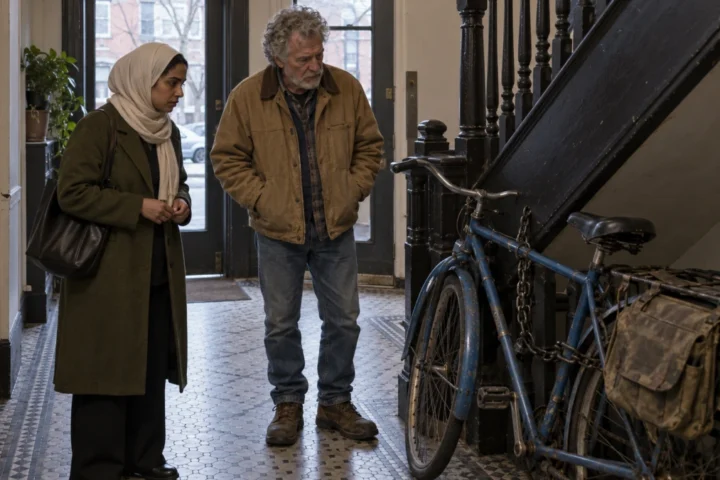
Amira Hassan heard glass strike the apartment hall tiles and turned from the mailboxes. A jar of peaches rolled beneath the radiator. Celia stood behind her walker, one hand shaking against its rubber grip, while the bicycle's brake lever held the torn handle of her bag.
Gus Mercer came out of the basement carrying a coffee cup. At sixty-seven, he still wore the tan work jacket he had worn fixing Richmond buses, although retirement had softened its shoulders. His gray curls were damp from the rain.
"I can tuck that farther back," he said.
"You tucked it back yesterday," Celia answered.
Amira set down her own bag. Her olive coat brushed the wheel as she reached for the peaches. Beneath the stairs, the bicycle was chained to a railing, its battered tool pannier bulging into the passage. She had walked around it for months without considering what walking around meant for somebody who could not turn sideways.
"It needs to come out," she said.
Gus looked at her as though she had slapped his cup away.
From the upstairs landing, a young man called, "That's the bike he uses to get to work on ours."
Another door opened. Someone mentioned a stroller. Someone else said Gus had saved her two weeks of bus fares. Celia remained in the middle of the hall with peaches dripping through a split paper sack.
Amira pulled a dish towel from her shopping bag and wrapped the broken jar.
"He can be helping people," she said, looking up at the gathered neighbors, "and this can still be blocking Celia."
Gus put his coffee on the bottom stair.
"Then help me unchain it," he said. "But don't tell me there's somewhere else until you've actually found somewhere."
The video began with Nina Park carrying a library book toward her car. It did not show the cart beside the dumpster, the rain starting, or the handwritten sentence that had made her stop.
By breakfast, a man she had never met was calling her a thief beneath a photograph of her volunteer badge.
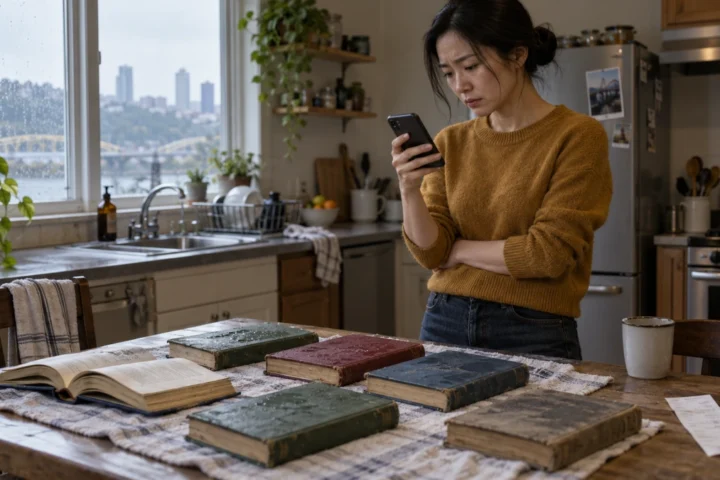
Nina watched the clip standing in her kitchen in the same ochre sweater she had worn the previous evening. Her black hair was still in its low bun. On the table lay six books, their faded cloth covers drying beside a grocery receipt.
Inside one, a dead man had written, Beth called. Did not answer. Must do better tomorrow.
She had not meant to take that sentence home. She had been looking for his descriptions of the neighborhood before the steel mill closed, the little observations he penciled beside whatever he happened to be reading. She had imagined saving a voice.
Now that voice was open on her table, saying something its owner's daughter might never have been meant to see.
Her phone rang. Gloria Hayes, the library manager, did not waste time asking whether Nina had seen the video.
"Bring everything back before we open. Don't post anything."
"They were withdrawn books."
"I know what they were. That isn't the same as permission to take them."
Nina looked at the six volumes. One had a warped spine. Another carried a red pencil line under the words forgive yourself.
"Can I explain when I get there?"
"Yes," Gloria said. "But bring the books first."
At the bottom of the screen, a new message appeared from Beth Voss.
Those are my father's. Please tell me you have not photographed the pages.
The letter asking Dana Reeves to turn off her father's porch light arrived inside a sympathy card.
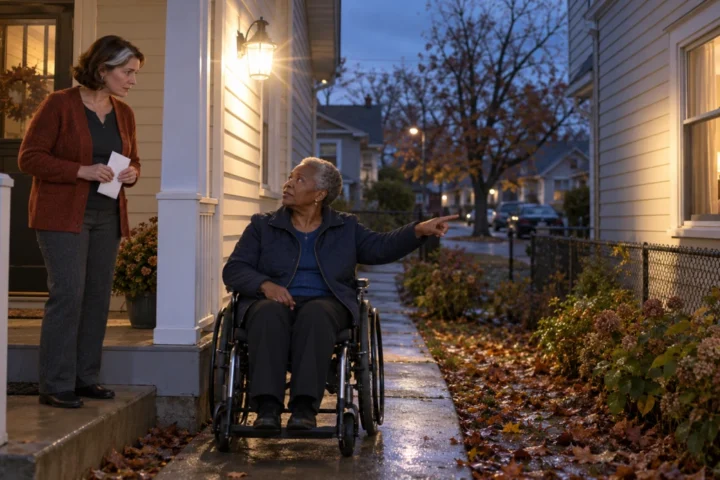
Someone had crossed out the printed message and written, I am sorry about Walter. I am also still awake at three in the morning.
Dana stood beneath the clear glass fixture in her rust cardigan, holding the card by its corners. Across the narrow side yard, Ruth Bell waited on the concrete path in her wheelchair. Her navy jacket was zipped to her chin. She pointed toward the white rectangle burning across her bedroom curtains.
"I asked him twice," Ruth said. "He meant to fix it."
At forty-three, Dana had returned to Dayton with a divorce, a temporary bookkeeping contract, and the keys to a house full of things her father had meant to fix. The porch lamp seemed like one problem she could solve without a probate folder or a screwdriver.
She reached inside the door and flipped the switch.
Ruth's window went dark. So did the porch, the cracked flowerpot, and the empty wooden chair facing the street.
"Thank you," Ruth said, without triumph.
Four hours later, someone knocked hard enough to rattle the brass mail slot.
A man in a reflective vest stood outside. Behind him, a woman with a strawberry-blond braid hugged a green work jacket around herself. A city bus was already pulling away from its regular stop at the corner.
"I'm Eddie," the man said. "I drive the late route. Did something happen to Walter's light?"
Dana tightened her hand around the door.
"Walter died."
His expression changed. "I'm sorry. I didn't know."
The woman behind him glanced at the empty chair.
"My ride isn't coming," she said. "And I thought this was still where we could wait."