Original fiction
On this page
A Visitor Badge on My First Day
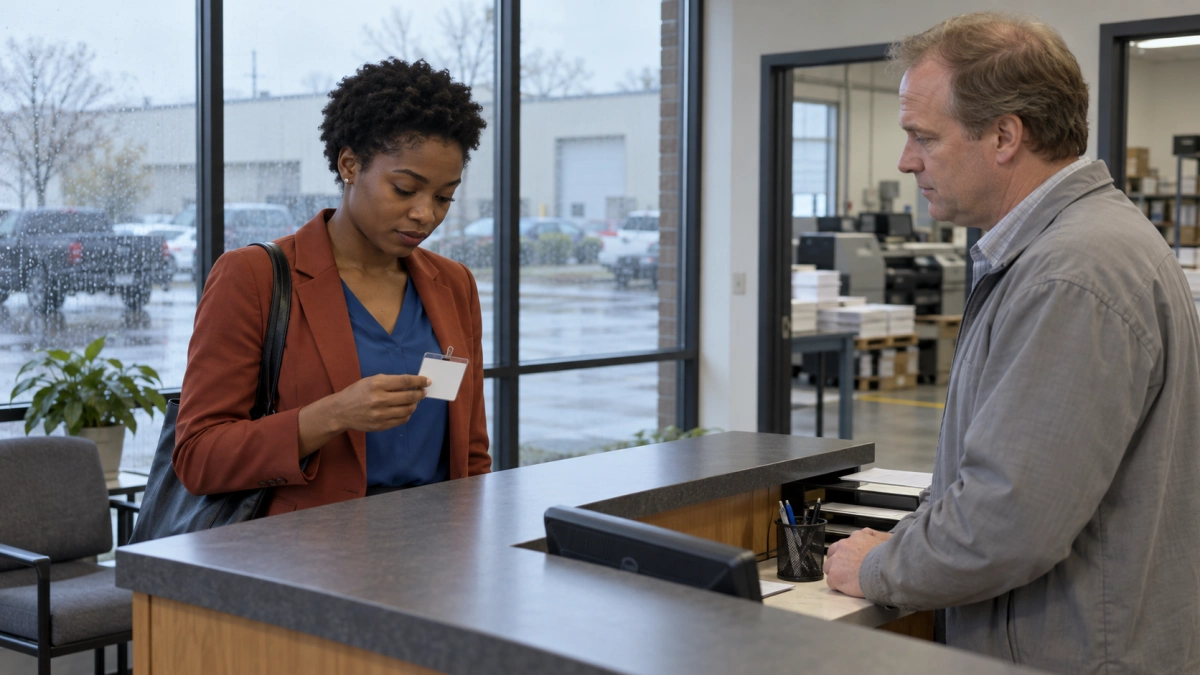
The badge Brent Keller handed me said visitor, although the job offer in my bag said employee.
There was no name on the little white rectangle. I stood at the plain reception counter in my rust blazer and blue blouse, rain cooling the back of my neck, and turned it over as if the other side might explain something.
“Everybody starts with one,” Brent said. His light gray jacket still had a store crease along the sleeve. “Agnes will get you settled.”
I had ironed that blouse at midnight. I had stopped applying for other jobs on Friday, after accepting his written offer for nineteen dollars an hour. At twenty nine, after four months without steady work, I had wanted one morning when I didn't have to introduce myself as available.
Behind the counter, Agnes Porter slid her green reading glasses down her nose. Her silver braid rested against a cardigan with a missing button.
“Did you bring lunch?” she asked.
It sounded like kindness. Later I would understand it was also a warning.
By noon I had corrected two delivery lists, answered calls, and arranged a replacement shipment for a customer whose funeral programs had gone to the wrong church. Brent stood beside my desk while I explained the mistake to a driver.
“That's the initiative we're looking for,” he said when I hung up.
Then he pushed a form toward me. Three trial days. No wages. No guarantee of employment.
I looked at the clock. Six hours since I had arrived. My sandwich was untouched.
“I already accepted the job,” I said.
Brent glanced toward Agnes, who had stopped sorting the mail.
“You accepted consideration,” he said. “Let's not get ahead of ourselves.”
For a moment I thought I must have missed a page. I opened the email on my phone and enlarged the paragraph until the words filled the screen. Position: junior office operations assistant. Start date: Monday. Hourly rate: nineteen dollars. Please reply confirming acceptance. My reply sat directly underneath, grateful and embarrassingly prompt.
Brent didn't take the phone. “That's our standard invitation,” he said. “We still have to establish fit.”
“Then why does it call itself an offer?”
He gave me the tired smile people use when they want an audience to believe the conversation is difficult because of you. Behind him, the copier spat out yellow routing sheets. Someone on the warehouse floor shouted for a pallet jack. Everything around us was continuing, and that made my own confusion feel unreasonable.
“We can talk after you finish those corrections.”
I put the routing sheets down. “Are those hours paid?”
“We're talking about three days, Iris. Not a career.”
I had spent the bus ride calculating a career in smaller units: the electric payment, a replacement winter coat, groceries that didn't require borrowing from my younger sister. Three days were not small to me. Three days were three lunches, six bus rides, and the courage it took to decline the afternoon interview I had canceled for this job.
Agnes stood. “The line three customer is holding,” she told him.
Brent pointed at the unsigned form. “Read it carefully. I don't want anybody saying we weren't transparent.”
He went into his office and shut the door before I could answer. The glass shook in its aluminum frame. Agnes waited until his voice began on the telephone, then brought me my sandwich from the reception refrigerator. She set it beside the form without looking at either.
“Don't eat over the keyboard,” she said. “It sticks already.”
I followed her to the break room because I needed somewhere to put my face. A microwave hummed beside a calendar showing the wrong month. Agnes rinsed a mug so thoroughly that I wondered whether she was trying to give me time to cry. I didn't. I was too busy being angry at how close I had come.
“Is this normal here?” I asked.
She turned off the water. “The temporary badges are normal. The other thing isn't something I decide.”
“That's not what I asked.”
“I know.”
She was fifty seven, she told me later, with a husband waiting for surgery and insurance she couldn't replace by being brave for one afternoon. At that moment she was simply a woman holding a mug between both hands. I wanted her to become a witness, a shield, a person who could tell me I hadn't misunderstood. She couldn't become all those things because I needed them.
“Write down when you arrived,” she said. “And when you leave. On your own paper.”
I took my sandwich outside. The rain had thinned to mist, turning the loading yard into a dull mirror. A shipping clerk in a wool cap stood under the awning, eating an orange. He nodded toward my badge.
“New operations?”
“Apparently new consideration.”
He stopped peeling. “He gave you the trial speech?”
His name was Malik Turner. He had worked there seven years. He didn't offer a grand account of company corruption. He told me where the public sidewalk began so we could talk without blocking a truck, then said he had trained three people at my desk since August.
“All three left?”
“One never came back after lunch. One stayed the week. One was here two mornings.”
“Did any get hired?”
He shook his head. Then, quickly, “I don't know what they signed. I don't know their arrangements.”
I appreciated that he knew the difference between what he had seen and what he suspected. I needed facts, not a furious person who could afford my consequences because they weren't his.
“Do you have their names?”
“I can ask whether somebody wants to contact you. I'm not handing out people's numbers.”
I wrote mine on the clean back of a bus receipt. My fingers were cold enough to make the final digit crooked.
Back inside, I gathered my bag. Brent emerged before I could reach reception.
“Where are you going?”
“Home. I won't do more work without an agreement that the hours are paid.”
“You're leaving a customer situation unfinished.”
The funeral order flashed through my mind: a daughter waiting at a church, programs with her mother's photograph still in a van. I hated him for choosing that pressure so accurately. I also knew I had already sent the corrected address and received the driver's confirmation. The situation was not unfinished. It was merely useful to him.
“The replacement delivery is confirmed. The reference is on the routing sheet.”
“We don't usually hire people who walk out.”
“You just told me you hadn't hired me.”
Agnes looked down. Malik, passing with a stack of empty trays, kept walking. No one applauded. The room did not transform because I had finally found one sentence I could say without shaking.
I put the badge on the counter. Brent reached for it, then drew his hand back as though accepting it would acknowledge a transaction. Agnes placed it in a drawer. I asked for a copy of the trial form. He said it was internal. I wrote its title and the three unpaid days in my notebook instead.
Outside, the bus shelter had a broken side panel. Wind pushed mist onto my good trousers. I opened the afternoon interview email, the one I had canceled, and typed a request to reschedule. By the time I got home, a polite reply explained that the opening had been filled.
My sister Tessa was at my kitchen table with a grocery bag and the expression she wore when she had decided not to mention money first. She was twenty six and worked evenings in a veterinary clinic. She had brought soup containers, bread, and the dog treats she always accidentally carried in her coat.
“First day face?” she asked.
I hung the rust blazer carefully because it was the only interview jacket I owned. “Last day, maybe.”
I told her badly, beginning with the badge instead of the offer. She listened without interrupting, then reached for my laptop.
“Let's save the messages before you spend all night arguing with them in your head.”
We saved the offer, my acceptance, the email confirming Monday's arrival, and the message telling me to bring identification for payroll. I wrote my arrival time, the calls I remembered, and the time I left. I did not download customer lists or try to enter the company system from home. Those weren't mine to use, and I didn't want another person's funeral caught inside my argument.
The work total was six hours, including the short meal break I had finally taken after the conversation. I separated the periods carefully. If anyone disputed the total, I wanted to explain what I meant rather than inflate it until it sounded impressive.
“Ask for a hundred and fourteen dollars,” Tessa said after multiplying the hours by the offered rate.
“That won't fix this.”
“No. But it's what they owe for today, if they honor the offer. Don't make it become every bad thing that ever happened to you.”
I sent a short email to Brent and the general office address. I quoted the offer, listed the hours, requested payment at the stated rate, and said I would not attend an unpaid trial. I asked whether the paid position remained available. That last sentence hurt more than the rest. Part of me still wanted him to reply that somebody had made a clerical mistake and I should come back tomorrow.
He answered the next morning. The trial, he wrote, was an evaluation opportunity, and I had voluntarily discontinued participation. He would consider a courtesy payment if I returned the company badge.
I stared at the message until Tessa, on the phone, asked whether I was still there. I had returned it in front of him.
“Then say that,” she said.
I did. I copied Agnes only because she had received it, not because I wanted to conscript her into every disagreement. Then I closed the laptop and went to the library to apply for jobs on a computer that didn't contain my entire humiliation.
At the next desk, a man dictated a password to his mother in a whisper louder than speech. A teenager was printing a concert ticket. Ordinary problems surrounded me, and I found their scale comforting. I completed two applications, corrected the employment dates on a third, and ate bread from a paper towel outside.
That afternoon Ana Perez called. She had received my number from Malik after agreeing to speak. She sounded cautious, almost formal, until I mentioned the three day trial.
“He told me two days,” she said. “Then on Wednesday he said the system training hadn't counted.”
She had answered phones, corrected mailing addresses, and packed a rush order. She had childcare receipts and a message from Brent praising her productivity. She hadn't complained because she was embarrassed that she had believed the offer. She was working a pharmacy register now and could speak only until her break ended.
“I'm not asking you to join anything,” I said. “I wanted to know if it happened.”
“It happened.”
The relief was so sharp I sat down on the library steps. Nothing about my bank balance changed. Nothing about Brent changed. But the fog around the morning began to separate into things I could name.
Ana agreed to send her own dates and messages directly to someone appropriate if I found a contact beyond Brent. She did not want her pharmacy called. She did not want her daughter's name in any account. I wrote those conditions next to her number. Being mistreated didn't mean she had surrendered her right to decide what happened next.
The second former applicant replied by text that he wanted no involvement. I thanked him and stopped. The third number Malik remembered was no longer connected. A pattern could be incomplete and still be real. It did not have to become a perfectly lined row of people willing to stand beside me.
Before Wednesday, I tried calling the old interview contact instead of relying on email. The woman who answered remembered me. That made it worse somehow. She had liked our first conversation, she said, but their selected applicant had already completed the background process. There wasn't another opening hiding behind the one I had declined.
“Would you keep my information?” I asked.
“For future openings, yes.”
I thanked her with the bright voice I had learned to use when disappointing news came from somebody who wasn't responsible for it. After hanging up, I sat on the floor because the phone charger wouldn't reach the chair. Dust clung to the baseboard behind my shoulder. I had meant to clean before starting work, arranging my apartment into the shape of a person whose life was improving.
My mother called that night from Akron. I nearly let it ring. She had told three neighbors about my new job, and I couldn't bear to hear myself downgrade it in real time. But she would call Tessa if I didn't answer, and then my shame would become an errand somebody else had to carry.
She listened, then asked whether I had eaten. I said yes, though dinner was still in the refrigerator.
“Your grandfather worked a whole Saturday once before a man told him he was only watching,” she said.
I braced for advice about being tougher.
“He went back Monday,” she continued. “Your grandmother was furious. They needed the money. He thought needing it meant he had to believe the man.”
“Did they pay him?”
“Eventually. Not because he went back.”
She didn't make the story into a lesson. She asked about the bus home and whether my boots had dried. Afterward I heated the soup. I didn't feel stronger exactly, but I stopped imagining that this had happened because I was uniquely easy to fool.
On Wednesday I attended a job clinic in a church basement. A volunteer named Ellen looked at my resume, then at the printed offer I hadn't meant to show her. She had worked in human resources before retiring. She did not promise an enforcement squad or tell me I would own the building by Christmas.
“Someone can help you understand your options,” she said. “But first, who can authorize money there besides this man?”
The company website listed Nina Shah as general manager. I found a business email through the public contact page. My first draft to her was eleven paragraphs long. Ellen read it without flinching and asked which three things I needed Nina to know before opening another meeting invitation.
We reduced it to the accepted offer, the productive work, and the unpaid trial introduced afterward. I attached only my own records. I asked for wages, a written answer about the position, and review of the trial practice. Ana sent her separate account after I confirmed the recipient. Ellen gave me information for a local worker assistance service in case the company refused, explaining that deadlines and possible remedies depended on facts someone qualified would need to review.
“You can pursue that and keep job hunting,” she said. “Neither one has to wait for the other.”
By Thursday my anger had become tiring rather than strengthening. I spent the morning comparing my grocery total against the rent set aside in a separate envelope. I returned a new pair of work shoes, still unworn because Monday's rain had made me choose old boots. The refund went back to my debit card. It was not income. I had to remind myself of that when the receipt briefly looked like good news.
Agnes called at four. I could hear street traffic, not office machinery.
“I'm off the clock,” she said. “I want to be clear about that.”
She had confirmed in writing that I returned the badge and arrived before eight. She had not described the whole trial conversation because Brent had spoken low enough that she hadn't heard every word. She was sorry she couldn't do more.
“You did something accurate,” I said. “That's more useful than doing something big.”
There was a pause. Then she told me she had kept the drawer shut the rest of Monday because seeing the badge bothered her. I imagined that blank rectangle under paper clips and spare keys, an ordinary object carrying an argument it hadn't asked for.
Nina answered Friday morning. She asked for a call and said payment review would not require me to return for a trial. I sent my availability, then spent twenty minutes choosing whether to sound angry. On the call, her voice was level enough that I could hear my own breathing.
“I approved a paid opening,” she said. “I need to understand why you were told something else.”
“I need to understand whether I was hired.”
She didn't answer instantly. I was grateful for that. Instant reassurance would have sounded too much like the offer itself.
“The letter should not have gone out unless the hiring decision was complete. I am checking who sent it and what authority they had. Your hours are a separate question, and I don't intend to hold payment hostage to that investigation.”
I described the funeral order, the corrected lists, and the calls. I did not give her the grieving daughter's name. Nina already had access to the business records. I explained why I had left and told her about the canceled interview. She said she was sorry, then stopped short of promising to compensate every consequence.
“I understand an apology doesn't put another interview back on the calendar.”
For the first time that week, somebody inside the company had described a loss I recognized.
She offered to meet Monday in a room away from Brent. I agreed, then nearly canceled that evening. Returning felt like putting my hand near a dog that had already bitten. Tessa said she could come as far as the coffee shop across the street. She didn't offer to speak for me. That was why I said yes.
During the weekend, Ana forwarded her messages to Nina. Malik sent a factual note describing whom he had trained and when. He did not say he had witnessed their pay arrangements. Each account had its own edges. I began to understand that accuracy could hold us together without making our stories identical.
Monday's receptionist was Agnes. She didn't reach into the badge drawer.
“Nina's expecting you,” she said, and walked me to the meeting room herself.
Nina wore black glasses and carried a folder with paper tabs. Brent wasn't there. The empty chair beside her was so conspicuous that I spent the first minute looking at it rather than at her.
She laid out a time record showing six hours and a payroll authorization for one hundred fourteen dollars before applicable deductions. The payment would go through the ordinary payroll process, with a wage statement. It wasn't a settlement, she said, and she wasn't asking me to sign away claims or keep silent in exchange for receiving it.
I read every line. “Why did he call it a courtesy?”
“Because he shouldn't have been handling that response alone.”
“That's a careful answer.”
“It is. I don't want to tell you something today that turns out not to be true tomorrow.”
She explained that the business had used short interviews and paid skills assessments before. Brent had been allowed to coordinate recruitment while another supervisor was out. The three day unpaid form wasn't an approved substitute. She had found drafts of it in the office folder. Approval gaps were her responsibility too, she said, not just something to pin on the nearest manager after a complaint.
I asked whether former applicants would receive money. She said they would be contacted individually to establish their time and arrangements. I could ask Ana afterward whether that happened, but Nina wouldn't disclose anybody else's records to me. That was reasonable. It was also frustrating not to leave with a list of victories.
Before discussing a new start, Nina asked whether I wanted Brent present to explain his account. I said no. She accepted that answer without calling it a refusal to cooperate. I could answer her questions, I said, but I didn't want another meeting in which his confidence became the most persuasive object in the room.
“He says there was confusion about the hiring stage,” she told me.
“There wasn't confusion when he told me which customer calls to answer.”
She wrote that down. I watched the pen move and wondered how many people had described a problem to somebody taking notes, then gone home to discover that writing it down had changed nothing. Notes were useful. They weren't proof of courage.
“Who's doing the work today?” I asked.
“We're covering it with existing staff until recruitment is clarified.”
I thought about Agnes losing her lunch to another ringing phone, Malik carrying paperwork upstairs between shipments. If the company stopped using applicants and simply loaded the work onto them, that wasn't a solution they would thank me for. I said so.
Nina nodded. “That staffing decision is mine. It shouldn't be yours to repair.”
I couldn't tell whether she understood how unusual it felt to hear a person with authority name something as her responsibility. I also couldn't tell whether she would follow through. I let both uncertainties remain instead of converting her into either a villain or a hero.
Then she offered me the job.
The sentence landed between us with almost comic weight. Nineteen dollars an hour. A confirmed paid start. Brent would no longer supervise the role directly while Nina reviewed staffing. The offer would be written again, with the hours and supervisor clear.
“You don't have to answer in this room,” she said.
I wanted to punish her by declining instantly. I wanted to protect myself by accepting instantly. Both impulses felt like ways of leaving the room before making a decision.
“Send it,” I said. “I'll read it.”
At the coffee shop, Tessa slid an untouched muffin toward me. I told her about the money first, then the offer. She watched me peel the paper from the muffin in one long strip.
“Could you work there?” she asked.
“I could do the work.”
“That's not the same question.”
Across the street, a delivery truck reversed into the loading yard. Somewhere inside, Malik was probably checking a manifest, Agnes answering a call, Brent deciding what version of the week he would tell. I didn't need to believe every person there was bad to know I didn't want my next mistake evaluated by that man.
That afternoon Ellen called about a small print cooperative needing temporary operations coverage while its bookkeeper recovered from an injury. Six weeks, twenty four hours a week, paid from the first hour. It was less work than I needed, and the bus connection was worse. Ellen had made no promise on my behalf. She had only passed along my resume with permission.
Before the cooperative interview, I walked the route from the bus stop with a borrowed umbrella that turned inside out twice. The building was smaller than the printing warehouse, with upstairs windows painted shut and flowerpots made from old ink buckets. I checked the bus timetable. Missing the connection after an evening shift would add forty minutes to my trip. I wrote that down beside the hourly rate so relief wouldn't erase the cost.
Inside, two people were debating whether a neighborhood theater poster needed more green. Nobody stopped talking to stare at my blazer. Simone came downstairs carrying a stack of paper samples and apologized because her hands were dusty. She asked whether I needed water before asking anything about work.
I had prepared an explanation of the unpaid trial, polished until it sounded almost impersonal. I didn't use it. When she asked why I was available, I said a position hadn't begun under the paid terms I had accepted. She didn't demand the most painful parts as proof.
“We can discuss your references separately,” she said.
The interview took place beside a paper cutter older than I was. The coordinator, Simone, asked how I handled a wrong delivery address. I felt the familiar heat rise in my face, then told her about the funeral order without telling her about Brent. She asked a practical follow up: what had I done to ensure the original shipment wouldn't also arrive and confuse the customer?
I explained the cancellation note and the driver's confirmation. Her next question was about spreadsheets. For forty minutes I was not a person disputing a badge. I was somebody who knew how to get work done.
Before I left, she explained the temporary hours, pay schedule, supervisor, and what would happen when the six weeks ended. She offered a paid two hour orientation if I accepted. I asked her to put it in writing. She said, “Of course,” without making me feel I had insulted her.
I declined Nina's renewed offer the next morning. My email thanked her for addressing the payment and said I would not be returning. I didn't add a speech about self worth. I couldn't afford the apartment on self worth, and I didn't want to pretend otherwise. I attached my confirmed time record and asked when the wage statement would arrive.
Nina replied with the date. She said recruitment communications were being reviewed and productive trial work suspended while they established a paid assessment procedure. I saved that message with the others. It was a statement I could check, not a guarantee that every future applicant would be safe.
Ana called that evening. Nina had contacted her, and they were reconciling her hours. She had found a childcare receipt that helped establish one of the dates. She sounded pleased, but tired.
“I'm not quitting the pharmacy,” she said.
“Nobody asked you to.”
“Good. I like knowing what Friday means.”
We laughed, not because anything was particularly funny, but because Friday could be a small reliable thing instead of the date by which somebody might finally decide we deserved wages.
My payment arrived during the following week. After deductions it was less than the number I had been repeating in my head. I checked the wage statement against the six hours rather than treating the deposit as mysterious generosity. I used part for groceries and left the rest in the rent envelope. The lost interview stayed lost. No deposit could make Monday happen differently.
At the cooperative, I made mistakes that belonged to an ordinary beginning. I filed a purchase receipt under the delivery date instead of the invoice date. I confused two volunteers with the same first name. Simone corrected me, and neither mistake became evidence that I should work for nothing until I proved grateful enough.
On my third day, a customer arrived for memorial cards and couldn't remember which spelling of a relative's name she had approved. I pulled up the proof and turned the screen toward her. We waited while she called her brother. Behind me, the cutter thumped steadily, a sound like someone closing a heavy book again and again.
She apologized for taking so long.
“It's worth checking,” I said.
I thought of Agnes rinsing that mug, Malik asking permission before sharing a number, Ana searching for a receipt after her daughter went to bed. None had rescued me. Each had made one piece of the truth less lonely to carry.
The six weeks still had an ending date. At home, I continued applying for permanent jobs on two evenings a week. Tessa and I argued once about groceries because gratitude didn't make borrowing pleasant. I apologized for snapping. She apologized for saying it was only a little money when it wasn't little to either of us.
One Saturday I washed the blue blouse by hand and hung it over the bathtub. The rust blazer had a loose thread at the pocket. I repaired it with brown thread that wasn't quite the same shade, using the sewing kit my mother had packed when I first moved out.
I didn't throw either garment away. They weren't costumes from a foolish version of me. They were clothes I had chosen for a morning when I expected to be taken seriously.
The next Monday, Simone asked whether I would show a new temporary worker how the delivery log worked. A young man waited beside her, holding his lunch in a plastic bag. I recognized the way he stood without resting against anything, trying not to occupy space before someone confirmed he belonged.
“Has payroll got what it needs?” I asked Simone.
“Yes. He's on the clock now.”
Only then did I pull out the chair beside mine. I showed him where we kept the corrected addresses and how to mark a call that needed a second answer. When he opened his notebook, I gave him time to write.
At lunch he asked whether the neighborhood grocery sold hot food. I told him which counter stayed open and which bus driver waited if he saw you running. We talked about nothing important for ten minutes, and I was surprised by how much I enjoyed it. Not every first day had to become a story somebody would tell with their stomach tightened, years after leaving work.
My phone buzzed in my pocket. Agnes had sent a photograph of her husband's hospital discharge flowers, with his permission, and a message saying the surgery had gone well. I answered from the stairwell so I wouldn't interrupt the new worker's call. I told her I was glad. I didn't ask about Brent.
Outside the narrow window, rain collected on the fire escape. I could see the bus stop at the corner and the puddle I would have to step around that evening. My shift would end in three hours. Those hours belonged on a timesheet, yes, but they also belonged to a day I was actually living, not a test whose rules might change when I reached the end of it again.
Read next
The Envelope in the Locker
The Shift Nobody Covered

My Name on the Presentation
The Hotel Manager Accused Me of Stealing Wedding Linen—Then I Asked Her to Read the Orange Tag
Reading notes
A new employee arrives for work and discovers the job she accepted is not the position waiting for her.
This is an original work of fiction. Characters and events are fictional. Explore public-domain books at Project Gutenberg or browse more stories on ReadStoryvia.