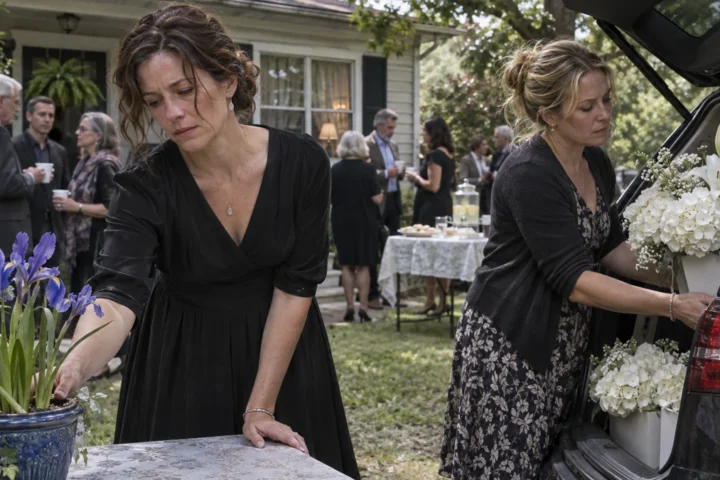
“Don't be selfish, Alice,” my cousin said. “Your mother would want those flowers to help someone.”
She was loading a white arrangement into her SUV before the last guests had left the memorial lunch. My mother's name still hung from its ribbon.
I had asked for three arrangements to remain. One would go to Mom's oldest friend in the nursing home. One would go to the women who had cared for her. The small one with blue irises was coming home with me.
Beth had offered to coordinate the remaining donations. She said a community group could use them at a fundraiser that evening. I had agreed, grateful for one fewer decision on a day full of them.
Now the irises were in her hands.
“That one's mine,” I said.
“There are plenty of others.”
I reached for the pot. She let go so suddenly water spilled down my black skirt.
People looked away. My aunt murmured that grief made everybody difficult.
An hour later, the florist called about collecting her display stands. I mentioned the fundraiser so she would know where the larger arrangements had gone.
“What fundraiser?” she asked.
I gave her the address Beth had texted. The florist went quiet.
“That's a private anniversary party. They called yesterday asking whether I could supply white flowers at half price.”
I sat on the kitchen floor because every chair held an abandoned coat.
Mom had known Beth since she was born. She had babysat her children and paid for a dental emergency Beth never mentioned once she married into a wealthier family. I didn't want to believe she had turned the funeral into stock for a decorating job.
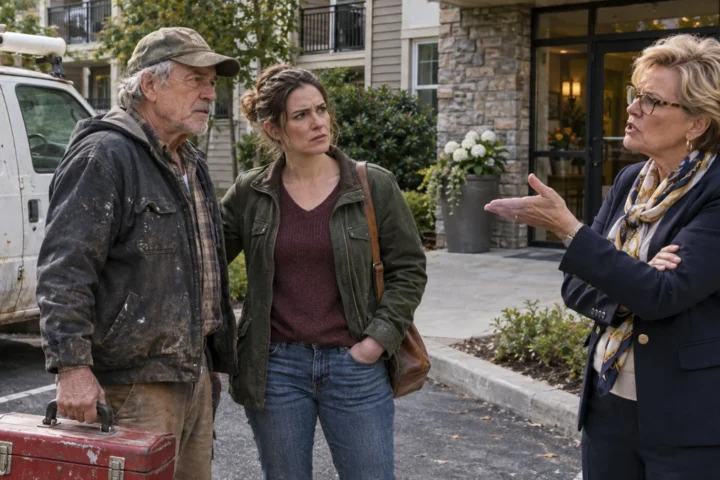
“Visitors like him can park behind the dumpsters,” the condo president said, pointing at my father's white van. “We have standards.”
Dad stood beside the open passenger door with a toolbox in his hand. He had come to fix my kitchen drawer, and I had made soup because he always forgot lunch.
The van was fourteen years old. Its paint had faded around the lettering of his plumbing business. It was clean, insured, and parked in the visitor space I had reserved.
“Like him?” I asked.
Mrs. Kline adjusted the scarf at her neck. “Commercial vehicles lower the tone.”
Dad shut the van door before I could say anything worse.
“Let's fix your drawer, Mara.”
Three days later, I found an emergency repair invoice slipped under my door. It demanded $2,860 for a leak the building manager said had started in my apartment. Attached was a photograph of Dad entering the lobby with his toolbox.
The note beneath it said: Unauthorized contractor observed. Owner responsible.
Dad had repaired one wooden drawer. He hadn't touched a pipe.
I called the manager. He said Mrs. Kline had identified the likely cause and the board expected prompt payment. I asked for the plumber's report, the photographs of the actual leak, and the basis for assigning the charge to my unit.
He suggested I avoid making things complicated.
I set the soup container Dad had returned on the counter and opened my laptop.
The first thing I found was the visitor registration confirmation. It listed Dad's arrival at 11:06 on Tuesday. The emergency invoice described a leak discovered at 8:40 that same morning.
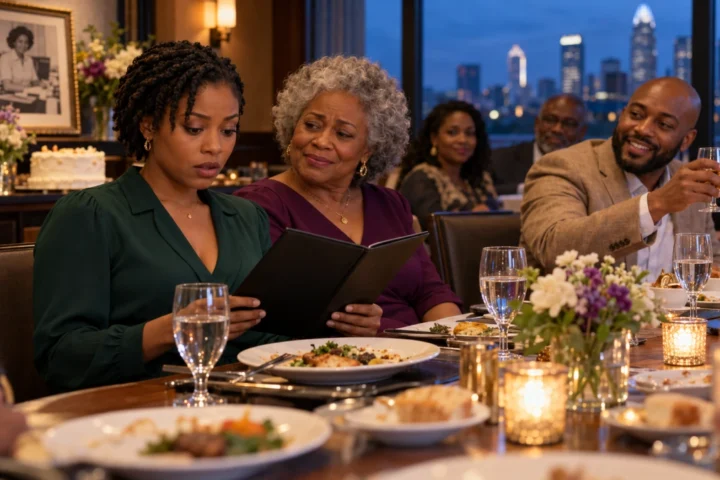
Brent lifted his glass before the waitress could set the black folder down.
"And to Talia," he said, "for treating us like royalty tonight."
Seventeen people turned toward me. My mother touched her silver curls and smiled from the head of the table. Behind her, the Charlotte evening pressed blue against the restaurant windows.
I had arranged the room. I had chosen the lower priced menu. I had brought the framed photograph of Mom on her first day at the hospital, wearing shoes so white they looked unfinished.
I had not offered to buy dinner.
The waitress placed the folder beside my water glass. Inside was a final total of $1,460. A smaller line showed the $200 deposit I had paid to hold the room. Balance due: $1,260.
Across the table, Brent was already reaching for the last crab cake. He wore the tan blazer he saved for pictures. He had added five people to the reservation three days earlier and told me not to worry about the details.
Mom saw the bill before I closed it. Her smile stayed where it was.
"It's such a beautiful thing you're doing," she said quietly.
I was thirty two, a hotel banquet coordinator with a good blouse and a savings account named COURSE. The certification application closed Monday. Tuition was due at enrollment, and the money in that account was almost exactly what remained on the bill.
The waitress leaned down. "Would you like me to bring the card machine?"
My mother put her hand over mine. For a moment I thought she was going to explain.
"Don't make it awkward," she whispered.
I moved my hand carefully out from under hers.
"Please bring another chair," I told the waitress. "We need to talk about how this is being paid."
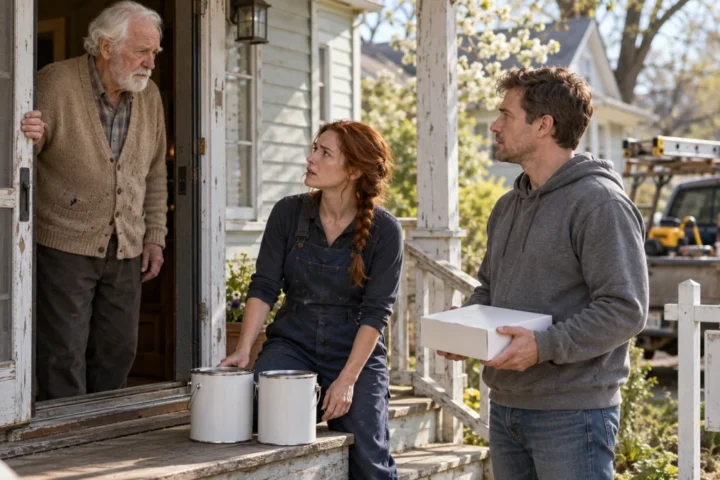
The sale sign was already in the yard when Mae backed her truck against the curb. In the bed lay two gallons of porch paint, a rented sander, and the ladder our father had finally agreed not to climb.
I had brought doughnuts. That was the sort of son I could afford to be that Saturday: generous with twelve dollars, useless with a mortgage.
Mae sat looking through her windshield. Then she got out in her navy overalls and walked past me without taking the box.
Dad opened the screen door. His tan cardigan had a hole near the wrist, and his white beard was damp from shaving.
"I should have called," he said.
"Before or after they put that up?" Mae asked.
Across the street, somebody's sprinkler clicked over wet concrete. I noticed the little red flag on the sign, the cheerful invitation to come inside on Sunday. Strangers would be walking through the room where our mother had died. They would open cupboards, discuss light, and decide whether our lives smelled like old carpet.
"It's my house, Ellis," Dad said, although I hadn't spoken.
That frightened me more than the sign.
In my coat pocket was a message from the man who had lent my restaurant money. He wanted a date, not another explanation. For months I had comforted myself with something Dad said whenever the roof needed work: Your house someday. Both of you.
Mae put the paint on the bottom step.
"Where are you going?" she asked.
Dad reached behind the door for a rental brochure. The picture showed a low brick building with handrails along its paths.
"Somewhere I can get to the bathroom without stairs."
Only then did I notice he was holding the doorframe instead of standing on his own.
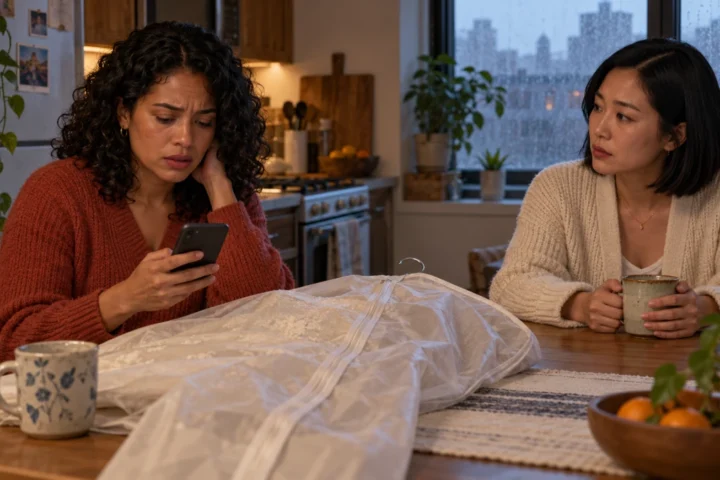
Lucia Moreno found out she was no longer in the bridesmaid photograph while standing in her own kitchen, holding a dress she had already paid for.
The dress had cost one hundred sixty dollars. The message on her phone cost nothing to send.
Celia had posted the new picture plan in the wedding group: four women beside the bride, arranged by height. Lucia's name was gone. Under the list was a note about keeping the morning simple for the girls who had committed to everything.
Everything had changed three days earlier, when a two-night trip outside Des Moines appeared in the chat. Shared lodging, activities, food, and travel would add six hundred eighty dollars. Lucia had privately told Celia she could not go.
She had not asked anyone to cancel. She had not mentioned rent, her aging car, or the small balance she kept between herself and trouble. She had said she could still afford their original agreement: the dress and ninety dollars in local wedding expenses.
Now she set the garment bag over a chair and read the word committed again.
Across the table, Nadine Cho put down her tea. Her cream cardigan sleeve brushed the saucer.
"Maybe she forgot to copy your name," Nadine said, without sounding convinced.
Lucia scrolled. Someone had replied with four heart emojis. Celia had answered, Perfect, finally settled.
She was thirty years old. She could manage her money, turn down a trip, and survive not being in a photograph. What she could not figure out was how a private limit had become a public measure of how much she loved her friend.
She typed a question, deleted the part explaining her checking account, and sent what remained.
"Celia, am I still a bridesmaid?"
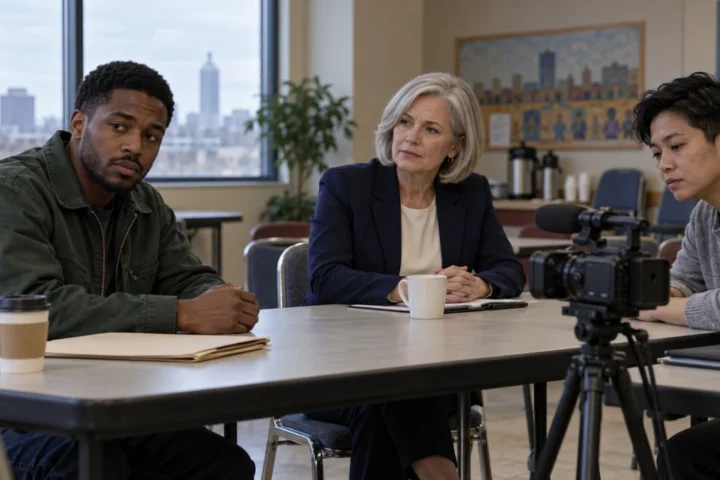
The camera was already pointed at Darius Bell's chair when he arrived for the scholarship interview. Beside the lens, someone had taped a sheet headed MY WAY OUT.
He recognized his name in the first sentence. Nothing after it belonged to him.
At twenty-eight, Darius had survived abandonment, hunger, and a family that never believed in education.
His mother had driven him to his placement test. His younger sister had bought him a calculator with grocery-store overtime. On Tuesday his uncle had spent two hours helping him understand fractions, admitting cheerfully that neither of them remembered enough.
There had been hard months. That did not make this their story.
"We can make it sound natural," said Ingrid Sloan, the scholarship committee chair, smoothing the sleeve of her navy blazer. "It's just a starting point."
Darius kept his dark green work jacket on. He had come to ask for eighteen hundred dollars toward electrical courses and tools, not to explain his family to strangers with donation buttons.
Behind the camera, Robin Tate stopped adjusting a cable. Their gray sweater had a tiny burn near one cuff.
"Before we start," Darius said, "is doing this part of being considered?"
Ingrid glanced at the empty chairs reserved for two other interviewers. "Our supporters like to meet the people they help."
That was not an answer. His parking meter had forty minutes left. Another candidate waited outside with a folder as carefully organized as his.
He could smile, replace a few sentences, and hope nobody noticed what he had traded. Or he could ask again and risk leaving with nothing except the bus schedule he had folded into his application.
Robin reached for the power switch, then waited.
Darius put the prepared sheet facedown on the table.
"I can tell you why I want to be an electrician," he said. "I won't say those things about my family."
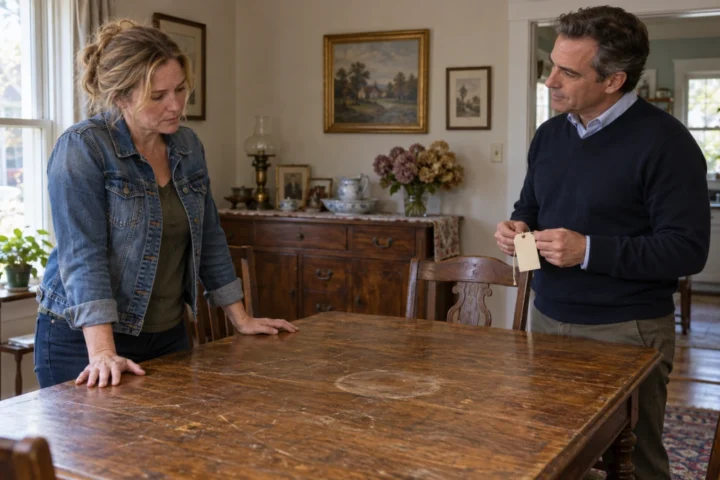
The man buying my mother's table brought a blank tag and a moving blanket. I kept both hands on the oak while he checked whether the legs would come off.
"One eighty, like we agreed," Adrian Shaw said.
I nodded. My car needed a six hundred forty dollar repair. I had four hundred sixty set aside, and the arithmetic was easier than looking at the empty dining room would be.
At forty six, I was old enough to know a scratched table wasn't my mother. Still, I could feel the pale ring where she had put a hot pan during the ice storm, feeding neighbors by candlelight. My dark blond hair kept falling across my face as I bent to undo the leaf catches. Adrian waited in his navy sweater, his dark hair gray at the temples, polite enough not to offer comfort I hadn't requested.
He paid. We carried the table out. I swept the rectangle of dust it had left behind.
Four days later, my brother sent me a photograph of the same table in Adrian's shop window. The asking price was twenty four hundred dollars.
That wasn't what made me sit down.
The sales listing called it a cherished piece from the private dining room of a prominent Louisville family. It described my mother's candlelit suppers as gatherings of civic leaders. Beneath that were photographs of Mom, my brother, and me, cropped to hide the paper plates and the broken screen door.
I had given Adrian those pictures to explain how the table came apart. Not to sell our childhood beside it.
Then I saw the surname he had attached to us.
It wasn't ours.
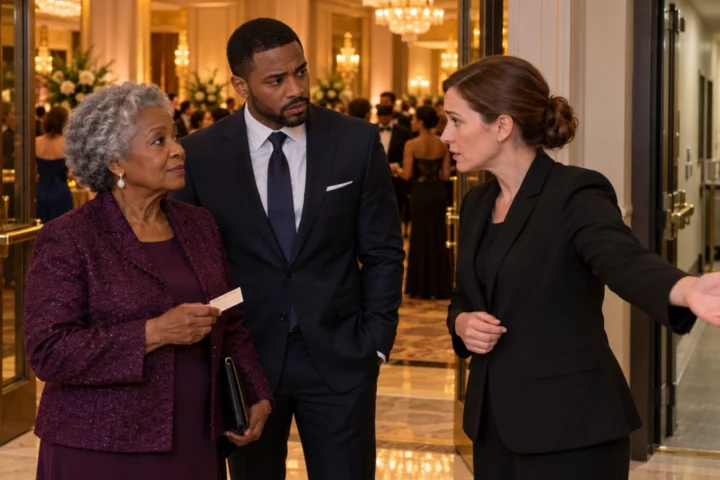
The woman in the black blazer looked at my mother's plum jacket, then pointed past the coat check toward a door marked for deliveries.
"Service check in is around the back. They'll give you an apron there."
My mother held out the ticket I had bought her. She did not laugh to make the woman comfortable. At sixty two, Harriet Cole had retired from a school cafeteria after thirty one years of feeding children who sometimes thanked her and sometimes dropped their trays without looking up. Tonight her silver natural hair caught the light from the ballroom chandeliers. She had asked me twice whether her jacket was dressy enough.
"I'm here with my son," she said.
I was standing right beside her in the dark suit she had helped me choose. On my lapel was a ribbon identifying me as an honoree. Beyond the open ballroom doors, our nonprofit's largest donor was waving me toward a photographer.
The staff woman glanced at my ribbon. "Of course. Let me find somewhere she can wait while we sort this out."
Somewhere. Not a chair at the table listed on her ticket. Not the reception where everyone else was being handed glasses of sparkling water.
My mother lowered her hand. That was the movement I noticed: the ticket disappearing against her side, as though she had brought an embarrassing document into the wrong office.
"Check both tickets," I said. "We'll wait here."
The donor, Vivian Beck, had stopped waving. My director was already crossing the foyer with the tight smile she used when a conversation might cost money.
My mother touched my wrist.
"Before you decide anything," she said, "ask me what I want."
Grant Bell waited until Elena Ruiz had locked her car before telling her it could not stay behind the restaurant.
"We're trying to present a different image," he said.
Elena looked at her faded blue sedan, then at the grease barrels beside the service door. The passenger door was silver because a matching replacement had cost more than she could spare. The engine ran. The lights worked. Nothing leaked onto the cracked Richmond pavement.
"It's behind the building," she said.
"Guests can see it from the patio entrance."
She held her keys between two fingers. Through the rear window she could see her mother's brown sewing case. Rosa had asked for a ride after finishing a curtain repair nearby. Elena would collect her after the dinner shift; until then, the tools were safer locked inside than carried through a crowded kitchen.
Grant, clean shaven in a pale blue shirt and dark apron, gestured toward the alley. "Use the overflow lot tomorrow. Tonight we're already late."
Elena went inside. The staff board still showed the parking instruction she had followed for nineteen months: rear spaces after four, leave the loading area clear. Her car occupied the farthest marked space, nowhere near a delivery door.
At ten seventeen, a dishwasher came looking for her. He had seen a truck pulling a blue car out of the lot.
Grant reached for a folder instead of his phone. "The rule changed this afternoon. There was a notice."
"You just told me tomorrow."
"I meant the overflow arrangement."
Elena walked outside. The empty space seemed smaller without her car in it. A new sign stood near the gate, turned toward arriving drivers, where she would not have passed it on her way into work.
Her mother called then. Elena answered before Rosa could ask where she was.
"Don't leave the library steps," she said. "I'm finding out where they took your tools."
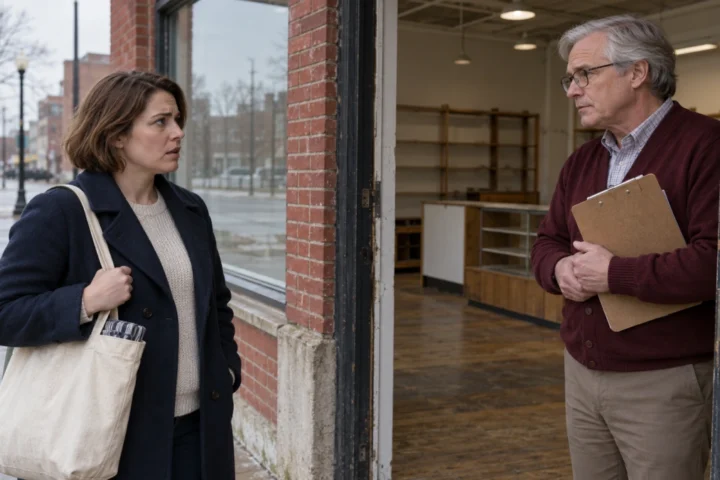
Nora Ellis arrived with a folded apron in her canvas tote and a loaf of bread for the man who was supposed to hand her the keys. Outside the empty brick shop, the October wind pushed a receipt along the Dayton sidewalk. Martin Voss opened the door only far enough to keep the warmth inside.
"I thought Leah called you," he said.
Nora smiled because she did not yet know what else to do. She had spent three years baking before her warehouse shift, saving tips from weekend markets in a separate account. Eight thousand dollars had finally purchased something more substantial than permission to dream.
Martin held his clipboard against his burgundy cardigan. "The reservation was reassigned. You're not taking this unit."
"I paid for this unit."
"Your representative submitted a change."
Leah Moreno was more than a representative. She had held Nora's hair during a stomach virus, helped bury her father, and remembered which market customers needed bread without sesame. She also handled administrative work for small businesses. Nora had paid her to review the shop paperwork because friendship did not make someone's labor free.
Martin turned a page. Nora saw her own last name beside a different address.
Ellis Sandwich Company.
Her brother's company.
Owen had called the previous evening to say that things were finally working out. Nora had congratulated him while scrubbing flour from the seams of her kitchen table. She remembered the relief in his voice now, and the way he had asked whether she had spoken to Leah.
"Don't print anything new," Nora said. "Show me exactly what you already have."
Martin hesitated, then stepped aside. Nora carried the bread inside with her. She had imagined crossing this threshold as a tenant. Instead, she sat at a bare counter and asked to see the record of who had spent her future.