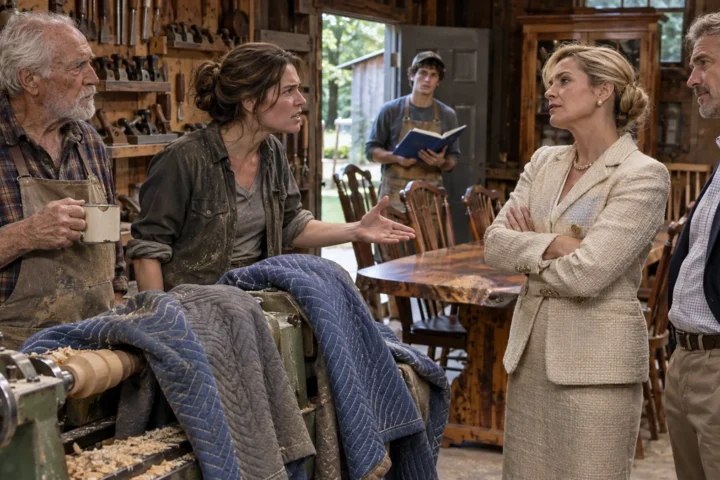
“Dad doesn't need to see this,” my sister said, covering the price on a lathe with her handbag. “It'll only upset him.”
Dad was in the next room, packing his own mugs.
The man beside her had brought a trailer. Two workers waited at the workshop door. On the bench where Dad had taught me to sand a chair rail, someone had placed a stack of moving blankets.
My sister, Vanessa, told me she was selling redundant equipment before Dad moved into his smaller apartment. The sale would help cover his expenses. She had arranged everything while I was away caring for my husband's mother.
“Has he agreed?” I asked.
“He asked me to simplify things.”
Dad appeared with a chipped mug in his hand. At seventy-six, he walked slowly because his knee hurt. There was nothing wrong with his hearing.
“I asked you to sell the spare drill press,” he said.
Vanessa turned toward him with the patient expression she used for difficult customers. “We discussed the whole workshop.”
“No,” he said. “You discussed it. I said I'd think.”
The buyer looked at his workers. One lowered his end of a blanket.
Then a bicycle bell sounded outside. Owen, Dad's former apprentice, came through the gate with a blue order book tucked beneath his jacket.
“I found the copy you wanted,” he said to Dad. “And you should know who's buying your name.”
Vanessa reached for the book before Dad did.
I moved between them.
Three years earlier, Dad had stopped accepting large commissions. Owen took over the rented storefront, with his own equipment and a new business name. Dad kept his home workshop and occasionally made small pieces for old clients. Vanessa managed his invoices because she said paperwork was the one thing he should retire from.
“Your mother's things are outside, Lena. Don't make this embarrassing.”
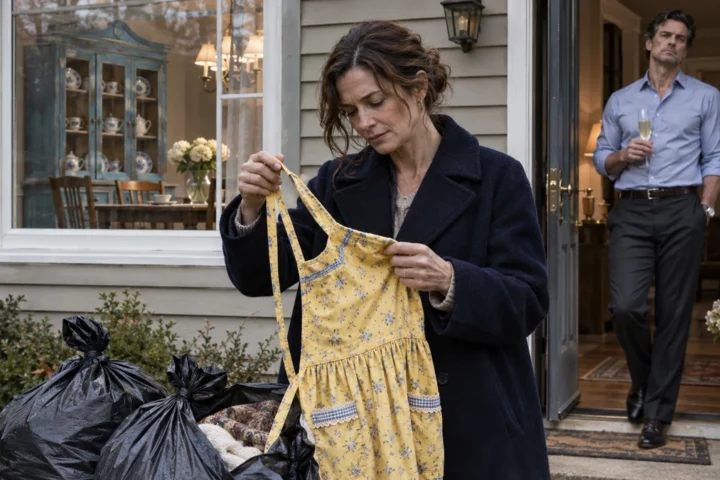
My brother stood in our mother's kitchen holding a champagne flute. Behind him, a woman measured the window for curtains. Mom had been buried seventeen days earlier.
I looked through the back door. Three black bags leaned against the dumpster. The corner of her yellow sewing apron stuck through a split in one of them.
“Those aren't things,” I said. “Those are the things she asked me to keep.”
“Then you should have come sooner.”
I had come every Tuesday during her final year. I changed the sheets, organized the medication list, and drove her to appointments while Paul sent messages about being essential at work. After the funeral, he told me he needed two weeks before anyone touched the house.
Now strangers were drinking in it.
The woman lowered her measuring tape. “We're only here about the furniture.”
Paul put down his glass. “The house has to be cleared before the estate sale.”
I asked who had approved an estate sale. We were both named to handle Mom's belongings together. He said someone had to make decisions while I was busy being emotional.
From the bags, I rescued the apron, two photograph albums, and a dented biscuit tin. The tin held Mom's sewing receipts. Underneath them was a folded delivery slip for a blue cabinet.
The cabinet still stood in her dining room. Paul had placed a red SOLD sticker across its glass.
I photographed the slip before I went back inside.
The woman my mother said had abandoned us was standing beside her in a graduation photograph, holding her shoes.
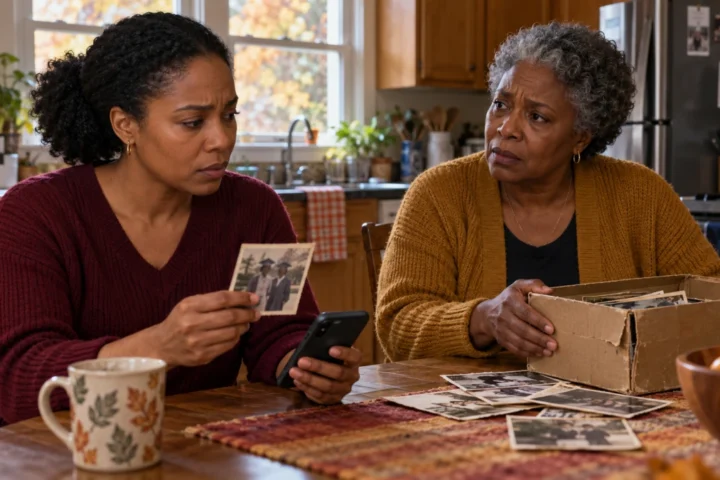
I found the picture in a bent envelope while collecting material for our school's alumni display. Mom had graduated from the same Richmond high school where I now worked as a counselor. In the photograph she was eighteen, her gown lifting in the wind. Beside her stood my aunt June, sixteen, barefoot on the grass, carrying two pairs of heels and laughing at something outside the frame.
On the back, in Mom's handwriting, were four words: Couldn't do it alone.
I was thirty five. I had not seen June since I was two, and I knew exactly one story about her: when my mother needed her most, she left.
Then my phone lit up.
"Camille, thank you for the invitation. I'll come if you still want me. But does Denise know you asked?"
June's message sat beneath the cheerful email I had sent the night before. I had found her through an alumni contact and invited her to stand beside Mom at the opening. I had even described the display as a chance to bring our family together.
Mom came into the kitchen carrying a box of photographs. At sixty one, she still looked at school projects as something we should finish before dinner.
"Who are you writing?"
I turned the phone toward her.
She put the box down so hard that a corner split.
"You asked her without asking me?"
"I thought after all this time—"
"You thought you'd give me an audience."
I looked from her face to the two laughing girls in the picture. For the first time, the story I knew did not explain what I was holding.
The storage manager handed Nora Bennett a pair of bolt cutters and asked whether she wanted to keep the wedding dress.
"What wedding dress?"
He checked the number on his clipboard. "Your father said the family was clearing everything today."
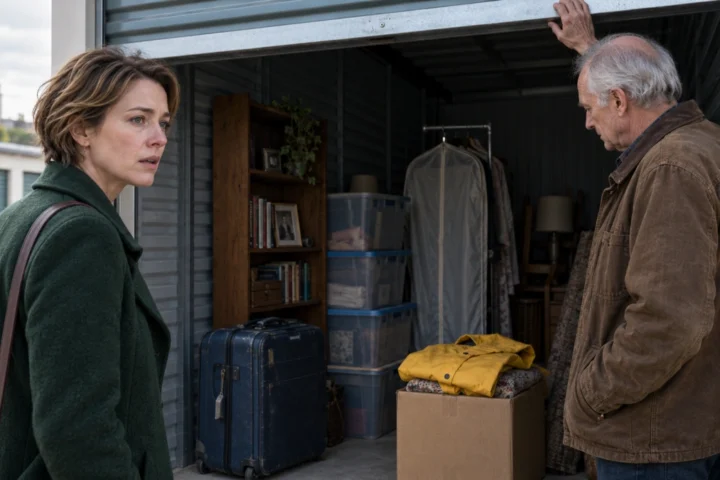
Nora looked at Russell. Her father stood beside the loading door with both hands buried in his brown jacket, although the Toledo morning was already warm. For eleven years, he had told her that unit forty-six held her brother's woodworking tools. For eleven years, she had pictured a table saw, the unfinished maple chair, the things Adam had left behind when a driver ran a red light.
She had come to help her father stop paying a hundred and eighteen dollars every month to keep grieving behind a padlock.
"We aren't cutting anything," Russell said.
The manager looked between them, set down the cutters, and went back inside.
Nora held out her hand. "You asked me to clear it today."
Her father took the key from his pocket.
When the door rattled upward, the first thing she saw was a blue suitcase. Not a saw. Not a chair. Behind it stood a narrow bookcase, three plastic tubs, and a dress bag hanging from a garment rack. A woman's yellow raincoat lay folded on top of a cardboard box.
Nora knew that coat. She had given it to Tess the Christmas before Tess left Adam.
"Why do you have her things?"
Russell kept his hand against the door as if the whole mechanism might fall.
"Because your brother wouldn't give them back."
Nora turned toward him. There was no confusion in his face, no mistake she could help him correct.
"You let us say she abandoned everything."
Her father looked into the narrow room.
"Yes," he said. "I did."
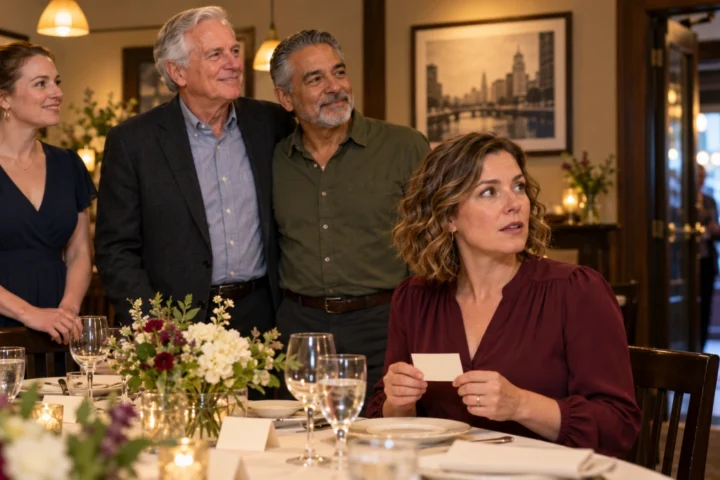
I was moving the last place card when my father walked into his retirement dinner holding a man's hand.
Not helping him through the doorway. Not greeting an old friend. Their hands rested together until they saw me, and then Dad let go.
That small retreat hurt before I understood why.
"Morgan," he said. "This is Rafael."
I looked down at the card I'd written that afternoon: CALVIN'S GUEST. At forty, I had organized enough dinners to know you asked for a guest's name. Somehow, when Dad said he was bringing someone, I had pictured a woman from his walking group and stopped listening.
Rafael had a neatly trimmed gray beard and an olive shirt beneath his coat. He extended his hand.
"It's good to meet you."
Behind me, my younger sister Paige said his name with the ease of someone greeting a person she'd met before.
I turned. "You know each other?"
Her silence answered first.
We were in a small restaurant room in Milwaukee, waiting for eight other guests to arrive. Dad's charcoal jacket still had a loose thread at the cuff. I'd meant to cut it off before the photographs. Twelve years after Mom died, I was still managing details as though enough careful work could keep our family in its familiar shape.
"We should have talked before tonight," Dad said.
"About what, exactly?"
He glanced at Rafael, who didn't rescue him.
"About the fact that Rafael is my partner."
Outside the door, a server laughed with somebody at the bar. I heard the restaurant continue being ordinary while the place card bent between my fingers.
Then Rafael looked at it.
"My name will fit," he said quietly.
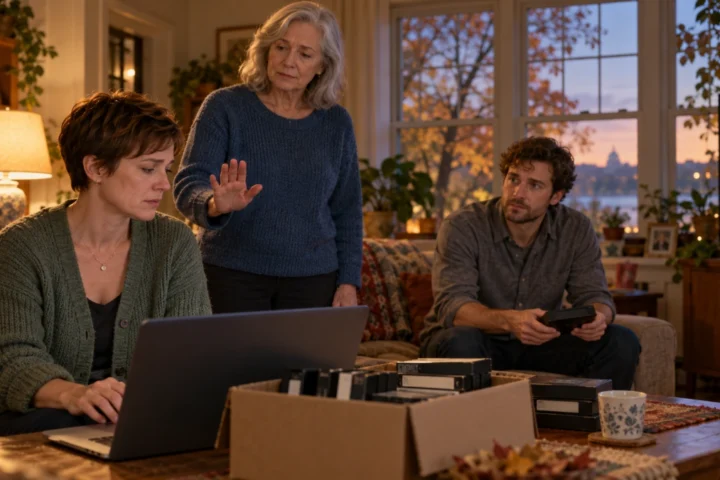
Mom asked me to stop the video before the cake hit the floor.
I had already reached for the volume. On the television, my father was laughing, alive again in our Madison kitchen, and for a second I wanted nothing except to hear him finish.
"Not this one," Mom said.
My brother Jonah leaned forward on the sofa. "It's the birthday cake. Everybody loves this one."
Everybody had included me. There I was on the screen, seventeen, laughing so hard that the camera shook. Behind Dad stood our mother, holding a platter with both hands. The cake leaned toward the edge like a house on a collapsing bluff.
In our living room, twenty years later, Mom gripped the back of a chair.
"Sadie. Stop it."
I paused. Her mouth remained open on the television. Dad's hand hovered near the platter. A blue plastic candle lay sideways in the frosting.
We were planning a home-movie evening for the first anniversary of his death. I was thirty-seven, old enough to know memory wasn't neutral, but apparently not old enough to stop treating my family's favorite joke as proof that we had been happy.
Jonah lifted the tape case. "We can't erase family history because it's embarrassing."
Mom looked at him, then at me in my sage cardigan, with my careful folders and invitation list.
"I'm not embarrassed about a cake."
The refrigerator started humming in the next room. Without the soundtrack, I noticed a kitchen towel tucked into the waistband of her younger self's skirt. I remembered that towel. I remembered none of the work around it.
Mom walked over and closed my laptop without slamming it.
"Before you show anyone," she said, "watch what comes before."
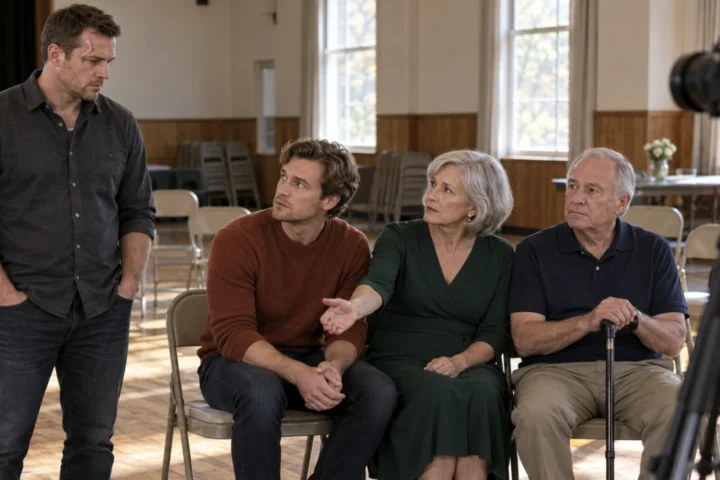
My mother told my brother to move out of the family picture.
Not to the back row. Not beside the cousins who had arrived late. Out.
“Just until we do the main one, Aaron,” she said, waving toward the beige folding chairs along the community hall wall.
I had driven into Ohio the night before, and I still wore the rust sweater I had pulled from my bag. Beside me, my father sat with his cane between his knees. My mother, Vera, smoothed the waist of her green dress as if that were what had gone wrong.
Aaron stood at the edge of the group in a plain charcoal shirt. At thirty-nine, he had the same broad shoulders I remembered, the same pale scar beside his left eyebrow. He looked at the space she had pointed to, then took one step toward it.
“Wait,” I said. “Why is he moving?”
The photographer lowered her camera. A cousin laughed because he thought I was making a joke.
“We've already explained he's away,” Mom said quietly.
I looked at Aaron. “Away where?”
A woman near the refreshment table answered before he could. “Overseas, isn't it? Your mother says the work keeps him traveling.”
Aaron worked at a warehouse twenty minutes from our parents' house. I knew that. I knew he had left school at seventeen after Dad's fall, when I was eleven. I knew more of what he had paid for than he liked me to mention.
What I did not know was that my family had found a way to make him absent while he stood in the room.
Mom touched my sleeve. “Caleb, please. Not in front of everyone.”
Aaron reached the chairs, picked up his jacket, and stopped waiting for anyone to tell him where to stand.
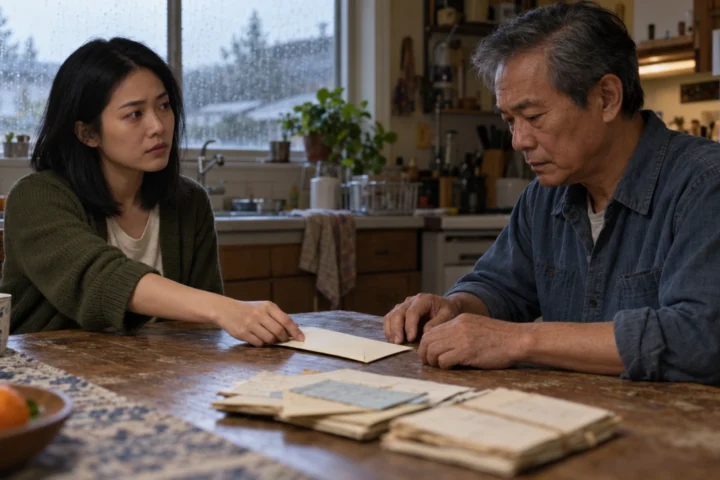
My father pushed the envelope back across the kitchen table without opening it.
“You already told me this,” he said.
I had not. That was the point.
Outside his Tacoma window, rain trembled on the bare branches. I was thirty-two, still wearing my olive cardigan from work, and the cream envelope between us had traveled through three apartments before coming home to him. Inside was a letter I had written at twenty-four, asking whether he would come to a small concert where I was going to sing alone for the first time.
He had never come. He had never mentioned the invitation.
“Tell me what I said, then.”
Dad rubbed a pale thread from the cuff of his faded blue work shirt. His salt-and-pepper hair was flattened on one side, as though he had slept in his shop again. He could make a ruined chair look loved instead of new. He could hear a loose spring under three layers of fabric. But that afternoon, he would not look at a sheet of paper.
I had found eleven of my letters in a tin under his bed while helping him search for a spare house key. Their envelopes were open. Their pages were folded with care.
“Read this one,” I said. “Just the first part.”
“Linh.”
“You told Aunt Mai I stopped writing. You said I got busy.”
He reached for his glasses, put them on, and took them off again.
My mother had been dead for six years. Until that moment, I had thought the silence belonged to grief, or stubbornness, or something wrong with me.
Dad laid both hands flat on the table.
“If I read it,” he said, “you will know something I should have told you before you ever sent it.”
The unfamiliar name appeared between Owen's father's number and the box for special instructions.
Leah Mercer. Authorized pickup.
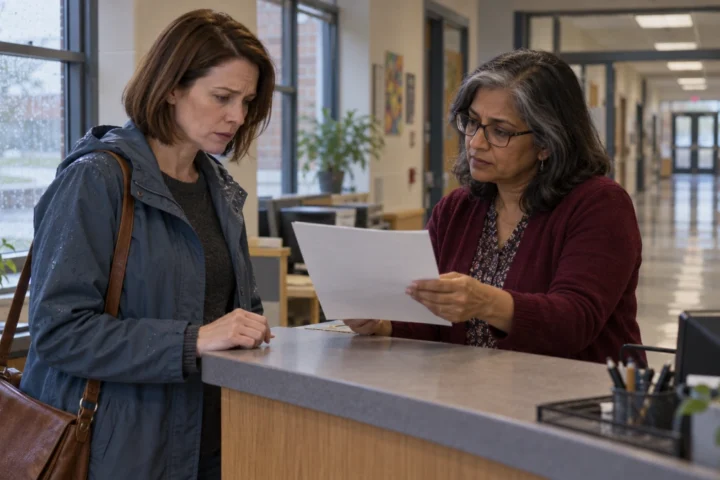
Claire Bennett read it twice while rain ran down the school office window. She had come to collect her eight-year-old for a dentist appointment, not discover a stranger on his emergency form.
"Who added her?"
Ms. Patel turned the paper so she could check the entry. "His father submitted the update. Let me look at the notes before we make assumptions."
"Has she picked him up?"
"No. Owen is with his teacher. You're the person collecting him today."
The administrator's calm helped Claire keep her own voice low. She loosened the strap of her brown shoulder bag and asked for a copy of the form. Beneath her slate-blue raincoat, her sweater felt suddenly too warm.
Daniel had mentioned no new girlfriend. Their divorce agreement had not made them experts at telling each other things, but they usually managed schedules, shoes, and school notices without surprises.
Claire called him from the empty stretch of counter.
"Who's Leah Mercer?"
For a moment she heard only the indicator clicking in his car.
"I meant to explain."
"Explain now."
"She won't pick Owen up without us talking. I told her that."
"Then why put her on the form?"
He stopped the indicator. Somewhere behind Claire, a copier started feeding paper.
"Because she asked if she could help sometime. Because I thought it would make things simpler."
"What things?"
His next answer arrived quietly enough that she had to press the phone closer.
"She's my daughter."
Claire looked at the unfamiliar name again. Daniel had been her husband for eleven years. Owen knew every cousin on his father's side, every dog the family had owned, every version of the story about the broken canoe.
He had never been told he had a sister.
Walter Reed knew the feel of a bad lock. For thirty years he had repaired doors in factories, apartment buildings, and nursing homes, and he knew when a cylinder needed graphite and when somebody had installed a different one.
This one was different.
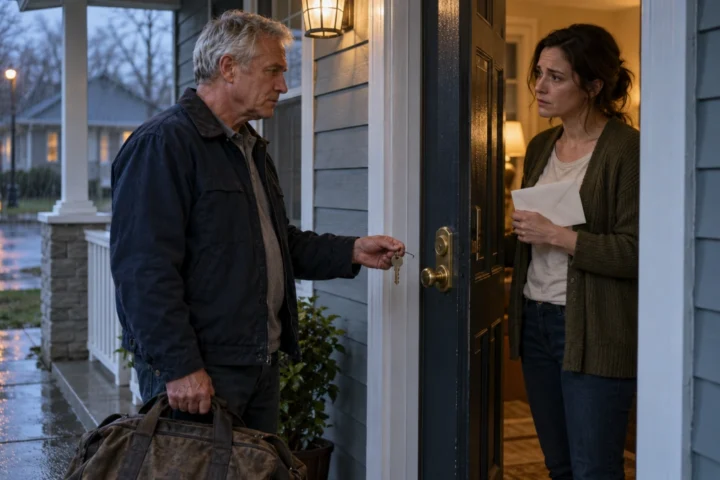
He stood on his Dayton porch with rain dripping from his navy work jacket and tried his key once more. Beside his boot, the brown canvas duffel sagged like something equally tired of traveling. Inside the house, his daughter switched on the hall light.
Nora opened the door only as far as the chain allowed. Her dark hair was tied back, and she wore the olive cardigan he had bought her last Christmas.
"Dad. You said tomorrow."
"Job finished early."
She looked at his key. He looked past her at the empty rectangle beside the stairs, where his mother's walnut cabinet had stood since before Nora was born.
"You changed my lock."
"I have a key for you."
She closed the door to release the chain. That small necessary movement hurt more than he wanted to admit. He had spent eleven nights sleeping beside an interstate so he could keep this house, and now his own daughter was making him wait outside it.
When she reopened the door, she held a plain envelope.
"Before you call Uncle Glenn," she said, "please let me explain."
Walter had not mentioned his brother.
From the kitchen came the steady clicking of the dishwasher. On the hall table lay a receipt from a locksmith and a photograph of the missing cabinet, its drawers standing open in somebody else's garage.
"Where is it?" he asked.
Nora did not offer the envelope again.
"That's what I was trying to find out when he used your spare key yesterday."