Original fiction
On this page
The Bags on the Porch
My grandson turned his phone toward me before taking off his coat.
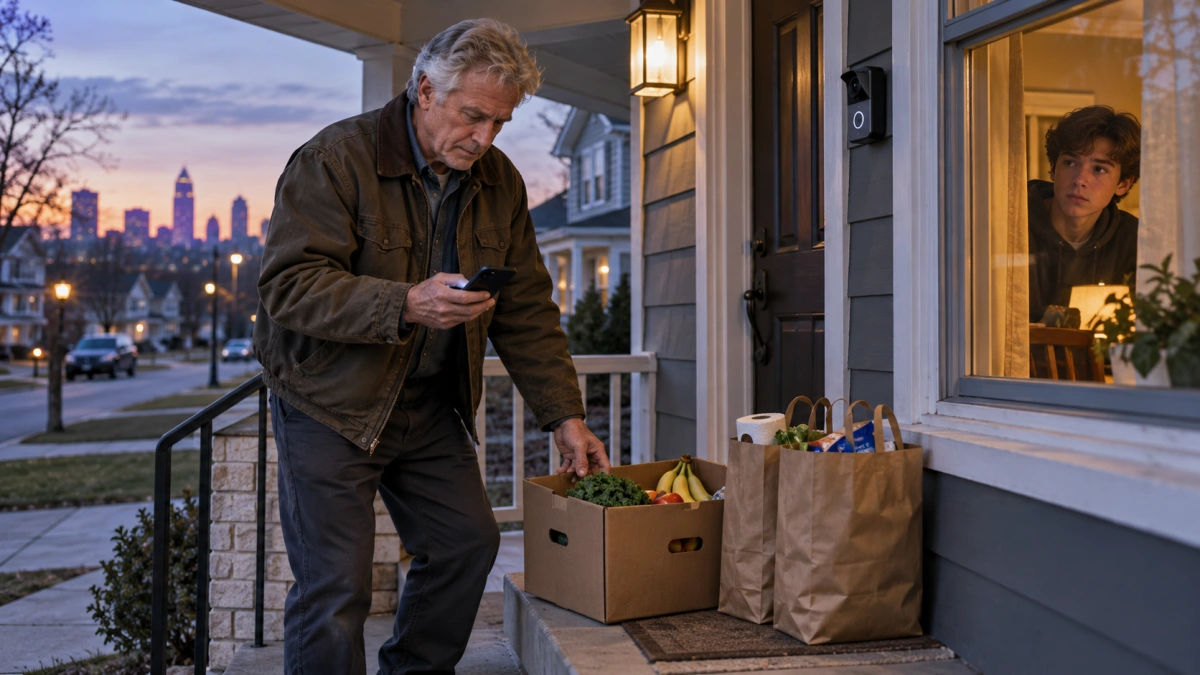
In the video, I was lifting two grocery bags from Mrs. Walsh's porch. The caption read: This man has been stealing from our neighbors for months.
“You told me you were helping people,” Owen said.
I set down my tool bag. Cleveland was turning dark outside our small house. I'd repaired two washing machines that day. Nothing had made my hands feel as heavy as the phone he was offering.
“I was helping.”
“Then why does Megan say not to let you near anybody's house?”
The clip lasted fourteen seconds. It didn't show me delivering those bags to the house at the end of the street. It didn't include Mrs. Walsh's message from seven that morning, or the schedule explaining who was collecting what.
It also didn't show me setting down a new box before lifting the bags.
I called Mrs. Walsh. Voicemail. She was in the hospital, and her daughter had asked us not to call unless it was important.
Owen needed an answer he could take to school tomorrow.
I opened my old messages. There were names, addresses, and things neighbors had told us privately when asking for help. I closed the screen before he could read them.
“I'll prove what I did,” I said. “But I can't use somebody else's private life to do it.”
Then my phone vibrated. The woman who posted the video had just shared my home address in the neighborhood group.
I saved the post, recorded the time, and called the group administrator. Rachel lived two blocks away. I explained that my address was circulating beside an unverified theft accusation and a child lived in the house. I asked her to remove the address immediately while preserving the original for review. Had I taken the bags? Yes, with permission. After a pause, she said she would deal with the address first.
It didn't feel like winning. Owen still stood in the living room, uncertain whether to believe me. My name is Arthur Bell. I was sixty-two, a retired mail sorter doing appliance repairs part time. My daughter worked evenings at a rehabilitation center, so Owen stayed with me during the school week. She would finish at ten. I had four hours to stop something outside from taking over the place where he needed to sleep.
“You don't have to fight with your friends for me,” I said. “If somebody sends more, show your mom or me.”
He asked whether I was receiving charity. Not during that pickup, I said, but accepting help wouldn't make somebody dishonest. He looked irritated that I'd answered a question beyond the one he'd asked. I understood. He wanted right or wrong, something short enough for a school hallway. I had a truth that needed more room than a caption.
The previous year, after my wife died, I took a soup pot to Evelyn Walsh's house and stood outside without knowing what to say. She had fed us during the week of the funeral. I wanted to return the pot without taking all the silence back home. She invited me inside and mentioned a few things that needed doing: a porch bulb, a cabinet hinge, vegetables for a neighbor recovering from knee surgery.
I fixed the bulb first. The other tasks carried me through winter. Grief didn't make me a better person. It made me somebody with an appointment on Tuesday morning. Some days, that was enough reason to dress, eat something, and open the door. Evelyn didn't call it healing. She asked whether I could carry the potatoes because that bag was too heavy.
Our exchange began with three households sharing large produce orders. Everybody collected what they'd purchased. Surplus went privately to neighbors who needed it. Nobody had to declare income. Some paid, some offered driving, and some only received during a difficult month. Evelyn's covered porch became a collection point. I delivered and collected returns. We confirmed pickups by message. We weren't a registered charity, just neighbors making specific arrangements.
That morning, Evelyn asked me to take two bags to Mr. Turner at the end of the street and leave a box for the Diaz household. I followed the instructions. Megan Price, newly moved into the house opposite, recorded the middle part with her doorbell camera. I knew she'd lost a package recently. I didn't know she'd decided a man lifting bags from somebody else's porch explained what happened to her delivery.
The message was still on my phone. I could post it. Beneath the instruction, however, were Mr. Turner's address and a note that he didn't want neighbors knowing his son hadn't sent money that month. Needing vegetables wasn't permission for the public to examine his family finances. I covered that information, leaving the date, pickup instructions, and Evelyn's name visible. I sent the redacted image to Rachel before posting anything myself.
Rachel called back. The address was removed and comments temporarily closed. I requested an explicit correction to the claim about months of theft. Megan hadn't answered her yet. I said an unsupported accusation didn't need the accuser's permission to stop being presented as fact. Rachel labeled it unverified and said resolving the pickup would require confirmation from the property owner. The label was a beginning, not a complete correction.
I contacted Evelyn's daughter, Julia, rather than messaging her entire family. There was a porch-related problem and a video, I said. She didn't have to handle it that evening if she was caring for her mother. Twenty minutes later, she replied. Evelyn was receiving hospital treatment and had left her phone at home. Julia knew about the produce arrangements but not each pickup. She would verify it in the morning. I thanked her without requesting medical details.
A repair customer canceled the next day's appointment. She would find somebody else. I asked whether it concerned the video; she didn't answer. I recorded a cancellation, reason unknown. A rumor could cost work. A washing machine might also no longer need repair. I wouldn't protect facts by adding details I couldn't establish. Keeping that distinction became harder when I counted the empty hours on my calendar.
My daughter, Leah, came home early. Owen had called while I spoke with Rachel. Leah watched the clip and asked whether anyone had approached the house. No. She checked the door, closed the curtains, and offered to save incoming messages. I said I didn't want her handling it. She said she didn't want to be excluded from something affecting where her son slept. I listened and handed over the phone.
Owen barely ate dinner. He asked whether the police would come. Nobody had contacted me, I said. If they did, I would respond and supply appropriate records. He wouldn't have to explain for me. Leah would notify his teacher so circulating the video didn't become an excuse for harassment. Owen asked her not to reveal who received groceries. He had heard what I'd said, although he wasn't looking at me quite the same way yet.
I didn't sleep. My wife used to say I repaired things before asking whether people wanted them fixed. I'd learned to ask. The clip had no space for that question, only a bent back and two bags. I looked at the coat by the door, the same one in the video, and felt angry at wondering whether to wear something different. A different coat wouldn't leave suspicion hanging on the hook.
The next morning, Megan messaged that she'd remove the post if I returned what I'd taken. I asked what was missing, from which address, and when. She sent a photograph of gardening equipment supposed to arrive Friday. My pickup was Tuesday, at Evelyn's house. I pointed out the different dates and locations. I would verify the grocery arrangement. I wouldn't accept responsibility for a package she hadn't located.
She replied that people like me always had explanations. I didn't ask what she meant. Arguing over one sentence could consume another day. I requested preservation of the original footage, removal of my address, and an end to calling me a thief. I copied Rachel, who said screenshots had spread outside her group. She couldn't delete those herself. The correction would have to travel farther than one removal button.
Julia went to her mother's house at noon. On Evelyn's tablet, she found the collection schedule and photographs of produce receipts. I asked her to confirm my specific authorization rather than send the entire folder. She could state that I had permission and that the porch was an agreed collection point. She sent that confirmation to Rachel from her own account. Nobody needed Mr. Turner's financial situation to verify my pickup.
Rachel published a separate notice. The owner had confirmed the authorized collection; there was no basis for calling it theft. She didn't write that everyone had misunderstood. Everyone hadn't made the accusation. I asked her to keep the correction visible and link it under the original before hiding the post. She agreed and requested Megan's complete recording. Megan hadn't supplied it. The fourteen seconds remained the only version most people had seen.
That afternoon, Samuel from down the street knocked. Should he post that I was a good man? I thanked him and suggested sending the sourced correction wherever he saw the accusation instead. I didn't want a contest between people who liked me and people who liked Megan. He understood. Then he offered to drive Owen to basketball because Leah was working. Help with a definite shape made me less tired than praise.
I consulted a lawyer at a community advice office, bringing posts, messages, and removal requests. I wasn't asking for a promise that I'd win a lawsuit. I wanted to preserve evidence and request corrections without exposing more private information. She explained that speculation and factual assertions needed distinguishing, along with distribution and demonstrable loss. For now, I chose written requests and careful records. A consultation gave me options, not an order to pursue every one immediately.
Two days later, the carrier located Megan's gardening package at a house with the same number on another street. The mistaken recipient had already contacted them, but the reports hadn't been connected. Megan posted a photograph saying it had finally turned up. She didn't mention me or link the correction. A box found its proper doorstep faster than a person recovered his reputation.
I asked her to state that I hadn't taken that package and the porch clip didn't establish theft. She said she hadn't accused me of taking that particular box. I sent her screenshot back: months of stealing from neighbors. I added no insult. Did she stand by that assertion after the homeowner's confirmation? She didn't reply until evening. Then she said she'd only wanted to protect the neighborhood.
I believed that might be what she thought. I'd wanted to help and forgotten to ask before. But when other people objected and new evidence appeared, good intentions weren't permission to continue. I wrote that the neighborhood included the people she was warning everyone against. Protecting it required correcting her unsupported claim, not simply explaining the feeling that led her to make it.
Rachel arranged a call with our agreement. Leah joined me. Julia attended for Evelyn's household. I requested no recording for publication, although everyone could take notes. From a bright kitchen, Megan explained she'd been frightened by the missing parcel. Julia asked whether she'd knocked at her mother's house. Evelyn didn't always answer the bell, Megan said. She hadn't tried another contact before posting.
I asked about the original recording. Megan said she'd shortened it because the beginning wasn't important. Rachel asked her to open it. I appeared carrying a box, set it down, checked my phone, and picked up two bags. The camera didn't record the instructions on my screen. It plainly showed a delivery before a collection. The omitted part made the action harder to label. Beyond the room, Owen worked with headphones on. My hands went cold again.
“You saw me bring something first,” I said.
“I thought you took different things afterward.”
“Then you could have asked. You wrote as though you knew.”
She looked down. Tears weren't necessary for the call to matter. I needed a correction identifying the false claim, shared through the channels she could reach. I needed her to ask recipients to delete accusation screenshots and stop asking about grocery recipients. I didn't require her address posted so she could learn what exposure felt like. Repeating a harm wasn't a condition of repairing it.
Megan agreed to preserve the original with Rachel, not publish it broadly. Her first apology said she regretted anyone being hurt by her concerns. Leah looked at me without speaking for me. I said the problem wasn't concern. It was asserting theft without contacting the homeowner and omitting the delivery. Megan revised the statement slowly. The discomfort belonged to the person making the correction, not the person inaccurately described.
The final notice confirmed permission, no connection to the missing package, and the misleading effect of the shortened footage. Megan acknowledged sharing my address was inappropriate and asked recipients to delete it and stop circulating the accusation. I confirmed its factual account without writing that everything was fine. Rachel pinned it for a week and added rules against exposing addresses and presenting unverified allegations as neighborhood warnings.
Some people apologized. Others said I was oversensitive: why fear a video if I hadn't done anything wrong? I didn't answer everybody. I sent the correction to customers who asked directly, leaving Mr. Turner and other recipients out. Two repair bookings returned. One didn't. I recorded losses I could actually connect to the post, not an imaginary invoice totaling every anxious thought. Some consequences remained real without becoming numbers I could prove.
Evelyn called after returning home. Julia had explained enough. She asked about Owen before asking about groceries. He was improving but still worried, I said. She offered to post exactly whom I'd helped so everyone would understand. I thanked her and said those people hadn't agreed. She paused, then said I was right. Familiarity had protected privacy until now. We needed arrangements that depended less on everyone knowing one another.
We met under the porch roof on Saturday: Evelyn, Julia, Rachel, and me. Evelyn tired easily, so Julia brought chairs instead of treating the meeting as proof she had recovered. We agreed on bag codes rather than recipient names, separate contact information, and a backup when Evelyn couldn't respond. A collection-point notice would list a shared number Julia managed. No household list would be attached to the door.
I asked whether each recipient still wanted to use the porch. Some might worry about recognition after the video. We sent private messages describing the changes, without pressuring anyone to respond as proof of trust. One household switched to direct collection from the store. Two paused. I didn't ask whether embarrassment was the reason. A choice didn't need an acceptable explanation before we respected it.
Julia suggested photographing recipients to establish delivery. I thought bag codes and private acknowledgments met our needs without making somebody stand before a camera to receive produce. She considered it and agreed. We weren't building a perfect institution. We needed a way for the carrier and recipient to confirm their part without publishing each other's circumstances. Recordkeeping could be useful without becoming another performance people had to endure.
Rachel asked whether publicity should become a donation drive. I didn't have time to administer money and promises to donors. Neither did Evelyn. We'd continue buying within our means, distinguishing purchases from gifts of surplus. Expansion would require another plan. Public sympathy could disappear quickly. The people receiving food shouldn't be stranded halfway through a project we'd made too large because strangers felt generous for a weekend.
Afterward, Evelyn returned my wife's old soup pot. She'd borrowed it before my wife became ill and kept forgetting. I recognized the dent beneath its handle. For a while, we sat without discussing the recording. I admitted I'd considered never approaching her porch again. Seeing the camera opposite made me want to turn around. She said I could take a break. That permission made returning easier than any speech about good people refusing to quit.
I took a week away from deliveries. Samuel and Julia divided the collections with recipients' agreement. I took Owen fishing by a nearby lake without trying to turn the outing into therapy. He caught a branch. I tangled a line badly enough to cut it. Over sandwiches, he asked why I hadn't published every message immediately so the whole thing would end. He needed an answer I hadn't yet given properly.
I said information could be covered, as I'd done. Anger could also tempt a person to reveal more and more until nobody dared question him: names, illnesses, unemployment, money trouble. Those details weren't mine. Owen asked whether helping other people mattered more than stopping his classmates from teasing him. I set down my sandwich. I'd spent so much time protecting other people's dignity that I hadn't named his hurt clearly enough.
“No,” I said. “I needed to protect you, too. I'm sorry I sometimes sounded like you had to put up with this so I could do the right thing.”
He said someone had shared the clip in the basketball chat. Leah contacted the coach, but Owen feared people thought I'd forced the correction. What did he want us to do? He wanted the coach to address it at practice without explaining the groceries or inviting him to make a speech. I messaged Leah so she could arrange it. I didn't need to represent every feeling he had.
At the next practice, the coach said the video's allegation was false and corrected. The team wasn't to circulate it or use it to harass anyone. He didn't hold a vote on whether people believed me. Owen came home describing two points he'd scored and a bad pass. I listened to the whole game before asking anything else. He didn't owe us a report on his distress each time he entered the house.
Leah and I talked after he slept. She said I often decided alone what I should bear to avoid burdening people. I thought I was protecting her. She said she sensed the trouble anyway and lacked information to help or prepare Owen. We agreed I'd share developments affecting safety, work, and our home, without recounting every comment. She didn't need every detail to count as a member of the family. I didn't need to carry every detail alone.
I resumed repairs. A new customer asked whether I was the man in the video. I said yes, offered the sourced correction, and asked whether she still wanted the appointment. She read it and apologized for asking. Asking first was better than guessing, I said. Then she showed me her noisy dryer. I assessed it and quoted the replacement part, leaving her to decide. My experience wasn't a reason she should trust repair claims I hadn't tested.
The customer who canceled called again, acknowledging the post. Could I come Friday? I was booked and offered Monday. She thought I should be flexible because she'd returned. I looked at the calendar, remembering how often I'd squeezed work into rest so nobody could call me difficult. Monday remained available, I repeated. She accepted. An apology didn't buy control over the recipient's time. I didn't have to punish her or surrender my schedule.
Megan offered to reimburse income I could document losing because of the post. I consulted the lawyer before answering. I wouldn't accept money accompanied by language settling things I didn't understand. We agreed on specified costs in writing, without requiring praise or preventing truthful statements. It didn't restore Owen's anxious nights. It let the person who caused harm bear some expense instead of expressing regret while somebody else paid the whole bill.
We didn't become friends. At the grocery store, I greeted Megan when our eyes met. I didn't perform closeness to prove the neighborhood had recovered. Once she offered to help with deliveries. I directed her to Julia and the recipients rather than treating volunteer work as a shortcut to my trust. She said she understood. I didn't know how fully she did. Grading her personal growth wasn't another responsibility the accusation had assigned me.
A month later, Rachel arranged a library discussion about verifying neighborhood information. I contributed written suggestions instead of sitting before a room describing suspicion so the meeting would be compelling. Experienced moderators explained the process. Residents could report genuine concerns, but needed to separate observation from interpretation, contact appropriate people, and stop using an identifiable person's image as a verdict. Protecting safety didn't require pretending uncertainty had already been resolved.
The adopted rules didn't promise to eliminate rumors. They told administrators how to remove addresses promptly, preserve material for review, identify confirmation sources, and place corrections where original viewers could find them. I appreciated the concrete verbs. Be kind was good advice. It didn't explain who should do what when somebody stood outside another person's home holding a phone and feeling certain. The rules supplied tasks people could actually carry out.
Eventually, Owen asked to see the full recording. Julia had a preserved copy, but further sharing needed agreement. Megan allowed him to view it privately, without reposting. Leah sat with us. He watched me set down the box and said the cut version made me look sneaky. Both clips recorded real actions, I explained. One removed the part that should have made people ask another question. He watched once, then returned to homework.
We didn't turn his phone into a collection of prohibitions. We agreed not to forward addresses, to question claims about motives, and to seek corrections after sharing errors. Leah reminded us adults had the same responsibility. I remembered things I'd forwarded without reading carefully. I removed unsupported old posts and notified people I'd sent them to. I didn't have to become a perfect reader before correcting something I already knew needed correction.
Before deliveries resumed, Julia tested the arrangements with an empty bag. She sent a code, I acknowledged collection, and she closed the pickup in a separate record. The first notification still displayed a recipient's name. We had intended to hide it. She changed the settings and tried again. I suggested asking each household which contact method felt safe, since some people shared phones. She added a preference field instead of assuming everybody wanted photographs or messages arriving during work.
The test took longer than writing our original plan. That didn't mean the plan had failed. A household could want groceries without wanting a message visible to every person borrowing its phone. Someone could be comfortable with a doorstep delivery but not a photograph identifying the building. We couldn't anticipate everything by being well intentioned. We could ask, record only what was necessary, and leave room for an answer to change. The empty bag gave us a way to make mistakes before attaching them to somebody else's private life.
Mr. Turner called afterward. Did he need to write a letter proving I was helping him? That part was resolved, I said. He didn't have to explain his vegetables to the neighborhood. He went quiet, then offered to contribute money the next month. Was that what he wanted, I asked, or something he felt required to do after the video? He wanted to, but needed to wait until he knew what he could afford. Then we would wait. Gratitude didn't require a financial promise.
After hanging up, I thought about my wife. She usually asked what the other person wanted. I tended to assume whatever I already had would help. I opened the delivery notebook, removed private notes we no longer needed, and retained the required acknowledgments. Knowing a story wasn't permission to keep it forever. I couldn't retrieve every screenshot circulating elsewhere. I could decide what my own phone contained and why. Other people were allowed to change their choices even after I'd made arrangements.
When I took the old pot home, I washed it before putting it away. The dent beneath the handle had always annoyed me. My wife said a pot that sat flat and didn't leak could have a dent. I had wanted to straighten it and nearly damaged the handle. Standing at the sink, I remembered how often my first answer was a repair rather than a question. The neighborhood work had given me useful mornings. It hadn't given me authority over the lives of everyone who accepted a bag.
I didn't tell Owen that thought over dinner. He had heard enough adult explanations for one week. I asked him to set out spoons, and he complained that I'd made soup again. We found bread in the freezer and toasted it badly, scraping the darkest edges into the trash. Ordinary disagreement was a relief. He could dislike dinner without it becoming evidence that he still distrusted me. I could tell him to finish setting the table without proving that our relationship had recovered. We were allowed an evening that didn't report progress.
Later, while reviewing repair appointments, I noticed how many times I'd typed an apology into a message that didn't need one. Sorry, I can't come Friday. Sorry, the part costs more than the original estimate. I erased those beginnings and wrote the facts with courtesy. It wasn't the same as refusing to admit mistakes. If I ordered the wrong part, I would say so. Having a schedule or a price didn't require apologizing for taking up space. The video had made me anxious to seem harmless in every interaction. That wasn't a sustainable way to work.
Leah read one of the messages when I asked. She said it sounded like me, only less worried about being liked. I laughed because I was still worried. She knew. Her point wasn't that I could stop caring what people thought by choosing different words. I could stop offering control over my time as reassurance that I was decent. We checked the actual bookings together, distinguished cancellations from inquiries, and put uncertain losses in a separate note. Accuracy sometimes meant a smaller claim than anger wanted to make.
I also asked Rachel what would happen if somebody shared the accusation again. She showed me the response process rather than promising it couldn't happen. A moderator would remove exposed personal information, link the established correction, and contact the person reposting it. Repeated violations could limit group access. If new information appeared, it would be reviewed instead of automatically dismissed because I'd once been wrongly accused. I appreciated that last part. I wanted a process that examined facts, not a permanent exemption because people felt guilty about me.
We discussed the original post's archive. Rachel needed a restricted copy to document moderation and answer further reports. It wouldn't remain publicly searchable for neighborhood entertainment. She recorded who could access it and why. My request to preserve evidence hadn't meant keeping it available to every curious person indefinitely. There was a difference between retaining a record and maintaining an audience. I hadn't thought much about that distinction until becoming somebody other people could replay while waiting in a checkout line.
Some nights I still searched my name. Usually I found appliance listings or nothing at all. Once an old screenshot appeared in a discussion I couldn't access. I sent a removal request with the correction and closed the browser. I wanted certainty that every copy was gone. Nobody could give it to me. Leah reminded me I could save the request and stop for the evening. I put the phone beside the kettle and listened to Owen describe a basketball drill from the other room.
The lawyer had told me to separate what I could request from what I could guarantee. I wrote that on a page beside my records. I could request a correction, preserve dates, explain an actual loss, and decide whether another step was worth its cost. I couldn't guarantee strangers would read carefully. I couldn't make every apology sincere. Keeping those limits in view didn't excuse Megan. It stopped the work of responding from becoming another thing she could take without end.
I kept the folder closed during breakfast. Owen noticed and asked whether the problem was finished. The known facts were settled, I said, but some effects took longer. That didn't mean we needed to work on them every morning. He asked whether we could make pancakes Saturday. I checked the repair calendar before answering, then said yes.
A promise made after checking was better than an enthusiastic answer I might need to cancel. He wrote pancakes on the kitchen calendar, beneath the delivery times. For once, I looked at that square and saw what we had planned rather than everything I needed to prevent. There was room for that ordinary appointment, too.
At the start of the next month, I resumed Tuesday deliveries. The notification preview showed a bag code and appointment time, not a recipient's name. I carried a box to Evelyn's porch, set it down, and collected two bags. Megan's camera still faced the walkway. I knew it was there. I didn't wave to establish innocence or turn my face away. I checked the codes and instructions and continued. The work deserved care even when nobody was recording.
When I got home, Owen waited with a small bulb from his science model. Could it be repaired? I asked what he'd tried, then we examined the connections. A loose wire was the problem, not the bulb. He laughed and said it was lucky he hadn't thrown it away. I didn't turn that into a speech about the video. I held the model while he used the little screwdriver. Asking before deciding was something we could practice together in a quiet room.
Read next
One More Stop Before Home
The Obituary with My Phone Number
The Name on the Cake Boxes

The Landlord’s Son Told My Neighbor to Leave Her Shop by Friday—Then She Handed Me a Receipt Older Than He Was
Reading notes
A short porch video turns an ordinary act of help into a neighborhood accusation.
This is an original work of fiction. Characters and events are fictional. Explore public-domain books at Project Gutenberg or browse more stories on ReadStoryvia.