“You've had a cheap ride long enough,” the landlord's son said. “Empty the freezer and leave the keys by Friday.”
Mrs. Alvarez stood behind the counter in her green cardigan. She was seventy-two. Her grocery shop had occupied the corner of our street since before I was born.
Rain streaked the front window. On the scratched red freezer sat a tray of bread she'd set aside for customers who paid on pension day.
The young man, Grant, tapped the counter with a key ring.
“My father wants this finished.”
“Then your father can speak to me,” she said.
“He's recovering. I'm handling everything.”
I had come in for milk after work. Mrs. Alvarez looked at me, then at the receipt in her hand.
“Would you read something for me, June? The small print is getting difficult.”
Grant reached for it.
She folded it before he could touch the paper.
“Not you.”
After he left, she took a tin box from beneath the counter. Inside were rent receipts, repair invoices, and a faded agreement dated thirty-four years earlier. The receipt she'd been holding documented a payment toward the shop's electrical installation. It was signed by Grant's father, Walter.
Mrs. Alvarez had helped pay for improvements when Walter bought the building. Their written agreement described a rent credit and a renewal process. More recent papers showed she had renewed the shop lease through the following September.
Friday was five days away.
I'm a library assistant, not a lawyer. I could help organize papers and find qualified advice. I couldn't tell her what every old clause meant. I said that clearly, and she nodded.
“Take that through the back,” the fundraiser chair told my son. “The front tables are for sponsor-quality displays.”
Eli stood under the auditorium lights holding a cardboard solar system. We'd painted Saturn's rings with the last of my gold nail polish because the craft store had closed.
He looked at the project, then at me.
Mrs. Harlow wore a blazer with the school foundation pin. She was a parent volunteer like me, but she had a headset and a clipboard, and everybody stepped aside when she walked past.
“My confirmation says table six,” I told her.
“That was before we finalized the program.”
At table six, a glossy display advertised her husband's tutoring center. Our school's science evening had somehow acquired a sales desk.
I took Eli to his teacher, who found a safe place for the project in her classroom while I asked about the change. I wouldn't make him stand in the doorway while adults discussed whether his work belonged.
Mrs. Harlow told me families who contributed should receive recognition.
“I did contribute. I designed the program.”
“You helped with a little formatting, Nina.”
I had spent fourteen evenings designing it after finishing shifts at a print shop. The written arrangement was simple: my design work would count as the family sponsorship contribution, and every approved student project would receive a numbered display place.
She had confirmed it by email.
Now she said there was no record.
The program printer was my colleague, Frank. I called to ask which version had gone to press. He said Mrs. Harlow had supplied a replacement after I signed off the original.
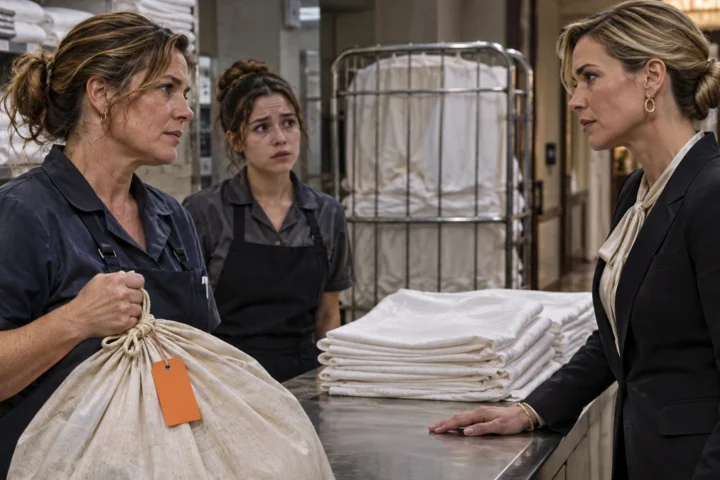
“Empty your bag, Rosa,” the events manager said. “We can do this quietly, or we can do it in front of security.”
My bag held my lunch container, a bus pass, and the cardigan I wore when the laundry room grew cold. Twenty feet behind me, wedding guests were drinking champagne.
I had worked at the hotel for eleven years. That morning I had counted 184 ivory tablecloths into the ballroom delivery. Now sixteen were missing, and Ms. Vale had decided the laundry supervisor must know where expensive fabric went.
I put my bag on the service counter but didn't open it.
“Please get the duty manager,” I said. “And bring the return sheets.”
She smiled toward the junior attendant beside me.
“You see how this becomes difficult?”
The attendant, Nia, looked down. I couldn't blame her. She had been there six weeks.
Ms. Vale pointed to an orange-tagged linen bag beneath the counter. She said it had been found near my locker. I recognized the tag immediately. It was from an outside rental company, not our stock.
“Read the number,” I said.
She reached for the tag, then stopped.
“Orange isn't proof of anything.”
“No,” I said. “That's why we keep the numbers.”
Every outside linen delivery received a tag and a signed intake sheet. Hotel linen was marked with a small blue stitch. Ms. Vale had ordered special ivory runners for the wedding, and our team had been told to keep them separate. I had emailed her two days earlier because the quantity on the delivery note didn't match what arrived.
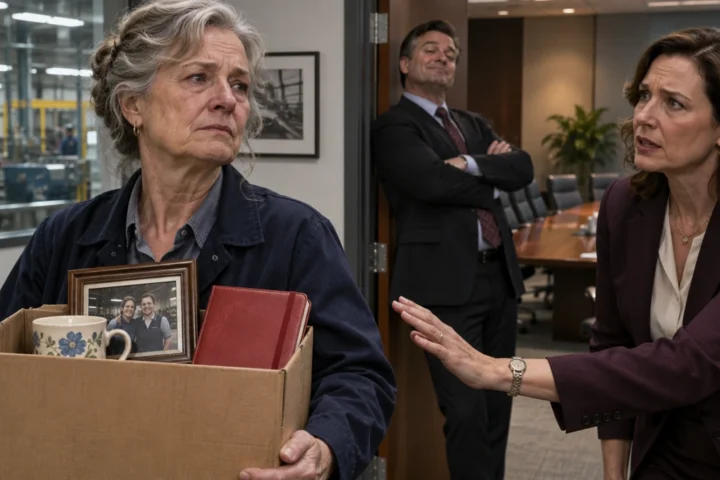
“Take these home before the visitors arrive,” my manager said, nudging the cardboard box with his shoe. “We don't want the place looking like a yard sale.”
Inside were a ceramic mug, three handwritten cards, and a framed photograph of the packaging team I had trained for twenty-three years.
It was my final Thursday at Halden Supply. I had planned to retire at the end of the month. My manager, Ross, had moved my last working day forward without discussing it, saying the handover was complete.
Across the room, a banner welcomed our largest client. Ross had put his own name on the presentation describing a new shipping system. I had designed its test procedure after two damaged deliveries the previous winter.
I picked up the box. Under the photograph lay my red notebook, the one where I recorded trial numbers before transferring them into the official log.
As I reached the door, the client's quality director stopped me.
“Evelyn? You're leaving before we review the cold test?”
Ross stepped between us.
“I approved everything. Evelyn's already enjoying retirement.”
The director frowned. “Then why does the report list her as the final sign-off?”
I set the box down.
“I haven't signed off a final cold test.”
Ross laughed too loudly. “She means the paperwork hasn't caught up.”
I knew exactly which test he meant. Three weeks earlier, a prototype container had failed after extended cold storage. I had recommended a different adhesive and a repeat trial before any production order. The revised test was scheduled for the following Monday, after my newly shortened last day.
“Don't be selfish, Alice,” my cousin said. “Your mother would want those flowers to help someone.”
She was loading a white arrangement into her SUV before the last guests had left the memorial lunch. My mother's name still hung from its ribbon.
I had asked for three arrangements to remain. One would go to Mom's oldest friend in the nursing home. One would go to the women who had cared for her. The small one with blue irises was coming home with me.
Beth had offered to coordinate the remaining donations. She said a community group could use them at a fundraiser that evening. I had agreed, grateful for one fewer decision on a day full of them.
Now the irises were in her hands.
“That one's mine,” I said.
“There are plenty of others.”
I reached for the pot. She let go so suddenly water spilled down my black skirt.
People looked away. My aunt murmured that grief made everybody difficult.
An hour later, the florist called about collecting her display stands. I mentioned the fundraiser so she would know where the larger arrangements had gone.
“What fundraiser?” she asked.
I gave her the address Beth had texted. The florist went quiet.
“That's a private anniversary party. They called yesterday asking whether I could supply white flowers at half price.”
I sat on the kitchen floor because every chair held an abandoned coat.
Mom had known Beth since she was born. She had babysat her children and paid for a dental emergency Beth never mentioned once she married into a wealthier family. I didn't want to believe she had turned the funeral into stock for a decorating job.
“Visitors like him can park behind the dumpsters,” the condo president said, pointing at my father's white van. “We have standards.”
Dad stood beside the open passenger door with a toolbox in his hand. He had come to fix my kitchen drawer, and I had made soup because he always forgot lunch.
The van was fourteen years old. Its paint had faded around the lettering of his plumbing business. It was clean, insured, and parked in the visitor space I had reserved.
“Like him?” I asked.
Mrs. Kline adjusted the scarf at her neck. “Commercial vehicles lower the tone.”
Dad shut the van door before I could say anything worse.
“Let's fix your drawer, Mara.”
Three days later, I found an emergency repair invoice slipped under my door. It demanded $2,860 for a leak the building manager said had started in my apartment. Attached was a photograph of Dad entering the lobby with his toolbox.
The note beneath it said: Unauthorized contractor observed. Owner responsible.
Dad had repaired one wooden drawer. He hadn't touched a pipe.
I called the manager. He said Mrs. Kline had identified the likely cause and the board expected prompt payment. I asked for the plumber's report, the photographs of the actual leak, and the basis for assigning the charge to my unit.
He suggested I avoid making things complicated.
I set the soup container Dad had returned on the counter and opened my laptop.
The first thing I found was the visitor registration confirmation. It listed Dad's arrival at 11:06 on Tuesday. The emergency invoice described a leak discovered at 8:40 that same morning.