“Don't be selfish, Alice,” my cousin said. “Your mother would want those flowers to help someone.”
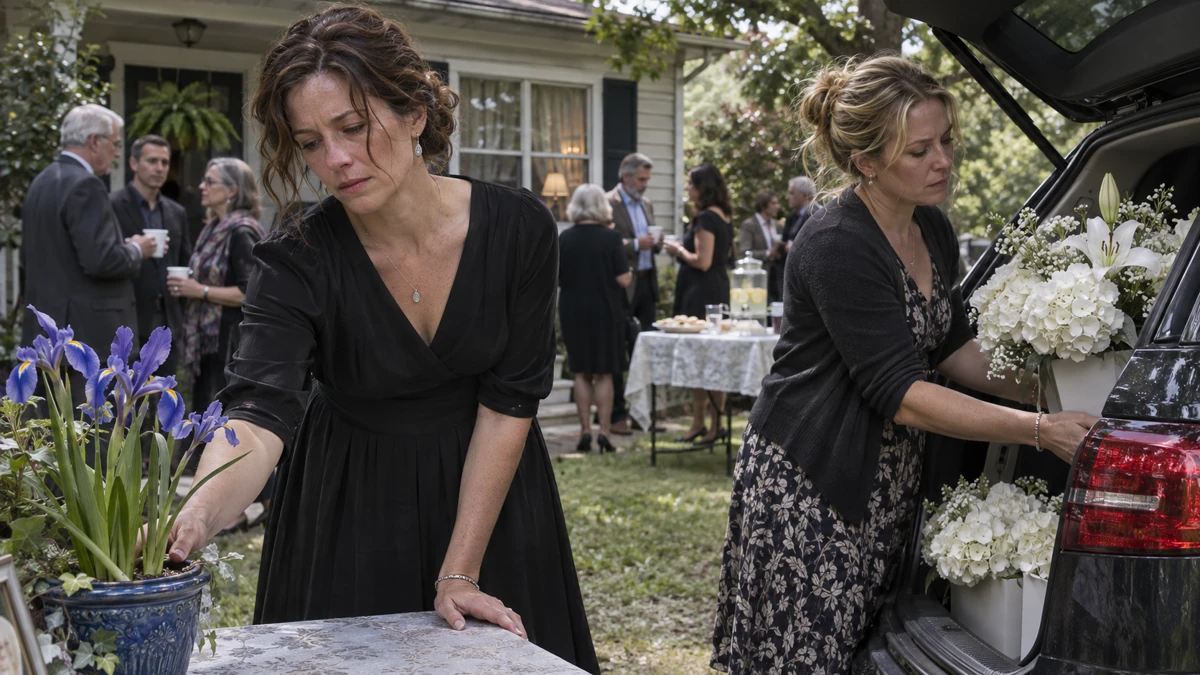
She was loading a white arrangement into her SUV before the last guests had left the memorial lunch. My mother's name still hung from its ribbon.
I had asked for three arrangements to remain. One would go to Mom's oldest friend in the nursing home. One would go to the women who had cared for her. The small one with blue irises was coming home with me.
Beth had offered to coordinate the remaining donations. She said a community group could use them at a fundraiser that evening. I had agreed, grateful for one fewer decision on a day full of them.
Now the irises were in her hands.
“That one's mine,” I said.
“There are plenty of others.”
I reached for the pot. She let go so suddenly water spilled down my black skirt.
People looked away. My aunt murmured that grief made everybody difficult.
An hour later, the florist called about collecting her display stands. I mentioned the fundraiser so she would know where the larger arrangements had gone.
“What fundraiser?” she asked.
I gave her the address Beth had texted. The florist went quiet.
“That's a private anniversary party. They called yesterday asking whether I could supply white flowers at half price.”
I sat on the kitchen floor because every chair held an abandoned coat.
Mom had known Beth since she was born. She had babysat her children and paid for a dental emergency Beth never mentioned once she married into a wealthier family. I didn't want to believe she had turned the funeral into stock for a decorating job.
So I asked questions before accusing her.
Beth replied that the party organizers were making a charitable contribution. She refused to name the charity because, she said, I would harass them in my state.
I saved the conversation. Then I asked the florist whether she could give my number to the party organizer. I didn't ask for private customer details. She agreed to pass along a message.
The organizer, Mrs. Lang, called that evening. She was horrified when I explained why I was asking. Beth had charged her $1,450 for “fresh floral styling and delivery.” The invoice described a professional service. It mentioned no donation and no reused arrangements.
Mrs. Lang emailed it with her permission to use it in resolving the matter. In the party photographs, Mom's white roses sat around a cake celebrating thirty years of marriage. The ribbons had been removed.
I didn't resent the couple's happiness. I resented the price Beth had put on our farewell without asking us.
I told Mrs. Lang I would not post her photographs or name her family. She said she would handle her own complaint with Beth and send me any relevant reply.
The next morning, Beth called six times. I answered the seventh.
“You've ruined my reputation with a client.”
“A client?”
She paused.
“I did work. I transported everything. I arranged it.”
“You told me it was a charity fundraiser.”
“Because you'd have said no.”
There it was, in her own voice, without the explanation she had wrapped around it.
I wrote down the words immediately afterward. I didn't pretend a private note was a recording. What mattered was that her written claims and the invoice already contradicted each other.
My aunt called to say Beth needed money. I asked whether she had known about the invoice. She said flowers would have died anyway. When I asked again, she admitted Beth had mentioned a paid party but insisted she had misunderstood the arrangement.
I asked both of them to meet me at Mom's house on Saturday. My brother would be there. So would the florist, who needed her stands returned and had agreed to identify which arrangements were involved.
Beth arrived angry, holding an envelope with $200 inside.
“For whatever charity you want,” she said.
I didn't touch it.
My brother placed her fundraiser message beside the invoice. The florist identified the containers and explained that two reusable stands had also been taken to the party. They belonged to her business, not to our family.
Beth said the price included her labor. Nobody disputed that she had transported flowers. We disputed her permission to sell them and her lie about where they were going.
My brother read her message aloud: Everything goes directly to the community fundraiser. No charge.
Beth looked at our aunt.
“Say something.”
Our aunt stared at the invoice. Perhaps seeing the total printed beneath the phrase fresh floral styling made it harder to call the whole thing a misunderstanding.
“You told me they were paying you for transport,” she said.
Beth's face flushed. She said nobody respected the work she did. She said our mother had always expected her to help for free. Then she stopped, hearing what she'd said in the room where Mom's reading glasses still lay beside the chair.
The resolution was practical. Mrs. Lang had already requested a full refund and declined Beth's offer to credit a future event. Beth returned the $1,450 in two payments. The florist recovered her stands and received payment for one damaged container. My family did not accept the $200 as a substitute for telling the truth.
Beth sent a written correction to the relatives she had told I was blocking a charitable donation. She didn't use the word stolen. She said she'd misrepresented a paid event as a fundraiser and that I had not authorized the sale. I checked that the correction reached the same family group before I left it.
For several months, I didn't see her. At Thanksgiving she asked whether there was any way to put the matter behind us. I told her we could be civil, but she would no longer handle money, deliveries, or donations for me. She disliked that boundary. She respected it.
The irises lasted nine days. I changed their water every morning. When the petals fell, I kept the plain ceramic pot on my windowsill.
In spring, Mom's nursing-home friend sent me a packet of basil seeds. She had received her flowers from me in person, along with a photograph she asked to keep.
I planted the seeds in the iris pot. My brother came over for lunch when the first leaves were large enough to cut. We ate tomatoes and basil at Mom's table, now in my kitchen.
There was no arrangement in the center. There were two plates, sunlight, and enough room to remember her without anyone carrying a price tag.
Fictional story.