Original fiction
On this page
The Dinner They Put on My Account
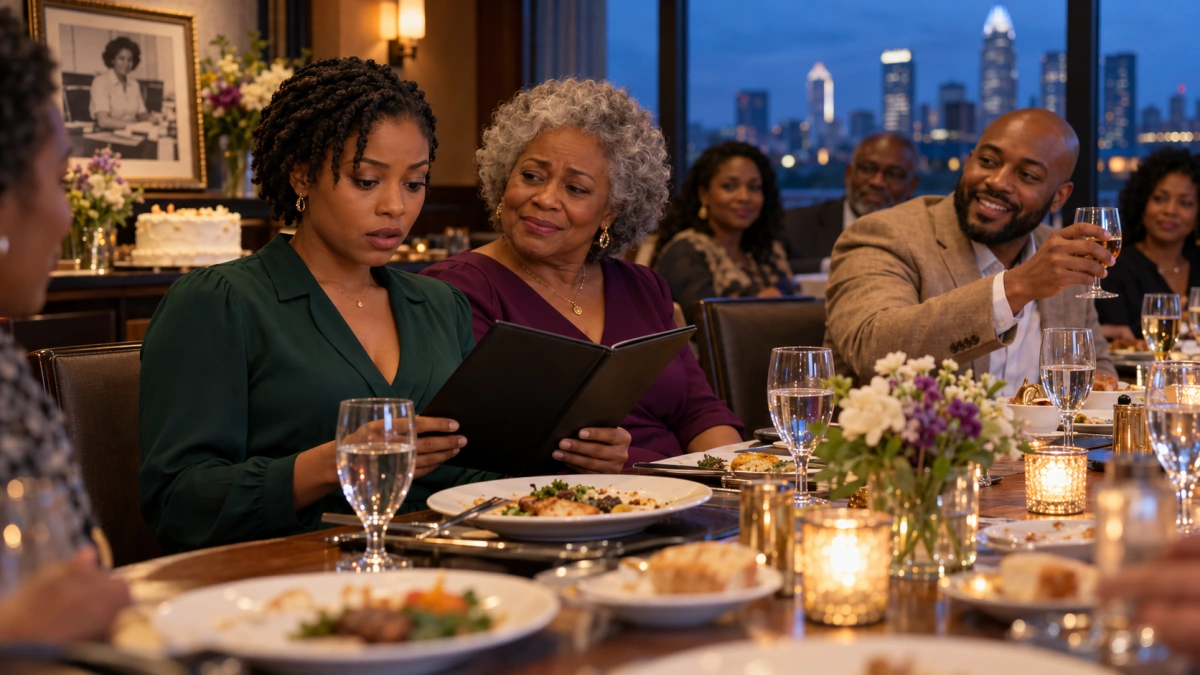
Brent lifted his glass before the waitress could set the black folder down.
"And to Talia," he said, "for treating us like royalty tonight."
Seventeen people turned toward me. My mother touched her silver curls and smiled from the head of the table. Behind her, the Charlotte evening pressed blue against the restaurant windows.
I had arranged the room. I had chosen the lower priced menu. I had brought the framed photograph of Mom on her first day at the hospital, wearing shoes so white they looked unfinished.
I had not offered to buy dinner.
The waitress placed the folder beside my water glass. Inside was a final total of $1,460. A smaller line showed the $200 deposit I had paid to hold the room. Balance due: $1,260.
Across the table, Brent was already reaching for the last crab cake. He wore the tan blazer he saved for pictures. He had added five people to the reservation three days earlier and told me not to worry about the details.
Mom saw the bill before I closed it. Her smile stayed where it was.
"It's such a beautiful thing you're doing," she said quietly.
I was thirty two, a hotel banquet coordinator with a good blouse and a savings account named COURSE. The certification application closed Monday. Tuition was due at enrollment, and the money in that account was almost exactly what remained on the bill.
The waitress leaned down. "Would you like me to bring the card machine?"
My mother put her hand over mine. For a moment I thought she was going to explain.
"Don't make it awkward," she whispered.
I moved my hand carefully out from under hers.
"Please bring another chair," I told the waitress. "We need to talk about how this is being paid."
The waitress, whose name was Lila, paused for less than a second. Then she nodded and went to find her manager. I knew that look. At the hotel I had worn it while a bride's uncle demanded an extra bar with no change to the contract. It meant the evening had changed shape, but the people working it still had to carry it to the end.
Celia quietly gathered the children's crayons, leaving their drawings undisturbed; the argument didn't need to swallow their evening too.
Brent lowered his glass. "What's happening?"
"I offered to arrange the employee referral rate. I didn't offer to pay for everyone."
My mother stared at the little vase of flowers between us. She had worked thirty four years in hospital laundry, finishing as a shift supervisor. Tonight was supposed to mark the first week she would not set an alarm for five. Her plum dress had been bought on sale and altered by my aunt. I knew all that, and for a dangerous moment it felt like a reason to open my banking app.
"We can do this later," she said.
"The restaurant needs the money tonight."
Our relatives began a soft rustle of purses, napkins and explanations. My uncle Aaron took out his wallet, then stopped when his wife touched his wrist. At the far end, Brent's friend DeShawn looked toward the door as if someone outside might know the correct version of the invitation.
The manager introduced herself as Priya and brought a chair, exactly as I had asked. She sat at the open corner rather than standing over us. I thanked her, then asked whether we could have ten minutes to arrange payment. She said yes, but the balance needed settling before the party left. Nobody threatened to call anybody. Nobody offered to erase the charge because the evening was important.
"I thought the deposit meant you had it covered," Brent said.
"The message said a deposit to hold the room."
"You do these events all day. I figured you knew."
"I did know. That's why I called it a deposit."
I could hear my work voice getting hard. I took a drink of water. The glass trembled against my teeth, making a tiny sound that seemed louder than our conversation.
Three weeks earlier Mom had asked for something nice but not extravagant. No basement fellowship hall, she said, not this time. She had spent enough weekends putting foil over other people's casseroles. I understood. I wanted her to sit down and let somebody bring her a plate. My hotel had no suitable room that evening, but a nearby independent restaurant offered a referral discount through a hospitality partnership. I sent Brent the menu and room terms because he had volunteered to collect the family responses.
I had written, I can book this rate and put down the deposit. We need everyone's numbers before I confirm food. I had not written what each person would owe. That omission was mine. It did not turn the rest into a gift.
Brent had replied with three clapping emojis and, Cousin coming through. I was walking a ballroom checking table spacing when it arrived. I took his enthusiasm for agreement. Later, when he added his brother's girlfriend, a neighbor and three friends who knew Mom, I changed the head count instead of asking whether he had discussed the cost. I wanted to be efficient. I also wanted to be the daughter who could make things easy.
"What did you tell people?" I asked him now.
"That you had a connection."
"And?"
He looked down. "That you were handling it."
The words travelled along the table before either of us could stop them. My aunt Valerie said she had understood dinner was a gift. Aaron said nobody had told him anything about a price. His wife, Celia, said that didn't mean the food was free. They had argued about money on the drive, she explained later, and she had mistaken his wallet for the beginning of another argument.
Mom stood up. "Let's not spoil a lovely evening."
It was the same phrase she used when my father missed a birthday before he finally left. Keep the children smiling. Keep the plates full. I had inherited the habit so thoroughly that people called it a talent and paid me a salary to do it. Now it was being used to turn my silence into a purchase.
"Sit down, Mom," I said softly. "You haven't spoiled anything. But we do have to talk."
She sat, her eyes bright with anger. I knew the anger was not entirely aimed at me, which didn't make it hurt less.
I asked Priya for a copy of the itemized bill. The fixed menu for eighteen people, tax and the stated service charge came to $1,260. Two hundred dollars of bar orders, also inclusive of the listed charges, brought the evening to $1,460. The deposit was already credited. Priya explained the figures once and waited. I recognized a professional refusing to become a family referee.
"I can put in another hundred," I said. "With my deposit, that's three hundred from me."
My cousin opened his mouth. I held up a hand.
"Not because I agreed to sponsor. Because I want to give Mom that much, and I can. The other eleven sixty has to come from the rest of us."
The number made the room smaller. Aaron's daughter Nia, twenty, worked part time while taking classes. She held her debit card. Valerie lived on a modest pension. At the other end sat Brent's friends, who had ordered most of the second round. Four children rounded out our eighteen: Aaron and Celia's two younger kids and Malik and Renee's twins, their meals included in their parents' contributions. None of the adults being asked needed decisions made for them.
"Don't ask Nia," Mom said immediately.
Nia put her card on the table. "You can ask me. I just can't do a hundred."
Something shifted when she said it. We had been talking around one another as if a limit were a stain that had to be concealed. She said her limit was forty dollars, including the lemonade she had ordered. She had brought lunch to work all week to buy Mom a gift. The gift was a little jar of good hand cream, sitting in a paper bag under her chair.
"Forty is fine," I said.
"You don't get to decide it's fine for everybody," Brent muttered.
"Then help us decide."
He pushed his chair back, scraping the floor. I thought he might leave. Instead he took his phone out and scrolled through something, jaw working. He had planned to drive to Atlanta the next morning with two friends. He had spoken about the trip all evening, describing the rented car as though he already owned it.
"I can do three eighty," he said eventually. "Two eighty tonight. The other hundred Friday."
"They need it tonight," I reminded him.
His face tightened. "I heard you."
DeShawn leaned forward. "I can cover that hundred until Friday, if you're asking me."
Brent looked at him. The invitation to ask, instead of simply accept, stayed there until he finally said, "Would you?"
"Yes. Send it Friday morning."
I didn't praise them. They were making an arrangement between adults, not performing a redemption for my benefit. The restaurant had still not been paid, and Lila had other tables beyond our door.
We worked it out aloud. Aaron and Celia would contribute $200 together. Valerie offered $70. My cousin Malik and his wife Renee could do $120. The five guests Brent had added agreed on $70 each, a total of $350; DeShawn was one of those five, and his loan to Brent was separate. Nia's $40 brought their contributions to $1,160 with Brent's $380. Along with my $300, the whole bill was covered, including Mom's meal. We said the amounts back to one another once. Not everybody looked happy. Nobody pretended happiness was required for arithmetic.
Priya suggested three card payments rather than eighteen. Aaron collected the others' cash and transfers, including DeShawn's $170: his own seventy and the hundred lent Brent. I paid my extra hundred, the deposit already on the account. Brent paid his $280. Aaron paid the remaining $880 by card. Lila brought receipts, and we checked the balance together. Zero, because people had paid it, not because somebody had rescued us.
Valerie folded her receipt into her purse. Her seventy dollars meant she would not take the bus trip to a craft fair she had mentioned that afternoon. She said so when Mom tried to tell her she didn't have to. "I'd rather buy your dinner than a wreath," she said. "But next time tell me before I get dressed."
One of Brent's friends, Simone, said she would have chosen a less expensive place if she'd known. She wasn't cruel about it. She also wasn't obliged to be pleased. Brent apologized to her in a voice I had never heard him use at a family table, stripped of all his easy joking.
I found Lila by the service station and thanked her for waiting. I asked whether the service charge went to the staff. She explained that it did according to the restaurant's arrangement. I had seen it on the menu and had no reason to question it now, but I wanted to make certain nobody used the awkwardness to skip a charge. She said the dinner had been pleasant until the bill. I nearly apologized for my whole family. Instead I apologized for the delay. She didn't need my history to finish her shift.
When I returned, Mom was putting the framed photograph in its bag. The woman in the picture looked about my age, one hand resting on a wheeled laundry cart. She had been twenty eight when that picture was taken, with decades of early mornings and late shifts still ahead. I had wanted to show her that those years counted. Somewhere between the reservation and the toast, counting had become a very different thing.
We carried the leftover cake to the parking lot. Mom walked beside me without speaking. Relatives hugged her, promised to call, and left in cars that needed gas people had not planned to buy on top of dinner. Brent stayed near his car until the others were gone.
"I wasn't trying to use you," he said.
"You added five people without asking about money."
"They wanted to celebrate her."
"Then you could have told them what celebrating here cost."
He tugged his blazer sleeves. For years I had admired his ability to enter a room as though someone had been waiting to hand him something good. I had not noticed how often he left the waiting to other people.
"I told Mom I wasn't sure," he said. "She said you were doing well."
Mom stood by my passenger door, looking at the cake box. I asked him when that conversation had happened.
"Tuesday. When I called about the extra chairs."
Tuesday I had worked eleven hours, then sat in my kitchen choosing which certification session fit my schedule. Mom had called to ask what color I was wearing. I remembered being touched that she wanted a photograph of us together.
"I'll talk to you tomorrow," I told Brent.
He started to say something else, then stopped. I didn't hug him. It felt rude, and I let it feel rude.
In the car Mom kept the cake on her knees. We drove through three green lights before she spoke.
"I didn't know it would be that much."
"You knew people thought I was paying."
"Brent said you had it handled."
"Did you ask me?"
She watched the windshield. I had spent the evening protecting her from a ruined retirement dinner. Now I needed her to look at the thing she had allowed, not at how unpleasant it was to be asked.
"No," she said.
I pulled into her apartment parking lot and turned off the engine. A neighbor was walking a little dog along the grass. The ordinary world was carrying on with no idea that my mother and I had arrived at a place neither of us knew how to cross.
"I have money for school," I said. "Not money I can't think of anything to do with. Money I saved."
She looked at me then. "You never said you needed help."
"I don't need help paying for it. I need you not to give it away."
Her face flinched. I wanted to take the sentence back and make it softer, but it was already as soft as I could make it without losing its meaning.
The course was an advanced event operations certification offered in a weekend intensive followed by assessed work. My employer would reimburse part of the fee only after completion, and only if the quarter's training budget still had room. I wasn't counting that money until it arrived. I wanted to qualify for larger events without waiting for somebody to notice how hard I already worked. There was no guaranteed promotion. There was a chance I was willing to pay for.
"I see the pictures you send," Mom said. "Those ballrooms. Those flowers."
"They're not mine."
"I know that."
"Do you?"
She pressed a thumb into the cake box until the cardboard bent. "I wanted them to see you'd done better than I did."
I looked at her hands, the pale patches along the knuckles from years of laundry products despite gloves. She had sent me to school with clean clothes during weeks when our dryer was broken. She had taken a bus after late shifts rather than call me away from studying. I loved her for those things. I did not know how to make that love stop being offered as collateral.
"Doing better can't mean I never get to say what I can afford."
"I didn't ask you to buy it."
"You asked me not to say I hadn't."
She closed her eyes. The dog passed again on the other side of the lot. Its owner lifted a hand, and Mom lifted hers automatically.
"When he thanked you," she said, "I thought, let her have this."
"Have what?"
She didn't answer for a while. Then she said, "The way they looked at you."
I began to cry, not loudly, not in the way that would let either of us turn the conversation into comforting me. I wiped my cheeks and kept sitting. That look had cost me something even before a card machine came into the room. It had made saying the truth feel like stepping down from a platform I had never asked to stand on.
Mom offered a tissue from her handbag. I took it. We were not finished, but refusing every kindness would not make my boundary stronger.
"You worked hard," I said. "That was enough reason for dinner. You didn't need a successful daughter paying for everybody to make it worth celebrating."
She nodded, staring at the dashboard. Then she apologized, plainly. She had heard the confusion and liked it. She had let Brent talk and hoped I could carry the result. She did not say she had only wanted the best for me.
"I'm still upset," I told her.
"I can see that."
I helped her take the cake upstairs because it was large and her knees hurt. At her door she asked whether I wanted tea. I said not tonight. She kissed my cheek without trying to make me promise I wasn't angry anymore. I went home and set my blouse in the sink to soak a spot of sauce out of its cuff.
The next morning I opened the family message thread. Brent had posted a group photograph before the bill arrived. In it I was standing behind Mom, smiling as if I had personally invented retirement. His caption thanked me for an incredible night. I asked him privately to change it so it thanked everybody who contributed. I did not want a paragraph explaining the argument. I wanted the picture no longer used to repeat the mistake.
He called instead of replying. The Atlanta trip was off, he said. He had moved money from his travel account to pay dinner and could not afford the rental car deposit. One friend would lose part of a prepaid ticket because of the change. Brent had promised to cover that loss next month. He sounded exhausted, and I almost offered a way to smooth it over.
"That sounds hard," I said.
"It is."
"Are you still paying DeShawn Friday?"
He was quiet, then said yes. He changed the caption while we were talking. A minute later he sent the invitation he had written for the five extra guests. Talia's got us, it said. There was no price, no suggestion they bring money.
"I said I was handling it," he said. "I meant you."
I sat on the kitchen floor because the chair was covered in laundry. He admitted he had wanted to be the cousin who brought a crowd to celebrate, the one who knew how to make an evening feel important. Mom's first retirement plan had been coffee and cake. He had told her she deserved more. Then he had handed the work and the uncertainty to me.
"I could have asked," he said.
"Yes."
"Would you have said no?"
"To paying all that? Yes. To helping make a plan? No."
We didn't agree on everything. He still thought I could have taken him aside before announcing the problem. I told him he had made the thank you public while the bill was already at my elbow. There hadn't been a private version left for me to choose. He listened, which wasn't the same as liking it.
On Monday I submitted the certification enrollment. The extra hundred at dinner meant a tighter month, not a ruined career. I postponed replacing two worn tires until my next paycheck and stopped driving except to work and the grocery store in the meantime. A bus could take me to the training venue. My savings account dropped to a number that made me nervous, but the tuition was paid. Nobody else had paid it for me, and nobody had been starved or shamed so I could keep it.
On Tuesday I stopped at Mom's to return a serving knife we had used for the cake. She had washed the plum dress by hand and hung it over the shower rail. Without the restaurant lighting it looked less grand, a good dress bought by somebody who knew how long good things could last.
She offered me leftover cake. I said yes. We ate standing at the kitchen counter, too tired to carry plates to the table. I noticed an envelope beside the kettle, with my name on it.
"What's that?"
"I was going to give you something toward what you paid."
"Can you afford it?"
She looked annoyed. "I'm not helpless."
"I didn't say you were."
We set down our forks. It was strange to hear her defend the right to answer a question I had wanted somebody to ask me. She opened the envelope. There were sixty dollars inside, money she had saved for a hair appointment before visiting her sister in June.
"I want to give it," she said.
"I wanted to give you dinner for three hundred. I don't want that back."
"Then what am I supposed to do?"
I thought about it instead of answering quickly. "Ask me next time. Even if you think you know the answer. Especially then."
She put the bills back in her purse. We finished the cake. It tasted of refrigerator and vanilla, not quite as good as it had at the restaurant, but there was no need to throw it away.
Before I left, she asked if I could take her to her sister's on the first Saturday in June. I looked at my calendar. It was my training weekend. She asked whether the second Saturday worked, and I said it did. She wrote down the date. Neither of us called this progress, which made it easier to trust.
At work I told my supervisor I needed the Saturday already approved for training. I didn't tell her the dinner story. My family wasn't an amusing example of clients who couldn't read a contract. I wanted to keep one room in my life where that weekend did not follow me around as a lesson.
Still, when a colleague called me lucky to have such a glamorous job, I said I was lucky to have work I liked and that most of it involved sore feet. She laughed and showed me the blister under her own heel. We ate lunch from plastic containers while someone downstairs arranged orchids neither of us could afford.
Mom called Wednesday. She had taken the photograph out of the fancy frame because the glare hid her face. She put it in a plain one on the bookshelf. She asked whether I would help her choose a picture for a message to her old shift crew. I said yes, as long as she chose the words herself.
She read them aloud. Thank you for the years we carried each other through. Then she stopped. "Too much?"
"It sounds like you."
She did not mention me or the dinner. Her work could be honored without being attached to my success, and my help could be ordinary instead of total. I stayed on the phone while she learned how to attach the photograph. It took twenty minutes. I had twenty minutes to give.
She told me the woman standing just outside the photograph was named Evelyn. They had trained together, learning which linen carts belonged on which loading dock, laughing whenever an administrator called clean sheets a minor detail. Evelyn had retired the year before. Mom had her number but hadn't called because she thought the invitation should come from the person with more free time.
"You both have free time now," I said.
"That's the trouble. Neither of us knows what to do with it."
She found the number while we were still talking. I heard her reading the digits under her breath. Then she said she would let me go. I sat a moment after the call ended, thinking of all the parts of her day I had never asked about. Knowing she had made mistakes did not mean I knew her whole life. I wanted to hear about Evelyn sometime, when Mom wanted to tell me, not as evidence that either of us had changed.
Friday DeShawn texted that Brent had repaid the hundred. I told him he didn't owe me a report. He sent back, I know. Just didn't want you wondering. I appreciated it more than I expected. It was a small piece of business finished when somebody said it would be.
Valerie called too. Mom had offered to cover her next craft fair trip after the first pension payment came. Valerie declined the offer and asked Mom to come over and help sew a curtain instead. She told me this because she wanted me to know they were all right, not because she wanted a vote. I was learning how often families recruit witnesses to avoid speaking directly. This time they had spoken.
The first training day arrived with heavy rain. I left home early, carrying shoes in a bag so I could change out of wet sneakers. In the classroom a woman from a conference center asked where I worked. When I named the hotel, she said she had always wanted to see its rooftop ballroom. I told her about the freight elevator that stopped a foot short of the floor when overloaded. She told me about the broken ice machine at her venue. We understood each other immediately.
During an exercise I volunteered to speak for our table, then stopped and asked whether anybody else wanted to. A quiet man who managed school events said he would try. He stumbled over the first sentence and then explained our idea better than I could have. I wasn't becoming a different person. I was discovering how often I stepped into a space before finding out whether it needed me.
At lunch I checked my phone. Mom had sent a picture of her windowsill, where she was trying to keep a grocery store mint plant alive. No request underneath it, no announcement of how much she missed me. I sent back a picture of my cold coffee and the spare socks drying over a chair. She replied with a laughing face. I put the phone away and returned to class.
For two weeks I did not organize anything. When someone asked in the family thread what we were doing for Sunday dinner, I let the message sit. Aaron suggested grilling. Celia said their grill was broken. Nia suggested sandwiches in the park, and Brent asked what everyone could bring before anyone confirmed. The conversation took a day longer than it would have if I had simply made a reservation. It also belonged to everybody.
Mom and I met for breakfast before that picnic. We went to a diner near her apartment, not a place where I had a connection. The waitress asked whether we wanted separate checks. Mom looked at me instead of answering for us both.
"I'd like to buy yours," she said. "Breakfast, not the whole restaurant. Is that okay?"
I smiled. "Thank you. Yes."
We ordered eggs. She told me about waking at five without an alarm and having nowhere she had to be. At first she had felt guilty, then frightened. She had spent so long introducing herself by where she worked that retirement felt like losing the first sentence of every conversation.
"At dinner I wanted another sentence," she said. "Mother of somebody important."
"You're still Yvonne."
"I'm working on liking that introduction."
I reached across the table and touched her hand. I didn't tell her she should already like it, or that thirty four years of work ought to make the change easy. She had allowed a wrong thing because she was hurting. Both facts could remain true without one erasing the other.
When the check came she read it before reaching for her card. I did not offer to take it away. She asked for a box for the toast, and I asked whether she wanted mine too. For a moment we were only two women finishing breakfast, each allowed to want something small.
That Sunday the park tables were damp from morning rain. Brent brought a towel and wiped them down without announcing it. Aaron arrived with a cooler of sandwich fillings. Valerie carried paper plates left over from another party. Nia brought the hand cream because Mom had forgotten it under the restaurant chair and I had taken it home. She handed it over herself this time.
There was no toast to my generosity. There was no speech about what everyone had learned. Simone came for an hour, then left for work; nobody treated her early departure as a slight. Brent asked before adding his neighbor to the sandwich count, and Celia said there was enough if the neighbor could bring bread. He called and asked. The man arrived with two loaves and sat down.
Mom put the hand cream in her bag. Then she asked about my first training weekend. I told her the classroom was colder than any ballroom I had worked in and that I had missed a bus coming home. She asked what I was learning, and I told her. Not what I hoped it would make me look like. The actual work.
When we packed up, my cousin reached for the remaining sandwich bags and looked at Aaron. "Can I take two?"
Aaron said yes. Brent took two, leaving the rest. I folded the tablecloth I had brought from home. It had a stubborn sauce mark near one corner, and I didn't turn it underneath. My mother held the other end while we shook off the crumbs, then handed my half back to me.
Read next
The House We Were Supposed to Inherit
The Bridesmaid Budget
The Scholarship Interview They Wanted to Film
My Cousin Sold My Mother’s Funeral Flowers for “Charity”—Then the Florist Recognized the Delivery Address
Reading notes
A retirement dinner bill forces a daughter to challenge her family's assumptions.
This is an original work of fiction. Characters and events are fictional. Explore public-domain books at Project Gutenberg or browse more stories on ReadStoryvia.