Original fiction
On this page
The House We Were Supposed to Inherit
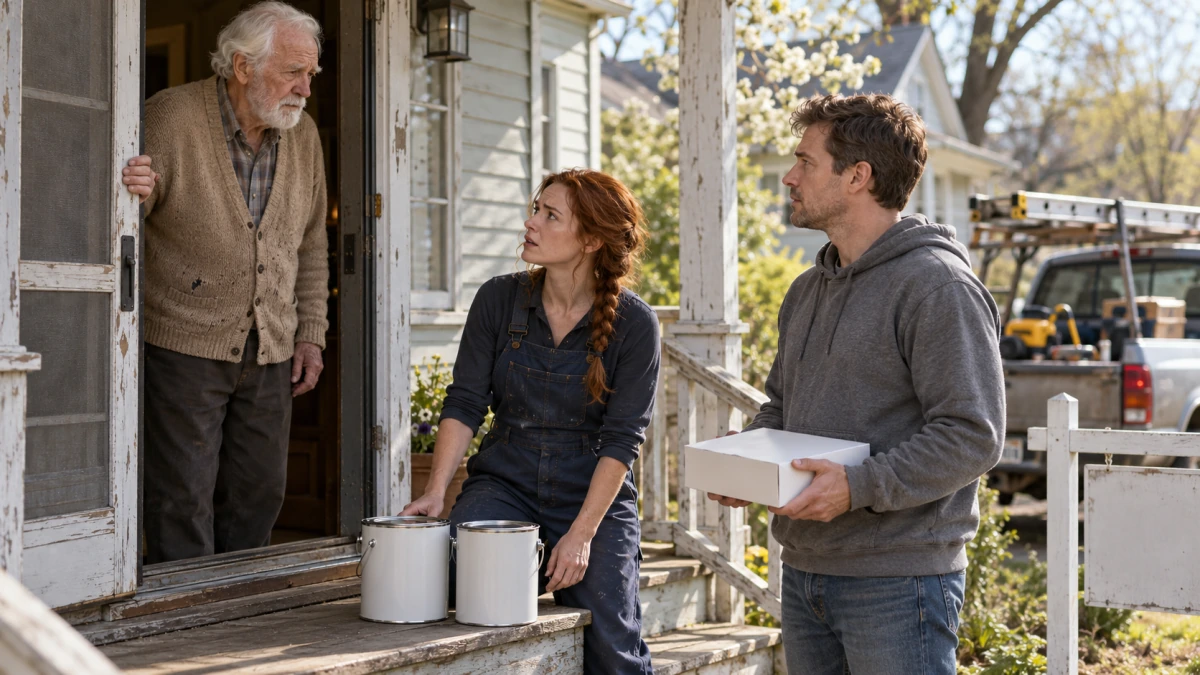
The sale sign was already in the yard when Mae backed her truck against the curb. In the bed lay two gallons of porch paint, a rented sander, and the ladder our father had finally agreed not to climb.
I had brought doughnuts. That was the sort of son I could afford to be that Saturday: generous with twelve dollars, useless with a mortgage.
Mae sat looking through her windshield. Then she got out in her navy overalls and walked past me without taking the box.
Dad opened the screen door. His tan cardigan had a hole near the wrist, and his white beard was damp from shaving.
"I should have called," he said.
"Before or after they put that up?" Mae asked.
Across the street, somebody's sprinkler clicked over wet concrete. I noticed the little red flag on the sign, the cheerful invitation to come inside on Sunday. Strangers would be walking through the room where our mother had died. They would open cupboards, discuss light, and decide whether our lives smelled like old carpet.
"It's my house, Ellis," Dad said, although I hadn't spoken.
That frightened me more than the sign.
In my coat pocket was a message from the man who had lent my restaurant money. He wanted a date, not another explanation. For months I had comforted myself with something Dad said whenever the roof needed work: Your house someday. Both of you.
Mae put the paint on the bottom step.
"Where are you going?" she asked.
Dad reached behind the door for a rental brochure. The picture showed a low brick building with handrails along its paths.
"Somewhere I can get to the bathroom without stairs."
Only then did I notice he was holding the doorframe instead of standing on his own.
Mae took his elbow. He shook her off, not angrily, but with the embarrassment of a man caught dropping something precious. We followed him into the kitchen. The table was still covered with newspaper to protect it from the paint cans we were supposed to open. Dad folded the newspaper into a square and set it beside the sink. Nobody sat in Mom's old chair. Eight years after her death, that still happened without discussion.
"Did you fall?" Mae asked.
"Last month. On the landing. Nothing broke."
"And you didn't tell us."
"I knew what you'd say."
I did too. A rail, a brighter bulb, a promise to answer his phone. We had become excellent at finding a small repair that let us avoid considering a large change. I put the doughnuts on the table. The powdered sugar looked festive in a way I suddenly resented.
Dad was seventy one. He had worked forty years maintaining school boilers, and in my mind retirement meant fishing and having an opinion about every televised football game. It had not meant standing at his own sink calculating how long he could keep the heat low before his hands hurt.
"You own it outright," I said.
"Owning isn't the same as living here for nothing."
He went to the kitchen drawer where Mom used to keep birthday candles. There were still candles in it, bent from summer heat, but he brought out an envelope of bills. Property tax, insurance, furnace service, the electric statement. Mae reached for them before I did. She was thirty six, three years younger than me, and had always been the one who understood a thing by touching it.
"You could have told me about the insurance," she said.
"You paid for the water heater."
"That was two years ago."
"I remember when it was."
His pension and Social Security covered ordinary months, he explained, if ordinary meant no dentist, no broken appliance, and no wet spring that found another crack in the basement. He had begun putting groceries on a card. The house had four bedrooms. He used one and heated all four because the pipes did not care that the children had left.
I watched his thumb rub the edge of the brochure. "How much are they asking?"
He named the listing price. I began dividing before I could stop myself. Mae looked at me, and I knew she had seen it happen.
"That's before everything," Dad said. "And it isn't an offer."
"I know."
I hadn't known. I had imagined a number arriving intact, like a birthday check, with my name already penciled onto a share. There were selling expenses, a move, rent every month afterward. There was the inconvenient possibility that Dad might live a long time. The shame of that thought made me pick up a doughnut and immediately put it down.
Mae laid the bills flat. "Does the apartment have room for somebody else?"
Dad glanced at her. "It's a one bedroom."
"I meant when we visit."
I knew that wasn't what she meant. Her divorce had been final in February. She was renting a room from a woman who fostered cats, and when she came to dinner her clothes sometimes smelled faintly of the lavender litter stored beside the dryer. She had described the arrangement as temporary so often that the word had become a piece of furniture nobody could move.
"There's a sofa," Dad said. "Or there will be."
"You already chose a sofa?"
"I looked at one."
Her face changed. Not dramatically. It simply closed the way a hand closes around a splinter before deciding whether to pull it out.
The agent was coming at eleven to photograph the porch. Dad hadn't wanted to tell us on the phone, he said, and then each day had seemed worse than the previous day. He had let us buy paint knowing there would be no painting. That small betrayal was easier to be angry about than the large truth.
"I took the morning off," Mae said.
"I'll pay for the rental."
"That's not what I said."
I stepped outside because my phone was vibrating again. Victor, who supplied bread to my restaurant and had later lent me eighteen thousand dollars, had sent a question mark. There was nothing threatening about it. That was part of what made it unbearable. He had trusted me before the bank would, and I had turned his patience into another source of money.
I typed Monday and erased it. Inside, Mae was saying something too quietly for me to hear. I looked at the porch rail she had rebuilt, the straight spindles, the careful way she had matched the old paint. I had helped carry lumber that day. I remembered being proud of myself for showing up.
"Business?" Dad asked behind me.
I put the phone away. "Bread delivery."
He stood inside the screen, where the afternoon would turn it into a mesh of sunlight. "Ellis. Don't ask me to keep the house because of your restaurant."
My first impulse was to deny it with enough force to make him apologize. Instead I asked whether Mae had told him something.
"No. You have a face. I've known it thirty nine years."
The restaurant was called Reed's Counter. We served breakfast and lunch in a narrow rented storefront near a tire shop. At first people came because a newspaper ran a picture of my biscuits. Then the street closed for utility work, eggs got expensive, and I discovered that customers who loved a place could still bring their own lunches. None of those facts explained why I kept ordering food for crowds that no longer came.
"I just need time," I said.
Dad leaned against the jamb. "So do I."
We stood with that between us until Mae came out carrying the unopened paint. She asked whether I would follow her to return the sander. Her voice had the briskness she used with customers at the hardware store when something heavy needed moving. I wanted her to stay and argue on my behalf. She wanted somebody who would take the other end.
In the truck, she moved an empty coffee cup from the passenger seat. There was a folded blanket behind it, and beneath the blanket a box marked WINTER. I asked if she was moving again.
"My landlord's daughter needs the room in June."
"You said September."
"That was before the daughter changed her mind."
At a red light she rubbed her forehead with the heel of her hand. "I asked him about coming home in January. He said we'd work something out. I took that to mean yes."
"Maybe it did mean yes then."
"That's worse, Ellis."
At the rental counter she waited while a teenager inspected a machine she had never switched on. The store returned most of the fee but kept the reservation charge. Mae took the receipt without arguing. In the parking lot she tore it in half and then carefully put both pieces in her pocket so they wouldn't blow away.
"I spent nine Saturdays on that porch," she said. "I liked spending them with him. I also thought I was making somewhere I could live. Both things can be true."
I said I understood, although I had never given nine Saturdays to anything that wasn't mine. She looked toward the road.
"What did you borrow?"
"Why?"
"Because you looked at that brochure like it had stolen your wallet."
I told her about Victor, then about the equipment loan, then the card I had used for payroll during the road closure. Speaking the amounts out loud made them sound invented. Mae didn't add them for me. She waited through each silence, which was worse and kinder.
"Does Dad know?"
"Not all of it."
"Does your cook?"
I stared at the dashboard. Rosa had a son starting community college. She had asked in March whether her hours would hold through summer, and I had said yes because I wanted it to be true. My sister didn't need to know her name to locate the worst part.
We bought sandwiches from a grocery deli and ate them in the truck. I had not eaten another restaurant's lunch in months. It felt like disloyalty until I remembered that I owed my own restaurant honesty, not hunger. Mae gave me half her pickle. We had done that as children, when I hated pickles and accepted them anyway because she expected me to.
"I'm not helping you talk him out of selling," she said.
"I didn't ask."
"You were going to."
I nodded. The admission hurt less than carrying the argument around would have.
When we returned, a woman was taking photographs of the front room. Dad introduced his agent, Leanne. She had removed a footstool from the hallway, and Dad had put it back. Their disagreement had apparently reached the polite stage where both people repeat the same sentence with different smiles.
"He needs it to put on his shoes," Mae told her.
Leanne moved it into the kitchen instead. "We'll bring it right back."
Dad looked tired. For the first time I wondered how many conversations he had already had alone: the agent, the rental manager, somebody at the bank explaining the balance on a credit card. I had interpreted secrecy as ease. Maybe it had been loneliness wearing its best shirt.
I asked Leanne to stop photographing for a minute. She went onto the porch, and the three of us sat at the table. This time Mae sat in Mom's chair. Dad noticed but didn't say anything.
"You told us this would be our house," I said.
"I thought it would."
"You said it last Christmas."
He looked at the place where Mae had set the bills. "I wanted one thing to be easy to give you."
"But you hadn't given it," Mae said. "You were still living in it."
Dad nodded once. He had imagined a painless inheritance, a house passed between loving hands after he no longer needed it. He had never meant to promise us the right to decide how long he would need it. Yet when Mae repaired a railing, when I came with groceries, he had said the phrase again. Your house someday. An old man's reassurance had become a currency none of us admitted spending.
"I liked that you wanted to come," he said to Mae. "I didn't know how to say I couldn't manage two people on what I had. I didn't want you buying food for me."
"So you let me buy you a water heater."
His eyes filled. "Yes."
It was a small word, without an explanation attached. Mae looked away, and I felt the room change around it.
I told him about the restaurant. Not the hopeful version with a good summer at the end. I told him what I owed Victor and how many months remained on the storefront lease. I told him Rosa didn't know how close we were to losing shifts. Dad didn't ask why I hadn't come to him sooner. He gripped his knees and looked at the floor.
"Were you waiting for me to die?"
"No," I said too quickly.
Then I tried again. "I was waiting for something I hadn't earned to fix something I wouldn't look at. I didn't think about what that meant for you."
He closed his eyes. There was no gracious response he could offer that would make the sentence less ugly. I was glad he didn't try.
Mae asked what the rental cost. Dad showed us the figures he had written on the back of the brochure. A ground floor unit, a bathroom wide enough to turn in, laundry down a level corridor. Not luxurious. The kitchen window looked at a parking lot. He would be giving up a garden and a garage full of tools. He would also be able to carry soup from the stove to the table without navigating a loose floorboard.
He had paid a holding deposit from savings. The apartment could be his in seven weeks. The house might sell sooner or later; he had enough to cover a short overlap, not a long delay. He would accept a reasonable offer rather than wait for the number we had all liked hearing.
"I want to know where you're going," Mae said. "I don't need to approve it. Those are different."
Dad slid the brochure toward her. "Will you come look?"
"Yes. Not today."
On Sunday strangers walked through the house while Dad sat at my restaurant's counter. I had closed early, surrendering two hours of trade I couldn't afford because I couldn't bear sending him to wander a store alone. Mae joined us after work. We ate soup from bowls with little chips along the rims, bowls I had once meant to replace after the restaurant became successful.
Dad admired a new pendant light. I admitted I had bought it used, then wondered why I had felt obliged to confess. Mae was tracing a crack in the laminate with one finger. For years I had invited them there as proof I was doing well. Now there was nothing on the table except lunch.
"Your mother would hate that sign," Dad said.
Mae's hand stopped. I waited for the familiar vote from the dead, the one that could overrule anything the living wanted.
"She'd hate strangers knowing we were leaving before the neighbors did," he continued. "Then she'd start measuring the apartment."
We laughed unexpectedly. Mom had kept a tape measure in her purse. She had measured hotel curtains once, not because she wanted them, but because she couldn't understand why anybody had hung them so high. Missing her did not require keeping every decision she had ever made in force.
Monday morning I met Victor before the lunch rush. He arrived in a flour marked jacket and ordered coffee he didn't drink. I had prepared a speech about roadworks. Instead I put my actual figures in front of him and told him the inheritance wasn't coming.
"I never asked about an inheritance," he said.
"I know. I used it to keep promising you dates."
He rubbed both hands over his face. His delivery van needed a transmission, and his sister's bakery had not paid him for two weeks. I had built my desperation around the assumption that everybody else had spare room. Victor was angry without raising his voice. He wanted the first payment that Friday. He would hear a proposal for the rest, but he would not lend another dollar.
After he left, I called Rosa into the dining room. She stood with a towel over her shoulder, listening while the lunch soup simmered behind her. I said I could not promise full hours after next month. She asked how long I had known.
"Long enough that I should have told you."
"Don't make that sound noble," she said. "It's just late."
She took a shift at her cousin's grocery kitchen that weekend. The vacancy meant I would work Saturday alone. That was a consequence, not a punishment I could admire myself for accepting. I burned a tray of biscuits while taking an order and had to tell six customers the wait would be longer. Two left. Four stayed. The world did not arrange itself into an inspiring lesson.
On Tuesday Mae and Dad visited the apartment. I went after the lunch dishes were washed. They were standing in an empty bedroom with a measuring tape stretched between them. Dad wanted his big dresser. Mae pointed out that the drawer would hit the bed. He said he could sleep on the other side. She said he would still need to walk through the room. They sounded like themselves again, which didn't mean they were finished being hurt.
The manager let Dad test the shower bench. Mae waited outside the bathroom door rather than following him in. I looked through the kitchen window at somebody loading groceries into a hatchback. There was a small strip of earth beside the sidewalk. Dad could put a pot there if he asked. It was not his garden. We didn't pretend it was.
Driving home, he asked what he should pay Mae for the repairs. She turned sharply in the front seat.
"Don't offer to buy your way out of talking about it."
"I'm trying to do right."
"Then remember I was there. And don't tell people you did that porch yourself."
He flushed. At church he had apparently described the work as something he had put together over the summer. Mae had heard about it from a neighbor and said nothing. I had always assumed her quietness meant she required less. Now I could see how convenient that assumption had been for both of us.
Dad offered to cover the sander charge and the unopened paint she couldn't return because it had been tinted. Mae accepted that. For the older work, she wanted no invented wage or repayment schedule. She wanted the truth when people admired it, and she wanted him to understand why losing the house hurt her differently. He said he would try. She said trying would have to involve actual sentences.
The offer came on Thursday, below asking. The buyers were a couple with no connection to us. They wanted an inspection and time to sell their condo. Dad considered it overnight, spoke to Leanne, and accepted with a later closing date. There was no beautiful letter about raising children beneath our maple tree. There was a price he could use and a timetable he could manage.
I read his text at the restaurant and had to sit on a milk crate behind the freezer. Part of me still expected something to interrupt the sale, an unforeseen complication that would let me keep being a son wronged by circumstance rather than a man responsible for his own debts. The freezer motor kicked on. I went back to scraping the grill.
That evening Mae called. She had found a small apartment above a dentist's office. The rent would take more than she wanted to spend, and the windows faced a brick wall. She could afford it if she postponed replacing her truck and stopped sending extra money toward the credit card from her divorce.
"Is it safe?" I asked.
"I checked the lock, Ellis."
"I meant can you manage."
"Those aren't the same question either."
I apologized. She asked whether I would help carry a sofa on Sunday. I said yes before checking the restaurant hours, then caught myself and told her I could come after three. She laughed a little. It was the first promise that week I had made after considering whether I could keep it.
The inspection found trouble with the upstairs wiring. Dad agreed to a credit that reduced what he would take from the sale. He called us both, told us the amount, and said he was not asking permission. I heard the strain in his voice. Transparency was not suddenly comfortable just because we had decided it was better.
Two weeks later I sold the restaurant's large convection oven. I had bought it dreaming of evening dinners, an expansion we never opened. A used equipment dealer paid less than half what it had cost. Watching two men wheel it out was like watching an ambitious version of myself leave without saying goodbye. The money went partly to Victor and partly toward overdue rent. It did not save the restaurant. It bought room to decide what losing it would mean.
I reduced the menu and stopped opening Sundays. Then I met the landlord and admitted I couldn't carry the lease through its remaining year. He wasn't pleased. Eventually he found another tenant who wanted the storefront in August, and I agreed to surrender my deposit and pay a final month. It was a loss I would keep paying after the sign came down. I signed because pretending there was no choice had become the most expensive choice available.
Rosa found steady work at the grocery kitchen. On her last morning she made the biscuits herself and left me the measurements in a grease spotted notebook. I asked whether she wanted the mixer for a fair price. She said she wanted the wages I owed on Friday, not another complicated kindness. I paid her Friday. We hugged awkwardly beside the mop sink.
At Dad's house we sorted the garage. Mae kept a set of clamps. I took the small hand drill I had used badly as a teenager. Dad kept more tools than the apartment could hold until Mae put tape on the garage floor marking the size of his new storage closet. He stood inside the rectangle with a rake in his hand, looking furious and old.
"I know," she said.
He set down the rake. That was all. She didn't rush to fill the silence with the advantages of less yard work. Sometimes a practical decision still left you holding something you loved with nowhere to put it.
We found Mom's measuring tape in a coffee tin. Dad pressed it into Mae's palm. She cried then, unexpectedly, and leaned against the workbench. He reached for her and waited until she moved toward him. I kept sorting screws because somebody needed to give them the courtesy of not being watched.
The last Saturday at the restaurant, Mae came in before opening. She had never seen the room without customers. Without their coats and conversations, the yellow walls looked almost theatrical. She ran a hand along the counter where I had sanded through the finish in one spot while preparing to open.
"You did make something," she said.
I was fitting used takeout boxes inside a larger box. "Not something that worked."
"Those aren't always opposites."
I wanted to let that comfort me completely. Instead I told her about the supplier I would still owe after the equipment sold. She pulled out a stool and sat down. We talked about debt without finding somebody else to blame. She told me the monthly payment on her divorce card. I told her the cafeteria wage. Neither of us suggested that the other should have made better choices ten years earlier.
At seven, a man named Harold arrived for the breakfast he bought every Saturday after visiting his wife at a nursing home. He had heard we were closing and brought a plastic container. He wanted six biscuits to freeze. I gave him eight and charged for six. Then I wrote the sale down, including the two I had given away. Mae watched me do it.
"I used to call that advertising," I told her after he left.
"Was it?"
"Sometimes. Sometimes I liked being the guy who could give things away."
She folded a clean towel. "I liked being the person who could fix everything with a drill."
We worked until noon. She washed dishes while I cooked, and when I offered lunch she asked for the same sandwich as the paying customers, without an elaborate extra plate to thank her. At closing I put cash in an envelope for her hours. She pushed it back.
"This morning was help. I get to decide that."
I took the envelope. It was not evidence that she didn't need money. It was a choice she had made with the cost visible. I was beginning to understand the difference.
That evening we went to Dad's for the last things in the attic. A rainstorm moved over Omaha, turning the windows dark before supper. Dad stood beneath the hatch while Mae handed down a box of Christmas decorations. I was carrying it toward the bedroom when the bottom opened. Paper angels and tangled lights spilled across the floor.
Nobody was hurt. Nevertheless Dad sat down on the stairs and began to cry. He kept saying the cardboard had looked sound. Mae crouched to gather the ornaments. I sat beside him, unable to find any useful thing to do with my hands.
"I thought I'd go out feet first," he said.
I had heard him use that phrase as a joke for years. Now it sounded like an instruction he had given himself without knowing the terms. Leaving alive felt, somehow, like failing to love the place enough.
"You can miss it," I said. "You don't have to persuade us every minute."
He wiped his face with his sleeve. "I persuaded myself."
The rain rattled against the metal awning. Mae found the cloth star Mom had made from an old blouse. Its bent wire would not stand straight. Dad held it while she untangled the lights, and I found another box. We packed without choosing a lesson from it.
Before leaving, Mae stood on the porch and called the neighbor who had admired the railing. Dad had asked her to wait while he fetched his phone, then changed his mind and walked next door himself. Through the kitchen window I watched him point toward the porch and gesture toward her. The neighbor waved. Mae waved back, then looked down at her boots.
"That counts," she said when he returned.
"I should have done it before."
"Yes. It still counts."
He asked whether she wanted the old porch swing. She measured it and said it wouldn't fit her apartment. He accepted the answer. They sat on it together for a few minutes anyway, listening to water drip from the gutter. I locked the back door and joined them, balancing on the arm where I had been told not to sit as a boy.
On moving day the porch paint was finally opened. Not for the house. Mae had brought a battered little table for Dad's kitchen, and we used the paint on its legs in the driveway. The shade was a blue he had never chosen for himself. He said it looked like a swimming pool. Mae asked if he wanted it changed. He considered, then said no.
I told him I had accepted an early shift cooking at a hospital cafeteria. The pay was steady and the position had benefits after the waiting period. I would still owe money, still sell the smaller restaurant equipment, still miss hearing somebody ask for my biscuits by name. Dad didn't call it a fresh start. He asked what time I would need to wake up.
"Four thirty."
"You always were terrible in the morning."
"I know."
He grinned. For a moment I was sixteen, furious about a job he had found me, and then I was thirty nine again, grateful he hadn't tried to turn disappointment into destiny.
The proceeds arrived after closing. Dad told us he had paid off his card and set aside money for rent and emergencies. The rest stayed his. Mae brought a folder for the documents because he kept losing envelopes. I brought nothing financial, which felt harder than bringing doughnuts. We did not discuss what might remain when he died.
Victor called that afternoon to confirm my payment had arrived. He asked about the cafeteria and told me which loading entrance stayed unlocked before dawn. His bakery delivered there. It wasn't forgiveness, and he didn't offer to forget the balance. Still, I wrote down the entrance beside my starting time. We would see each other somewhere neither of us owned.
Our first dinner in the apartment was takeout chicken eaten around the blue legged table. Mae's sofa had arrived at her own place that afternoon; I had carried one end up the narrow stairs while she directed from the landing. Dad asked about her kitchen window. She described the brick wall honestly and the shelf where she had put basil. He listened without suggesting she could have chosen better.
After dinner he asked us to walk down the corridor with him to the laundry room. He wanted to see whether the change machine worked before he needed it. Mae went ahead carrying the empty basket. I walked beside him, matching his slower pace. Nobody was taking the stairs. Nobody was making a promise about someday. At the end of the hall, my sister held the door open, and our father went through first.
Read next
The Bridesmaid Budget
The Scholarship Interview They Wanted to Film
The Price of the Old Table
My Cousin Sold My Mother’s Funeral Flowers for “Charity”—Then the Florist Recognized the Delivery Address
Reading notes
A father's decision to sell his home exposes his children's unspoken expectations.
This is an original work of fiction. Characters and events are fictional. Explore public-domain books at Project Gutenberg or browse more stories on ReadStoryvia.