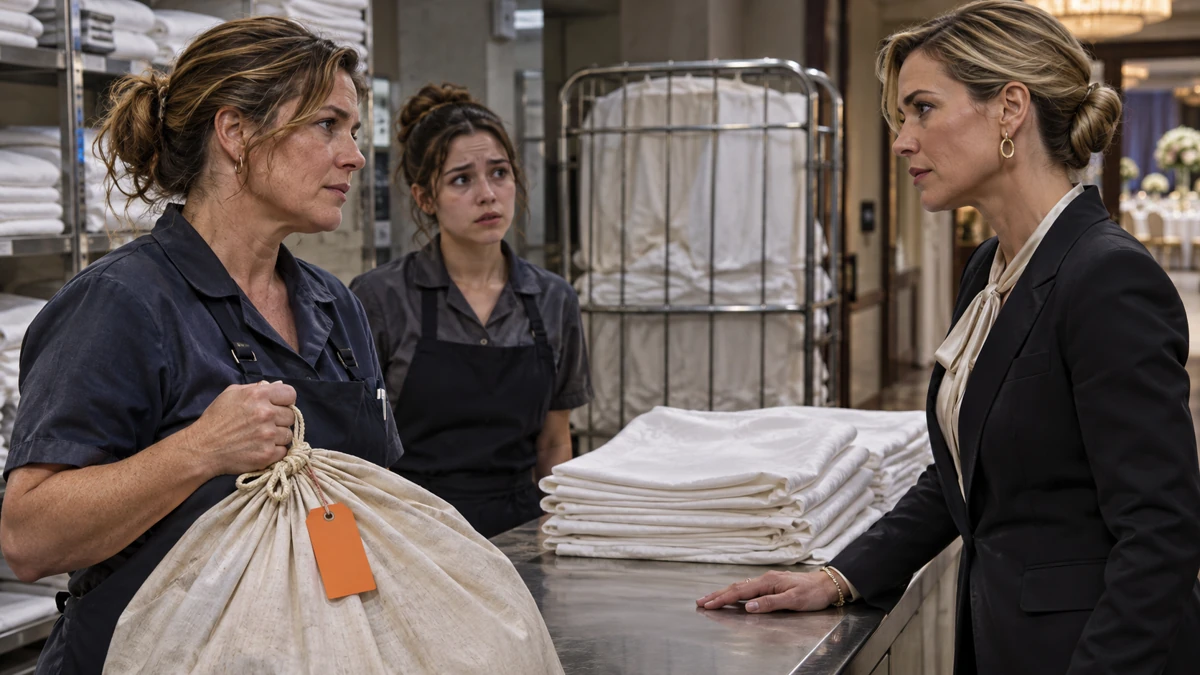
“Empty your bag, Rosa,” the events manager said. “We can do this quietly, or we can do it in front of security.”
My bag held my lunch container, a bus pass, and the cardigan I wore when the laundry room grew cold. Twenty feet behind me, wedding guests were drinking champagne.
I had worked at the hotel for eleven years. That morning I had counted 184 ivory tablecloths into the ballroom delivery. Now sixteen were missing, and Ms. Vale had decided the laundry supervisor must know where expensive fabric went.
I put my bag on the service counter but didn't open it.
“Please get the duty manager,” I said. “And bring the return sheets.”
She smiled toward the junior attendant beside me.
“You see how this becomes difficult?”
The attendant, Nia, looked down. I couldn't blame her. She had been there six weeks.
Ms. Vale pointed to an orange-tagged linen bag beneath the counter. She said it had been found near my locker. I recognized the tag immediately. It was from an outside rental company, not our stock.
“Read the number,” I said.
She reached for the tag, then stopped.
“Orange isn't proof of anything.”
“No,” I said. “That's why we keep the numbers.”
Every outside linen delivery received a tag and a signed intake sheet. Hotel linen was marked with a small blue stitch. Ms. Vale had ordered special ivory runners for the wedding, and our team had been told to keep them separate. I had emailed her two days earlier because the quantity on the delivery note didn't match what arrived.
She hadn't replied.
The duty manager, Mr. Santos, came downstairs. I asked to move the conversation away from the wedding guests and to have a neutral person present if my belongings were inspected. He agreed and asked everybody to stop making accusations until the stock was checked.
My lunch and cardigan were exactly where I had said. No linen appeared in my bag. Ms. Vale said the missing cloths could already be outside the hotel.
“Then let's account for the delivery,” Mr. Santos said.
I handed him the morning count sheet. He compared it with the ballroom issue record. Both showed 184. The return count showed 168, but dinner hadn't begun. Sixteen cloths were supposedly missing from tables that had not yet been cleared.
He looked up.
“Who created the return count?”
Ms. Vale said it was a preliminary estimate. The word preliminary appeared nowhere on the sheet. My initials did.
I hadn't written them.
Nia lifted her head. “I saw those cloths in the west meeting room.”
Ms. Vale turned sharply. “That room is closed.”
It was closed to guests because her private event styling company had been using it for storage. Most employees knew about the storage arrangement. We had assumed management approved it.
Mr. Santos went upstairs with a house supervisor. I stayed in the office. I wanted the physical check done by someone who wasn't being accused and someone who wasn't making the accusation.
They returned with sixteen folded tablecloths and two orange bags.
All sixteen had the hotel's blue stitching. The orange bags held the outside runners, whose rental number matched my unanswered email.
The problem wasn't an innocent mixing of colors. The hotel cloths had been packed beside a collection schedule bearing the name of Ms. Vale's outside company.
She said she was borrowing them for a client tasting and would have brought them back before anyone needed them.
“Then why is Rosa's name on a missing-stock report?” Mr. Santos asked.
“I never said she definitely took them.”
Nia looked at me, then at him.
“She told Rosa to empty her bag in the corridor.”
I asked that the words and the completed inventory be included in the incident record. I also asked for the false initials to be identified as disputed rather than quietly replaced.
Mr. Santos asked whether I wanted to finish the shift or go home. I asked for five minutes first. In the staff bathroom, I ran cold water over my wrists and looked at the pale mark where my watch usually sat. I had taken it off that morning to avoid snagging the tablecloths.
My daughter had given me that watch after her first paycheck. I imagined trying to tell her why I had come home early, and I felt angry all over again.
When I returned, Nia was waiting outside with my lunch container. She had wiped a splash of water off the lid.
“I should have said where the cloths were sooner,” she said.
“You said it when you could.”
“I saw her take them in there yesterday. I thought it was allowed.”
“So did everybody who saw the bags. That's why the records matter.”
I asked her to write down only what she'd actually seen, including anything she was uncertain about. She didn't need to turn her fear into a more impressive story. She wrote that she had seen a cart entering the room, not which cloths were on it. The house supervisor had identified the actual stock afterward.
That distinction stayed in the review. I was grateful for it. After having someone place my name on a claim I hadn't made, I wanted the correction built from words people could stand behind.
The hotel suspended Ms. Vale's authority to remove stock while it reviewed the matter. I went back to work because the wedding still needed clean napkins. My hands shook so badly that I asked another supervisor to check the final count with me.
That evening, I wrote a factual account at home. I included the time, the witnesses, and the records I had been permitted to review. I didn't post it on social media. I wanted my name cleared in the same workplace where it had been damaged.
Over the next three weeks, management reviewed previous outside collections. Two other hotel linen batches had been used for Ms. Vale's private events without proper approval. The rental company also confirmed that she had tried to return hotel cloths in place of some missing runners.
The hotel recovered its stock and charged her company for cleaning and replacement costs documented in the review. Her employment ended after the internal process. I wasn't part of that decision, but I was told clearly that the allegation against me was unfounded.
I asked for more than a private reassurance.
At the next supervisors' meeting, Mr. Santos corrected the record in front of the staff who had heard about the accusation. He stated that I had followed the inventory procedure and had not removed hotel linen. A written correction went into my personnel file, and I received a copy.
The new process required two signatures for stock leaving the building and prohibited managers from using junior employees as witnesses to improvised searches. Nia joined the paid inventory training I had requested months earlier. She was good at it. She noticed when numbers disagreed, and she no longer lowered her eyes before saying so.
A few weeks later, she found me at the service counter eating lunch.
“I thought I'd lose my job if I spoke,” she said.
“I thought that too, the first time.”
She sat beside me. We shared the orange I had packed and talked about her evening classes.
My cardigan hung on the back of the chair. My bag was closed beside it. Above the counter, a fresh stack of tags waited for the next delivery, each with a blank line where a real person's name had to go.
Fictional story.