Original fiction
On this page
The Empty Chair at the Wedding
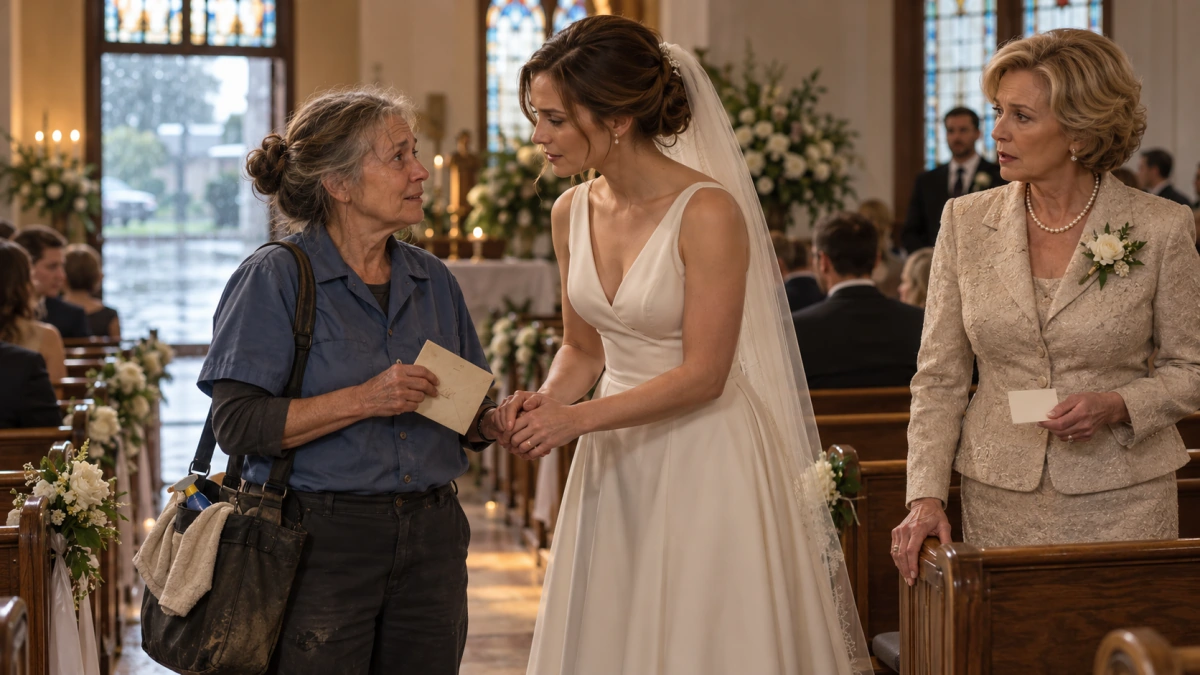
The groom’s mother lifted the place card from the front row and pressed it into the hand of a woman wearing a cleaning uniform. “These seats are for family. Staff use the back entrance.” I saw it through the door of the bridal room. The organist was still rehearsing. The woman looked down at her blue work shirt, then at the shoes the rain had soaked, and reached for her canvas bag. Twelve years earlier, those hands had braided my hair before a school audition. She disappeared that afternoon. I was told she had stolen money and run away. I was told to stop waiting for someone who had never really loved me. That morning, a message arrived: “It’s Ruth. I received your invitation.” I pulled a chair close to the aisle. I didn’t know what I should call her anymore. I knew she needed a seat. I stepped out, catching my dress on the hinge. Daniel turned toward me. “Claire?” I reached Ruth before she reached the door. “If she leaves, I leave.” Daniel’s mother looked from me to Ruth. For a moment, her irritation became something else. Recognition. Ruth took a faded envelope from her bag. “I didn’t come to ruin your wedding,” she said. “But I won’t accept money to disappear again.” Daniel put a hand on the chair. “Mom, do you know her?” His mother didn’t answer. She watched the envelope as Ruth let go of my hand and laid it where the place card had been. The door closed behind me with a sound much louder than it should have made. Mara, our wedding coordinator, stopped straightening the flowers beside the lectern. She looked at me for instructions. I could see her trying to fit what had happened into a problem with a practical solution: a missing chair, an unexpected guest, a delay that could be covered by another piece of music. “Please keep everyone in the lobby,” I said. “Ask Pastor Bell for twenty minutes.” Then I took off my veil. One pin caught in my hair, and the sharp little pain helped me breathe. Daniel led us into the classroom beside the chapel. Children’s drawings covered one wall. A paper rainbow hung above a cabinet of crayons. Nothing in that room had been designed for the conversation we were about to have. Ruth sat near the door with her bag on her knees. Evelyn Mercer remained standing. She still held the invitation, its edge bending between her fingers. I could see the name I had written in blue ink. Just Ruth. I hadn’t known whether she used another last name now, and I hadn’t wanted to get that small thing wrong after getting so much else wrong for so long. “Claire,” Evelyn said, “we cannot let a misunderstanding ruin this day.” “Then explain it,” Daniel said. He didn’t stand between us. He pulled a chair beside mine, close enough that I knew he was there, far enough that I could get up without asking him to move. Later, I would remember that distance more clearly than anything he said. At that moment, every other arrangement in my life seemed to be shifting. He let me have space inside it. Ruth placed the envelope on the table. The address in the corner belonged to my aunt’s old house in Dayton. I recognized the slant of the handwriting. I still made my capital C the way Ruth had taught me, sitting at the kitchen table with a pencil worn almost to the eraser. I had spent years trying to forget her while writing a small piece of her into my own name. My mother died when I was eight. Aunt Marlene took me in. She worked in the office of Mercer Commercial Cleaning, keeping payroll records and invoices. Ruth worked on one of the cleaning crews and rented the little room at the back of our house. At first, she watched me between shifts. Then she became the person who remembered lunch money, checked food labels for walnuts, and sat on my bed during thunderstorms. Marlene called her our boarder. I thought of her as home. That was a distinction I didn’t have words for as a child. My aunt supplied the roof and school clothes. Ruth knew when I was frightened before I said anything. I loved them both, and believed that loving one person couldn’t possibly take anything away from another. I met Daniel at the public library where I ran children’s reading programs. He came to fix the heating system, left a wrench behind, and returned just before closing. We talked while I locked the activity room. I didn’t connect his surname to my aunt’s former employer until my first dinner with Evelyn. I told her about Marlene and Ruth, including the story about the stolen money. Evelyn said she didn’t remember that employee. Her husband had died by then, and Daniel ran an independent heating business rather than working for the cleaning company. The connection seemed like one of those small Ohio coincidences that didn’t mean anything. I accepted her answer. It had never occurred to me that she might be recognizing a story and choosing not to recognize a person. “She never read the letters?” Ruth asked her now. Nobody answered. Ruth looked at me, and something hopeful in her face slowly went away. She opened the envelope and took out three smaller envelopes with their seals intact, followed by a typed document. The post office markings said the addressee no longer lived at that address. I had lived in that house for four more years after Ruth left. “There were more than three,” she said. “These were the ones that came back.” Evelyn set the invitation down. “Marlene said the child needed stability.” “The child is sitting here,” I said. “And I’m asking what you did.” Ruth slid the document toward me. It was a separation agreement bearing the company name and Evelyn’s signature. It wasn’t a confession. It listed final wages and a confidentiality clause concerning client information. Underneath, someone had added a handwritten instruction that Ruth was to have no further contact with Marlene’s household. I read it twice. It didn’t make leaving me right. It changed the shape of the story I had been given. Daniel waited until I nodded before picking it up. He read slowly. Somewhere outside, a guest asked where the bathroom was. The ordinary question frightened me more than silence would have. The world still had parking spaces and restroom signs and people looking for coffee. Inside me, a sixteen-year-old girl was waiting by a window for a woman who wasn’t coming home. “Why was the company deciding who could talk to an employee’s niece?” Daniel asked. Evelyn finally sat. “Marlene took money from the payroll account. Ruth found it. Your father was in treatment. We were close to losing a major contract. I needed to handle it quietly.” “By letting everyone think Ruth took it?” “I never told Claire that.” “But you knew someone did.” She looked down at her hands. I had watched Evelyn smooth over awkward dinners, late deliveries, disagreements about flowers. She always found the appropriate sentence before anyone else found the courage to object. Now there was no sentence ready. The absence of one felt like information. Ruth explained her part without raising her voice. She found three wage payments marked as completed even though the workers hadn’t received the money. Marlene said it was a banking error. Ruth kept the time sheets and asked again. When the explanation changed, she went to Evelyn. The next day, Marlene told her to move out of the back room. Evelyn offered the agreement and said the unpaid wages would be settled if Ruth signed. “They said if I kept coming around, your aunt would take you somewhere else,” Ruth told me. “I wasn’t your guardian. I didn’t know who would listen. My mother was sick in Toledo. I needed money for a room and a bus ticket. I signed.” She looked at me directly. “I thought I could write later. Then I thought you didn’t want to answer. Eventually I was afraid to try again. That part belongs to me.” I almost said it was all right. I knew how to comfort adults before they became unhappy enough to make the whole house unhappy. The words reached my mouth automatically. Then I remembered sitting by the window with a good report card folded in my pocket. I remembered putting it away because the person I wanted to show had gone. I had learned to call loneliness independence, and people had praised me for it. “I need time to hear all of this,” I said. “I can’t forgive you in this room just because I understand more.” Ruth nodded. She didn’t cry in a way that required me to hug her. She didn’t tell me how much worse her life had been. She rested her hands on her knees and waited. That small permission was something I hadn’t known I was missing: the chance to feel what I felt without immediately making it useful to somebody else. Daniel asked who had sent the invitation. I told him I’d found Ruth’s address through a former coworker after years of assuming she had died or changed her name. Six weeks earlier, I mailed a card with a letter. I didn’t know what happened, I wrote. If you want to come, there will be a place for you. I hadn’t told him because I was afraid of turning that little hope into something the whole family would watch. “I’m sorry I kept it from you,” I said. “I’m sorry you felt you had to.” He turned to his mother. “You knew at that first dinner.” Evelyn admitted she had called Marlene that evening. My aunt said Ruth had caused trouble and that I had finally moved on. Evelyn accepted the explanation because it was convenient. I heard the word and thought about the things she liked in me: independent, agreeable, never demanding. Perhaps I had been easy to welcome because I didn’t ask questions that made anyone uncomfortable. My phone buzzed. Marlene was still at her hotel, complaining that the rain had ruined her hair and saying she would be late. I called her. When she heard Ruth’s name, she went quiet, then told me not to let that woman make a scene. I said I was putting her on speaker and told her exactly who was in the room. Her voice immediately softened into the one she had used with my teachers. “You don’t understand what things were like then, honey. I kept a roof over your head.” “Did you take money from payroll?” “I borrowed it. The company deducted it from my wages. Nobody lost anything in the end.” Ruth closed her eyes. I asked about the letters. Marlene said I had been fragile and that continuing the attachment would have kept me from accepting reality. I didn’t ask whose reality. I asked whether she had written the return instructions on the envelopes. She said she had done what was necessary. It was clear enough. I ended the call before she could turn the question into a discussion of my gratitude. Marlene was supposed to walk me down the aisle. Her little bouquet was still in its white box in the bridal room. I imagined her hand resting on my arm. I had planned to thank her at the reception for raising me. Now I had to hold two truths together without letting either erase the other: she had given me a home, and she had used that home to control who was allowed to love me. Mara knocked. Our twenty minutes had ended a while ago. Guests were taking their seats, and the organist wanted to know whether to keep playing. Daniel looked at me and asked what I needed. He didn’t mention the deposits. He didn’t mention his grandmother’s long drive. Those things were real, but he didn’t set them on the table as reasons I should ignore what was happening to me. “I can’t get married today,” I said. His eyes reddened. He glanced at his ring, then back at me. “Do you want me to leave?” “No. But I need to know you can love your mother without defending what she did. I don’t want an answer because you’re afraid of losing me.” He exhaled. “Then let’s not make promises right now. Let’s do the next thing.” Evelyn stood abruptly. The guests were here, she said. The food was ready. We could discuss this after the honeymoon. I asked whether she believed I could stand in front of those people in an hour and make a vow about trust. She didn’t answer. Daniel went with Mara to announce that the ceremony was postponed because of a family matter we needed to address. He didn’t name Ruth. He didn’t describe me as overwhelmed or nervous. He didn’t give guests an explanation that made one person look unreasonable so everyone else could feel comfortable. He simply said we weren’t holding the ceremony that day and thanked them for coming. Later, Mara told me he repeated the same sentence when people pressed him for details. I asked the caterer to serve the meal anyway. People who had traveled didn’t need to go hungry to prove they understood. Pastor Bell came to the classroom and asked whether we needed a quiet place. He didn’t say everything happened for a reason. He brought a pitcher of water and four paper cups, then sat outside the door so nobody could wander in with advice. Before Evelyn left, she reached for the separation agreement. I told her it belonged to Ruth. She looked at Ruth as if waiting to be rescued from the awkwardness. Ruth put it back in her envelope. She had lost a room, a job, and a child she loved while trying to satisfy people who held more power. This time her voice was gentle and completely clear. “I’ll keep my copy.” I changed in the bathroom into the jeans and sweater I had packed for after the reception. Mara undid the buttons down my back without asking for the story. Red marks crossed my shoulders where the dress had pressed. When I came out, Ruth was holding my shoes. She didn’t try to draw me into a memory. She asked whether I wanted something to eat. We went to a diner near the church. Daniel stayed to help with guests and said he would call that evening if I wanted. Ruth ordered soup. I ordered toast because the thought of a whole meal felt impossible. She explained the uniform: she had taken an extra shift cleaning a clinic to afford the trip. Her replacement arrived late. Changing clothes would have meant missing the ceremony. “I didn’t know you’d put me in front,” she said. “That was my choice.” She set her spoon down and left it there long enough for the soup to cool. I asked whether she still braided hair. She smiled and said arthritis had slowed her hands. We didn’t fall into an embrace while the diner played a perfect song. I asked where she lived. She asked about my work. Twelve years sat between the bowls, and ordinary questions were the only way across. That night I stayed with my friend Leah. At my request, she put my phone in a drawer. Some guests sent kind messages. Others thought I had overreacted. I didn’t read them all. Daniel sent one line saying he was handling calls and I didn’t need to explain myself that night. His next message listed the remaining wedding bills so the postponement wouldn’t become a vague debt hanging over us. Three days later, we met at the library. I brought a notebook. He brought the catering paperwork. Most deposits were gone. We divided the outstanding costs according to our original agreement, canceled the honeymoon, and accepted airline credits. Neither of us used the money as proof the other owed a wedding. Kindness was something we could check against a number, not simply a reassuring tone. Daniel had spoken to his mother. She admitted signing the agreement, knowing Ruth was being blamed, and keeping Marlene employed until retirement. The missing money had eventually been recovered through deductions from my aunt’s pay. Ruth and two other workers received their wages, but internal records described them as special assistance payments. The person responsible kept her position. The person who reported it acquired a reputation for trouble. “I wanted to tell you Mom has done good things, too,” Daniel said. “I actually said that to her. Then I realized it didn’t answer anything you were asking.” “You don’t have to decide whether she’s a good person or a bad person,” I said. “You have to decide what you do when you know she did something wrong.” We weren’t wearing our engagement rings again yet. Mine stayed in its box. It wasn’t a punishment. I needed the promise to mean more than a date we had already printed on invitations. Daniel didn’t ask when I would put it back on. He asked whether we could keep talking, and whether I would tell him when I needed a break rather than disappearing inside silence. Ruth agreed to meet a lawyer at a legal aid center and invited me along. The lawyer explained that too much time had passed to promise any particular claim. Deadlines, documents, and the kind of relief available would need careful review. There would be no dramatic guarantee of a lawsuit that solved everything. She suggested starting with personnel records, payroll documentation, and a written correction. Ruth wanted her name separated from the word thief. Evelyn sent me a two-page apology. The first page described her husband’s illness, the threatened contract, and her responsibility to dozens of employees. On the second, she said she was sorry if her decisions had hurt me. I set it down. Daniel read it and asked her to write about what she had done rather than everything that had made her uncomfortable. I hadn’t asked him to speak for me. I could tell he understood the difference. Marlene appeared at the library while I was shelving books. She brought the bakery box I had loved as a child. I took her outside, where other people were present but couldn’t hear. She said I was letting an outsider break up the family. I asked whether she remembered the evening I waited for Ruth by the door. She did. I asked why she hadn’t told me the truth. “You would have chosen her.” “I was eight when Mom died. I was sixteen when Ruth left. I shouldn’t have had to choose between the person who gave me a room and the person who held me.” She said she had been afraid of losing everything. I believed she was afraid. I didn’t accept the bakery box. I told her she couldn’t come to my home or workplace for now. Contact had to be by letter. If she wanted a relationship, she needed to describe the money and the letters honestly, without blaming a child for loving someone else. She left, and for once I didn’t chase her to make the ending gentler. The following weeks contained no perfect reunion. Ruth forgot that I no longer drank coffee. Once I called her Aunt and flinched at the memory of Marlene. She had a close friend I’d never met, and I felt jealous of years that woman had shared with her. When Ruth arrived late one afternoon, I became angrier than the delay justified. She called when her bus broke down. I still heard an old door closing. I found a counselor. During the first session, I kept explaining how difficult things had been for the adults. She asked whether I could tell the story once without defending any of them. I cried at the question. Later, I told Ruth I knew a delayed bus wasn’t abandonment, but my body hadn’t learned that yet. She sat beside me while I calmed down. She waited before explaining the bus. Daniel and I went to premarital counseling, too. He practiced listening without immediately offering solutions. I practiced asking for time alone without withdrawing from the relationship. Once he said his mother couldn’t attend Sunday dinner because she had work. I asked whether he knew that or was covering for her. He called to check, then admitted he had assumed. We corrected a small habit before it became the architecture of our marriage. A month later, Evelyn sent new letters to Ruth, to me, and to the other two workers. She confirmed that Marlene had diverted payroll funds, that Ruth had discovered it, and that the company had pressured Ruth to leave. She acknowledged knowing about the false accusation and failing to correct it. The company assigned a review to someone outside the former management team. Ruth received an amended record and written confirmation, not a promise made over the phone. Evelyn offered to cover Ruth’s legal expenses without requiring silence or the withdrawal of any statement. The lawyer reviewed the terms before Ruth accepted. Money couldn’t give me my childhood back. Still, repair could begin when the person responsible stopped deciding where the repair was allowed to end. Ruth chose what to accept. I didn’t have to turn her decision into a verdict on my own feelings. I wasn’t ready to meet Evelyn. Daniel told me she wanted an appointment, and I said not yet. He didn’t report that she was crying or having trouble eating. He answered her and then came with me to buy light bulbs. That ordinary evening mattered. Someone else’s unhappiness didn’t automatically become an assignment I had to complete before I could enjoy dinner in my own home. Marlene’s letter arrived six weeks later. She admitted marking the three envelopes for return, keeping the others, and throwing them away when she moved. She said she wanted me to distrust Ruth so I wouldn’t leave her. No apology could recreate those pages. I wrote back thanking her for telling the truth and saying I didn’t want a visit yet. Her letter went into its own drawer, away from the cards Ruth now mailed every week. In spring, I visited Ruth’s apartment. A photograph of me at fifteen was attached to the refrigerator, its corner curled from kitchen steam. I used to believe that people who left wouldn’t keep pictures. She showed me a notebook of addresses and people she’d tried after Marlene moved. Some years had no entries. She didn’t hide them. She had been afraid of rejection and exhausted from working two shifts. I listened, and it hurt. This time truth didn’t require me to pretend. We made the pasta my mother used to cook. Ruth remembered lemon zest. I remembered too much pepper. Both memories fitted into the same pot. After we ate, I asked whether she would come to a smaller wedding if we held one. She said yes, then asked whether I was ready to marry. There was no urgency in her question. Nobody in that apartment needed my answer before I had it. I met Evelyn on a Saturday afternoon at a coffee shop near the library. She arrived first and chose a table beside the door. I could leave easily. When I sat, she didn’t ask about another wedding date. She said she had recognized Ruth’s face before noticing the uniform. Telling her to use the back entrance had been a way to move the person who made her ashamed out of sight. I didn’t help her find a gentler description. “I don’t know whether we’ll be close,” I said. “But I won’t hide things to make you comfortable.” She nodded. I asked why she had claimed not to remember Ruth at our first dinner. She said she had seen an opportunity to begin again with a daughter-in-law who knew nothing about her past. She had chosen that opportunity over honesty. “You don’t get a fresh start by leaving someone else inside a lie,” I said. We stayed forty minutes. She apologized without reaching for my hand. I went home feeling tired rather than relieved. Daniel asked whether I wanted to tell him about it. I said tomorrow. He warmed dinner, and we watched a movie so bad we both laughed. I didn’t have to turn every difficult conversation into a lesson before I was allowed to rest. In May, I put my ring back on. There was no surprise dinner or proposal in front of strangers. I took the box from the drawer and sat beside Daniel on the floor while he sorted bills. I told him I wanted to marry him, and that I would still have days when I feared the people I loved would leave. He didn’t promise never to upset me. He promised to tell the truth and stay in the conversation when he did. We reserved the library’s community room for a June morning. Twenty-four guests, a cake from the neighborhood bakery, flowers arranged by Leah. Evelyn was invited on the understanding that she wouldn’t change the guest list or seating. Marlene wasn’t invited. I informed her by letter and didn’t debate it. I wasn’t ready to make a wedding invitation the reward for an apology that still felt new. Ruth asked whether she needed to buy a dress. I told her to wear something she liked. She found a dark blue one at a secondhand store and brought it to Leah to shorten the hem. When she asked whether it was nice enough, I told her the seat didn’t depend on her clothes. She laughed, but her fingers held tightly to the fabric. Some sentences need to be heard more than once before they become believable. A week before the ceremony, Ruth visited the library while I was setting up a reading group. A little girl asked whether she was my mother. I looked at Ruth and said she was someone who had helped raise me. It wasn’t the whole answer, but it was true enough for a child. Ruth sat at the back and helped a boy find a folded page. Afterward, she asked whether I would mind if she came again. I handed her next month’s schedule and circled my sessions. She said she’d try to change a shift. I told her to call if she couldn’t; we could have lunch another day. We were learning to make plans without turning every meeting into a test of love. Before leaving, she returned a pencil to its box. I remembered those hands gathering my homework and watched them helping other children now. For the first time, remembering what I had lost didn’t prevent me from noticing what was happening in front of me. The night before the wedding, I slept badly. I remembered the envelope and Daniel’s face when I said I couldn’t marry him. He remembered, too. In the morning, we ate toast in the kitchen and turned off our phone notifications. He asked what would happen if I needed to pause during the ceremony. I said I would tell him. He said that was enough and washed our cups instead of insisting the day would be perfect. Ruth arrived twenty minutes early. She stood in the community room doorway, studying the chairs like someone checking whether an address really existed. Her place card was on the front row. Leah’s was beside it. I didn’t want Ruth’s chair left empty as a symbol. I wanted her in it, holding tissues, complaining about the air-conditioning, asking whether there was more cake. I wanted her to have the ordinary privileges of belonging. Evelyn came next. She stopped before Ruth, said good morning, and asked whether she could sit in the second row. Ruth told her to ask Claire. Evelyn turned to me. I pointed to the chair with her name on it. There were no tears or applause. The exchange took a few seconds. For once, the decision belonged to the right person, and nobody had to surrender comfort to protect someone else’s pride. I walked in with Ruth. She wasn’t replacing my aunt or my mother. She was Ruth, who had cared for me and had lived through years when she hadn’t cared for me. We walked slowly because her knee hurt. At Daniel’s side, she released my hand before I had to pull away. I looked at him, then at the people seated behind him. I knew I could say no. That was what made my yes belong to me. In his vows, Daniel promised not to mistake silence for agreement. I promised not to test his love by hiding what I needed. We didn’t retell the old story for our guests or turn Ruth into a speech about resilience. Pastor Bell asked his questions. We answered. Applause filled the space between the bookshelves that had been rolled aside to make room. Afterward, Evelyn helped collect paper cups. Ruth ate cake and told Leah I used to put socks in the microwave to warm them before school. I protested that it had happened once. She said twice. Daniel asked whether he needed to inspect our microwave. I heard myself laughing and realized the sound wasn’t an effort to make somebody else feel less awkward. When the guests left, I picked up Ruth’s place card. Coffee had marked the back, and one corner was folded. I thought about pressing it inside a book. Ruth asked whether she could keep it instead. I gave it to her. She tucked it beside her keys and bus ticket, without an envelope or any need to prove a thing. The chair was empty behind us because she was standing beside me. We waited together while Daniel locked the library, then headed home for dinner.Read next

My Father’s Plus-One
The Recording Mom Asked Us to Erase
The Brother Outside the Picture
My Sister Gave Away Dad’s Workshop Before He Moved Out—Then His Apprentice Arrived with the Missing Order Book
Reading notes
At a wedding, a woman in a cleaning uniform brings an envelope and a family history nobody wants to explain.
This is an original work of fiction. Characters and events are fictional. Explore public-domain books at Project Gutenberg or browse more stories on ReadStoryvia.