Original fiction
On this page
The Desk with the Best View
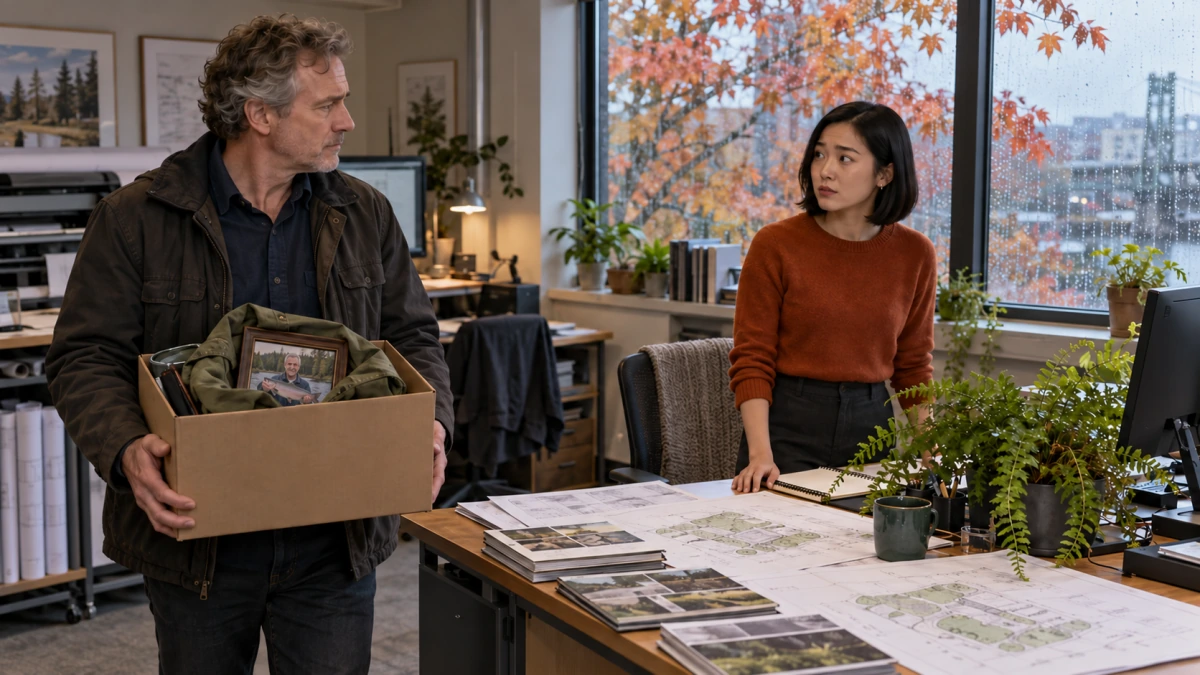
Someone had put a fern where Owen kept the photograph of his father.
It was the first thing he noticed when he returned to the Portland office after eight weeks away. Not the new bid board or the stack of supplier catalogs. A fern, green and extravagantly alive, leaned across the window desk he had occupied for eleven years.
Behind it sat a young woman in a burnt-orange sweater.
"You must be Owen," she said, standing. "I'm Hannah. Paula said you'd be back today."
His father's photograph lay in a cardboard box beneath the coat hooks, wrapped in his old olive overshirt. The picture showed a man holding a salmon he had not caught; Owen had caught it, and his father had insisted on posing. During the last two months, Owen had helped that same man get from bed to bathroom without falling.
"That's my desk," he said.
Hannah looked at the fern, then at him. "Paula told me this was my permanent station."
Through the glass wall, their director lifted one finger to say she was on a call.
Owen stood holding the box. At fifty-two, he had expected returning to feel like stepping back into his own shoes. Instead, a twenty-seven-year-old stranger had her mug beside his window and a plan for the client account he knew best.
"I'm taking the Alder Commons tender through submission," Hannah said. "I was hoping we could review the drainage quantities."
Paula opened her door before he could answer.
"Wonderful. You've met. Owen, you'll be relieved Hannah kept everything moving."
He was not relieved. And the expression that crossed Hannah's face told him she had already understood that much.
Paula offered him the inside desk beside the plotter. She said it was temporary, though the monitor had been connected and someone had stuck his name on the phone. The window behind Hannah framed wet maple branches and a strip of Portland sky. His new view was a machine announcing it needed cyan.
He put the photograph beside the keyboard. His father had spent the morning insisting he could make his own lunch now. Owen had cut bread anyway, then regretted it when the old man went quiet. Apparently he had arrived at work carrying the same argument in a different box.
"Coffee?" Hannah asked.
"I know where it is."
She nodded and returned to her screen. He heard his own answer after she had turned away, too sharp for the offer, and did nothing to repair it.
Paula called him in at ten. Her cropped red hair was still damp from the bike ride she mentioned before every rainy meeting. She closed the door and leaned against the desk in her navy blazer.
"How's your dad?"
"Walking with a cane. Starting outpatient therapy."
"That's good news. We missed you."
He waited for the sentence that would make the desk a misunderstanding.
"Alder Commons is due Thursday at two," she said. "You'll take final responsibility, as usual. Hannah's done a lot of the groundwork."
"She said she's taking it through submission."
"She's enthusiastic. You'll help her understand our standards."
Owen looked through the glass. Hannah was speaking into a headset, drawing a rectangle on a scratch pad with her free hand.
"You said my accounts would be waiting."
"And they are. I couldn't leave a chair empty for two months."
He had not meant the chair. Now he could not say so without sounding as if he had.
The firm estimated and installed landscapes for commercial sites around the metro area. Alder Commons was a converted office courtyard, with planters over a garage roof and a narrow delivery entrance off a busy street. Owen had priced its first feasibility sketch the previous winter. He knew the developer's habit of calling every expensive change a small adjustment.
Hannah had built a careful quantity workbook. Her tree schedule matched the latest drawings. She had obtained updated nursery quotes and flagged a long lead time on the specified stone. Owen opened the file intending to find something wrong and found competent work, which irritated him more than a mistake would have.
In a comment beside drainage rock, he wrote: Verify actual site conditions. Not a desktop exercise.
She appeared at his desk five minutes later.
"I walked it twice. There are photos in the site folder. What condition are you concerned about?"
"The ramp."
"I measured it. We need the smaller loader. It's in equipment."
He clicked the tab. There it was.
"Fine," he said.
"If there's something else, tell me specifically."
Her voice stayed level. He disliked the effort that must have required and disliked himself for noticing it as though it were another skill to grade.
That evening, his father was practicing getting a saucepan from the lower cupboard. A folded towel lay over the counter's sharp corner. Owen had put it there after the fall, and his father had left it alone until now.
"You can stop watching," Frank said.
"I'm not watching."
"You took your coat off with your eyes on my feet."
Owen hung the coat, then asked about therapy. Frank told him the therapist had made him walk around traffic cones. He described it with enough indignation that Owen knew he had enjoyed having somebody new to complain to.
"There's somebody at my desk," Owen said over dinner.
"I thought you worked at the company's desk."
"You know what I mean."
Frank chewed slowly. At seventy-eight, he had earned no special wisdom from a broken hip, but he had gained a low tolerance for conversations disguised as other conversations.
"Did they fire you?"
"No."
"Then tell me what happened."
Owen described Hannah, younger than most of his work boots, though he did not say that part aloud. Frank asked what she had done wrong. Owen said that wasn't the point, then realized he had not yet found a different one.
Tuesday began with a supplier call. The roof planters required lightweight engineered soil, not ordinary planting mix. Hannah had a delivered bulk quote from a supplier south of town. Owen had an old spreadsheet with installation allowances from a similar roof job. Paula told him to combine the best of both and bring the number down if possible.
"The client knows you," she said. "That relationship matters."
He heard reassurance and accepted it too quickly.
Hannah asked to review the soil line before it was locked. Owen told her he would send it when he had something worth reviewing. She went back to comparing irrigation notes. He saw her jaw tighten and decided she was impatient with experience.
The old allowance assumed a conveyor stationed next to the work area. At Alder Commons, the street permit allowed unloading for a shorter window, and the courtyard access meant moving material in small runs. Hannah had already added the compact loader. Owen replaced her soil installation line with his historical rate, overlooking the separate handling hours she had included.
The number looked better by almost nine thousand dollars.
At the afternoon review, Paula circled it. "That's why we needed you back."
Hannah lifted her pen. "Does that include double handling from the curb?"
"It's an installed rate," Owen said.
"For this access?"
Paula glanced at the clock. "Let's not get lost. Owen's done rooftop work before."
He let the meeting move on. Later he would remember the relief he had felt at being defended, and how neatly it resembled competence from inside his own head.
At five, Hannah was still at the window. The fern's reflection shivered on the glass as the heater came on. Owen asked why the screen showed the earlier workbook.
"I'm checking what changed."
"You don't trust my quantities?"
"I asked about labor."
"You could ask without cross-examining me."
She took off her headset. "I did. Twice."
He picked up his bag. His father needed a ride to therapy at seven the next morning. He had wanted work to be a place where he could stop feeling inadequate, and now he was taking the same feeling home in another form.
At breakfast, Frank dropped a spoon and told him not to pick it up. Owen waited while his father used the reacher the therapist had recommended. It took nearly a minute. Owen's hand twitched against the table.
"You don't have to be useless for me to be useful," Frank said.
"I didn't say that."
"Neither did I."
Owen laughed despite himself. On the drive to therapy he thought about Hannah waiting with her pen raised while Paula looked at the clock.
He arrived at the office at nine-thirty. Hannah's chair was empty. A yellow note on his keyboard asked him to meet her at the courtyard at ten. No explanation, no apology for taking up his morning. He nearly called Paula to ask whether he should go, then heard how that would sound.
At the site, Hannah stood under a temporary awning in a rain shell over her orange sweater. She handed him a tape measure.
"Show me where you'd put the conveyor."
He looked at the curb, the retained wall, the opening between two concrete columns. A delivery truck passed close enough to spray his boots.
"Here, if the barrier moved."
"It doesn't move. Building manager confirmed yesterday. The fire access has to stay clear."
He measured the opening. She waited. He measured it again, though nothing had changed between the first reading and the second.
"My rate is wrong," he said.
"Yes."
She did not say it triumphantly. That made it harder to protect himself from hearing it.
They stood out of the rain beside a locked service door. Owen opened the workbook on his phone. The missing handling hours were still visible in an earlier version, labeled by Hannah with the site visit date.
"I took these out."
"You overwrote the line. I should have stopped the review instead of waiting until afterward."
"I didn't exactly make that easy."
"No."
The bluntness was a relief after two days of speaking through Paula's phrases.
Owen called the supplier to verify unloading requirements. The bulk price depended on a full load and clear access for the equipment they did not have. Bagged delivery would cost more but fit the permitted window. They worked through both options while rain ticked against the awning.
The correction added eighty-four hundred dollars to the tender. Worse, the delivery slot for installation Thursday, three weeks away, had gone. With trucks scarce, reserving another required a six-hundred-dollar nonrefundable payment now, before award: a deliberate company risk, not a delivery before they had won the job.
"We should tell Paula together," Hannah said.
Owen's first impulse was to explain it himself, keep the error inside a conversation among people who had known one another for years. Then he looked at her wet sleeves.
"Yes. And I need to say which part was mine."
Back at the office, Paula asked why both of them were leaving muddy prints by her door. Owen kept his coat on and explained the rate, the missing hours, and the delivery slot.
"Could we call the extra labor contingency?" she asked.
"It's not uncertain. It's required."
Hannah put the site photographs on the desk. "And we can't price a truck we can't book."
Paula pressed her lips together. "We need to remain competitive."
"Then we bid the actual cost and choose our margin," Owen said. "We don't make the crew absorb a bad estimate."
He had said that to other estimators before. Saying it about his own work stripped the phrase of its comfortable authority.
Paula agreed to the correction, then looked at Hannah. "Next time, raise this earlier."
"She did," Owen said.
The office went quiet.
"At the review. You moved on, and I let you."
Paula sat down. "Fine. I rushed it. We all need to communicate."
Hannah rested a hand on the back of the empty chair. "We also need to know who actually owns this tender. You told me I did."
"You are both on it."
"That's not what you told me when I accepted the permanent job."
Owen turned toward her. Until that moment, he had imagined a promise made by implication, a young worker hearing opportunity in a supervisor's polite encouragement.
"What did she tell you?" he asked.
Hannah looked at Paula before answering. "That I'd be estimator for the urban commercial portfolio. Alder Commons through award, then the next three sites. Not a temporary assistant waiting for you to come back."
Owen took a folded email from his bag. He had printed it before leaving for his father's surgery because he wanted something solid to read when the leave began to feel too long.
Paula had written that his commercial accounts would remain his on return, including Alder Commons, and that temporary coverage would not change his role.
He laid it beside Hannah's photographs. No one had to read private correspondence. It was a work promise addressed to him, and he was choosing to share it.
Hannah opened the offer message on her phone and turned it toward him. The names of the same accounts stood in the second paragraph.
"Did you think we'd never talk?" Owen asked.
Paula's face reddened. "I thought we'd have time to work out the details. Your leave extended. Hannah did more than we expected. I couldn't risk losing either of you."
"So you let me think she was taking something," Owen said.
Hannah shook her head. "She didn't make you speak to me like that."
He looked at her. "No. She didn't."
The distinction stayed in the room. Paula had made incompatible promises. Owen had supplied the contempt himself.
They still had a tender due the next afternoon. Hannah said she would finish the corrected supplier comparison, but would not accept responsibility for a submission she could not approve. Owen said he would review quantities with her, not over her. Paula authorized the booking payment and wrote both names on the tender cover record.
It was a start smaller than the problem. The client would not read the names in their internal record, and neither estimator yet knew what would happen after Thursday. But the corrected number had somewhere honest to stand.
They worked until six-thirty. Hannah found an irrigation valve count Owen had missed. He noticed a demolition quantity that included a planter the architect now intended to retain. The savings did not erase the handling cost. They entered both corrections anyway.
At seven, Owen called his father to say dinner would be late.
"Mine isn't," Frank said. "I made eggs."
"You used the stove?"
"No. I persuaded the eggs."
Owen closed his eyes. "All right. Save me some if there's enough."
"There's enough. Stop sounding surprised."
When he returned to the desk, Hannah was putting on her coat.
"I've got a bus," she said. "I can check the final comparison at eight-thirty tomorrow."
He had been about to offer pizza and another two hours, the old ritual of proving loyalty by staying until the office felt like a bunker.
"Eight-thirty works."
She paused. "The photo was never in the trash, by the way. I packed it because the sun was fading it. Paula said you'd have a different station. I should've asked where to put it."
"You shouldn't have had to guess."
"Neither should you. About the desk. Not about my work."
He nodded. She left him with that careful boundary, and he found he could respect it without enjoying it.
On Thursday, they checked every major line aloud. Paula tried to draw Owen into a call with the client alone, but he asked Hannah to join because the delivery option was hers to explain. She answered two questions, corrected a mistaken assumption about the garage roof, and did not look toward him for permission.
They submitted at one-seventeen. There was no dramatic countdown. At one-twenty, Hannah went to buy lunch. Owen sat with the strange emptiness left by an error that had been caught but still cost money and a more competitive bid.
The six hundred dollars came from the firm's operating account. Paula said she would have to explain it at the monthly review with the managing partner. Owen said he would attend. Hannah asked for a separate conversation about her role before any new assignment was made.
That afternoon, Owen moved his photograph away from the plotter's warm exhaust. He found a faded rectangle along one edge of the frame where the window light had stopped. For eleven years he had looked through that window without noticing what it was doing to the paper beside him.
He did not take the green fern off Hannah's desk.
He had bought the photograph's frame in a drugstore after a fishing trip, choosing the cheapest one because he wanted to give it to his father before he drove home. Frank had given it back the next Christmas, saying Owen needed proof that the old man had once left the house willingly. The joke had become an office fixture. Owen had mistaken its long presence for a claim on the room around it.
Now he wiped dust from the glass with his sleeve. The picture was his. The memory was his. Neither required Hannah to sit somewhere else. He could still mourn the view without making her responsible for returning it, and he could still ask Paula why she had moved him without a conversation before he returned to work.
At home, Frank had set two plates on the table and left the towel off the counter corner. Owen almost put it back. Instead, he asked whether the therapist thought the kitchen setup was working.
"She watched me use it," Frank said. "You could watch once without taking over."
So Owen stood at the doorway while his father carried a saucepan three careful steps. The cane waited within reach. It was neither the independence Frank wanted nor the safety Owen wanted, but it was what they could manage that evening.
On Friday, Owen apologized to Hannah before Paula arrived.
"I treated your age like evidence that you didn't belong. And I used your work without hearing you when you questioned mine."
She looked up from her notebook. "I don't need you to think I'm unusually mature. I need you to answer the question I ask."
"I can do that."
"Sometimes you haven't."
"Then I need to start."
She closed the notebook. "Thank you for saying which mistake was yours Wednesday."
He wanted to tell her she should never have had to thank him. He stopped because it would make her words another opportunity for him to sound enlightened.
"You're welcome," he said.
The managing partner, Martin, joined them the following Monday. He was responsible for several teams and did not appear with a speech about culture. He asked why one portfolio had been promised twice.
Paula described growth, uncertainty, the changing length of Owen's leave. Martin listened, then asked the same question again.
"I made commitments I hadn't reconciled," she said finally. "I expected Owen to keep the relationships and Hannah to keep doing the work. I didn't tell either of them that clearly."
Hannah's hands lay still on the table.
"That sounds clear enough now," she said. "It isn't an offer I'd accept."
Owen looked at the client list. He had kept it folded in his notebook all weekend, crossing out proposed arrangements and writing others. Every version where he retained all the familiar names left Hannah with the job he had already decided she should not have to do.
"I want to keep the school grounds and the county maintenance work," he said. "I know the long-term conditions. I can hand over the urban courtyards, including Alder. But not by being quietly responsible whenever something gets difficult."
"And I won't be an assistant with an estimator's workload," Hannah said. "I want the role in the offer. Named accounts, authority to speak to suppliers and clients, and a salary that isn't the temporary rate carried forward."
Paula said the title could be settled immediately, but compensation needed approval. Hannah asked when. Not eventually, not at the next review when she had demonstrated gratitude. When.
Martin said Wednesday. She wrote it down.
They agreed Owen would review complex site logistics on Hannah's first two urban jobs, with hours allocated rather than added invisibly to his own workload. Hannah would review the digital takeoffs on two of his maintenance bids. Neither review made one the other's supervisor. If they disagreed on cost, both estimates would go to Paula with the reasons attached, and she would choose openly.
Owen disliked needing that last sentence. Hannah disliked having to negotiate for what she had believed she already possessed. They signed nothing ceremonial. Martin asked Paula to stop making assignment promises until the outstanding ones had been resolved, and took responsibility for checking the final arrangement himself.
Wednesday brought a revised offer: estimator, urban commercial projects, four thousand dollars above Hannah's proposed permanent salary. It was less than she asked for. She took a day to consider, then accepted after the account boundaries and review date were included. Owen did not ask what she earned. He could recognize her right to negotiate without using her answer to measure his own value.
Alder Commons went to another bidder. The client said the difference was about six thousand dollars and thanked them for a careful proposal. They did not learn whether the winner had allowed for every handling hour. Owen refused the comfort of assuming the other firm must have made the same mistake.
The lost bid meant the booking payment bought nothing they could use. Paula reported it that way at the review. Owen explained his overwritten line. Hannah described the access constraint. Martin asked what would prevent a repeat, but he also left the cost visible instead of treating a new checklist as a refund.
The first handover took place in the little conference room with the unreliable radiator. Owen brought eleven years of notes in two binders. Hannah brought a laptop and a list of questions, which annoyed him until he saw that the first concerned a planter replacement he had forgotten to flag.
"The client hates that stone," he said. "Every time we price it, he asks for something warmer."
"Then why is it still in the standard specification?"
"Architect likes it."
"Have we recorded the substitution he accepted last time?"
He knew where the email was, or thought he did. It took eight minutes to find. Hannah waited without filling the silence. When he opened the attachment, the approved stone was cooler, not warmer. He had remembered the argument more clearly than the answer.
"Don't put my version in the notes," he said. "Put this."
She saved the attachment. "That's why I ask. Not because I think everything before I got here was wrong."
He leaned back from the table. Through the wall came the cough of the plotter starting another long sheet.
"I used to be the youngest person here," he said.
"I figured. Most people start that way."
He smiled unwillingly. "The senior estimator called me college boy until I was thirty. I hated it."
"Did that stop you doing it to me?"
"No."
She waited for more, then returned to her list when he did not try to make the history an excuse.
They spent the remaining hour on supplier relationships. Owen explained which nursery would hold stock with a phone confirmation and which needed a deposit. Hannah showed him a substitution log she had made during his leave. It included dates, prices, and which changes the client had actually accepted. He asked for a copy instead of suggesting improvements before he had used it.
Near noon, Paula appeared in the doorway with an invitation to a client lunch. She looked at Owen first.
"They want to discuss the next courtyard."
He could feel Hannah go still beside him. This was how the old arrangement could reassemble itself without anyone openly breaking the new one: one familiar face in a doorway, one lunch too casual to count as an assignment.
"Hannah's account," he said. "She should go."
"You can both come."
Hannah closed her laptop. "Is that part of the handover hours, or are you asking him to keep the relationship?"
Paula looked irritated, then caught herself. "Handover. One lunch. I'll introduce you as the estimator for the account."
"All right," Hannah said.
At the restaurant, the client directed the first question to Owen anyway. He answered the historical part, then asked Hannah to describe the current site. He did not pretend they had never met before or refuse to speak. Making room proved less dramatic than he had expected and more repetitive. The client needed to hear the introduction twice before his questions began turning toward her.
On the walk back, Hannah said she had noticed.
"I didn't know whether to jump in," Owen said.
"You didn't need to disappear. Just stop being the only destination."
He thought about that on the bus to his father's house. Frank wanted to tell him about therapy, and Owen wanted to describe the lunch, but both began talking at once and then stopped. They laughed, irritated and affectionate. Owen let his father go first without making a point of the gesture.
Later, washing dishes, he told Frank the younger estimator had asked good questions.
"You sound surprised."
"I'm trying not to be."
Frank dried a plate carefully, with his hip against the counter. "That sounds like work."
"It is."
"Well. They pay you."
Owen laughed and handed him another plate. The conversation did not solve the office, but it made the evening lighter without requiring Hannah to provide him with reassurance.
For the next month, the office felt less friendly. Paula spoke more carefully and sometimes too little. Owen caught himself waiting for her to return to their old shorthand, then remembered who that shorthand had excluded. Hannah kept her doorless corner tidy and did not invite him into every conversation. Cooperation had not purchased intimacy.
They argued over the next courtyard. Owen wanted extra allowance for removing roots near a retained wall. Hannah thought his number included work outside the scope. They went to the site together, found the drawing ambiguous, and asked the architect rather than guessing whose instincts mattered more. The answer removed half the allowance. Neither of them won completely.
At the inside desk, Owen began using headphones during plotting runs. Hannah offered to swap stations on the days he needed uninterrupted concentration. He nearly accepted as though the universe had finally corrected itself. Then he asked whether the window light helped her read plans.
"It helps me stay awake at four," she said. "The other desk makes me feel like I'm working inside a printer."
He laughed. "It is a very large printer."
They asked for a second task light and moved a low cabinet so the inside station had room to spread drawings. The changes did not make it the best desk. On quiet Fridays they traded, by agreement, and moved back without pretending the arrangement was permanent.
Frank progressed from the cane indoors to walking without it between the kitchen and sitting room. Owen went back to sleeping at his own apartment, first two nights a week, then most nights. He still called too often. His father still sometimes failed to admit he was tired. Their new arrangement had the same untidy edges as the one at work.
One morning, Owen opened his notebook and found the printed promise Paula had sent before his leave. He had carried it so long that the folds had begun to split. He put it with the revised account list rather than throwing it away in a gesture of trust. The first promise had mattered. The new arrangement mattered too. Keeping both did not mean he intended to spend every day preparing an accusation.
Paula stopped by to ask whether he could review a nursery substitution that afternoon. He checked his workload before answering. Once he would have said yes immediately, pleased to be needed, then stayed late and resented whoever had created the extra work.
"Tomorrow morning," he said. "Or I can move the maintenance quote if that's less urgent."
She chose tomorrow. No argument, no proof that he had become dispensable. After she left, he sat for a moment with his hands flat on the desk. A small part of him missed the old emergency. He could admit that without arranging another one.
Across the room, Hannah was explaining a delivery constraint to someone on the phone. Owen recognized the patient tone from their first conversation and winced, then returned to his quote. This time she did not need him to do anything except his own work well.
In early winter, Hannah asked Owen to look at a drainage detail before she called a supplier. She stood beside the inside desk instead of sending a comment through the file. He turned the drawing so they could both read it.
"What are you seeing?" he asked.
She traced the line with her pencil. He listened until she finished. Then he pointed to the missing outlet elevation, and together they wrote the question that needed an answer.
When she went back to the window, he stayed with the drawing a moment. Rain moved through the maple branches. He could see only a little of the sky from where he sat, but it was there.
At five, his father called to say dinner was ready if Owen wanted to come. Not needed. Wanted. Owen put the photograph in his drawer for the weekend so the frame would not get knocked over when the cleaners came.
"Monday," he said to Hannah.
She lifted her hand without looking away from her work. The fern had a brown leaf now. Nothing about the room had become perfect. Owen turned off his lamp, left her to finish her own day, and went to have dinner with his father.
Read next
The Apology in the Draft Folder
The Meeting on the Third Floor
The Voice on the Empty Desk
The Hotel Manager Accused Me of Stealing Wedding Linen—Then I Asked Her to Read the Orange Tag
Reading notes
A returning estimator and his replacement discover incompatible promises.
This is an original work of fiction. Characters and events are fictional. Explore public-domain books at Project Gutenberg or browse more stories on ReadStoryvia.