Original fiction
On this page
The Apology in the Draft Folder
The apology had no subject line. Rosa found it between a paper supplier's quote and a message about the church raffle, in the shared project mailbox Evan had asked her to cover while he took his mother to a medical appointment.
Malik, I should have stopped the meeting before they made you carry this.
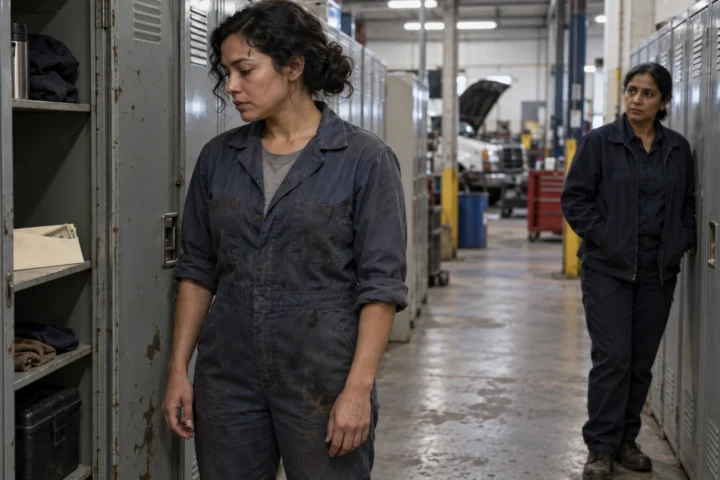
She took her hand off the mouse. Behind her, the folding machine slapped another stack of Cleveland school calendars into neat thirds. It had made that same sound the afternoon Malik cleared out his locker.
Rosa had not gone looking for secrets. The draft sat under the school job number, where a purchase order should have been. She read three lines before she understood what it was, then closed it. But she could not close the sentence in her head.
One month earlier, eight hundred calendars had gone out with the wrong dismissal times. Malik, twenty-eight, had been the last person at the press. Evan had said he ignored the approved file. Rosa had watched Beena, the owner, remove his name from the production board.
And Rosa had remembered a different file arriving after lunch.
She had kept that memory small. An attachment nobody asked her about. A hurried instruction. A thing she could not prove without making trouble for the manager who had recommended her for a bonus.
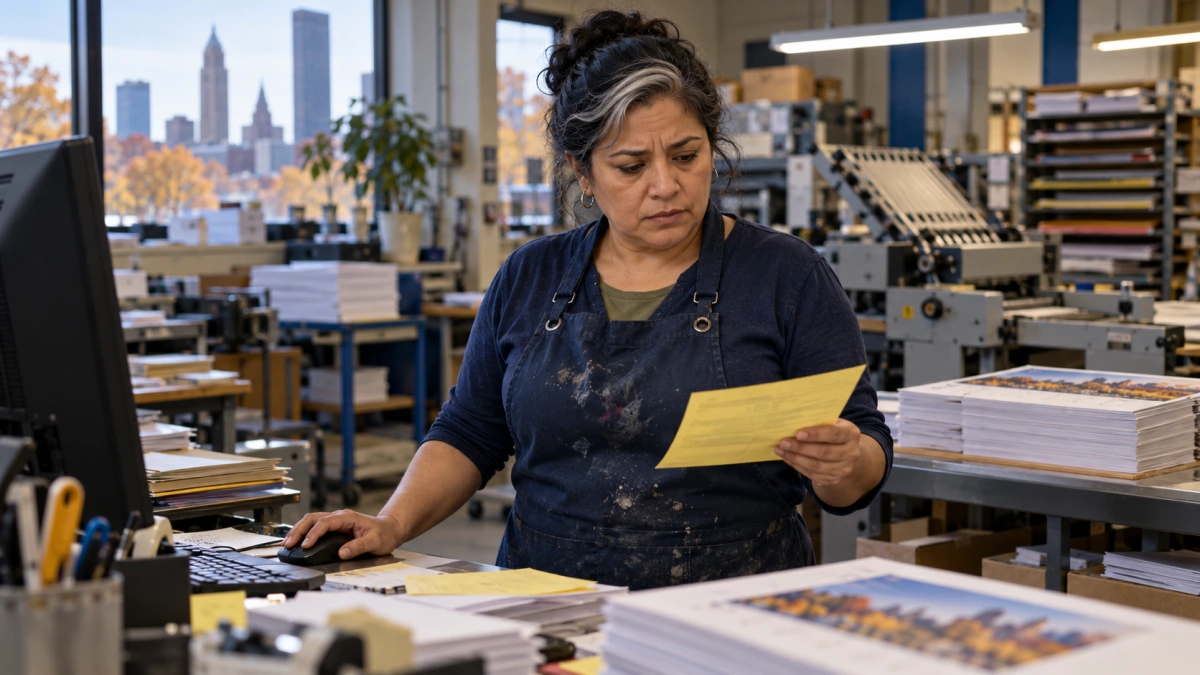
Now, at forty-six, with silver showing through the dark hair in her bun and ink on her navy apron, Rosa opened the job archive instead of the draft.
The first thing she found was her own handwriting on a yellow routing slip.
Use revised pages. Evan aware.
She remembered writing it against the edge of the cutting table because there had been no room on her desk. There was always no room on her desk. Samples, returns, a coffee somebody had put beside the color charts. She had used those crowded surfaces as an explanation for nearly everything that happened that September.
The routing slip had been scanned with the delivery receipt. Her initials stood beside the time: 1:47. The customer approval in the archive was stamped 11:12. Between them lay two hours and thirty-five minutes that had become Malik's fault.
Rosa printed the slip. Then she stopped herself from printing the draft. It was an unfinished message, not an account of what happened, and Evan's borrowed absence did not give her ownership of every sentence he had never sent. She put the slip in an empty sample envelope and went back to the calendars.
At noon, Beena came downstairs with a sandwich wrapped in waxed paper. She had bought the shop from her uncle sixteen years earlier and still ate standing when freight was late. Her gray bob tucked behind one ear as she examined the first folded sample.
"Good registration," she said. "I told Evan you'd keep us out of trouble."
Rosa pressed the envelope against her stomach.
"I need time with you tomorrow. About the school run."
Beena's hand stopped above the sandwich. "A customer complaint?"
"About what we said happened."
From the next room came a scrape as Luis dragged a pallet jack over the threshold. Rosa wished, absurdly, that someone would call her to lift something heavy. She understood heavy things. You put your feet in the right place and asked for help before the load moved.
"Nine," Beena said. "Bring what you have."
Evan returned at three carrying a pharmacy bag and the tight expression he wore after hospital parking. Rosa asked about his mother. He said the appointment had been routine, then looked at the work stacked for him.
"Anything catch fire?"
"Not today."
She followed him into the small office beside the paper racks. Through its glass wall she could see her own apron reflected over his pale blue shirt.
"I opened the school job draft in the shared mailbox. I thought it was an order. I stopped reading when I understood."
His face went slack in a way anger would have concealed.
"You weren't supposed to see that."
"I know. I didn't copy it. I did look at the archive. My routing slip is there."
He sat down without taking off his coat.
"I was going to call him."
"When?"
He rubbed the handle of the pharmacy bag between his palms. "I don't know."
It was the first useful thing either of them had said about Malik in weeks.
Rosa told him about the meeting with Beena. He asked whether they could talk first, just the two of them, sort out what belonged to whom. She heard the invitation inside that phrase: make the pieces small enough that nobody had to lift the whole weight.
"We can talk," she said. "I'm still going tomorrow."
He nodded, but she could see him calculating what tomorrow might cost. She was doing the same calculation. Her refrigerator compressor had started groaning in October. The promised twelve hundred dollars would replace it and put something back into the emergency account she had emptied for dental work.
On the bus home, she opened Malik's contact. His last message was a photograph of a crooked birthday cake from the spring potluck. She had replied with three laughing faces. After he left, she had typed Hope you're doing okay twice and sent neither version.
She wrote that she had found a production record showing the school job had been mishandled and wanted to correct her part in it. She asked whether he wanted to speak. Then she deleted a sentence about how badly she felt. He did not need to take delivery of that, too.
His reply came while she was draining pasta.
About time. Tomorrow after six. Not at the shop.
She put the phone on the counter and let the water run too long.
At nine the next morning, Beena cleared a space between invoices. Rosa laid down the routing slip and a copy of the customer's revision email. She had searched the job archive, not anyone's personal folders. The school's office secretary had attached a new back page at 1:39, with the correct early dismissal times. The message said the principal had just approved the change.
"We had already plated the original," Rosa said. "I told Evan the replacement would mean a restart. He said to keep the press moving until he checked the attachment."
Beena looked at the slip. "You wrote 'Use revised pages.'"
"For the packet going upstairs. Not an instruction handed to Malik. I put it on the sample set and left to meet the delivery driver. I assumed Evan would finish the handoff."
"Did he?"
"I didn't see him do it. That matters. I'm not telling you something I didn't see."
Beena reached for the job envelope. It had traveled through the shop with the paper and plates, accumulating the ordinary marks of people who thought they would remember enough. The press sheet showed the original filename. Malik's initials confirmed he had checked it against the approved proof in the envelope.
"He ran what was in front of him," Rosa said.
"That isn't what I was told."
"I sat there while you were told."
Beena pushed back from the desk. Rosa had expected questions about Evan. She had not prepared for the owner's silence, or for the disappointment that arrived without raised voices.
"Why didn't you say anything then?"
"I thought the late change might just complicate it. Evan said Malik had been distracted. I knew Malik had argued about overtime that week. It was easy to let that become an explanation."
"Easy for whom?"
"For me."
She could have added that she had been keeping the bindery moving with one person out sick. That Evan had covered her shift when her sister needed surgery. That certainty was expensive in a shop where every mistake came with an invoice. None of it altered the empty chair at the meeting where Malik had asked her, directly, whether she remembered the revised file.
She had said she remembered a busy afternoon.
Beena took off her glasses. "I wrote down that he disregarded an instruction. I used those words when a company called for a reference."
Rosa looked at the little scratch in the desk where Malik used to hook his safety glasses.
"Which company?"
"A packaging place in Parma. He gave us permission to speak to them. They asked whether we'd rehire."
"What did you say?"
Beena did not answer immediately. That was answer enough.
The owner called Evan in after lunch. Rosa was not invited to that conversation. She worked through a stack of restaurant menus, checking every fold against a ruler until Luis asked if the paper had offended her.
"Probably the opposite," she said.
At five, Evan found her washing ink from a roller tray. He stayed on the other side of the sink.
"I told her I never opened the revision until after the run. I thought the attachment was another approval copy."
Rosa kept the water low so she could hear him.
"Then why say Malik ignored it?"
"He said he never got it. I heard that as an excuse. By the time I checked, the replacement run was scheduled. I thought if I admitted it then, everything I'd said would look deliberate."
"It became deliberate."
"I know."
He said it without asking her to make the difference kinder. She shut off the tap.
"The draft wasn't a plan," she said. "It was somewhere to put what you didn't want to do."
He nodded once. Then he asked if Malik had answered her.
"Yes. Don't follow me there."
"I wasn't going to."
"I'm saying it anyway."
Malik chose a diner on Lorain Avenue where the booths had cracked red seats and nobody from the shop ate after work. He was already there, wearing a rust jacket over a shirt with a different company's small embroidered emblem. His short locs were neater than she remembered. She disliked herself for being relieved that he looked well.
"I have twenty minutes," he said.
She sat opposite him without taking the menu.
"You asked me about the revised file in the meeting. I knew one had come in. I didn't tell them."
He turned his water glass a quarter circle.
"You said you couldn't remember."
"I said it because I didn't want to choose a side. Which meant I chose one."
"Don't make it sound like some big philosophy. I asked you a question."
She looked down at her hands. "You're right. I lied."
A server came over. Malik ordered soup to go. Rosa asked for coffee because leaving the table without ordering felt like borrowing one more thing she had not earned.
She explained the records: the email time, the routing slip, his press sheet. She did not mention the draft. It had started her looking, but it was not Malik's responsibility to weigh Evan's unsent feelings.
"What do you want me to do?" he asked.
"Nothing. Beena needs to correct what she told the packaging company. I wanted to ask what you want corrected and where."
He leaned back. "I got another job. Not that one. Night shift for two weeks before a day position opened. My girlfriend and I passed each other in the parking lot like we were sharing custody of the apartment."
Rosa had imagined unemployment, a disaster with a clear shape. This smaller accounting made her throat tighten: meals missed, sleep divided, a life bent around a story other people found convenient.
"I'm glad you found something," she began.
"I'm not telling you so you can be glad."
"I know. Sorry."
He watched a bus ease past the window. "No, you don't know yet. I liked that shop. I knew which machine lied about its counter. I knew Luis needed the radio on when freight got rough. I didn't leave because I wanted to start over."
She let him finish.
"And I don't want to go back. Be clear about that. I don't want her offering me my locker like it's a prize."
"I'll tell her."
"Tell her to call me. She can ask me herself. You don't have to be the good person carrying everybody's messages."
The soup arrived in a brown bag. Malik stood, then paused with one hand on the booth.
"At the meeting, I thought you were scared. Afterward, you brought donuts on Friday. Everybody went on eating. That's what I keep remembering."
Rosa had bought the donuts because the week had been awful. She had called it taking care of her people.
"I remember," she said.
He left cash for the soup and walked out. She stayed with the coffee until it was cool enough to drink without noticing.
On Thursday, Beena asked Rosa to come upstairs again. This time the office door stayed open. The owner had Malik's press sheet beside the reference note, and her own handwriting across a fresh page.
"He agreed to a call tomorrow," she said. "He wants the production account corrected here. No meeting with him in front of everybody. No farewell lunch we should have given him then."
"That sounds like him."
Beena looked up sharply. Rosa stopped. Knowing his preferences now was not the same as having protected them when it mattered.
"I'll tell the crew the run failed because we never put the revised file through a proper handoff," Beena said. "That Malik followed the proof he was given. And that I accepted a claim against him without checking the records."
"Will you say I stayed silent?"
"Will you?"
Rosa could hear the air compressor start below them. She wanted a task she could complete privately, something with a clean edge and a measured size.
"Yes."
Beena folded her hands. "The lead bonus hasn't been issued. You know that."
There it was, without a theatrical pause.
"Yes."
"It was recommended on reliability and judgment. I'm not signing it this quarter. Your regular pay stays the same. I haven't decided who will cover the production meeting when I'm away next month."
Rosa made herself ask the question that sounded ugliest.
"Is Evan losing his bonus?"
"He isn't receiving one. His management duties are being reviewed. That doesn't settle what happened here."
"I know. I needed to ask."
Beena's expression softened a little, not into forgiveness but into recognition. "I understand. I also have to look at why I preferred the answer that let us keep running. You weren't the only one protecting a comfortable picture."
Downstairs, Luis was fitting a new blade into the cutter. Rosa waited until his hands were clear before telling him about Friday's brief meeting. He wiped his palms on a rag.
"About Malik?"
She nodded.
"I wondered when."
"You knew?"
"I knew you stopped saying his name. I didn't know why."
That evening, her refrigerator clicked, shuddered, and quieted. Rosa opened it and held her hand against the milk carton. Still cold. She sat on the kitchen floor with a flashlight and vacuumed dust from the coil, a repair she knew might buy only weeks. Her sister called and asked about the bonus.
"Not coming," Rosa said.
"The shop doing badly?"
"I did something badly."
She told the story without names at first, then gave up the false modesty of that. Her sister listened while Rosa described the routing slip, the meeting, the donuts. When she finished, there was a long silence.
"Do you want me to say you were under pressure?" her sister asked.
Rosa laughed once, painfully. "Yes."
"You were. You were also wrong."
"I know."
"I can help you look for a used refrigerator. That's a different conversation."
Rosa leaned back against the cabinet. For the first time that week, help did not feel like somebody agreeing to hide the damage.
Friday's meeting took eleven minutes. Beena shut down the nearest machine so nobody had to lean forward to hear. Evan stood beside a cart of untrimmed brochures, both hands flat on its top.
Beena explained the file change and the missing handoff. She named her own incorrect reference and said she was arranging a correction with Malik's permission. She did not recite his new employer or describe his private response.
Then Evan said, "I blamed Malik for ignoring a file I had not given him. When I learned that, I didn't correct it. He should not have had to leave under that account."
There was no visible relief in his face when he finished.
Rosa stepped forward before she could turn her statement into a speech.
"Malik asked me whether I remembered a revised file. I did remember. I said I didn't because I wanted to stay out of it. That helped make the wrong account stick. If you heard me say he was careless afterward, that wasn't something I knew. It was me defending what I'd already done."
She had not planned the last sentence. It referred to a conversation by the loading door, where she had told a delivery driver that young workers sometimes wanted responsibility without consequences. Luis looked at her then. He had been beside her.
Nobody applauded. Somebody's phone vibrated on a shelf. The new bindery assistant, a woman named Jo who had never met Malik, asked which file was now considered final when a revision arrived midrun.
It was a practical question, and Rosa was grateful for it until she saw how easily gratitude could become escape.
"We need a stop and a direct handoff," she said. "But fixing that won't change what we just told you."
Jo nodded. "I heard both things."
Afterward, Luis asked Rosa to help turn a stack. He did not offer absolution, but he did not make a performance of avoiding her either. Work continued with the familiar resistance of paper against paper.
Evan's management review took longer. He still worked in the shop, but Beena handled customer approvals herself for a while and gave the weekly schedule to another supervisor. Rosa noticed how quickly she searched his face for resentment, as though a sour expression could make her own conduct less serious.
One Tuesday he brought her the school archive with a question about the replacement invoice. She answered it. Then he said, "I called him. He let it go to voicemail. I left a short message."
"Okay."
"I didn't tell him to call me back."
Rosa nodded. They stood in the narrow aisle with a cart between them. There had been years of easy favors before this: rides in snow, shift swaps, a sandwich when one of them forgot lunch. She did not know which parts could survive. She only knew that preserving them by agreement would repeat the thing they were trying to stop.
"Your mother's doing all right?" she asked.
"She's tired. But yes."
"Good."
It was a small kindness, neither a pardon nor a bargain.
Beena reached the packaging company's hiring manager the following week. Malik had agreed that she could correct the reference, but did not authorize anyone to reopen his application. She sent him the same brief written correction she sent the manager. She also offered payment for the hours he had spent addressing the shop's mistake. He declined that offer and asked instead for the original allegation to be removed from any reference account they would use again.
"I shouldn't have put him in the position of deciding what my conscience costs," Beena told Rosa later.
Rosa was checking a shipment of cream stock. "What did you say?"
"That I'd correct it whether he accepted anything or not."
The owner had begun bringing her sandwich downstairs again. Some days she asked a question and waited through the first answer for the less convenient second one. Some days she still looked at the clock too quickly. Rosa did not confuse those small attempts with a transformed workplace.
One afternoon in November, Beena asked Rosa to drive a sample box to the school. The courier had already left, and the secretary needed paper choices for the winter concert. Rosa almost offered to pay for a second pickup. She had not been inside the building since the calendars were recalled.
The school occupied a low brick block beside a recreation field. Wet leaves stuck to the sidewalk. Rosa carried the box against her hip and waited while a parent collected a forgotten backpack through the office window.
The secretary, Mrs. Bell, recognized the shop label before she recognized Rosa.
"Put them here. Away from the hamster."
A classroom cage sat temporarily beside the copier. Rosa moved the box to the other end of the counter. The ordinary absurdity of its placement made her want to laugh, but Mrs. Bell was sorting attendance slips and did not look up.
"I owe you a correction," Rosa said.
The secretary's pen stopped.
"On the calendars. We said the press operator ignored your change. That wasn't true. We didn't get the revised file into his production packet. He ran the approved proof he had."
Mrs. Bell set down the pen. "Malik?"
Rosa had expected her to remember the invoice, not the name.
"He brought the replacements himself," the secretary said. "He stayed while we checked the stacks. A teacher was angry. He took it."
"I didn't know that."
"Did he do something else wrong?"
"Not that I'm here to discuss. This mistake wasn't his."
Mrs. Bell looked toward the hallway, where somebody was practicing a trumpet through a closed door. "I told our principal he must have been rushing. We were rushing him, of course, but it's easier to complain about the person standing there."
Rosa felt the temptation to agree too eagerly, to gather this woman into a fellowship of reasonable mistakes. Instead she opened the sample box.
"I said worse," she said. "I knew enough to speak up and didn't."
The secretary touched the pale blue stock. "I'll correct what I said here. Does he still work with you?"
"No."
"All right. I won't send a message through the shop, then. You can tell your owner I've heard the correction."
They selected paper without becoming friends. Before Rosa left, Mrs. Bell asked for the new quote to include the cost of an extra proof. It was a modest expense, not a moral lesson, and Rosa wrote it down.
In the parking lot she called Beena. The owner listened without interrupting and said she should have contacted the school herself. Rosa agreed. Neither of them used the conversation as evidence that everything was settled.
When she returned, Luis was unpacking a shipment with Evan. They had set aside a carton crushed on one corner. Evan asked Rosa whether she had signed for it that morning.
"Yes. I noted the corner damage on the receipt."
"Where's the receipt?"
The question was ordinary. She heard accusation anyway. Her shoulders tightened; an answer about how many years she had received freight rose to her tongue. Then she saw Evan watching her, equally ready to mistake defensiveness for proof.
"Clipboard by the door," she said. "I'll get it."
The note was there. Only the packaging had been damaged. They inspected the stock together, put it away, and went back to their separate work. Rosa remained unsettled by how little pressure it took to make her reach for rank instead of an answer.
That Friday, Luis asked whether she wanted a ride to the bus stop because rain had turned to sleet. In his truck, the heater made a rattle like loose coins.
"You don't have to keep looking like somebody died," he said.
"I don't know what to look like."
"Start with looking at me. You've been talking to my shoes."
She turned toward him. He kept his eyes on the wet road.
"I should've challenged you at the loading door," he said. "When you said that thing about younger workers. I laughed because I wanted you to like me. I'm telling you because I'm going to stop doing that. Not because it makes your part smaller."
"I don't like knowing you thought you had to."
"Well. Now you know."
At the stop, she thanked him for the ride. He told her to close the door hard because it stuck. The bus arrived before she had decided what else to say, which was probably a mercy for both of them.
The following week Rosa moved the sample cart out of the narrow space beside her desk. She had complained for years that nobody could find a place to ask her something. Moving it took four minutes and meant she had to walk farther for stock swatches. She resisted making the small inconvenience noble. It was only furniture. But when Jo arrived with a question, she could stand beside Rosa instead of hovering behind her chair, waiting to be noticed.
Jo asked about a damaged plate. Rosa did not know whether it could be reused. Together they took it to the press and examined the edge under the work light. For once, not knowing did not have to be a secret somebody younger would pay for.
In December, the school ordered concert programs. The office secretary called to ask whether the printer could handle one late sponsor addition. Rosa recognized her voice and felt an old defensiveness rise before the woman had even finished.
"We can," Rosa said. "I need to tell you what stage we're at first."
They had not begun plating. The addition would take fifteen minutes and would not change delivery. Rosa sent a fresh proof, then walked it to Jo, who was covering prepress. When Jo asked why a name had moved, Rosa explained rather than saying just use the latest one.
At lunch, Jo sat beside her on the loading step.
"Were you and Malik close?"
"I thought we were friends at work."
"That sounds complicated."
Rosa watched a truck turn into the alley. "It wasn't complicated when he asked me a question. I made it that way afterward."
Jo ate another bite of her apple. She did not ask for the rest of the story. Rosa was learning that silence could be room for somebody else instead of shelter for herself.
The refrigerator failed on a Sunday. Her sister drove over with a cooler, and together they carried the salvageable groceries downstairs to a neighbor who had offered shelf space. The replacement was used, beige, and louder than the old one had been when it worked. Rosa paid for delivery in two installments and resented every dollar for about an hour.
Then she stopped trying to turn the cost into proof that she had suffered enough.
Malik sent one message before Christmas. Beena had forwarded the correction. He had no questions. He wanted Rosa to stop checking through mutual acquaintances about whether he was doing all right.
She had asked Luis twice. She had told herself it was concern.
Understood, she wrote. I won't ask again.
She did not attach a photograph of the crew or ask him to remember the good years. She did not tell him about the bonus. That evening she deleted the speech she had been composing in her head for a reunion he had never requested.
On Christmas Eve, her sister asked whether Malik had forgiven her. They were peeling potatoes at the kitchen table, with a bowl between them and an old movie playing too softly to follow.
"He hasn't said that."
"Maybe later."
Rosa cut a dark spot from a potato. "Maybe not."
Her sister looked ready to comfort her, then reached for another potato instead. Rosa appreciated the restraint more than she could explain. She had spent weeks imagining forgiveness as a door she would eventually be allowed through if she stood outside long enough, being sorry. It had made even her patience into another kind of demand.
They finished the bowl. Her sister asked about the replacement refrigerator, and Rosa described the missing shelf and the beige color. Soon they were arguing about whether beige was a color at all. The evening became ordinary without becoming innocent. Rosa found she could laugh and still remember what she owed. She did not have to keep herself miserable to keep herself honest. She did have to leave Malik alone, exactly as he had asked her.
January brought a broken heater in the front office and a week of breath whitening near the loading door. Beena asked Rosa to lead the production meeting while she met a repair contractor. It was not a promotion. Rosa wrote down what she knew, marked what she did not, and asked Jo to describe a recurring problem with missing stock.
When Evan interrupted, Rosa felt the old instinct to smooth the moment before it became uncomfortable.
"Let her finish," she said.
He leaned back. Jo finished. They discovered that the shortage was on the inventory sheet, not in the racks, which saved an unnecessary order and did not redeem anybody.
After work, Rosa stayed to sweep the small curls of paper from beneath the cutter. A holiday card had slipped behind the cabinet. Malik had signed it the previous winter with an exaggerated drawing of the folding machine eating a mitten. She stood holding it longer than she meant to.
She did not throw it away. Remembering him kindly was not the offense. Using that kindness to rewrite what she had done would be.
She put the card in the drawer with the shop photographs and returned the broom to its hook. Outside, Cleveland traffic hissed through dirty snow. Her bus would come in seven minutes if it came on schedule.
At the door, Beena called her back to ask whether a school proof could wait until morning. Rosa checked the delivery date instead of guessing what answer the owner wanted.
"Yes," she said. "But we need Malik's old checklist. Jo found it in the press binder."
Beena nodded. "Use his name on it. He made it."
Rosa took the binder down, opened it flat, and left the page where the morning crew could see. Then she turned off her work light and went home.
Read next
The Meeting on the Third Floor
The Voice on the Empty Desk
The Name Behind the Trophy
The Hotel Manager Accused Me of Stealing Wedding Linen—Then I Asked Her to Read the Orange Tag
Reading notes
An unsent message makes a print-shop lead confront a colleague's false blame.
This is an original work of fiction. Characters and events are fictional. Explore public-domain books at Project Gutenberg or browse more stories on ReadStoryvia.