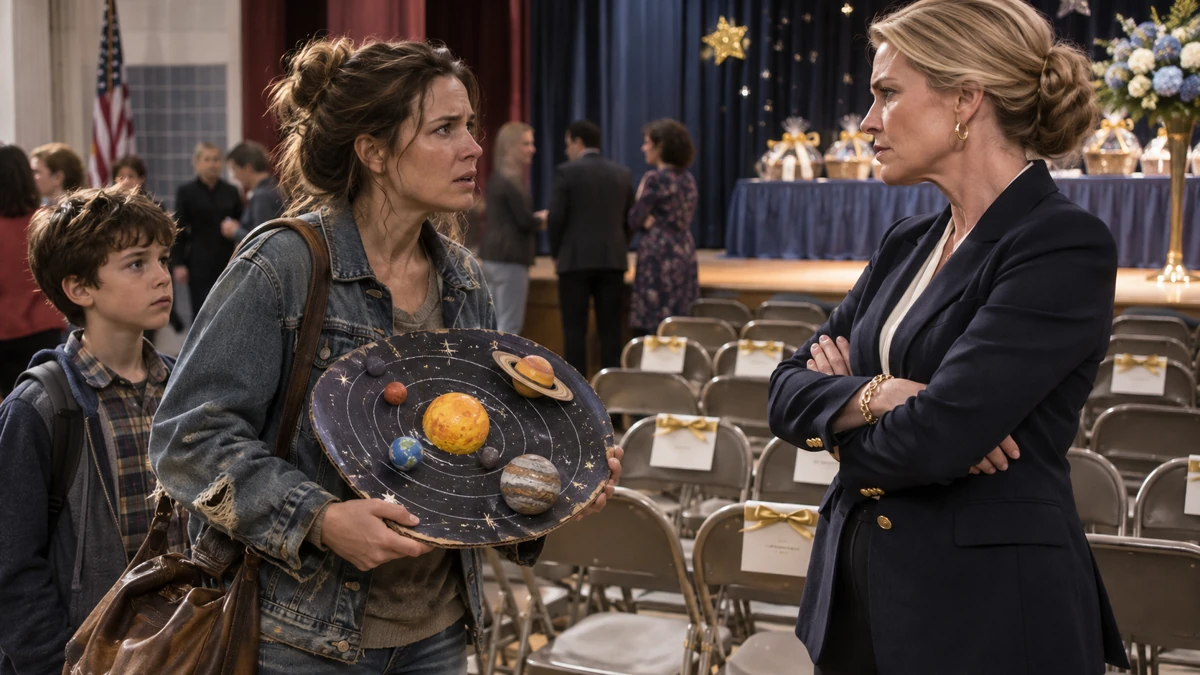
“Take that through the back,” the fundraiser chair told my son. “The front tables are for sponsor-quality displays.”
Eli stood under the auditorium lights holding a cardboard solar system. We'd painted Saturn's rings with the last of my gold nail polish because the craft store had closed.
He looked at the project, then at me.
Mrs. Harlow wore a blazer with the school foundation pin. She was a parent volunteer like me, but she had a headset and a clipboard, and everybody stepped aside when she walked past.
“My confirmation says table six,” I told her.
“That was before we finalized the program.”
At table six, a glossy display advertised her husband's tutoring center. Our school's science evening had somehow acquired a sales desk.
I took Eli to his teacher, who found a safe place for the project in her classroom while I asked about the change. I wouldn't make him stand in the doorway while adults discussed whether his work belonged.
Mrs. Harlow told me families who contributed should receive recognition.
“I did contribute. I designed the program.”
“You helped with a little formatting, Nina.”
I had spent fourteen evenings designing it after finishing shifts at a print shop. The written arrangement was simple: my design work would count as the family sponsorship contribution, and every approved student project would receive a numbered display place.
She had confirmed it by email.
Now she said there was no record.
The program printer was my colleague, Frank. I called to ask which version had gone to press. He said Mrs. Harlow had supplied a replacement after I signed off the original.
“Did she tell you I approved it?”
“Yes,” he said. “She said you were too busy to make the changes yourself.”
He emailed me both files and the message that accompanied the replacement.
My name had disappeared from the design credit. Four student displays had been removed from the floor plan. In their places were businesses connected to the fundraiser committee. The line explaining that sponsorships supported classroom science supplies had been replaced with a vague reference to enrichment services.
I saved everything. Then I asked Eli whether he wanted to stay with his teacher or go home. He wanted to show the model to his friends.
“Then we stay,” I said.
His teacher, Ms. Patel, found the original student list on her laptop. Eli and three other children had been approved. She hadn't been told any spaces were being removed. One of the other children had made a water filter from sand, stones, and a plastic bottle. Her grandmother stood beside it holding a tray to catch the drips.
There was plenty of room along the side wall if the sales banners moved.
Ms. Patel asked the assistant principal to make that decision. The children received tables before the doors opened. Eli placed Saturn carefully in the center of his display and began explaining why the rings weren't solid.
I should have felt relieved. Instead I kept thinking about the families who might have gone home when they were told to use the back entrance.
That night, Eli asked why the lady had wanted his project at the back. I was washing gold paint from the brushes. He stood beside the sink in his pajamas, waiting for an answer I couldn't make painless.
“She made a decision about the tables that she shouldn't have made.”
“Because we didn't buy the big kit?”
He meant the model with a battery-powered sun he'd seen online. I had told him it cost too much for one school project. We had made ours from grocery boxes and the foam balls his teacher supplied.
“No. Your project belonged there because you did the work and your teacher approved it.”
He watched a streak of gold disappear down the drain.
“Was mine good?”
I wanted to say it was the best one in the room. It wasn't. Another child had built a clever working water pump, and Eli had spent twenty minutes asking how it worked. He deserved an answer he could trust.
“Your labels were clear. You explained the rings without reading your notes. And when you didn't know why one planet has so many moons, you said you'd look it up.”
He smiled a little.
“We could look it up tomorrow.”
We did, at the library after school. While he searched the children's science shelf, I thought about how easily a careless adult could turn a shared evening into a lesson about who deserved space. I couldn't erase the doorway or Mrs. Harlow's words. I could make sure he saw adults correct a mistake instead of asking the children to carry it quietly.
The other parents wanted that too. The grandmother with the water filter called to thank Ms. Patel for finding a table. She had nearly taken her granddaughter home because she didn't want to cause trouble. With her permission, I included that fact in my account of the evening. It explained why simply finding four tables at the last minute wasn't the whole repair.
On Monday, I sent the assistant principal the original agreement and both programs. I asked for the design credit to be corrected and for a review of how student spaces had been reassigned. I copied only the people responsible for the event.
Mrs. Harlow replied to everyone that I had misunderstood an informal favor. Then she called me privately and offered a $100 gift card if I would stop making the school look disorganized.
I asked her to put the offer in the email thread. She hung up.
The foundation treasurer, whom I had never met, requested a meeting. She had approved a budget for student displays and science supplies, not private businesses selling packages inside the event. She wanted to know whether any sponsorship terms had changed.
I brought my own records. Frank supplied the printer correspondence directly. Ms. Patel brought the approved project list. The treasurer brought the event ledger.
Mrs. Harlow arrived with her husband and said everyone was overreacting to a successful evening.
The treasurer placed the two floor plans side by side.
“Who approved removing these children?”
“We needed the larger contributors near the entrance.”
“Where is the policy that permits that?”
Mrs. Harlow turned toward me. “Nina knew her contribution was small.”
I opened the email in which she had accepted my design work as the sponsorship contribution. The amount she had valued it at was higher than two of the paid business packages.
Her husband studied the page, then asked why his center's invoice included a premium placement fee if the committee had never approved selling student spaces.
She said she had been trying to raise more money.
The treasurer asked where the premium fees appeared in the ledger.
They had been collected through a payment page linked to the committee's outside event account, which Mrs. Harlow managed. The treasurer hadn't received its final statement.
The review took a month. It found $2,300 in placement fees that had not been transferred into the foundation account. Mrs. Harlow transferred the balance, provided the statements, and reimbursed an unauthorized banner purchase. The businesses were offered refunds for terms the school had not approved. The school retained only properly documented sponsorship money.
Mrs. Harlow stepped down from the committee and lost access to its payment tools. The foundation introduced written approval for future sponsorship packages and required two people to reconcile event funds. The corrected digital program restored the student list and my design credit.
I didn't ask them to print hundreds of replacement copies. I asked for the corrected version to reach the families who had received the first one. It did.
At the spring science display, Ms. Patel asked Eli whether he wanted to bring the solar system again. He said he had a better idea. He wanted to build a wind turbine from a small motor and cardboard blades.
We worked on it at the kitchen table. I bought paint this time, but he chose the same gold for one blade.
On display night, the tables were numbered before anyone arrived. Every child had the same amount of space. The sponsor board stood in the lobby, separate from their work.
Eli's turbine lit a tiny bulb when he turned the fan toward it. His grandmother clapped so hard she startled the child at the next table.
I stood beside him in my old denim jacket, holding the spare tape. Nobody asked us to move. When the bulb flickered again, Eli looked straight at the visitors and explained exactly how he'd made it happen.
Fictional story.