Original fiction
On this page
The Last Plot in the Community Garden
The woman I found picking tomatoes in the abandoned plot knew exactly which ones were ripe, and the man who supposedly owned it had never received my warning.
I learned the second part after I had already promised his garden to somebody else.
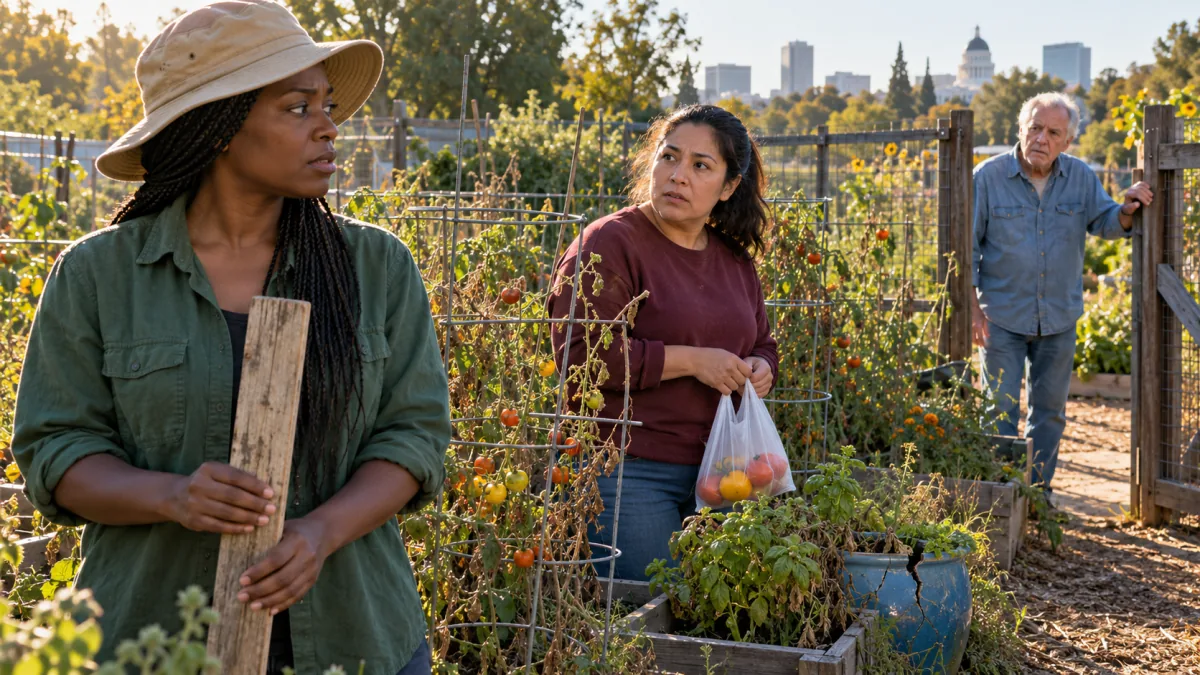
It was seven on a September morning in Sacramento. I had come to pull the little wooden marker from Plot Eighteen before the waiting family arrived. My spreadsheet called it inactive. The weeds along its edges agreed.
But a woman in a burgundy sweatshirt stood between the leaning cages, putting tomatoes into a grocery bag. She held one up when she saw me, as if I had come to help.
“The yellow ones split if you leave them another day.”
“Are you Walter Price?” I asked, although she plainly wasn't a seventy-four-year-old man.
She lowered the tomato.
My name was Amara Okafor. I was thirty-seven, three months into coordinating the garden, and determined to make its waiting list mean something. One family had waited an entire year. Meanwhile this plot had missed the spring workday, the summer cleanup, and every message I had sent.
“I'm Elena,” the woman said. “Ruth told me I could take what I needed.”
“Ruth Price died in January.”
“I know.”
Behind her, a tomato rolled from the bag and stopped against my shoe. I picked it up, feeling its sunless morning weight.
“Permission doesn't transfer the plot,” I said.
Elena looked toward the gate. A man with white hair and a faded denim shirt had stopped there, holding the fence instead of opening it.
“Nobody told me,” he said.
I still had the new family's name written on the back of Walter's marker.
I turned the marker over before he could see it. That was my first useful instinct of the morning and my first dishonest one.
Walter came through the gate slowly. There was nothing confused about the way he looked at the plot. His eyes went straight to the bed's southeast corner, where a basil plant had gone woody beside a cracked blue pot.
“Those were Ruth's,” he said.
Elena set her bag down. “She gave me some every summer.”
“I meant the seeds.”
His voice was not loud. Somehow that made the distance between the three of us feel larger. Beyond the fence, a bus sighed at the stop. Somebody's sprinkler clicked through its arc, watering the sidewalk because nobody had adjusted it since July.
I introduced myself. Walter nodded as if the introduction were an item he would deal with later. Elena said she lived in the apartments across the alley. I knew the building: laundry outside, six mailboxes, a stair rail that needed paint. I had delivered garden flyers there in June.
“I sent notices,” I said to Walter.
He looked at the marker in my hand.
“To where?”
The address in the garden file was a post office box. Three emails had also gone unanswered. I described both, hearing how confident I sounded. Walter said they had stopped paying for the box in February. The email account belonged to Ruth. He did not know its password.
“I gave the old coordinator my home address,” he said. “On a piece of paper. After the funeral.”
I imagined the file drawer I had inherited, thick with seed catalogs and folded receipts. I had congratulated myself on replacing it with a clean spreadsheet. Apparently I had not replaced everything.
“The mail didn't come back?” he asked.
“I don't know.”
It was the first completely accurate thing I had said.
Elena moved a foot toward her grocery bag. Walter watched her. I asked her to leave it there while we talked. She drew her hands into her sleeves, and I regretted how much the request sounded like an accusation made in public.
The garden had twenty-four plots on a narrow strip beside a city recreation building. It had one water meter, a shared tool shed, and no place to expand without becoming a parking lot or a basketball court. Every new coordinator inherited a waiting list and somebody's theory about how to shorten it.
I had inherited twelve names. The first belonged to Priya Shah, who worked hospital nights and wanted somewhere her father could grow vegetables with her ten-year-old son. She had checked in politely every month. When I emailed that Plot Eighteen would open for the autumn season, she replied in eleven minutes.
They were due at eight.
“I'm going to call the family,” I said. “Nothing changes this morning.”
Walter's shoulders loosened. Elena looked less certain.
“That doesn't mean nothing changes,” I added, too quickly.
It sounded like a threat. I put the marker down on the path and stepped away to make the call before I could improve the sentence into something worse.
Priya had already loaded compost into her hatchback. Her father was downstairs. Her son had picked out carrot seeds at the hardware store.
“Did I miss a form?” she asked.
“No. I made a mistake. There wasn't a properly delivered notice to the current gardener. I need to stop the handover until we've talked.”
She did not answer immediately. I could hear a child asking where the gloves were.
“How long?”
“I'll call you by tomorrow evening with a date for a decision.”
“A decision isn't a plot.”
“I know.”
She said she had traded shifts for this morning. Not angrily, exactly. As information I needed to have. I apologized without telling her about the dead wife. I would not use somebody else's grief to make my error harder to criticize.
When I returned, Walter was standing outside the bed. Elena had not moved the bag.
“You should take those home,” he told her, looking at the tomatoes. “They're already picked.”
She thanked him. He did not answer.
I asked them to meet the next afternoon, after I checked the old records. Walter said he would come, but he did not want Elena harvesting before then. She nodded, lifted the bag, and walked away without her usual familiarity with the gate. I had seen her in the garden before and assumed she belonged to somebody's plot. Assumptions were proving expensive.
Walter lingered. I asked if he wanted me to walk through the bed with him. He shook his head.
“I just came to see if the yellow ones were still here.”
Then he left too.
By nine the sun had reached the back fence. I sat in the shed with the old coordinator's files and found the returned envelope under a packet of membership receipts. It was stamped months earlier. My predecessor had left abruptly to care for her mother. Nobody had collected the shed mail properly during the handover. I had sent the final warning from home and never searched the paper pile.
Under the envelope was Walter's handwritten change of address, clipped to a condolence card the garden members had signed. I recognized my own signature on the card. I had written Thinking of you, then failed to think of him when his row stayed blank.
I was not responsible for every lost paper. I was responsible for acting as though an unanswered email settled the matter.
The garden rules were stapled inside a green folder. They were ordinary, imperfect rules made by people who had once argued over whose hose was left running. A plot unused for a season could be reassigned after notice and an opportunity to respond. Members could voluntarily release it for one growing season, with the recipient's place continuing through that season. Returning members joined the waiting list; there was no quiet reservation that kept two families hoping for the same ground.
I read the last sentence twice. Whatever we decided, we could not promise Walter an invisible second garden underneath Priya's.
The elected garden committee had three members. I called them that afternoon, told them exactly what I had missed, and asked that the next day's conversation not become a hearing with an audience. We would need their agreement to use the existing one-season release, if Walter chose it. We did not need them standing around him while he chose.
One member, Luis, asked whether I had already offered the bed. I said yes. He exhaled and told me to be clear with Priya that the delay was ours, not hers. He did not offer a loophole. I liked him better for that after I stopped wishing he would.
I went back outside with a trash bag. Cleaning the shared path did not fix anything, but it let my hands do something honest.
Elena appeared at the alley fence after lunch. She held the empty grocery bag folded into a square.
“I didn't sell them,” she said.
“I didn't think you did.”
“You asked me to leave the bag like I might.”
I put down the rake. “You're right. I'm sorry.”
She was forty and cleaned rooms at a hotel near the freeway. Some weeks there were five shifts; some weeks there were two. Her daughter Isabel, seventeen, was applying to community college. They had enough food most weeks, Elena said, then stopped as if she disliked how carefully she had measured that sentence.
“Ruth didn't ask me to explain my refrigerator.”
Ruth had first offered tomatoes four summers earlier, when Elena stopped to admire them while carrying laundry. Then came zucchini, basil, a bag left on her stair, an invitation to take what was ripe if Ruth was not there. Elena brought washed containers back, sometimes a loaf from the bakery counter where her sister worked.
“I thought Walter knew.”
“Did you ever ask him?”
She looked through the fence at the bed. “No.”
After Ruth died, Elena saw ripe lemons in a bag by the shed and almost took them, then realized they belonged to another gardener. That had reminded her how much of her permission had been a person's voice rather than a rule. She had kept coming to Eighteen anyway.
“I watered,” she said. “Sometimes. When the leaves looked sad.”
“I saw the dry patches.”
“I didn't say I did it well.”
There was anger in that, but not only at me. The remaining tomato plants were held up with strips of old pillowcase. Some ties were Ruth's; others Elena had added. She had mistaken tending a little for belonging a little, or perhaps those things were connected and still did not add up to a plot.
I told her the waiting family had no garden at home. She said she had not known anyone was waiting. I believed her. I also knew she had never asked.
“Can I come tomorrow?” she asked.
“Yes. Not to defend your need. To talk about what permission you actually had.”
She unfolded the bag, folded it again, then tucked it into her pocket.
I went to Walter's house that evening only after calling and asking. He answered from the porch. A narrow strip of front lawn sloped toward the sidewalk; the backyard, visible through a side gate, was mostly shaded concrete. There was no unused acre waiting to rescue our problem.
He had made tea and set out three cups before remembering it would be just us. He took one away without comment. I sat at the kitchen table beneath a clock that ticked much louder than it needed to.
“I found your address,” I said. “And the returned notice. You should have had a real chance to answer.”
He looked at the cup I had not touched.
“Would you have come?” I asked.
“I don't know.”
It was not the answer I expected. I had come prepared to own a mistake, and some part of me wanted his injury to be simple enough that an apology could fit it.
Walter and Ruth had worked Plot Eighteen for thirteen years. He built the tomato cages; she chose what went inside them. They disagreed about basil, which he considered an ambitious weed until she started putting it in his sandwiches. She died in January after a short illness. By March he had seedlings on the kitchen sill, because that was what they did in March.
He carried them to the garden, set them out, and stood staring at the spaces between them. Ruth always planted too close. He had spent years complaining. The bed looked correct without her, and he could not bear it.
He went back twice to water. Then the summer heat came, and somebody else kept enough alive that he could tell himself he had not abandoned it completely.
“I didn't ask who,” he said. “If I didn't know, I didn't have to decide whether to be grateful.”
I thought of Elena at the fence, defending the quality of her watering. Neither person had invented the whole story. Both had left room for something convenient to grow.
He had seen her picking once in June. She waved. He walked past as though he had somewhere to go. He did not tell me that until I asked whether they had spoken since January.
“Then she might have thought you agreed.”
“She might.” He turned his cup. “I didn't agree. I just couldn't start talking.”
I said that mattered, and that it did not make her permission permanent. We sat without improving either sentence.
Finally he asked about Priya. I told him only what she had agreed I could share: a year on the list, a father who had grown vegetables before moving to an apartment, a son eager enough to carry compost before breakfast.
“Ruth would tell me to give it up,” he said.
“What do you want?”
He rubbed a tea stain on the table with his thumb. “I want to go there and have her be annoyed that I forgot the string.”
I did not tell him to plant in her memory. Memory was already there, waiting behind every cage. He knew better than I did whether he could stand it.
On my way out he asked if I had thrown away the old marker. I said no. He nodded, and for the first time that evening I knew what I could promise without hurting anybody else.
The next afternoon was hot. I set three chairs beneath the tool shed awning and put a jug of water on an overturned crate. Walter came first. Elena arrived five minutes later, empty-handed. Neither took the chair nearest the plot.
I started with my mistake. The notice had not reached Walter, and I had offered the bed before checking. I would tell Priya that plainly. Walter could respond now. An autumn reassignment could happen only after a proper conversation, not because I wanted my calendar back.
“You say respond,” Walter said. “What if I say I want it?”
“Then we need to hear how you'll use it. You don't have to pretend the summer didn't happen. But the space can't stay unused indefinitely.”
His jaw worked. Elena looked at the dusty path between her shoes.
“I can't promise spring,” he said.
“Nobody is asking for spring today.”
I explained the one-season release already in the rules: Priya would receive the plot for the autumn season ending in February. It would not secretly revert to Walter afterward. If he wanted a plot again, he could join the list under the same rules as other returning members. We would not ask Priya to invest in ground she could lose whenever his feelings changed.
Elena spoke before he answered. “What happens to the tomatoes?”
Walter looked at her bagless hands.
“You don't get to keep picking because she once said you could.”
“I know that now.”
“You could have asked.”
She nodded, then raised her head. “You saw me in June.”
He looked away.
“I thought that meant you knew. I should have asked again, but I didn't take them out of spite.”
The water jug sweated onto the crate. From the basketball court came the hollow double bounce of a ball. I made myself stay quiet. They were finally talking about the same event instead of defending separate imagined ones.
Walter said he had known Ruth gave vegetables away. He had not known how broad the invitation was. Elena said Ruth sometimes encouraged her to come when they were absent, but had never said she could inherit the plot.
“I made that part up without saying it,” she admitted.
“I let the gate do my talking,” he said.
Neither apologized immediately. The admissions sat between them, awkward and more useful than the graceful words I had been hoping to supply.
Walter asked what would remain if he released it. I said he could take his personal cages and marker, and gather seeds from ripe fruit before the handover. Existing plants would be discussed with Priya. He could not promise their harvest to Elena for a season he no longer held.
“I don't want all those cages,” he said. “They barely stand.”
“Then don't take them because you think you should.”
He looked at the plot for a long time. Elena got up to refill her water, not to hurry him. At last he said he wanted to clear one corner himself and save some yellow tomato seed. He could not maintain the whole bed, and he would not call it maintained because somebody carried a watering can past it sometimes.
Elena flinched. He saw it.
“I mean me,” he said. “I kept saying it was still ours.”
He agreed to release the plot for the autumn season. I asked whether he wanted a night before confirming. He did. I wrote nothing on the marker.
That evening I called Priya when I had promised. I gave her a date for confirmation, two days away, and asked if she would meet Walter and Elena at the garden if the release went ahead.
“Am I supposed to persuade him?” she asked.
“No. And you're allowed to say this hasn't been fair to you.”
“It hasn't.”
She could come Saturday. Her father would not take another morning off his part-time job until the plot was real. I said I understood. Then she asked whether her son should leave the carrot seeds at home.
“Bring them if you'd like,” I said. “But we won't make him responsible for cheering anyone up.”
Friday Walter called to confirm. He had slept badly, then made breakfast and looked at the seedlings that never quite left his kitchen sill. He wanted the release to happen. He also wanted to know if he could change his mind later.
“About feeling sad, every day,” I said. “About taking the plot back from them this season, no.”
He laughed without pleasure. “Good. I needed you to say it.”
The committee agreed. That afternoon I met Priya outside the recreation building to give her the gate information. She had come straight from sleeping after a night shift. A crease from her pillow remained beside her cheek, and her hair was still damp from a hurried shower.
“My father thinks we should wait for another plot,” she said.
I held the envelope without offering it.
“Does he think this one isn't really available?”
“He thinks we'll always be borrowing it from a dead woman.”
I looked toward the fence. From there Eighteen was only a mass of leaning stakes. It was easy, once you knew a story, to forget that the ground itself was ordinary. Soil, roots, a bad length of plastic tubing. Priya deserved to begin without performing gratitude for being allowed inside someone else's memory.
“It will be your plot for the season,” I said. “You can change what grows there. You can ask people not to enter. Walter knows that.”
“Do you?”
I felt my face heat. I had been imagining a beautiful handover, everyone touched by the same jar of seeds. She had correctly heard how easily my wish could become another condition of access.
“I'm learning,” I said. “You don't have to make this into a good story for me.”
She took the envelope. “Nikhil will want pumpkins. We can't grow pumpkins in that space. I'm going to disappoint somebody before we even start.”
We laughed. It was a relief to discuss a disappointment that belonged to the size of a garden rather than the failures of the people running it.
She asked whether Elena would be there Saturday. I said yes, to clarify the old invitation and finish the harvest with permission, if Priya agreed. Priya said she did, but wanted no surprise agreement that she should keep providing vegetables. Her own father had once grown enough for several households. These days his hands hurt after half an hour. What they could grow would depend on what they could actually do.
“I want neighbors,” she said. “I don't want to be assigned a debt.”
I promised to say that clearly. After she left, I crossed out a sentence in the welcome note I had drafted: Continue the wonderful tradition of sharing. It sounded harmless until I imagined being the person required to continue it. I replaced it with information about the shared compost bin.
At home I called my older sister, who had listened to my excitement when I took the volunteer coordinator role. She asked whether I regretted it. I said I regretted believing a tidy file would save me from an untidy conversation.
“You used to alphabetize our cereal,” she said.
“That was once.”
“It wasn't.”
I had wanted the job partly because my paid work scheduling deliveries disappeared into a screen every evening. Here, at least, something grew where you could see it. I had not expected how quickly I would start treating people as another set of arrivals to arrange. My sister let me complain, then reminded me to eat. No insight excused skipping dinner and turning up short tempered tomorrow.
Before bed I checked the weather. Saturday would be warm, not dangerously hot. I packed extra water and the cushion for Walter, then took the cushion out because the shed already had one. He had not asked me to furnish an image of his frailty. I packed work gloves instead.
In the morning I arrived early enough to stand beside Eighteen alone. There were ants on a split tomato and a small spider rebuilding between two stakes. The plot did not know it was at the center of a difficult decision. That helped. It needed work, not an audience. I opened the shed and waited for the people who would do it together.
Luis came with a wheelbarrow on Saturday but kept his distance until somebody needed it. I met Priya at the gate. Her father, Dev, carried an old hand fork. Her son, Nikhil, held the seed packet with both hands, as though paper could bruise.
Walter was waiting under the awning. He had washed his faded denim shirt. Elena stood beside the hose, wearing the same burgundy sweatshirt with its sleeves pushed up.
I told Priya in front of everyone that I had offered the bed too early. The correction was mine. She thanked me for saying it and asked where the water shutoff was. Her practical question made the morning possible.
We walked through the plot. Dev crouched to test the soil. Nikhil found a snail shell and showed it to Elena. She admired it without claiming to be his new garden aunt or offering him tomatoes that were no longer hers to give.
Walter pointed out the yellow variety. He did not know its proper name; Ruth called them breakfast tomatoes because she ate them over the sink. Dev said his wife would have objected to the dripping. Walter said Ruth considered that an argument for a better sink.
Everyone laughed, briefly. Then Priya asked which plants needed removing.
The answer was most of them. The tomatoes had fungal damage along the lower leaves, the irrigation line had split near the back, and couch grass had worked through one edge. Elena's watering had kept fruit coming; it had not made the bed ready for another family. Walter walked to the corner he wanted to clear and knelt on a cushion Luis brought from the shed.
I offered to help. He asked me to hold a cage steady while he loosened its feet. We worked without much talking. On the other side, Priya and Dev pulled dead stems into the wheelbarrow. Elena asked before picking the last ripe tomatoes. Priya said yes, and asked her to set two aside for seeds.
Walter chose a yellow fruit, soft enough to split under his thumb. He handed it to Elena.
“You know which ones she liked.”
She took it carefully. “She liked the ugly ones.”
“She said they tried harder.”
He smiled, then turned away to blow his nose. Nobody called the smile healing.
We scooped seeds into a clean jar. Dev explained how he usually fermented tomato seed before drying it, then stopped and asked whether Walter did it differently. Walter described Ruth's method, nearly the same but involving an unreasonable number of saucers. They agreed a jar would do today.
Elena took the approved harvest home. There would be no standing permission afterward. Priya might share produce as she chose, but she owed no inherited arrangement. Elena said she understood. Her voice was tight when she said it. Understanding a loss did not make it a smaller one.
I told her about the shared herb bed, where any neighbor could pick a small amount under the posted rules, and the Saturday food distribution at the recreation building. She knew about the distribution already. She could not always make its hours. I let the information stay incomplete instead of pretending I had replaced her tomatoes with a solution.
She asked to join the garden waiting list herself. I wrote down her contact details, read them back, and asked which way she wanted to receive notices. It was a small task. I did it as though it mattered.
By noon, the plot looked abruptly larger. The missing plants exposed a length of faded string tied to one corner. Walter unwound it and put it in his pocket. He left the two sound cages for Priya because she wanted them, not because I asked him to demonstrate generosity.
Nikhil knelt where the carrots would go. Dev showed him how to break a clod between his palms. Walter watched from the path, his empty hands hanging awkwardly. Then he picked up his marker.
I had sanded the other family's name off the back before bringing it. I told him what I had done. He ran a thumb over the rough patch and said nothing. I did not ask him to forgive the gesture just because I had corrected it.
He carried it through the gate himself.
I wanted to follow him. Instead I asked Priya whether she needed the wheelbarrow another hour. She said yes. Walter had my number, and I had his correct address. Leaving did not have to become another emergency just because it was sad to watch. Across the bed, Elena rinsed the knife we had used for the tomatoes and returned it to the shared drawer. She dried her hands slowly. I thanked her for coming, not for understanding, and let her decide when she was ready to leave the garden too.
Two weeks later I saw him at the hardware store buying a bag of potting soil small enough to lift without help. He said the seed jar was ready. There would be no tomatoes on his porch that autumn; the light was wrong, the season too late. But he had found a pot for basil, which could stand by the kitchen window.
“Still an ambitious weed?” I asked.
“Unfortunately.”
He asked whether the carrots had come up. I said some had. I did not invite him to inspect them. He knew where the gate was and could decide when to open it.
Elena came to one shared workday in October. She weeded the herb bed, took a little parsley, and left before the others brought out coffee. Later she told me she had bought tomatoes that week and resented them. I said I understood, though I had never measured a grocery bill against the loss of somebody's casual welcome.
Priya repaired the irrigation line herself with Dev's help. The garden reimbursed the small materials cost from its maintenance fund. She sent me the receipt and a photograph of the new fitting. Neither message included a lesson about grief. I was grateful to have something uncomplicated to file.
That winter, I kept paper notices beside the contact list and checked the addresses with the gardeners rather than treating silence as consent. It did not make coordination effortless. People still missed workdays, hoses still kinked, and two members argued over shade. Fairness had not become gentler. It had become less confident about what it knew.
In February Walter came by with a small envelope of saved yellow tomato seed. He asked me to give half to Priya if she wanted it. The rest he would keep. He had not decided whether to join the waiting list. I did not put his name down for him.
He stood outside Eighteen while Nikhil pulled a crooked carrot and announced that it had legs. Priya asked Walter if he wanted one to take home. He said yes, then asked before stepping across the border.
At home that evening he sent me a photograph of the carrot beside Ruth's blue pot. The basil leaned toward the kitchen light. I looked at it for a while before putting my phone away. The garden had not restored his wife or given everyone ground. A family had gained a season; two neighbors had lost an arrangement they had never properly named.
The next morning I passed Plot Eighteen on my way to unlock the shed. Its new marker faced the path. Behind it, the small green tops stood unevenly in their row, growing in space somebody else had finally been allowed to use.
Read next
The Lost Dog with Two Names
One More Stop Before Home
The Obituary with My Phone Number
The Landlord’s Son Told My Neighbor to Leave Her Shop by Friday—Then She Handed Me a Receipt Older Than He Was
Reading notes
A disputed garden plot tests fairness, grief and an inherited invitation to harvest.
This is an original work of fiction. Characters and events are fictional. Explore public-domain books at Project Gutenberg or browse more stories on ReadStoryvia.