Original fiction
On this page
The Lost Dog with Two Names
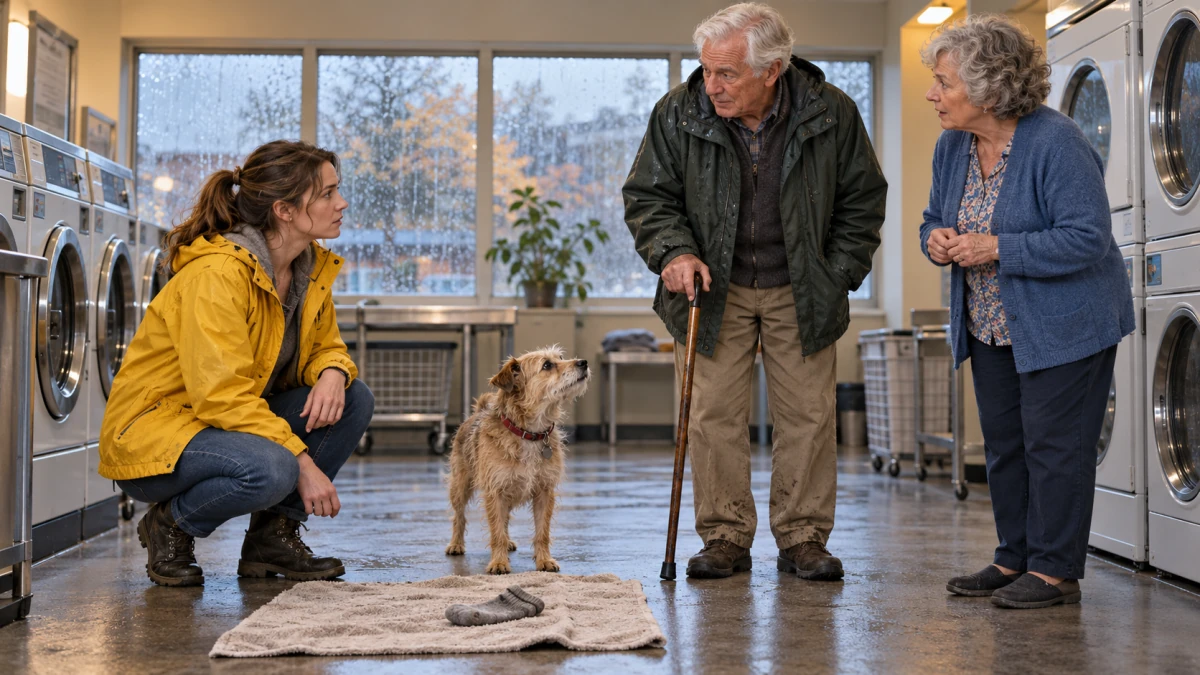
The dog came into the laundry room carrying somebody else's sock, and by morning two strangers had thanked me for finding him.
Both knew the crescent of white fur under his chin. Both knew he hated the garbage truck and would eat a green bean only if you pretended it was yours. Both said the little terrier in my photograph belonged at home with them.
Arthur called him Scout. Vivian called him Pip.
I was thirty-one, the maintenance worker at a Spokane apartment building with unreliable gutters, not a person qualified to divide a living thing between two lonely people. But the rain was coming sideways that Thursday night, and the dog had followed me through the service entrance before I could shut it.
His red collar had no tag. His white muzzle smelled faintly of peanut butter. When I crouched to read the worn buckle, he put the stolen sock in my lap.
I posted a photograph in the neighborhood group and gave him water in a clean paint tray. By seven the next morning, Arthur had sent me a picture of the same dog asleep against a woman's blue slippers. Vivian sent a veterinary receipt dated three weeks earlier.
Then Arthur arrived with a cane and a dark green jacket darkened further by rain. A woman in a blue cardigan came through the other entrance carrying a familiar red leash.
The dog scrambled off his towel. He ran to Arthur, sneezed against his knee, then turned and pressed himself against Vivian's ankles.
Neither person looked relieved anymore.
“Your son said you didn't want him back,” Vivian said.
Arthur closed his hand around the handle of his cane.
“He told me you wouldn't answer,” he said.
The washing machine behind us hit its spin cycle, making the folding table shudder. I moved the water bowl before it slid off. Much easier than knowing where to look.
“Ben,” Vivian said. “Ben Mercer.”
“I'm Arthur Mercer.” He looked from her to the dog. “And I never said that.”
She had one hand inside her cardigan pocket. The other gripped the leash so tightly that its loop flattened between her fingers. Arthur reached toward the dog, but bending put him off balance. I pulled out a plastic chair. He thanked me without sitting.
“Let's get out of the doorway,” I said.
It was not a verdict. Still, both of them looked at me as though I had begun a hearing. I wished I had left the neighborhood notice at a photograph and a telephone number instead of adding, Safe with me.
Our laundry room was warm because the dryer vent needed cleaning. I had worked late to deal with a flooded basement storage cage, which was why I was there when the terrier appeared. Now it was Friday, and a tenant upstairs had no hot water. My phone kept vibrating against a box of lint traps.
Vivian slipped the red leash onto his collar. Arthur's mouth tightened.
“Just so he doesn't run,” she said.
“He never used to run.”
“Neither did I,” I said, before I could stop myself. “Then somebody left a gate open.”
That made Vivian look at the floor. She explained that her porch latch had failed in the storm. She had gone to retrieve a package and the gate had blown against her grocery cart. She had searched until midnight, then started again before daylight. Her trouser cuffs were muddy.
Arthur had not known the dog was missing. His barber had seen my post and sent it to him. Arthur lived six blocks away, in a duplex with a concrete ramp and a porch he had painted every second summer until the last one.
“He was with you?” he asked Vivian.
“Since February.”
He stared at her. It was October.
The dog sat on my boot, pinning the loose lace with one paw. His breathing had settled into a small companionable snuffle. Whatever names we used, whatever the adults had misplaced, he appeared to believe breakfast was the urgent problem.
I had bought plain canned dog food at the corner store after checking that nobody had already fed him. Vivian said he usually ate a sensitive stomach formula. Arthur said chicken upset him. For the first time they looked at each other rather than at me.
“The lamb one?” Arthur asked.
She nodded. “Purple bag.”
He sat down then.
We fed a small portion from the food Vivian brought in her tote. Neither objected when I set it halfway between their chairs. I told them I would not hand the dog over while they were disputing where he should go. I also could not keep him indefinitely. My apartment lease allowed visiting pets, not an unannounced permanent resident, and my shift was beginning.
“I'm not asking you to solve this,” Vivian said.
Arthur looked up sharply. “But you've had him eight months.”
“Yes. And I didn't know your name until five minutes ago.”
There was no sensible way for that to be true, yet her astonishment did not look performed. Arthur took out his phone. His hands were broad, with thick joints, and he held the device as carefully as a hot bowl.
Ben answered on the fourth ring. Arthur put him on speaker without asking whether we wanted to listen.
“I found Scout,” he said.
For a second there was only the sound of a turn signal.
“Dad, what do you mean?”
“I'm sitting with Vivian.”
The signal stopped.
Ben said he needed to park. I pointed to the phone and asked Arthur to take the call off speaker. It felt wrong to make the laundry room into a stage before anyone had agreed to be on it. He nodded, and for a few minutes we heard only his half of the conversation.
“I asked every week.” Then, more quietly, “You said she was moving.”
Vivian stood so suddenly the dog lifted his head from his bowl. She went to the window, where a dryer sheet had stuck to the wet glass outside. She was sixty-six, a retired elementary teacher, she had told me in her first message. Nothing about the information helped me understand her face now.
Arthur finished by saying Ben should come at lunchtime. When he hung up, he looked exhausted rather than angry.
“I fell in February,” he told us. “On the back steps. Broke my hip. There were complications. Rehab took longer than anybody said.”
His wife, Ellen, had died the year before. Scout was eleven now. They had adopted him together from a rescue outside Spokane when he was two, a dog with an adult size and a puppy's opinion of socks. Arthur could not have him at the rehabilitation center. Ben lived in an upstairs rental with a landlord who did not allow dogs.
“He told me a woman from his office knew someone,” Arthur said. “Somebody who could help until I was home.”
“My friend Lorna,” Vivian said. “She used to do payroll with him.”
Arthur had come home in June. Ben said the temporary carer was visiting family and would call when she returned. Later there was a move, then a difficult week, then a suggestion that perhaps Arthur should recover more before taking responsibility for a dog.
“I thought he was looking after me,” Arthur said. “Every time I pushed, he looked like I was hurting him.”
Vivian turned from the window. “I asked to speak to you. He said the subject made you too upset.”
She had received a bed, two bowls, and an almost empty bag of kibble. Ben called the dog Scout, but said he did not seem to answer anymore. Vivian had called him Pip after he squeezed behind her piano on his first evening. He came out when she said it, and the name stayed.
“He answers to the refrigerator opening,” Arthur said.
For an instant they almost smiled. Then Vivian looked down at the leash in her hand.
I offered to keep him until after my shift, with permission from my building manager, provided someone brought his bed. I had an empty workroom adjoining the office where he could stay with me between repairs. It was not a kennel, but it was quiet, heated, and away from the exterior doors.
They both agreed. Vivian offered to bring the bed. Arthur asked whether he could come back at noon even if Ben was late. I said yes, then made clear they would need another place to talk. Tenants deserved a laundry room that did not contain our entire neighborhood's distress.
When they left, the terrier watched each doorway. He gave one sharp bark after Arthur and a softer whine after Vivian. Then he lay beside my toolbox and slept so soundly that his feet twitched.
I repaired a shower cartridge, cleared the gutter above the east stairs, and learned that it is possible to worry about a stranger's dog while arguing with a seized brass fitting. At eleven, Vivian returned with his bed and a container of measured food. She had also brought a towel embroidered with a small yellow duck.
“That was mine already,” she said, as though I might accuse her of manufacturing a history.
“You don't have to prove you like him.”
She set the bed down. The dog climbed into it without circling.
“That's the trouble,” she said. “I think I do.”
She asked whether I had ever lost someone. I told her my mother lived in Yakima and called too much, which was not an answer but was what I could manage. My own father had left when I was nine. For years my mother had translated his absences into kinder reasons. Busy season. Car trouble. Maybe Sunday.
I did not tell Vivian that. It would have made Ben into somebody I already understood, and I did not know him yet.
At noon Arthur arrived carrying a canvas bag. Inside were a rubber ball, medication records from before his fall, and the blue slippers from the photograph. He apologized for bringing the slippers. They had been Ellen's; he had grabbed them from the hall closet without thinking.
“He liked to sleep between them,” he said.
Vivian sat on the edge of a chair. She did not tell him that the dog now slept beside her sewing basket. Her silence was the first generous thing I saw either of them choose when generosity cost something.
Ben came at twelve twenty, still wearing his grocery distribution badge. He was forty-two, with wet hair flattened where a cap had been. He crouched immediately to greet the dog, which made both older people stiffen.
“Before you explain,” Arthur said, “did you tell her I didn't want him?”
Ben kept scratching the terrier's neck.
“I said you might not be able to manage.”
“Did you tell me she was moving?”
Ben stood. “I thought we should talk somewhere else.”
The community room at Arthur's duplex complex was unavailable. Vivian did not want to invite anyone to her house yet. I had half an hour left of my lunch break, and the rain had stopped. We went to a covered picnic table behind the building, where the concrete was dry enough for the dog's bed.
I brought my sandwich. That small declaration of an ordinary need steadied me. I was not a mediator. I was a woman missing lunch because a dog had come through a door.
“I'll stay a few minutes,” I said. “But you have to speak to each other, not through me.”
Ben sat opposite his father. Vivian remained at the end of the bench, the leash folded in her lap. A delivery truck rattled past the alley. The terrier lifted his head, then put it down when neither older person moved.
Ben began with the hospital: calls during work, a discharge date changed twice, a father who refused help in the bathroom, bills he could not understand. Arthur interrupted to say he had never asked Ben to handle everything.
“You didn't ask anyone else either.”
That stopped him. Rain dripped from the roof behind us.
Ben had found Vivian through Lorna when the first arrangement fell apart. He said until Dad's home. Vivian remembered asking whether that meant a month or six. He remembered answering that nobody knew. There had been no conversation about what would happen when Arthur returned.
“Then he was doing well at your place,” Ben said to Vivian. “And Dad was having trouble getting out of the chair.”
“I still have trouble sometimes,” Arthur said. “That wasn't permission to give him away.”
“I didn't give him away.”
Vivian's voice was very level. “You told me to stop worrying about a visit. You said he'd decided to let Pip stay with me. In August.”
Ben looked toward the alley.
“I thought if you both got used to it, nobody would have to be the bad person.”
Arthur leaned on his cane with both hands. “Except the woman you made up for me. The one who kept my dog and wouldn't answer.”
Vivian opened her mouth, then shut it. I could see the matching invention in her face: an old man relieved to be rid of a responsibility, unwilling to say so kindly.
“I didn't want to take him from her,” Ben said. “She'd been alone too.”
“You could have asked me what I could bear,” she answered.
He apologized then, but his first apology was mostly a description of being frightened. Arthur listened, rubbing one thumb along the cane handle. When Ben said he only wanted everyone safe, his father shook his head.
“I know you were scared. That doesn't make the things you told us true.”
My lunch break ended. I put the sandwich wrapper in my pocket and told them they could continue at the table, but the dog was staying with me until they had a safe plan for tonight. They agreed, though Ben looked as if he wanted someone to declare that the worst was over.
At three, Vivian knocked on the workroom door. Arthur was beside her. They had exchanged telephone numbers. It sounded absurdly small for a discovery that had hurt so much.
They wanted to call the veterinary clinic together. Vivian had given permission for the clinic to discuss the recent care she had arranged; Arthur would do the same for earlier records. I offered my office phone, then stayed outside with the dog while they spoke.
The microchip was registered to Arthur. The information had not been updated since Ellen died, and the first number was disconnected. That explained the missing connection, not what the dog's next home should be. Arthur said this himself when they emerged. Vivian's expression changed a little when he did.
The clinic confirmed the same old shoulder stiffness, the same food sensitivity, and the refill Vivian had collected recently. There was no secret medical disaster waiting to settle the dispute. The dog needed steady walks, his usual food, and people who noticed when he was tired.
Arthur asked Vivian if he could see where Scout had been living. She said yes, but not as an inspection. Then she asked to see Arthur's ramp. They looked at me. I raised my hands.
“I'm fixing a dishwasher at four.”
Vivian laughed once, unexpectedly. “We can take him ourselves.”
They went in her car. Arthur left his canvas bag with me by mistake. When I lifted it onto a shelf, the slippers fell out, their soles bent in the shape of someone absent. I put them back without photographing them or making them into evidence.
That evening they brought the dog to my building again, but only to retrieve the bed. He would stay with Vivian that night. Arthur had visited her little bungalow, seen the repaired porch latch, and watched how the terrier found the warm strip beside the radiator. Vivian had visited his duplex and seen a low threshold, a fenced side yard, and a chair positioned so he could stand without twisting.
“We haven't decided,” Arthur said. “Tonight isn't forever.”
Vivian nodded. She did not look victorious. Arthur did not look defeated. They looked like people carrying opposite ends of something heavy through a narrow door.
On Saturday morning I washed the borrowed paint tray and returned to the business of a building that never stopped leaking somewhere. I expected not to hear from them again. Then Arthur called to ask if I could return his bag. I offered to leave it at his door after work.
He asked whether I could come inside for coffee. I nearly said no. Something in his careful voice made me say I could stay twenty minutes.
His living room held plants in varying states of optimism. A photograph of Ellen stood beside a stack of library books. There was no shrine of dust, no theatrical disorder. He had dishes drying beside the sink and a folded exercise sheet under a coaster.
“Ben thinks if something hurts me, it must be prevented,” he said. “Sometimes it just has to hurt.”
He set out a second cup, then put it back because I had asked for water. The movement seemed practiced in a way that had not yet become natural.
Scout had been Ellen's idea. Arthur had wanted a larger dog, something that looked less like a misplaced shaving brush. Ellen brought home the smallest terrier at the adoption event and said he looked like a man who needed a job.
“He used to follow her while she watered these,” Arthur said. “After she died, he followed me. I thought that meant I was doing all right.”
He showed me a photograph from last winter: the dog standing on the bed while Arthur tried to make it. His laugh at the memory broke halfway through.
“You can miss him and still ask what works now,” I said.
“I know. I just don't want everyone to confuse that with not wanting him.”
He had been walking farther. His neighbor could help occasionally, not every morning or in ice. Ben had offered daily visits, but the distribution center changed his shifts often. Arthur did not want another plan built around promises his son could not keep.
He could manage a short afternoon walk. A startled dog pulling toward a garbage truck was different. Before the fall, he would have dismissed the difference. Now he rubbed his hip and admitted it mattered.
At Vivian's suggestion, they were going to spend Sunday afternoon together at his place with the dog. Not to prove anything. Just to see a whole afternoon, including the inconvenient parts.
I left before twenty minutes became an hour. At the door Arthur thanked me for not calling him a sweet old man in the neighborhood group. I had not realized how easily kindness could have become another way of making him small.
Sunday brought sunlight and a wind that sent yellow leaves along the gutters. Vivian later told me she had nearly canceled. Arthur later admitted the same. Neither wanted to visit a future in which the dog went home with somebody else.
They made grilled cheese. Arthur dropped a piece of crust, and the terrier appeared under the table as if summoned by a bell. Vivian stopped herself from commenting. Arthur picked it up before he could eat it.
“Stomach,” he said.
“I know,” she answered, and this time it did not sound like an argument.
They walked one block together. Vivian held the leash while Arthur used his cane. At the corner the dog paused at a hedge he remembered. Arthur told Vivian which neighbor had planted it and how Ellen had traded tomato seedlings for its first cuttings. He had not told anyone that story in months.
Back inside, the dog drank, turned twice on the rug, and slept. Vivian did not fill the silence with reassurance. Arthur asked whether she had changed the name because she disliked his.
“No. He felt frightened. I talked nonsense at him until he stopped hiding. Pip was just what came out.”
“He never liked the piano at our house either.”
She looked up. “Ellen played?”
“Badly. Enthusiastically.”
Vivian said she played badly too, but without the courage to be enthusiastic. They laughed, and then the laughter ended naturally. It did not establish a friendship or cancel the last eight months.
When Ben arrived, Arthur asked him to sit. He wanted him there for a decision, not to deliver it afterward. Vivian had suggested the dog could return to Arthur with her help. Arthur had suggested alternating weeks. Both ideas had looked fair in the air and less fair when they imagined the stairs, the handoffs, the dog's settled habits.
“I want him here,” Arthur said. “Wanting isn't the only thing I know.”
He asked Vivian whether she wanted to be the dog's primary home. Not for another unmeasured interval. For good, unless circumstances genuinely changed and they talked again.
Vivian cried, which made Arthur look away. Then she said yes. She did not say the dog had chosen her. She said she could manage his daily care, wanted to do it, and would not pretend Arthur had stopped mattering.
They settled on Wednesday afternoons at Arthur's, with Vivian handling the walk and driving. On Sundays Arthur could visit her if he felt up to it. There would be no automatic overnight stays, no schedule requiring either person to hide illness or exhaustion. A missed afternoon would get a direct call, not a message through Ben.
Arthur asked for the first Wednesday alone with the dog for an hour after their walk. Vivian hesitated. It was the hardest yes she gave. Arthur saw that and promised not to turn a visit into a refusal to let him leave.
Ben began to offer money for everything. Vivian said he could cover the gate repair he had helped postpone by saying he would do it later. Arthur asked him to come for dinner without arranging anyone's life first.
“And tell Lorna what happened,” Vivian said. “Your version, with the things you actually said.”
Ben nodded. He could not make either of them trust him by agreeing quickly. He would have to answer the next uncomfortable telephone call instead of inventing a better story.
On Monday Vivian came to collect the duck towel, which had fallen behind my workroom radiator. She stood with it tucked under her arm while I changed the batteries in a thermostat.
“I said yes too fast,” she said.
I put the cover back on. “Do you want to change your mind?”
“No. But I think he heard forever and I heard until I fail.”
She had retired from teaching the previous spring. She liked her quiet house, her Thursday bridge group, and the freedom to take a bus to Seattle to see her sister. During the last eight months she had canceled two visits because she believed a telephone call might arrive any day. Waiting had become its own responsibility. Now she feared that accepting the dog meant accepting Arthur's whole grief as well.
“I can feed Pip,” she said. “I can't make what happened fair.”
I told her that sounded like something Arthur needed to hear, not something I should carry to him. She pressed the towel between her palms. It was easier, she admitted, to be angry about Ben's silence than to risk a difficult call herself.
She made it from the bench outside my office. I could hear her voice through the screen but not her words. When she came back, she looked neither happy nor frightened.
Arthur had asked if she could explain the Seattle visit again. Then he said he did not want the dog boarded with him just to spare his feelings if that was unsafe. They would arrange a familiar sitter, with a practice afternoon first. He wanted to contribute to that cost, within what his pension allowed. Vivian could still travel. He could still miss his dog. Neither had to pretend those facts canceled each other.
“He said Ellen used to visit her sister without him,” Vivian told me. “He said they survived it.”
She smiled, then wiped her nose with a tissue instead of the towel. “I forgot he had a whole life before I met him.”
That evening Arthur called Vivian again. He had opened the closet to put Ellen's slippers away and could not finish. He did not ask her to bring Scout over. He asked whether she could stay on the telephone while he moved a box of winter boots off the shelf.
She told me about it later, carefully, without repeating the private things he had said. She had sat on her kitchen floor with the dog beside her. Arthur moved the boots. Then he decided the slippers could remain where they were for another week. It was a decision, not a failure to obey somebody else's timetable.
Ben came Tuesday with a new hinge for Vivian's gate. She watched him install it, then opened and closed it herself several times. When he started to explain why he had not done it earlier, she handed him the screwdriver he had left in the flower bed.
“You can just finish this,” she said.
He tightened the last screw. Afterward he asked if she would send him the picture of the dog from his first week there. She said she would ask Arthur whether he wanted a copy too. No longer keeping separate versions of an ordinary photograph felt strange to both of them.
Arthur told me about the gate repair when I returned his empty food container. He was pleased, then caught himself praising Ben as though one fixed hinge balanced every invented explanation. He stopped and tried again.
“He did what he said he'd do,” he said.
It was enough for Tuesday. It would not be enough for every day, but it was something they could actually build on.
Before I left, he asked whether I could carry the heavier plant onto the porch. I said my shoulder was sore from the gutter work. He accepted that without disappointment, or at least without making disappointment my problem. We slid it a few inches together instead. For once, help had a size both people could manage, and nobody needed to disguise it as a rescue or a debt owed.
On Wednesday I carried a replacement smoke detector past Arthur's street and saw Vivian's car outside. The dog stood in the side yard, nosing a damp tennis ball. Arthur sat beneath the porch awning with a blanket over his knees. Vivian was helping him move a heavy planter away from the ramp.
They waved me over. I stayed at the gate.
“How's the tenant?” I asked.
“Demanding,” Vivian said.
Arthur held up the sock from my laundry room. Washed, this time. Vivian had bought a cheap pair so she could return the stolen one to its anonymous owner, but no tenant had claimed it. The dog still carried it as though it were important work.
I watched him drop it at Arthur's feet. He did not seem torn between identities. He seemed interested in whether the man would throw it.
Arthur bent carefully, using the porch rail, and picked it up.
“I didn't do right by you when I thought you were refusing me,” he told Vivian. “I said some things to my neighbor.”
“You didn't know.”
“I still said them. I'll tell her I was wrong.”
Vivian took that without making him reassure her again. She said she had also spoken unfairly about him to Lorna. They would each correct their own words. Nobody asked me to post an uplifting update.
Before leaving, I gave Arthur the smoke detector packaging to recycle because he had a bin beside the gate. It was a small, unimportant exchange. I liked it more than being thanked again.
That night Ben called me. He wanted to know if I thought his father was truly all right with the arrangement.
“Ask him,” I said.
“He tells me what I want to hear sometimes.”
“Then tell him you can hear something else.”
He was quiet long enough that I thought the call had dropped. Then he said he understood, though I was not sure understanding would always survive the next frightened moment. It did not have to arrive complete to become useful.
Three weeks later the rain returned. Vivian sent a photograph, privately: the terrier asleep beside Arthur's chair, his red collar bright against the old rug. Beneath it she wrote that Arthur had asked to skip Sunday because he was having lunch with a neighbor. He had called her himself.
I answered with a picture of the repaired service door closer. No more uninvited nighttime arrivals, I hoped. She sent back a laughing face and asked whether the lost sock's owner had appeared.
Not yet.
That evening my mother called while I was making eggs. I let them cool while she described her neighbor's new fence. When she asked whether I was tired, I said yes instead of fine. She did not fix it. She stayed on the phone.
Outside, a garbage truck groaned around the corner. Somewhere six blocks away, perhaps a small dog lifted his head. Somewhere else a woman could speak an old man's number directly into her phone. That was the improvement we had managed: not loneliness abolished, not a rightful owner crowned, but fewer closed doors between people who had been told they should not knock.
On the next Wednesday, I saw Arthur walking the short flat stretch beside his duplex. Vivian held the leash, loose enough for a dog to investigate a leaf. At the gate she paused, and Arthur said something I could not hear. She nodded and handed him the red loop for the last few steps into his yard.
“Scout,” he called.
“Come on, Pip,” she added.
The dog looked back at both of them, then trotted toward the open door.
Read next
One More Stop Before Home
The Obituary with My Phone Number
The Name on the Cake Boxes
The Landlord’s Son Told My Neighbor to Leave Her Shop by Friday—Then She Handed Me a Receipt Older Than He Was
Reading notes
Two strangers recognize one terrier, revealing a son's misleading assurances.
This is an original work of fiction. Characters and events are fictional. Explore public-domain books at Project Gutenberg or browse more stories on ReadStoryvia.