Original fiction
On this page
The Envelope in the Locker
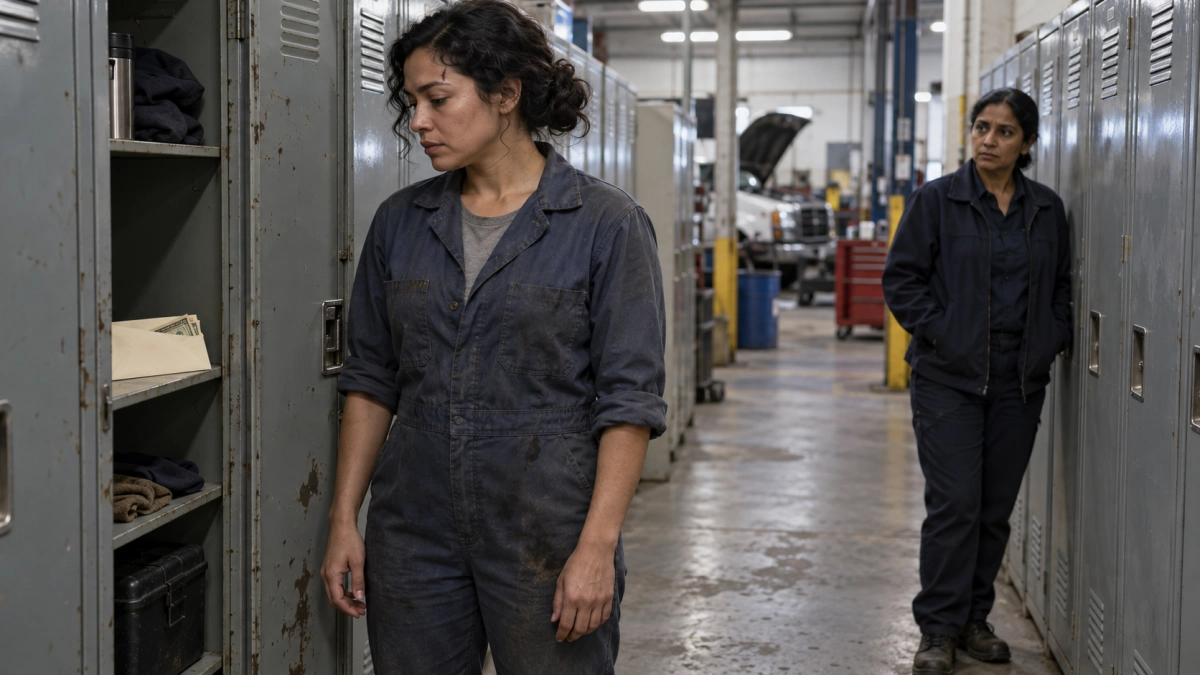
The envelope was already inside Lena Ortiz's locker when she arrived for the early shift, resting between her spare gloves and the photograph of a dog she no longer owned.
It was cream, unsealed, and thick enough to lift the gloves at one corner. A folded edge of currency showed through its mouth. On the front, someone had written only her first name.
Lena stopped with her hand against the locker door.
At the Dayton maintenance shop, people left things for one another all the time: borrowed sockets, grocery coupons, a sandwich someone had forgotten in the refrigerator. They did not leave money. Especially not the week the contractor's internal auditors were coming to ask why the records for city vehicles looked cleaner than the vehicles themselves.
Behind her, an air compressor started. She could feel the vibration through her scuffed brown boots. Her slate-blue coveralls smelled faintly of yesterday's work, and one dark curl had escaped the low bun at her neck.
She had seen an invoice on Tuesday for a cooling-system repair that, as far as she knew, had never happened. Her supervisor, Frank Danner, had called it an administrative delay. Her mentor, Walt Mercer, had told her to give him a day.
Now there was cash beside her gloves.
Lena withdrew her hand and called Priya Shah from the parts desk. She asked her to come to the lockers, without touching anything on the way.
Priya stopped at the end of the empty aisle in her navy work jacket. She looked from Lena's face to the shelf.
"Do you know where it came from?"
"No."
"Then let's keep it that way until someone records it."
Before Lena could answer, Walt appeared beyond the doorway.
He saw the open locker, the envelope, and Priya standing there.
"Don't make a big thing of this," he said.
Lena looked at the man who had taught her to recognize a failing bearing by listening with the radio off. His olive work shirt was buttoned unevenly at the collar. The gray mustache above his mouth moved once, as though he wanted to gather the sentence back.
"What is it?" she asked.
"I didn't say I knew."
"You said not to make a big thing of it."
Walt glanced toward Priya. "I mean don't decide what something means before you know."
That was good advice, offered at the wrong moment. Lena could not tell whether he was protecting her from a misunderstanding or asking her to help create one. She stepped away from the locker. Priya stayed where she could see it while Lena called the internal audit contact listed in the notice sent earlier that week.
June Park answered from the hotel where the audit team was staying. She asked Lena not to handle the envelope, not to invite more people to inspect it, and to stay nearby if practical. June would come with an HR colleague. Lena asked whether she should notify Frank. June said she would take responsibility for that notification. It was an ordinary sentence, but Lena felt herself stop holding her breath.
Walt said he had a truck waiting. He left without looking at either woman. Priya did not comment until his footsteps disappeared under the compressor's noise.
"You didn't put it there?" she asked.
"No."
"Good. That's the part I need to hear from you."
Lena had worked with Priya for six years. They were friendly without knowing much about one another's lives. Priya knew she brought leftover rice for lunch; Lena knew Priya's father called during every snowstorm to ask whether the loading bay was icy. Suddenly that modest familiarity seemed more dependable than the complicated loyalty she felt toward Walt.
June arrived in a dark coat with a damp umbrella. She did not produce a badge or make the locker aisle feel like a crime scene. She asked who had been present, wrote down the times, and requested permission to document what Lena had found in her own locker. With Lena and Priya watching, she photographed the envelope in place. Then she and the HR colleague recorded its contents and secured it according to their process. There were twelve hundred dollars inside and no note.
Lena asked for confirmation that she had reported it rather than taken possession of it. June said the record would say precisely that. She did not call the money a bribe. She called it unexplained cash. Lena respected the distinction even as she wanted somebody else to say the frightening word first.
The locker had no reliable lock. Several latches on that row had been damaged when the building flooded the previous spring. Staff had been told replacements were on order. The shop's ordinary cameras did not cover the locker aisle. June asked about access without pretending there was a secret recording waiting to resolve everything. Priya gave a statement about what she had witnessed. Lena described her arrival and the conversation with Walt, including his exact words and the uncertainty around them.
By seven thirty she was back in the workshop, standing beside a van whose owner needed it that afternoon. Frank came over carrying a clipboard. He was forty-nine and always seemed recently shaved, even at the end of a shift. He asked whether she was ready to discuss the maintenance question she had raised Tuesday.
"June is reviewing it," Lena said.
"I'm asking about a job, not a mystery novel."
She looked at the clipboard rather than his face. "Then show me which job you want me to work on."
He gave her an oil service that had nothing to do with the van. She accepted the assignment. Later she wrote down the change, without adding that it must have been punishment. She did not yet know whether it was. Keeping that uncertainty made her notes feel less satisfying and more useful.
At lunch, Walt sat beside her on the loading dock. He had a ham sandwich wrapped in foil, the same lunch he had brought for as long as she could remember. Seven years earlier he had walked her through her first difficult diagnosis without once taking the tools from her hands. When another technician mocked her careful diagrams, Walt had told him a drawing cost less than doing a job twice. She remembered that now because she wanted a way to look at him without seeing the doorway.
"I should've chosen my words," he said.
"Do you know who put it there?"
"No."
She waited.
"Frank gets scared about paperwork," he said. "He thinks every question is somebody coming for him."
"I'm not asking how Frank feels."
Walt folded the foil around the unfinished sandwich. "No. You're not."
Lena had first questioned the invoice while looking for a part number. Van twenty-seven had supposedly received a cooling-system repair on a Thursday when she remembered using its open engine bay to show a trainee where a leak might appear. She had tagged the vehicle for further inspection. The later invoice described completed labor and new components. The stock history showed no matching issue of parts. That alone proved little: parts could be purchased directly or recorded late. But the technician initials were hers, and she had not done the repair.
Frank had told her the office sometimes moved information between fields. Walt had promised to check the packet. Lena had given him a day because he had earned more than one day of trust. On Wednesday, he said he was still sorting it out. On Thursday, the audit notice arrived. On Friday, there was an envelope.
June asked to meet at two. Lena brought her personal notes, not a stack of company files taken without permission. She identified the work order and explained where the underlying records were kept. June arranged access through the office. She wanted the original entries, any revisions, supporting invoices, and the job assignment history. She also asked whether Lena had ever let another person complete her paperwork.
The question found something Lena had hoped was unrelated. In August she had signed a service checklist before the final inspection, expecting to finish it after lunch. Another urgent job arrived. Walt had finished the inspection, she thought, and the checklist remained under her name. She could remember asking him, but not watching him do it.
She told June. Her cheeks burned. It sounded like the sort of distinction people invented when they were caught.
"That needs looking at separately," June said. "It doesn't establish that you did the cooling repair. It does mean we need to check what that earlier signature represents."
Lena nodded, grateful and disappointed. Some childish part of her wanted reporting the envelope to make her entirely innocent of every other mistake. June offered no such bargain.
The following week, the shop acquired the unnatural quiet of people listening for their own names. Audit interviews took place in an unused training room. Frank kept working at first. So did Walt. Nobody announced a finding. Lena heard that the money was a gift from an old boyfriend, that it belonged to a customer, that she had staged the discovery to move into management. She had no old boyfriend who knew her locker number and no desire to manage the shop.
Priya told her not to answer every rumor. "Pick the one you can correct without feeding the others," she said.
Lena told colleagues she had reported unexplained money and had not accepted it. Then she went back to work. At home she called her younger brother, Daniel, who drove a delivery truck in Cincinnati. He offered to come up and stand in the parking lot looking menacing. She laughed for the first time all day. He admitted he would probably just ask whether everybody had eaten.
"Do you think I made it worse?" she asked.
"Worse than what?"
She had no answer. Worse than knowing somebody could put money beside her gloves and expect a particular response. Worse than being able to recognize a repair that had not happened and choosing not to recognize it. Worse than discovering the man who taught her pride in work had begun using pride as a reason to look away.
Three days later June asked about a handwriting entry beneath Lena's initials. Lena recognized Walt's angled sevens. She said she recognized his writing, not that she knew when or why he had written it. June showed her a copy of another work order bearing the same date. A vehicle listed as being in a repair bay had been dispatched off-site for most of that day. The dispatch record was ordinary business paperwork, not something somebody had secretly rescued from a shredder.
"Could work have happened before it left?" Lena asked.
"That's one of the questions," June said.
The answer reassured her. She did not want an auditor who took every mismatch as proof of the worst possibility. She wanted someone patient enough to find out which mismatches had explanations and which explanations required another false entry to survive.
Priya's records supplied a different piece. Three supposedly installed pumps had been credited back by the supplier. Frank had authorized the return but left the labor and parts on the billing summaries. Priya had assumed the adjustments reached accounts through another route. Now she asked the office to trace them. One had. Two had not. The fact that one was legitimate mattered as much as the others. It stopped the inquiry from treating the whole shop as a single dishonest machine.
Frank called Lena into his office after her second interview. The door stayed open. He told her an audit could damage everyone's jobs and that clients did not understand the difference between fraud and messy administration. Lena stood beside a chair with stuffing showing through the seat.
"Then we should explain the difference accurately," she said.
"You think you're the only honest person here?"
"No."
He seemed to have expected an argument. She gave him none. She said she would discuss concerns about her work with HR present if he wanted a formal conversation. He waved her out. That evening she forwarded a factual account of the exchange to June and the HR contact. The next morning HR asked Frank not to conduct individual conversations about the audit. The instruction was not a guarantee against retaliation, but it made the boundary visible.
On Wednesday, Walt asked her to walk outside. She said she would talk in the break room instead. He accepted. Through the window they could see Priya checking a delivery. Walt put both hands flat on the table, thick fingers spread as if bracing a panel.
"I signed work I didn't verify," he said.
There it was, smaller than her fears and large enough to change everything.
He had believed some jobs would be caught up before the next billing cycle. Frank said the shop needed to get through a difficult quarter. When the first missing work was not completed, Walt told himself the vehicle had probably been serviced elsewhere. Later he stopped asking. He had added completion dates to packets and allowed technician initials to carry forward from assignment sheets. He had not received a share of the invoices, he said. Lena did not know whether that was true.
"Why didn't you tell me Tuesday?"
"Because you'd look at me like this."
She turned her face toward the window. The warehouse across the lot had a broken downspout that overflowed every time it rained. For years somebody had placed a bucket beneath it. Walt had pointed out the stupidity once. A system that depended on a bucket, he said, was a system waiting for somebody to forget the bucket.
"Did you put the money there?" she asked.
"No. But Frank asked if you were having money trouble. I said your car needed work. I didn't think what he'd do with that."
Lena's old sedan needed a transmission repair. Walt knew because he had offered to help on a weekend. The offer had felt like friendship. Hearing her private worry repeated in connection with the envelope made her feel briefly sick.
"You need to tell June what you told me."
"I wanted you to hear it from me first."
"Now she needs to hear it from you."
He nodded. She did not promise to keep the conversation private. He did not ask, which was the first honest kindness he had offered her that week.
Walt gave an interview the next morning. Frank was placed on leave later that day. The announcement provided no explanation beyond the ongoing review. A temporary supervisor came from another location. Two vehicles with uncertain maintenance histories were held for inspection rather than sent out on the strength of a completed form. Other work was reassigned. Clients were told enough to arrange alternatives without being given employees' private statements. The shop lost time and money doing work it had already claimed to have done.
Lena inspected van twenty-seven with another technician. The old components were still there. They documented what they could observe and completed the needed work under the new supervisor's direction. Nothing exploded. No driver arrived to describe a narrow escape. The wrong was not less serious because ordinary checks had caught it before a dramatic accident. Somebody had paid for work, depended on it, and been given a record instead.
Her August checklist also came back. Walt had performed part of the final inspection but not every item. The vehicle had since received a proper service, and no immediate problem was found, but Lena's signature had claimed more than she knew. She received a written warning and additional documentation training. She asked to have the explanation attached: she had reported the mistake herself during the audit, and it was separate from the false cooling-system invoice. HR agreed to include those facts without removing the warning.
She went home angry. Not because she thought the signature was right, but because doing the right thing afterward had not restored the comfortable version of herself she wanted. Daniel listened, then said, "Sounds like they're finally taking signatures seriously. Yours too."
She told him he was annoying. He agreed and asked whether she needed help with groceries. They talked about his broken kitchen faucet until she could hear the rest of the day without grinding her teeth.
The source of the envelope took longer to establish. There was no fingerprint revelation. June compared the timing of staff access, reviewed the records available, and interviewed Frank more than once. Walt told her Frank had mentioned making Lena feel appreciated before the audit.
Frank first called that a joke, then described the cash as a private loan. There was no message requesting a loan, no agreement, and Lena had never discussed her car with him. Asked to explain why money had been placed in her locker without telling her, he eventually acknowledged placing it there to discourage further questions about the billing packets.
Lena learned that conclusion at the end of the review, not through a hallway leak. June and HR met with her to explain findings directly related to her complaint. They could not share every interview or every consequence. Frank's employment was ending. The organization was separately reviewing inaccurate invoices, client corrections, and possible recovery. Nobody asked Lena to predict what another authority might do. The review had established workplace misconduct; whatever followed would need its own process.
The cash remained documented while the organization resolved its handling with the appropriate advisers. Lena was not offered it as compensation, a reward, or money for her car. She had not expected to be. Still, it was strange hearing twelve hundred dollars discussed as an item when it could have changed the next month of her life. That was part of what made the envelope cruel: someone had calculated a pressure point and called the result generosity.
Walt received a suspension and lost the authority to certify others' work. When he returned, his assignment was limited and supervised. Some colleagues thought he should have been dismissed. Others blamed Lena for not protecting a man so close to retirement. She did not have access to all the factors behind the decision, and she stopped being drawn into debates that began with her obligation to forgive him.
He found her by the parts shelves on his first morning back. His mustache had been trimmed shorter. He looked older in a way she could not attribute to the hair.
"I told them the truth," he said.
"I'm glad."
"I know that doesn't fix it."
She waited, letting him finish without supplying a kinder ending.
"I don't know what to say now."
"Then don't say something because you need me to make you feel better."
He looked down, then nodded. She hated how hard the sentence had been to speak and how much she needed it spoken.
The week before that conversation, the temporary supervisor had held a meeting about the unfinished work. His name was Malcolm Reed, and he began by admitting he could not restore the schedule by asking everyone to work faster. He put the actual backlog on a board without employee names beside it. Seeing it made Lena angry all over again. For months they had carried the physical reality of those jobs while the summaries suggested they were finished. Now the unfinished work occupied a surface where management had to see it too.
A technician asked whether the clients would blame them. Malcolm said some would be angry, and he would not promise otherwise. He said explanations would come from the office, not from whichever mechanic happened to answer a phone. Lena felt a brief gratitude for being spared another invisible assignment. They were there to diagnose and repair vehicles, not improvise explanations for invoices they had not prepared. Priya asked who would answer questions about parts returns. Malcolm gave a name and wrote it beside the task. Nobody said they were all a family.
Afterward a senior mechanic named Ed caught Lena near the handwashing sink. He said Walt had helped more people in that shop than the auditors ever would. Lena turned off the tap before answering. "I know who helped me," she said. "I also know what he signed."
Ed shook his head. "People make mistakes."
"Yes. Mine is in my file."
That stopped him for a moment. He had not known about her warning, and she regretted how quickly she had offered a private consequence to prove she understood fairness. She told him she would not discuss the details. He apologized awkwardly, then said he was worried the place would close. She believed that fear. She shared it. But keeping the doors open by describing undone work as completed did not make the building safer for anybody who depended on the paycheck.
At home that evening, she found an old photograph from her first year at the shop. Walt stood beside a transmission assembly, pointing at something outside the frame. Lena was laughing, a pencil behind her ear. She had kept the photograph because it captured the moment work stopped feeling like a place where she needed permission to belong. She did not delete it. She moved it out of the small frame on her dresser and into a drawer. A good memory could remain true without being the picture she wanted to wake beside.
June's closing conversation also returned to the meaning of a signature. Lena had asked whether the new system would protect people from having initials carried across forms. June said a better system would reduce that risk, but nothing relieved an employee of checking what she certified. Lena found the answer irritating until she realized it was the same distinction she made when training: a tool could make the work easier without doing the judgment for you. She did not have to like the warning for it to identify something real.
She rewrote her personal routine on an index card. Check the vehicle identifier. Check the work performed. Record an unfinished item as unfinished. If another technician finishes it, record who did what instead of allowing a shared memory to stand in for a record. The card contained no inspirational language. She placed it inside her toolbox, where grease would eventually soften its corners. When a trainee saw it and asked whether she still needed reminders, she said yes. The admission cost less than the effort of pretending competence meant never needing help.
Priya had her own uncomfortable reckoning. One returned part had been sitting in her reconciliation folder longer than she liked to admit. She had assumed accounts would ask if something did not match. Accounts had assumed the shop would ask. Between the two assumptions, Frank had room to leave an invoice untouched. Priya told Lena this while they waited for a delivery, not as a confession requiring forgiveness, but because she was tired of describing the problem as something only one person had enabled. "I wasn't billing false work," she said. "But I was trusting a silence."
Lena understood. For a while she had treated Walt's assurance as a completed inspection. Not because she was stupid, and not because he had always been dishonest. Because trust saved time, and time was scarce. They talked about how to keep trusting people without using trust as a substitute for the check their own names promised. Neither had a neat answer. They agreed that asking for a record should not automatically mean accusing a colleague. A workplace that treated every question as betrayal would eventually make secrecy feel like loyalty.
When the locker repair finally appeared on the maintenance schedule, Lena asked why it had taken so long. The facilities coordinator showed her an order delayed twice because the wrong fittings had arrived. That explanation was mundane and supported by the packing slips. She felt almost sheepish for expecting another hidden motive. Reporting real wrongdoing had made ordinary mistakes look suspicious. She needed to recover the ability to distinguish inconvenience from intention, or the envelope would keep occupying more of her life than the person who placed it there had purchased.
She thanked the coordinator for showing her. He asked whether she wanted the old latch. She said no, then laughed because he looked relieved. There was no reason to preserve every broken thing as evidence of what she had survived. The useful record was already elsewhere. Her locker could become a place to keep gloves again.
On the bus, she began reading instead of replaying interviews. At first she managed half a page before her thoughts returned to Frank's office. Then a page, then several stops. She missed her car, but the journey gave her a boundary she had not expected: twenty minutes when she could not fix anything at the shop and did not need to answer for it. Daniel sent pictures of the faucet he had finally replaced. She sent a picture of her book, held open by a grease stain on one thumb.
Walt did not regain her trust through a single conversation. She watched him ask the new supervisor for clarification instead of filling a blank himself. She watched him decline to certify a job he had not checked. Those choices mattered, but she did not announce a running score. He was responsible for making them whether or not she noticed. Sometimes they talked about tools. Sometimes they had nothing to say. The silence was uncomfortable without being a punishment she had to end.
For the first time, she allowed their relationship to be smaller than it had been, and to exist without a promise about what it might become later. That was an honest limit, not a verdict on every year they had worked together. She could leave the future unwritten and still complete the task in front of her carefully, one verified step at a time, without signing for work she merely hoped somebody else had done.
There were practical changes. A person assigned a repair no longer appeared automatically as the person who had completed it. Revised entries kept their history. A second check was required for particular completed jobs, with enough time allocated to do it instead of an instruction to squeeze it in. Returns were reconciled with invoices through a named process. The temporary supervisor asked technicians to test the changes and report where they broke. Priya found three problems in the first afternoon.
"Good," he said, writing them down.
She looked so surprised that Lena almost laughed. They were used to being told a new system was finished before anybody who used it had touched it.
Replacing the locker latches took another two weeks. By then Lena had moved her spare gloves into her toolbox. She left the dog photograph where it was. The dog, Archie, lived with her former partner in Kentucky, and she missed him without wanting the relationship back. Not every absent thing needed retrieving. On the day the new latch arrived, she bought a plain combination lock and wrote the code somewhere she could find it without telling half the shop.
Her car remained unfixed until Daniel helped her compare estimates. She used savings for part, arranged the rest with the repair garage, and took the bus for nine days. Priya offered rides on the two mornings their schedules matched. Lena accepted without turning them into a test of independence. An honest favor had a shape: someone offered, someone could decline, nobody hid a price in the locker afterward.
One wet Thursday, Walt was waiting at the bus stop outside the shop. Lena considered walking past. He held up a folded maintenance diagram.
"The trainee asked where this line runs. I marked the wrong bracket. Caught it before I handed it over."
She looked at him. "Then correct it."
"Already did. I just wanted to say I heard myself about to tell him it didn't matter."
The bus appeared at the light. She did not tell Walt that admitting this made them even. It did not. But she understood why he had said it, and for once he had not asked her to carry the next step.
She remembered him telling her that a mechanic's first responsibility was not to sound certain, but to find out. He had not always lived by that advice. Neither had she. The failure did not make the advice worthless; it made the distance between saying it and doing it visible. She could honor what he had taught her without protecting what he had done. That understanding arrived without forgiveness or a speech, between the hiss of traffic and the bus driver's patient glance toward the curb. It was enough for this conversation. She did not owe him anything larger that evening.
"Keep catching it," she said.
He nodded and stepped back from the curb. She boarded, paid, and took a seat beside a fogged window.
Months later, the shop still had delays and broken equipment and people who grew defensive when a job ran late. The audit had not transformed them into better people by decree. Lena still liked fixing things more than discussing process. Yet when a completion box was blank, it could remain blank until the work was done. A supervisor might be irritated, but irritation was no longer accepted as evidence that the repair had happened.
On a Friday before the early shift, Lena opened her locker and found her gloves exactly where she had left them. The photograph leaned against the back wall. She took out a clean rag, closed the door, and turned the new lock. Across the workshop, a trainee was waiting beside an open engine bay with a question and a pencil.
Lena walked over. Before touching a tool, she asked him to show her what he had checked himself. He began carefully, then paused at something he had only been told. She thanked him for knowing the difference. Outside, the first city van waited for a repair that would happen before anyone signed its name.
Read next

The Shift Nobody Covered

My Name on the Presentation

The Last Shift at the Diner
The Hotel Manager Accused Me of Stealing Wedding Linen—Then I Asked Her to Read the Orange Tag
Reading notes
An envelope in a workplace locker unsettles a mechanic’s understanding of loyalty, credit and her mentor.
This is an original work of fiction. Characters and events are fictional. Explore public-domain books at Project Gutenberg or browse more stories on ReadStoryvia.