Original fiction
On this page
The Last Shift at the Diner
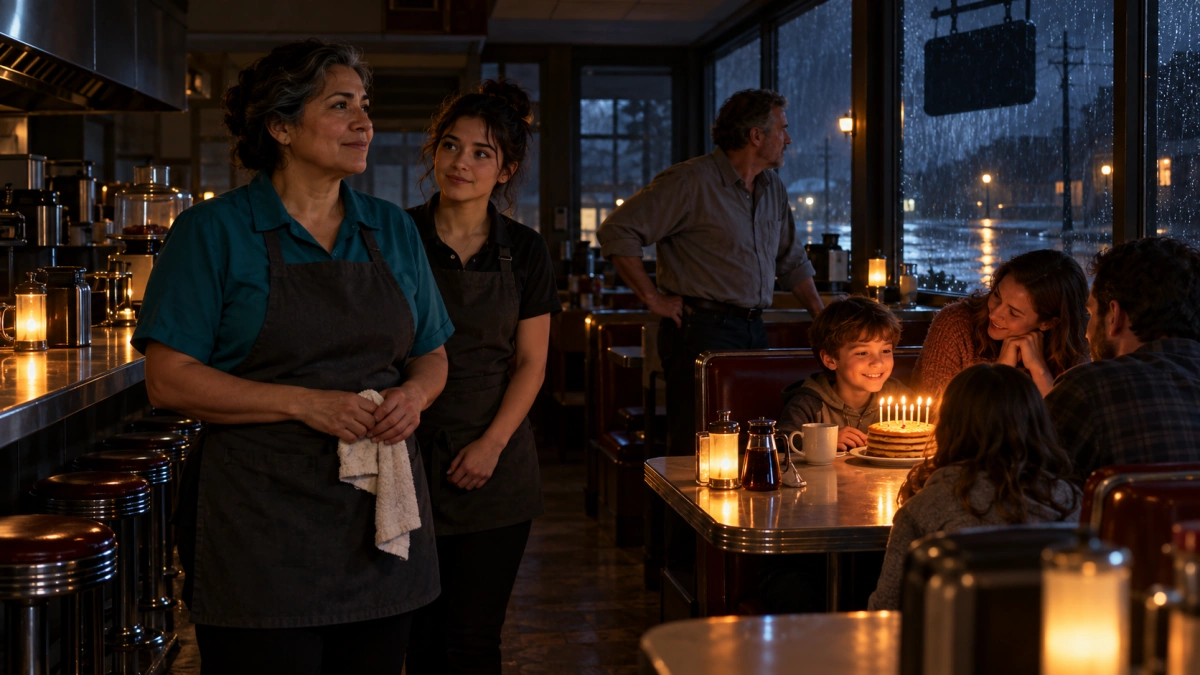
The lights went out while Rosa Medina was showing her replacement where the diner kept its birthday candles.
Across the counter, a little boy inhaled to blow out the seven flames on his pancakes. The exhaust hood stopped. The pie case went dark. Somewhere behind Rosa, a plate shattered.
"Nobody move yet," she said.
She had worked at Cedar Street Diner in Dayton for nineteen years. She knew which stools wobbled, which regulars needed help standing, and how long the emergency lights would last. What she did not know was why the woman she was training had been offered her entire schedule.
That morning, owner Dean Porter had said, "It's coverage, Rosa. You're moving into management. We talked about this."
They had talked about it for three years.
Now the new server, Tessa Ward, stood beside the register with a birthday candle illuminating her frightened face. Through the front windows, rain crossed the parking lot sideways. A dead traffic signal swung above the intersection.
Rosa turned off the coffee warmer and called to Luis in the kitchen. He was already shutting down the cooking line.
"Keep the refrigerator doors closed," she told him. "I'll check the tables."
Dean emerged from his office holding his phone above his head, searching for reception.
"We can still do cash," he said. "Rosa knows how to keep us running."
Tessa looked at her. "He told me you'd be leaving the floor on Monday."
Monday was four days away. Rosa had no new contract, no new pay rate, and no management schedule. At home, her sixteen-year-old son had two tickets to his school concert beneath a magnet on their refrigerator.
Dean moved toward the locked front door.
"Don't turn that sign," he said. "People need somewhere to go."
Rosa put her hand over the switch for the OPEN sign, although it was already dark.
"Then we decide what we're actually offering them," she said.
Dean stared at her hand as though she had placed it over his mouth. For a moment, only rain spoke. Then the boy at the counter said he had forgotten to make a wish, and his mother laughed too loudly. Rosa carried a flashlight to them, setting it upright in an empty water glass. "You can save it," she told him.
"Some wishes need better weather." His mother asked whether the pancakes were safe to eat. They had come straight from the griddle before the outage. Rosa said yes, then asked Luis to confirm that nothing else would leave the kitchen until they had assessed what they could safely serve.
Luis came through the swinging door, wiping his hands. He had shut off the burners and other cooking equipment. With the powered ventilation down, the kitchen was closed for cooking. He would monitor refrigerator temperatures without needlessly opening doors and follow their food safety procedures.
"I'm not guessing because someone wants eggs," he said. Dean made a motion for him to lower his voice. Luis did not. Tessa found the emergency flashlight by the hostess station because Rosa had shown her that drawer before the candles. She moved it toward the hallway, where an elderly customer was trying to find the restroom.
Rosa asked that customer, Mr. Keene, to wait while she checked the route. The backup lights worked, but a damp patch spread beneath the side entrance. She blocked that entrance with a chair and a handwritten notice, leaving the clear front exit available. Dean objected to the chair looking unwelcoming.
"So would an ambulance," Rosa said, and immediately wished she had sounded less sharp. She was not trying to win a conversation. There were fourteen customers, four employees, and rain coming under a door. Her mind wanted a list because a list was easier than admitting how angry she already was.
The fourth employee was June, seventeen, who washed dishes after school. She had one earbud tucked beneath her apron strap and a college application open on her phone. Rosa asked her to put the phone away only long enough to call home. "Tell your dad where you are.
Then help me dry this floor." June's father worked nights and slept through most afternoons. He answered on the third call. Rosa heard the girl's voice grow younger when she said she was fine. On ordinary days, Dean called them his diner family. Rosa noticed that the actual families were the first people everyone wanted now.
The phone network returned in brief bursts. The utility reported a widespread outage without a reliable restoration time. Dean suggested borrowing a generator from a neighboring garage. Luis asked who would install it, where it would run safely, and what equipment it could actually support. No one had answers.
Rosa said they would not improvise power connections or run an engine near doors and windows. Dean pocketed his phone. "You always make everything sound impossible." She looked at the candles, now extinguished on the birthday plate. "Not everything. Just the things we don't know how to do safely." Tessa quietly wrote NO HOT FOOD on a pad.
They offered the customers unopened bottled water and the packaged crackers stored outside refrigeration. Nobody would be charged for the water. People could finish food already served, settle later if card payments were impossible, and leave when they felt able to travel. Anyone waiting out the worst rain could sit in the dry front section while the emergency lighting remained adequate.
Dean wanted coffee from the insulated airpots sold at the usual price. Rosa checked when it had been brewed and what they could reasonably offer without turning the temporary shelter into a restaurant pretending to function normally. "No new meal orders," she said. "No promises we can't keep."
The birthday boy's name was Owen. His mother, Celia, worked at the tire warehouse two blocks away. She had collected him from school during her lunch break because dinner would be with his father. "This was my birthday part," she explained, embarrassed by the explanation.
Tessa knelt beside the booth and asked Owen to design the restaurant they should open on the moon. He said every booth needed a seat belt and the pancakes should float. While he drew on a placemat, Rosa brought Celia a clean takeout box. Nobody sang. Somehow that felt kinder than insisting the day remain cheerful.
Dean stood near the window recording a short video. In his phone screen, Rosa could see her own back and Tessa crouching beside Owen. "Cedar Street Diner never quits on Dayton," he said. "We're keeping the doors open for our neighbors." Rosa waited until he lowered the phone. "We're not open for service." He waved toward the seated customers.
"You know what I mean." She did know. For years, she had translated his generous language into actual labor. Staying late became caring. Taking calls at home became leadership. Training the nephew who lasted eleven days became an investment in her future. The future kept moving away whenever payday arrived.
Tessa approached while Dean returned to his office. "I didn't know," she said. Rosa wanted to believe her, and resented that belief required effort. Tessa was thirty, with a dark braid and a pale line where a wedding ring had been. She had arrived wearing new nonslip shoes and carrying a notebook divided with colored tabs.
Rosa had mistaken the notebook for confidence. Now she saw how carefully Tessa held it, as though organization could prevent a bad thing from happening twice. "What exactly did he offer you?" Rosa asked. Tessa took out the folded schedule she had brought from her interview.
There were Rosa's opening shifts, Tuesday through Saturday. There was her usual station, the six booths along the windows. Tessa's hourly rate was the same tipped base rate Rosa received. Beside the schedule Dean had written, TRAIN WITH MARA, THEN TAKE OVER. Under that, in smaller letters, he had added, MARA MOVING UP.
Tessa said she had turned down warehouse work because the hours would let her collect her daughter from aftercare. "I can't do evenings," she said. "I told him before I accepted." Rosa gave the paper back without folding it. It seemed important that Tessa should be allowed to keep the shape of what she had been promised.
Rosa had not always wanted to manage a diner. At twenty, she had wanted to repair antique furniture. There had been a course at the community college and a borrowed truck and then a baby whose father drifted west in installments: first for work, then for space, then permanently. Cedar Street Diner's morning shift had fit around childcare.
Dean's mother, Ruth, had owned the place then. Ruth paid promptly, never called an unpaid meeting a favor, and gave Rosa a winter coat without mentioning it afterward. When Ruth died, Rosa stayed because grief made loyalty feel like something solid you could carry into a room.
Dean inherited the lease, the equipment, and his mother's talent for remembering names. He did not inherit her comfort with saying no. He gave customers discounts while telling Luis that labor costs were killing him. He sponsored a Little League banner and postponed replacing the leaking side door.
He had offered Rosa management after she covered his six weeks away following knee surgery. There would be a raise, regular hours, and authority to arrange coverage. First they needed a better summer. Then they needed to get through winter. In March he said the accountant wanted to review things. In July he said she was practically managing already.
At home, practically did not pay the car insurance. Her son Eli had learned not to ask whether she was coming until the day itself. That morning he had stood in the kitchen holding his trumpet case, watching her search for her keys. "It starts at seven," he said.
"I know." "You said you'd ask off." "I did." "Asking and being off aren't the same thing." She had told him not to get smart, then spent the drive to work hearing how calmly he had spoken. The concert tickets remained beneath the refrigerator magnet because neither of them wanted to test the answer by putting one in her purse.
By three, the rain had eased enough for Celia and Owen to leave. Owen gave Tessa his moon restaurant drawing. Tessa thanked him as seriously as if he had paid a bill. Mr. Keene's niece arrived to collect him. June's father called again and arranged to pick her up at four, her scheduled finishing time.
Luis used the diner phone while reception held, telling his brother he might be home early. In the office doorway, Dean told Rosa they should use the empty afternoon for a deep clean. "Everybody's here anyway." She asked whether he intended to keep them clocked in. He frowned. "It's an emergency. We all have to contribute."
"They are contributing," Rosa said. "They're working." Dean lowered his voice and mentioned how much food he might lose. She could imagine the cold shelves, the invoices, the empty register. She did not think his fear was fake. That made the conversation harder, not easier. If he had been a monster, leaving would have required less grief.
"Then send people home when there's no safe work left," she said. "Don't ask them to donate their wages." He looked past her toward Tessa. "We should talk privately." Rosa stayed where she was. "We can talk about my job privately. Their time isn't my decision to give you."
Luis had heard enough to step forward. "I stay until the food is handled according to procedure. On the clock. Then I leave." June nodded, although nobody had asked her to announce anything. Dean said of course nobody was being forced to work free, with the wounded expression he wore when someone repeated his actual request without its soft wrapping.
Rosa felt the old impulse to smooth it over. She could say they were all tired, bring him a glass of water, make the employees feel less awkward. Instead she checked the hallway lighting. There were things worth using her competence for, and things it only helped conceal.
The last customer left at three thirty. They closed the front door to new arrivals, keeping it usable as an exit, and posted a clear closure notice. Dean wanted the word TEMPORARY underlined. Tessa underlined it once. Luis continued the food checks and explained which stock could remain safely stored and which decisions would depend on time and temperature.
He would not declare everything good because it still felt cool. Rosa called the evening server to say the diner was closed and Dean would confirm whether she should report if power returned. She handed the phone to him rather than making that promise herself. It felt oddly like refusing a dance step.
When June's father arrived, Dean asked whether she could wait another hour. June looked at Rosa. Rosa looked back without rescuing her. The girl swallowed. "I finish at four. My dad is here." Dean said he supposed they could manage.
June took off her apron with a relief that made Rosa ashamed of all the times she had taught younger workers that being indispensable meant never leaving. Outside, June's father lifted a hand through his windshield. Rosa lifted hers. She remembered Eli at nine, doing homework in the back booth while she promised they would go home after one more table.
Tessa found her near the empty pie case. "I can leave," she said. "I mean leave the job. I won't take somebody's hours." Rosa had been waiting all day for someone to offer her something she could accept without calculation. This was not it. "You need those hours." "So do you." "That doesn't make it your fault." Tessa ran her thumb along a chipped edge of laminate.
She explained that her daughter, Wren, was six. Her former husband worked unpredictable construction jobs and could not reliably collect her. The warehouse offer had paid more, but the shift started before school opened. Taking this diner job had been a choice between two kinds of insecurity.
Rosa told her she would finish the training she had been assigned, during paid hours, if Dean kept both of them scheduled. She would not teach her to answer work calls over dinner or buy supplies with her own grocery money. Tessa smiled briefly. "Those weren't in my notebook." "Don't add them." It was the first easy moment between them.
Then Dean called from the office, asking Rosa to come in. On his desk stood a framed photograph of Ruth beneath a faded paper crown from an old customer appreciation day. Rosa had made that crown. One point bent forward over Ruth's forehead like a crooked blessing.
Dean offered her the chair. She remained standing because sitting would have made it too easy to stay through another long explanation. "Today proves what I've been saying," he began. "You're the heart of this place." She waited. "I need you to help get us back on our feet. Come in tomorrow morning, work out the reopening, coordinate deliveries.
We can settle the management details after the weekend." "What rate tomorrow?" "Rosa." "What hours? What authority?" He leaned back. "I can't conjure money during a blackout." She said she was not asking him to conjure anything. She was asking him not to call unpaid uncertainty a promotion.
He rubbed his knee, a gesture she knew from painful days and uncomfortable conversations alike. "You think I don't remember what you've done?" "I think remembering is easier for you than paying for it." The words came out more quietly than she expected. Dean looked at the photograph.
"Mom trusted you." "Your mom paid me for the work she asked me to do." Outside the office, Tessa moved a chair. The ordinary scrape helped Rosa breathe. Dean said he could offer a weekly stipend for being available, once things stabilized. She asked for an amount. He spread his hands. The empty gesture settled something she had kept deliberately unsettled for years.
She said she would finish at five, as scheduled. She would work her posted shifts through the following Saturday if they remained available. After that she would not continue without a definite paid role and hours they had both agreed to. "That's an ultimatum," he said.
"It's a date." He asked whether she was threatening to leave in the middle of a crisis. She looked around his office, at the extra coats on a hook and the stack of unopened advertising flyers. She had spent nineteen years learning where things belonged here. "I am telling you when I stop being the answer to every crisis."
At five, the power was still out. Luis had completed the necessary checks and arrangements for the closed kitchen, with Dean responsible for further monitoring and reopening decisions. Nothing questionable was being sold or handed out to avoid a loss. Rosa wrote down the unfinished practical tasks for Dean, not a secret manual of everything she knew. Tessa clocked out beside her.
Dean stood by the entrance. "Tomorrow?" he asked. "My next scheduled shift is Saturday," Rosa said. "Call me if you have an actual offer. I won't be coming in to discuss the possibility of discussing one." Her voice shook on the last word. Leaving did not make her feel powerful. It made her feel unemployed in advance.
She drove home through neighborhoods where porch lights were beginning to return. Her own block had electricity. Eli was at the kitchen table polishing a trumpet valve. When he saw her, he checked the clock. "Did something happen?" She almost told him the whole story before taking off her shoes. Instead she asked what time they needed to leave.
"Six fifteen," he said. "Parking's bad." She put one ticket in her purse and the other on the table. Then she took the chicken she had planned for dinner out of the refrigerator. It was still properly cold, in a house where the lights had never failed. She was absurdly grateful for that simple certainty.
At the concert, Eli looked for her before lifting his trumpet. She raised her program, not waving enough to embarrass him. His school band missed the same entrance twice. A clarinet squeaked. The boy beside Eli turned a furious red.
Rosa loved the performance with an intensity that startled her, not because it was perfect but because she had arrived before it began. Her phone vibrated during the second piece. Dean had sent a photograph of the diner lights glowing again. Under it he wrote, We made it through. Need my right hand at six tomorrow. She switched the phone off without answering.
The next morning, fear woke her before her alarm. She opened the household budget on the back of an envelope, then closed it because she already knew the numbers. Rent did not become negotiable because she had found a boundary. She called the community employment center and asked about daytime food service work.
The counselor mentioned a retirement apartment complex looking for a dining attendant, a school kitchen with a waiting list, and an appliance warehouse cafeteria seeking a breakfast cook. Rosa had never been the primary cook. She said so. Naming what she could not do felt unexpectedly related to naming what she would no longer do for free.
She submitted two applications from the library because her old laptop kept freezing. The retirement complex, Maple Court, offered fewer hours than she needed, but the starting rate was fixed rather than tipped, and the early shift ended at two thirty. She attached a resume that looked painfully small after nineteen years in one place.
Customer service. Training. Opening procedures. Under supervisory experience she stopped typing. She had supervised plenty of work without ever being given the title or authority. Finally she wrote exactly that she trained new staff and coordinated floor service. She did not need to inflate her history to justify taking it somewhere else.
Dean called at noon. The diner had reopened after the necessary checks, with a shorter menu and a shipment due the next day. "People are asking for you," he said. She said she would be there Saturday. He offered the manager title immediately, with the raise to follow in a month. She asked whether the role would have a guaranteed wage and a defined schedule now.
Dean said she was making trust complicated. "Trust has been doing all the work," she answered. He went quiet. She could hear dishes clinking behind him. "I've got customers," he said. "So do I, when I'm on shift." They ended the call without saying goodbye.
Saturday was worse than the outage. With electricity, there was no shared emergency to hide behind. Tessa carried coffee to the window booths while Rosa showed her how to split a check for customers paying separately. A regular named Art asked whether Rosa was being promoted. Dean had told him.
Rosa said no decision had been made. Art told her good employees were rare these days and people ought to stick with a place. He left a dollar beneath his plate. She picked it up without turning the moment into a lesson. Her anger was not a public resource. She needed it intact for the decisions that actually belonged to her.
Luis ate his break meal with her outside by the dry side entrance. He said Dean had asked him to cover ordering as well as cooking. "I said what comes off my other work?" Rosa laughed once. "What did he say?" "He said he'd think about it." Luis had three children, a mortgage, and a brother whose health made extra income matter.
He was not about to quit in solidarity. Rosa told him she had never asked him to. "I know," he said. "I'm telling you so you don't make my staying mean your leaving is wrong." The traffic signal above the intersection was working again. They watched it change for nobody.
Her interview at Maple Court took place Monday in a dining room smelling of baked apples. The supervisor, Alana Price, asked how she would handle a resident who refused the available lunch. Rosa described offering the permitted alternatives, listening, and involving the appropriate staff if there were health concerns. Alana asked whether she could work every other weekend.
Rosa said yes, then asked about end times, paid training, and whether taking calls outside work was expected. She worried she sounded difficult. Alana answered without changing expression. There was no management opening. The job involved setting tables, serving meals, cleaning, and following dietary instructions. "I want you to know what it is," Alana said. "Not what it might turn into."
The offer arrived Wednesday: thirty hours a week, eighteen dollars an hour, paid training, and additional shifts only by agreement. The health benefits required more hours than the position guaranteed. Rosa would still need to keep her existing coverage and watch expenses. On strong tipping weeks, she had made more at Cedar Street Diner.
On weak ones, less. Maple Court was not rescue. It was a knowable number and afternoons she could plan. She read the offer twice, then called to accept, contingent on the ordinary hiring checks. Afterward she cried briefly in her parked car. Relief and grief did not take turns as neatly as people said they should.
She gave Dean written notice that Saturday would be her last shift. He read it while standing beside the register. "You already found something?" he asked. She said yes. "After everything, you couldn't give me a chance?" She remembered summer, winter, March, July, and a dark room where he had offered her his empty hands.
"I gave you time," she said. "You thought it didn't have an ending." His face changed then, not into understanding exactly, but into recognition that the conversation would not return to its usual place. He folded the notice and put it in his shirt pocket. She went to refill table four's water.
On her final morning, Tessa arrived early but did not clock in until her scheduled time. She stood outside with Rosa, drinking coffee from home. "He offered me the lead server thing," she said. Rosa asked what that meant. "Opening, training, handling complaints. Same pay, but he said we'd revisit." Rosa watched a delivery truck turn into the lot.
"What did you tell him?" "That I can serve breakfast at the rate we agreed. If he needs the other job, he can write down the hours and pay." Tessa looked frightened after saying it, even though Dean was not there. Rosa did not promise the boundary would cost her nothing. She said it was a clear answer.
The shift held no farewell speech. June brought a small bag of oatmeal cookies she had baked with her father. Luis wrapped Rosa's break sandwich carefully, putting the tomato in a separate container because she hated wet bread. Mr. Keene asked who would remind him about his umbrella now. Rosa told him to put it between his knees before standing.
They laughed, and then he actually practiced. When Owen and Celia came in, Tessa showed them his moon restaurant drawing taped inside her notebook, not on a wall Dean could claim as the diner's decoration. Owen added a tiny door for astronauts who arrived late. Rosa wondered how many people had learned to leave through doors she had kept open for them.
At two, Dean asked for five minutes. They stood in the narrow passage beside the stock shelves, where cases of napkins left room for only one person to pass comfortably. He offered her two paid mornings a week to handle scheduling and training, alongside three serving shifts. No guaranteed finish time on the management mornings, because problems happened.
She asked whether he could make it a fixed number of paid hours, with additional work agreed separately. He said a manager had to have flexibility. "Then you need somebody who can sell you more of their time than I can," she said. He looked tired. For once, she did not volunteer to fix that.
He said he could not believe she was leaving over hours. Rosa thought of trying to explain that hours were not small units when they contained your life. Instead she said, "Yes. Hours and pay. Those are real things." Dean nodded once, unhappily. He did not apologize, and she did not demand one as a final wage.
At three, she counted out her station, turned in the key, and collected the money owed from the shift through the usual process. She would check her final paycheck when it arrived, as anyone should, without turning the end of her working life there into another job. Her apron stayed on the hook. Her own pen went into her purse.
Outside, the afternoon was clear enough to hurt her eyes. She sat in the car for a minute before starting it. There was no triumphant music, only a shopping cart rattling near the laundromat next door. Tessa came out carrying the oatmeal cookies Rosa had forgotten. Through the window, Rosa saw Luis lift one hand without leaving the cooking line.
Dean was talking to a customer. The diner continued, imperfect and no longer entirely her responsibility. That hurt more than she had expected. It also meant she had been wrong about one thing: leaving was possible. She accepted the cookies and drove toward the grocery store before going home.
Two weeks later, she still reached for coffee refills at Maple Court before remembering that residents sometimes wanted to sit without another cup. Alana corrected her about a tray arrangement, plainly and without ceremony. Rosa apologized, changed it, and found herself relieved to be allowed a mistake that did not threaten anyone's faith in her.
On Thursday, she clocked out at two thirty. A cart remained to be reset. The afternoon worker took it, because that was the work the afternoon worker was paid to do. Rosa walked outside without first explaining where every spoon belonged. Eli had asked whether she could help him search thrift stores for a concert jacket. She had said yes on Monday, and Thursday had not changed the answer.
At the second store, Eli found a navy jacket with one loose button. He stood before a spotted mirror, pulling the sleeves down. "Too big?" he asked. Rosa folded a cuff inward. "A little. We can fix that." The word we sounded different without a work emergency attached.
She bought thread along with the jacket. They had enough left for sandwiches, though not the expensive ones Eli suggested first. When she said what they could spend, he chose again without complaint. She had been afraid a smaller, steadier income would feel like failure. Here it felt like a price they knew before ordering.
That evening, Tessa sent a message. Dean had shortened the opening hours on slow weekdays instead of finding another person to be permanently available. Luis was still cooking, June was still washing dishes, and Tessa had kept the morning schedule she had accepted. Nothing was perfect. Dean occasionally said Rosa would have known how to handle something. Tessa's reply was becoming, "You can decide, or show me the paid time to learn." Rosa read the message twice and put the phone beside her sewing basket. She did not ask what needed handling.
Eli sat across from her, doing homework while she tightened the loose button. The kitchen window reflected them against the dark. Once, she would have called this an ordinary evening, meaning something too small to protect. Now she understood how many ordinary evenings made a life.
When the thread tangled, she worked it loose instead of cutting through. Somewhere across town, Cedar Street Diner's sign would be glowing. Someone else would turn it off. Rosa finished the button, held up the jacket, and asked Eli to try it again. This time, before the mirror, he stood straight. She had time to see it.
Read next

The Name on the Report
The Name Tag in the Trash
The Printed Resignation
The Hotel Manager Accused Me of Stealing Wedding Linen—Then I Asked Her to Read the Orange Tag
Reading notes
A power outage interrupts a diner shift as a longtime server discovers what her promised promotion really means.
This is an original work of fiction. Characters and events are fictional. Explore public-domain books at Project Gutenberg or browse more stories on ReadStoryvia.