Original fiction
On this page
A Table for Three
The reservation said three guests. Mara checked it twice before she asked Ben who else was coming to their anniversary dinner.
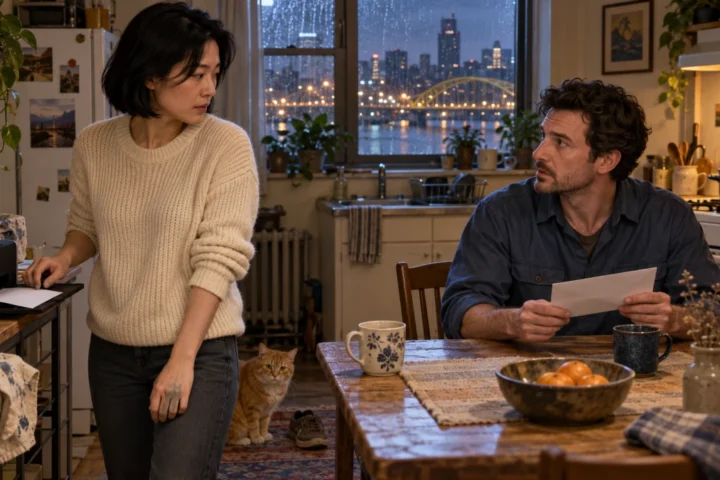
He stood beside the kitchen sink with a dish towel twisted between his hands. Outside their Pittsburgh duplex, October rain darkened the brick steps. Mara was still wearing her navy cardigan over the ivory blouse she had worn to work, and she had been deciding whether it was too ordinary for twelve years of marriage.
Now the blouse seemed like the least important decision in the room.
"Elise Ward," he said.
Mara knew the name. Six years earlier, Elise had worked with Ben at the distribution company that offered him a promotion in Cleveland. Mara had never met her, but she had heard her voice once, on speakerphone, confirming that the company had withdrawn the offer after Ben requested more time.
For six years, Ben had referred to Cleveland whenever their life disappointed him. When the furnace failed. When his younger brother bought a house. When Mara accepted a Saturday shift at the neighborhood arts center instead of visiting another open house.
I could have been somewhere else, he would say. We made our choice.
Mara had believed the choice was hers. Her mother had been recovering from an accident then, and she had asked whether they could wait until summer to move.
"Why would she come to our anniversary?"
Ben set down the towel with such care that Mara stopped looking at the reservation.
"Because she won't keep saying what I asked her to say."
The phone went dark in Mara's hand.
"Then cancel the restaurant," she said. "Whatever this is, you don't get to put a waiter beside it."
Ben reached for his phone, then stopped. "I thought a neutral place would help."
"Neutral for whom?"
He had no answer that survived saying aloud. Mara watched him cancel the reservation, not because she wanted proof of obedience but because she could not bear the possibility of sitting across from flowers while someone dismantled the last six years. The confirmation arrived with an apology from the restaurant. She almost laughed at its unnecessary courtesy.
Elise was already driving from the hotel where she was staying for a conference. Ben offered to call her. Mara said she would do it herself, then realized she had neither Elise's number nor any reason to trust the introduction he might provide. She asked him to put the call on speaker and say nothing except what she requested.
The woman who answered sounded tired rather than surprised. Mara introduced herself and explained that dinner was canceled. "I understand you have something to tell me. I want to hear it without Ben explaining it first. Can we meet tomorrow?"
There was a small silence. "Yes," Elise said. "And I'm sorry. I should have spoken to you years ago."
They arranged to meet at a coffee shop near the conference center at nine. Ben tried to add that he could come. Mara ended the call before either woman had to refuse him.
For a while, the refrigerator supplied the only sound. Mara put her phone on the counter. She wanted to ask everything at once and feared that doing so would let Ben choose the easiest question. Finally she asked, "Did the company withdraw the offer?"
"No."
The word was plain, almost disappointingly small. Something with such a long reach should have required more effort to pronounce.
"Did you turn it down?"
"Yes."
"Before I asked about waiting?"
He looked toward the window. "Three days before."
Mara remembered the conversation with terrible clarity. She had sat on the edge of their bed with her mother's discharge instructions beside her. She had told him she could arrange help, that she was frightened but willing to try. He had held her hand. Later he had said he could not ask her to choose between him and her mother.
At the time, she had considered that generosity.
"Why?" she asked.
Ben sat down without inviting her to do the same. "The job was bigger than I understood. Two sites. Overnight calls. People reporting to me who had been doing it longer than I'd been alive. I visited, and I knew I wasn't ready."
"You could have said that."
"I know."
"Don't use knowing now to skip what happened then."
He rubbed his palms against his trousers. His charcoal shirt was the one she had ironed that morning while he showered. She looked away from it because she could feel her anger trying to become an inventory of every small service she had ever performed. She needed something more useful than a ledger nobody could settle.
"I told Elise I needed the company to be the bad guy," he said. "She handled scheduling with the regional office. I asked her to say the timeline had changed."
"And then I became the bad guy."
He did not contradict her. That was new, but it was not enough.
Mara took the anniversary card from the table. She had bought it during lunch, choosing one without a joke about husbands. Inside she had written that she was grateful they had stayed through difficult seasons. She did not tear it up. She placed it in the kitchen drawer beneath the takeout menus, where it could remain unpresented.
"I need you to sleep somewhere else tonight."
"Mara, can we please talk before we do something permanent?"
"A night isn't permanent. Six years is a long time."
He packed a bag in the bedroom while she remained in the kitchen. When he came back, he asked whether he should take the car. They had two, both old, both paid off. She said he should take his own. Practical questions were already appearing, insulting in their smallness and merciful because they had answers.
After he left, Mara ate toast standing at the counter. She called her sister, Nina, and told her the bare facts. Nina offered a couch, a bottle of wine, and the possibility of coming over to dislike Ben in person. Mara declined all three but asked her to stay on the phone while she checked that the back door was locked.
"You don't have to decide the marriage tonight," Nina said.
"I'm trying to decide what I remember."
"You still remember what happened to you. His explanation changed. That doesn't erase your part."
Mara wrote that down on the back of an envelope. It sounded obvious until she considered how often she had let Ben's disappointment become the official description of their life.
At the coffee shop the next morning, Elise wore a dark green blouse and carried a laptop bag with a frayed strap. Her short curls were damp from the rain. She stood when Mara approached, then seemed to reconsider whether a handshake would be an imposition. Mara sat down before either of them had to decide.
"I won't tell you he's a good man," Elise said. "That's not what I'm here for."
"Why are you here?"
"I contacted him about a reference. He mentioned you two were still dealing with the consequences of Cleveland. I asked what that meant. He said you'd always felt guilty about keeping him here."
Mara held her cup without drinking.
"I told him he needed to correct that. He said he would. Two months passed. When this conference came up, I said I would be in Pittsburgh and wanted to talk to you. He suggested dinner. I thought you knew why. Then your call made it obvious you didn't."
"You thought an anniversary dinner was normal?"
Elise looked down. "He didn't tell me it was your anniversary."
That additional piece of management seemed almost petty beside the original lie. It also made the original easier to understand. Ben had not planned a confession so much as a room in which everyone else would have difficulty leaving.
Elise described the visit to Cleveland. Ben had been anxious before it and embarrassed afterward. He had said he could not afford to look unambitious with a new regional director watching. Elise had agreed to one phone call, telling herself that the couple had already settled the real issue privately.
"That was convenient for me," she said. "I didn't ask because I didn't want to hear an answer that made my part worse."
Mara appreciated the absence of excuses and resented having to appreciate anything. "Do you have the messages?"
"Some emails. I checked before I came. I'll send what concerns the offer. Nothing about other employees."
She turned her laptop around. Mara read a message in which Ben thanked the regional office for its confidence and declined the position for personal reasons. It was dated the Thursday before Mara's Sunday request to delay. There was no accusation against her in the email. That almost hurt more. Somewhere, a straightforward account of his decision had existed all along.
"Were you involved with him?" Mara asked.
Elise answered immediately. "No."
"I'm not asking because I think that's the only kind of betrayal. I just don't want to discover another room behind this one."
"We weren't involved. I can't promise what else he hasn't told you."
Mara nodded. She could work with a limit that was named.
They stayed twenty more minutes. Elise did not ask for forgiveness. She asked whether Mara wanted her to speak to anyone else who had heard the false story. Mara said she did not know yet. On the sidewalk afterward, they parted without touching. Mara felt neither victorious nor reassured. She felt as if someone had returned a heavy object she had been carrying under the wrong name.
Ben texted at eleven. Can I come home to talk?
She answered after lunch. Six. One hour. Don't bring flowers.
At work she entered attendance numbers, answered a parent asking about pottery classes, and helped an elderly volunteer move a folding table. The familiarity of those tasks steadied her. She was not merely the wife in a story Ben had mishandled. There were people who knew her for other reasons, and none of them needed her to explain why she looked tired.
When Ben arrived, he had printed a chronology. Mara nearly sent him away for making their marriage resemble a workplace incident. Then she saw the crossed out phrases and handwritten additions. He had at least attempted to separate what he remembered from what he wished he had done.
He began with fear. She stopped him.
"Start with the first time you blamed me after you knew the truth."
He looked at the paper for a long time. "Thanksgiving. My brother asked about the job. I said the timing wasn't right for us. Mom said family comes first. You thanked me for understanding."
Mara remembered washing dishes afterward with his mother. She had been told how fortunate she was to have a husband who did not keep score.
"And you let that happen."
"Yes."
"Then the furnace?"
"Yes."
"The house in Brookline?"
He nodded. They had declined to make an offer because the roof needed work, not because Cleveland had stolen their future. Still, he had spoken that afternoon about sacrifices becoming a habit. She had stopped browsing listings for months.
"I need you to understand something," she said. "You didn't just lie about a job. You made every preference I had feel expensive. If I wanted to stay home on a weekend, I wondered if I was limiting you again. If I took an extra class at work, I wondered if I was spending freedom you had given up for me."
Ben folded the paper. "I wasn't thinking of it that way."
"You benefited from me thinking of it that way."
He opened his mouth, closed it, and finally said yes.
The hour ended without a plan to repair anything. Mara asked him to stay with his brother through Sunday. She wanted copies of the household account statements, not because she had discovered financial misconduct but because she refused to make a decision while depending on his summary of their circumstances. They agreed that neither would move money beyond ordinary expenses without telling the other.
"Are you leaving me?" he asked at the door.
"I'm no longer promising to stay so you'll tell me the truth."
On Saturday, his mother called. Mara almost answered automatically. Then she let it ring and listened to the message. Ben was upset, his mother said. Marriage required grace. Whatever had happened with an old coworker, Mara should remember twelve years.
She forwarded the message to Ben with one sentence: Correct what you have allowed her to believe.
He called instead of texting. "I told her we were having a hard time. I didn't say anything about an affair."
"You left enough blank space for her to give me advice about one. Fill it accurately."
"She's going to feel terrible."
"She can feel terrible about a true thing."
He asked whether Mara wanted to be present. She said no. This was not an audition she intended to judge from the front row. He needed to speak accurately when she was absent, which was where most of the damage had been done.
An hour later, his mother sent a different message. Ben had explained. She was sorry she had lectured Mara. She also hoped Mara understood that he had been under pressure at the time. Mara answered only the apology. Thank you for saying that. I need some space.
It cost her an unexpected amount not to soften the message with a heart.
Sunday brought sunshine and an offer from the arts center's director. The regional library partnership needed a coordinator for a six month pilot. Mara had mentioned an interest in September, then hesitated because the work included two evening meetings a month and occasional travel across the county. Ben disliked eating alone. That had seemed a sufficient reason to wait.
Now the director asked whether she still wanted an interview.
Mara almost said she needed to check at home. She heard the sentence forming and stopped it. "Yes," she said. "Send me the details."
She did not apply as revenge. The pay increase was small and the workload real. She spent the afternoon reading the responsibilities and deciding whether she actually wanted them. The relief came not from saying yes but from discovering that the question belonged to her.
Ben returned Sunday evening to collect more clothes. His brother could host him another week. He had told his family what happened, including the dates and Elise's role. His brother had responded with an angry speech about making mistakes. Ben said he had stopped him when he called Mara unforgiving.
"I'm not telling you for credit," he added.
"Then don't wait for a response."
He winced, and she knew she had been sharp. She also knew that noticing his discomfort did not obligate her to remove it. She let the silence remain until he asked a practical question about the utility bill.
The following week, Mara toured a small apartment above a florist on a bus line near work. The landlord showed her the sloping kitchen floor and the window that stuck in wet weather. It was neither a beautiful escape nor a punishment. It was a room she could afford if she stayed careful.
She had expected Ben to argue that he should be the one to leave permanently. Instead he asked why she wanted to pay rent when they already had a house.
"Because I know what every sound in this house expects from me," she said. "I need to find out what I do somewhere else."
They sat at the dining table with a calculator and divided the costs of a temporary separation. Neither could maintain their previous spending. Ben would keep the house for three months; Mara would take the apartment. They would each contribute agreed amounts toward shared obligations and pause the weekend trips they had been discussing. They wrote the arrangement down in ordinary language and agreed to review it after six weeks.
No document could settle whether the arrangement was fair in every emotional sense. It could at least keep one person from paying for everything while the other called the uncertainty growth.
Packing exposed the smallest loyalties. Mara took her grandmother's blue bowl but left the good coffee maker because Ben used it every morning. Then she reconsidered, annoyed with herself. She did not want it. Leaving it was not proof that she was still surrendering. She put a cheap kettle into her box and allowed preference to remain preference.
Nina helped on moving day. She refrained from commenting on the narrow stairs until they had carried up the last box. Then she declared that Mara was forbidden to buy a piano. Mara laughed for the first time in days without hearing another feeling underneath it.
That evening, Ben texted a photograph of a letter he had drafted to his family. Mara did not read it. She wrote back: Send what is true. Don't make me your editor.
He sent it the next morning. His aunt replied to everyone with a story about her own difficult early marriage. Mara muted the conversation. She had not requested a family seminar. What mattered was that the false explanation would no longer circulate unchallenged.
At the apartment, she ate soup from the blue bowl and discovered that solitude had different textures. Sometimes it was restful. Sometimes it was simply lonely. She missed Ben's jokes about local commercials. She did not miss the way he could turn an ordinary disagreement into evidence that his life had narrowed for her sake.
Missing him did not answer whether she should return. She started writing that distinction in a notebook whenever the two feelings tried to merge.
Ben began counseling on his own. When he told her, he carefully said that an appointment was not a solution. Mara was glad he had learned that much and suspicious of any sentence that sounded rehearsed. Both reactions could exist. She did not have to choose the kind one merely because it made conversation easier.
They met on Thursdays at a diner to discuss household matters. At first, Ben brought every conversation back to what he had learned about himself. Mara stopped attending the lesson.
"If you want to tell someone about your insight, tell your counselor," she said. "I want to know whether you spoke to the insurance office and whether you can water the plant I left by the stairs."
"You don't want to hear anything personal?"
"I want you to notice the difference between sharing and asking me to reward you."
The next Thursday, he brought the insurance information and admitted he had killed the plant. Mara was unexpectedly grateful. A dead plant stated without an excuse was more useful than a theory about fear.
Her interview went well. The library pilot offered her the coordinator role, starting after the holidays. She accepted after asking about the evening schedule and the support available when volunteers canceled. There was no dramatic salary and no relocation. It was work she wanted, with problems she considered worth having.
She told Ben at their next meeting. He smiled, then said, "I guess now I know what it feels like to be the one waiting around."
The sentence landed between them like an old tool he had picked up without thinking.
Mara put down her fork.
He looked startled by his own words. "That was unfair."
"Yes."
"I'm sorry. I was trying to make a joke."
"It wasn't a joke before either."
For a moment, she thought he might defend his intentions. Instead he moved his plate aside. "I made your good news into something you owed me for. I don't want to keep doing that."
"Wanting isn't the same as stopping."
"I know."
She nearly objected to those familiar words, but this time he did not use them as an ending. He asked whether she wanted him to leave. She said no, then finished telling him about the pilot. He listened without converting the details into an assessment of himself.
Later, she wrote the exchange in her notebook without putting a star beside it. An interruption of a habit was not the disappearance of one. Still, it was something that had happened, and she would not falsify the record in either direction.
In December, Elise sent one short email asking whether Mara needed anything else from the correspondence. Mara said no. She added that the documents had helped her establish the sequence of events. She did not add forgiveness, but she thanked Elise for answering without demanding it.
The conference had ended weeks earlier. Elise had gone back to her own work and whatever consequences she had chosen to face. Mara was relieved that the woman did not remain a permanent third presence in their marriage. Her role mattered. It was not the center of the betrayal.
At Christmas, Mara visited her mother without Ben. Her mother had recovered enough to complain that everyone treated her like breakable china. When Mara finally explained Cleveland, her mother stared at the table.
"I thought you resented me," she said.
Mara reached for her hand. "I resented being told my choices had cost something I couldn't repay. That's not the same thing."
Her mother admitted that Ben had once told her Mara was having difficulty moving forward. At the time, she had assumed he meant worry about the accident. Another little room opened. Mara took a breath before anger could rush in and furnish it.
She called Ben that evening. He acknowledged the conversation. He had not remembered it when writing to his family.
"Then correct it now," she said.
He did. Her mother reported afterward that he had not asked her to persuade Mara to come home. That omission mattered more than anything he might have promised.
Between Christmas and New Year's, Mara found the notebook they had used while considering Cleveland. It was in a box marked warranties, beneath an instruction booklet for a blender they no longer owned. She had brought the box because it also contained the records for her sewing machine. On the first page, in her handwriting, were three neighborhoods and the names of two bus routes. She had researched jobs there. She had not been the immovable person Ben's later account required.
She sat on the apartment floor and read the list without photographing it for him. There had been weeks when she would have wanted to send every page as evidence. Now she wanted to know what the pages meant to her. She had been willing to change her life. That willingness had not disappeared merely because someone had misrepresented it. The list was not proof that she should have moved. It was proof that she had considered a world larger than the one she was accused of defending.
At their next meeting, she mentioned the notebook. Ben remembered it immediately. He had watched her look up apartments after he had already declined the job.
"Did you feel relieved?" she asked.
"At first. Then trapped. If I told you after you'd done all that work, you'd know I let you waste your time."
"So you let me waste more."
He lowered his eyes. "Yes."
She waited until he looked up again. "I need you to stop explaining a lie as if the next lie was forced on you. Every time was another chance to tell me."
He pushed his untouched coffee away. For once, he did not trace the path from his childhood to the decision in front of them. "You're right. There were chances. I kept choosing the easier conversation."
Mara did not feel better, exactly. But she felt less alone in the room with the facts.
Nina asked later whether these meetings were helping. Mara considered the question while they walked through the grocery store. Her sister was selecting oranges with the seriousness of someone hiring staff.
"They're helping me find out what I won't accept again. I don't know yet whether they're helping us stay married."
Nina put an orange back. "Those can be different projects."
"Everyone wants them to be the same."
"Not everyone."
Mara glanced at her, grateful. Nina had disliked Ben on command that first night, but she had since resisted turning him into a cartoon. That left Mara room to remember good things without feeling she was betraying her own injury. She could miss a person who had treated her unfairly. She could also decline to return to him. The grocery list did not require an answer.
At home, Mara made a folder for the library pilot and found herself hesitating over a proposed overnight training in Harrisburg. The hesitation angered her until she read the dates. It conflicted with her mother's birthday, which she actually wanted to attend. Freedom did not mean she had to say yes to every opportunity. She called the coordinator and asked about another session. There was one in February. She registered, pleased less by the travel than by the absence of a moral trial around arranging it.
She told Ben afterward, not before. He asked whether she needed him to check on her mother while she was away. Mara said no; her mother had neighbors and a sister nearby. He accepted the answer. Later, Mara realized that she had not spent the afternoon rehearsing how to reassure him. The saved energy was quiet enough that she almost failed to notice it.
She used it to sew a button onto her own coat and call a friend she had repeatedly postponed seeing.
When that friend asked whether she was happier, Mara said she was more accurate. It sounded strange, but the friend nodded. They talked about other things afterward: work, a terrible movie, the bus route that kept changing. Mara walked home relieved that an evening could contain her marriage without being entirely occupied by it. Ordinary conversation had begun to feel like space she could furnish herself, one unremarkable choice at a time.
January brought the pilot program, a leaking apartment window, and a cold that turned Mara's voice into gravel. Ben offered groceries. She accepted a bag left downstairs and refused his suggestion that he stay to cook. Receiving help was not a contract, she reminded herself as she carried the soup upstairs.
The next week, she helped him compare a confusing utility charge against their old bills. Boundaries did not require them to pretend they had never been useful to each other. They required usefulness not to become an invisible claim.
They discovered a duplicated charge and agreed who would make the call. Before leaving, Ben asked whether Thursday still worked for her. She checked her calendar instead of automatically agreeing. There was a staff dinner she wanted to attend. They moved their meeting to Friday. Nothing broke. Nobody announced a sacrifice. Walking back to the bus stop, Mara felt the small adjustment settle somewhere deeper than relief. This was what an ordinary arrangement should have allowed from the beginning, without gratitude being demanded.
At their next review meeting, they extended the separation. Neither had discovered a clean answer. Mara liked her work and wanted more time in her own rooms. Ben admitted that some days he felt angry she could not see how hard he was trying.
"I'm telling you because it isn't fair," he said. "Not because I think you should fix it."
She watched him resist adding anything else. It was an uncomfortable conversation and therefore, perhaps, a more honest one than the anniversary he had planned.
When spring arrived, the florist downstairs put buckets of daffodils beside the door. Mara carried a small bunch upstairs, paid for with money she had not consulted anyone about spending. Her apartment still had too little storage. The window still stuck. She had stopped describing it to friends as temporary, although she had not decided how long she would stay.
Ben asked whether she would walk with him on Sunday, somewhere without a bill to divide or paperwork to discuss. She let the message sit while she watered the flowers. She wanted to see him. She was frightened of what wanting might invite him to assume.
She answered carefully. One walk. No decisions about moving back. No anniversary replacement.
He replied, Understood. Then, a minute later: I mean I'll follow that, not just that I read it.
On Sunday, she found him near the river wearing an old jacket she recognized. They walked past cyclists and a man persuading an elderly dog to consider another fifty feet. Ben asked about the library program. Mara told him about a volunteer who had invented a sign system for missing supplies. He laughed at the right part because he had been listening.
At a bench, he asked whether he could say something about Cleveland.
"Briefly," she said.
"I didn't lose that job because of you. I chose not to take it. I made you carry my shame, and then I called it sacrifice."
She looked at the river. The words were accurate. Accuracy did not give her back the years, but it stopped asking her to surrender the present to a false account of them.
"I know," she said.
She did not tell him everything was all right. She did not take his hand to make the moment easier. After a while, she stood, and he stood too. They continued along the path until they reached the bridge where she would turn toward her apartment.
There, he asked if she wanted coffee.
"Not today."
He nodded without bargaining.
Mara crossed alone, carrying no flowers and no decision she had made to spare someone else's feelings. Behind her was a man she still loved in some complicated, altered way. Ahead was her small kitchen, an afternoon of work she cared about, and a door she could open with her own key. Neither direction was a verdict. For now, the choice of where to walk was finally hers.
Read next

The Speech He Rehearsed

The Unsigned Card

The Song He Gave Away

My Fiancé Asked Me to Hide My Son During His Mother’s Visit—Then I Found the School Form He Had Already Filled Out
Reading notes
An anniversary reservation for three exposes the story a husband has told about a choice he made himself.
This is an original work of fiction. Characters and events are fictional. Explore public-domain books at Project Gutenberg or browse more stories on ReadStoryvia.