Original fiction
On this page
The Speech He Rehearsed
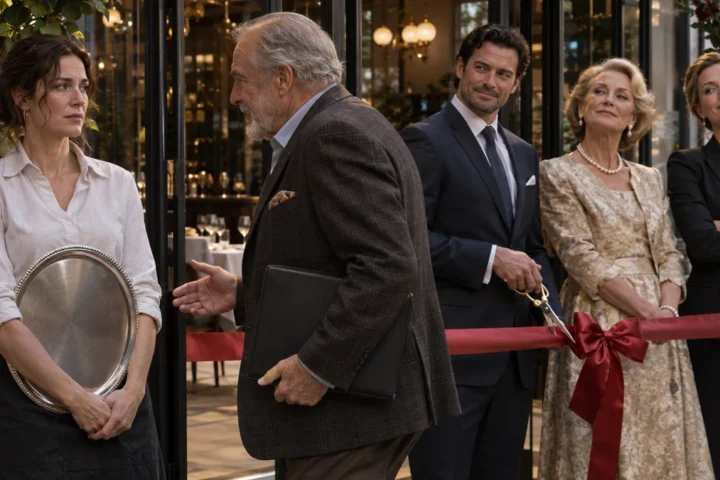
My husband announced my retirement between the crab cakes and the roast chicken, using a sentence I had never said aloud.
"I want a life that doesn't happen in the spaces my job leaves behind."
Around our anniversary table, eight people lifted their glasses. Martin stood beside me with his reading glasses folded into his shirt pocket. He looked nervous and handsome, the way he had looked twenty-six years earlier when he asked whether I wanted to share an apartment.
Only now he was telling our friends that I was leaving the library.
I was fifty-two. I managed adult programs at a Pittsburgh branch library. I had not given notice, applied for retirement, or agreed to quit. That sentence lived in an unsent email addressed to nobody, written after a particularly exhausting Tuesday.
"No more being the dependable one for strangers," Martin continued. "It's finally Nora's turn."
Another sentence. Same draft.
Our daughter, Wren, put down her glass. Across the table, Martin's sister Beth pressed her hands together, touched by a sacrifice she thought she understood.
Martin set a blue envelope beside my plate. Inside was a printed itinerary for a month driving through New England in September. September was when my branch launched the evening literacy program I had spent a year building.
"I already told people not to expect you back," he said softly, mistaking my stillness for happiness.
The restaurant smelled of browned butter. A server waited behind him with a cake bearing two crooked candles.
I looked at the envelope, then at the man who knew how I took my coffee and apparently believed he knew how I should spend the rest of my life.
"Which people, Martin?"
He lowered his glass.
"And before you answer that," I said, "tell me how you read my email."
The server backed away before anybody asked her to. I was grateful for that small intelligence. Martin remained standing, one hand on the back of my chair, while our friends looked at the table as if the answer might be printed beneath their plates.
"You left it open," he said.
"Where?"
"On the kitchen laptop. Nora, this isn't the place."
"It became the place when you stood up."
Wren reached for the cake knife, then stopped. At twenty-four she still tried to give her hands a useful job when her parents frightened her. I wanted to tell her this wasn't her job, but I could not manage another person's comfort yet.
Martin sat down. "I saw how tired you were. I thought you couldn't ask."
"So you decided I had asked."
Beth said my name with a warning folded into it. Our friend Dennis began explaining that travel reservations could usually be changed. Their kindness hurt because it was aimed at returning the evening to something recognizable, not at understanding what had happened.
I took the envelope out from under my bread plate. There were hotel confirmations, a map, a list of antique stores. Martin had circled one coastal town because I once loved a photograph of its harbor. He had remembered the photograph. He had not remembered to ask.
"Who did you tell?" I repeated.
"Beth. Dennis. Wren knew about the trip, not the rest. And your coworker, Saira. Just to check the dates."
My throat tightened. Saira supervised our branch. We had been friends before she became my boss, a distinction Martin often treated as administrative nonsense.
"What did you tell Saira?"
"That you needed a clean break. She said you'd have to speak to her yourself."
I put cash beside my untouched dinner. Not enough to make a point, just enough to pay for what I had ordered. Wren stood, but I asked her to stay. I needed a cab, not an escort. Outside, a light rain had turned the valet tickets translucent. I booked a ride to a hotel near the hospital, where nobody would wonder why a local woman arrived without luggage.
Martin called twice. I sent one message: I am safe. I will talk tomorrow. Do not come here. Then I called Saira. She answered over the noise of her dishwasher.
"You don't have to explain tonight," she said.
"I'm not resigning."
"I didn't think you were. We'll talk Monday."
That should have comforted me. Instead I cried because a woman who had known me nine years understood the difference between something my husband wanted and something I had chosen.
In the hotel bathroom I washed my face with hand soap. My anniversary earrings lay beside a paper cup. I had chosen them because Martin liked the green glass against my gray hair. I still liked that he liked it. Betrayal had not conveniently removed affection. It had left affection standing in a room where I no longer knew which doors belonged to me.
The next morning I met him at a diner halfway between the hotel and our house. He had ordered my usual breakfast. I asked the waitress for oatmeal instead, not because eggs were oppressive, but because I wasn't hungry for them.
Martin noticed. Everything had become evidence to him, though I wasn't building a case.
"I was trying to give you permission," he said.
"I don't need permission to leave work. I need room to decide whether I want to."
He rubbed a pale patch on his finger where he had twisted his wedding ring. "You wrote that you felt trapped."
"I also wrote that I loved teaching Mr. Alston to use the bus app. Did you read that part?"
He looked away.
The answer arrived in pieces. My email had been open on the shared laptop one Sunday in June. A draft title, Things I Can't Say Yet, caught his eye. He opened it. When the computer asked whether to remember my account, he selected yes. Afterward, when I worked late, he went back. Five times, he said first. Then he admitted he had stopped counting.
There were other drafts. A birthday letter to my dead mother. An angry paragraph about Wren canceling dinner. Notes about hot flashes, sleep, the peculiar loneliness of answering questions all day and coming home unable to answer another. Some sentences contradicted sentences written the previous week. That was why they were drafts.
"You were disappearing," he said.
"You watched me think without letting me know you were there."
His eyes filled. I knew those tears. He cried when our old dog died, and when Wren drove away to college pretending she wasn't scared. They were real tears. They did not tell me what to do.
I asked whether he had forwarded or photographed anything. He said he had copied two passages into a document to practice the speech. The document was on his own computer. No one else had seen it, he said. He offered to hand me his phone.
"I don't want us to become people who inspect each other's devices. I want you to tell me the whole thing."
He said that was the whole thing. For the first time in our marriage, I could not use his certainty as somewhere to rest.
I returned home that afternoon for clothes and my work bag. Martin waited on the porch because I had asked him to. Inside, our house looked offensively ordinary. The basil needed water. A towel had slipped off the oven handle. On the kitchen counter sat a card that read To Our Next Chapter.
I turned it facedown without opening it.
I signed my account out of the shared laptop, changed the password on my own phone, and ended other active sessions. Those actions took minutes. They did not restore the private space he had entered. They only stopped the door from swinging open again.
When I came outside, Martin held my raincoat. "Can I at least carry the bag?"
"Not today."
He let his hand fall. I had expected an argument and was exhausted by the relief of not getting one.
For three nights I stayed with my friend Patrice, a respiratory therapist whose spare room smelled faintly of her granddaughter's crayons. She did not call Martin a monster or tell me what she would never tolerate. She put clean towels on the bed and asked whether I wanted company at breakfast.
On Monday, Saira closed her office door. "Your position isn't in question," she said. "But I do need to know whether September is still realistic."
That was fair. The program needed an actual coordinator, not the heroine of a domestic emergency. I told her yes, with one change: I needed somebody else to handle volunteer scheduling. We worked out which hours I could stop donating without pretending they hadn't been work.
I had wanted changes. That was the part I couldn't surrender simply because Martin had used it against me. My fatigue wasn't imaginary. Neither was my attachment to the job. I could be tired and still belong there.
When I left the office, Mr. Alston was waiting beside the printer with a boarding pass and the patient expression of a man who knew machines held grudges. His sister was turning eighty in Cleveland. We printed the return ticket too. For eight ordinary minutes, I was good at something that had nothing to do with my marriage.
Wren met me that evening at Patrice's kitchen table. She brought oranges, an offering so unlike her usual takeout that I almost laughed.
"Dad said you were reconsidering everything," she said.
"I'm reconsidering how we live. You don't have to reconsider either parent."
She peeled an orange in one long strip. "I thought you wanted the trip. He asked which towns you'd like. I told him about that harbor picture."
I reached across the table. "You helped with a surprise. You didn't agree to what happened."
Her eyes stayed on the peel. "He does this with me sometimes. Tells people I've accepted a job before the interview. Says it makes me sound confident."
I remembered calling that enthusiasm. I remembered Wren's tight little smile when Martin introduced her as our future veterinarian, three years after she stopped wanting that career.
"I should have listened when you asked him to stop," I said.
She nodded. She didn't make it easy for me by saying it didn't matter. We ate the oranges, and for once neither of us supplied a better ending to the other's sentence.
On Thursday I told Martin I wanted to live separately for six months. I would take the furnished studio above Patrice's cousin's upholstery shop. It had a monthly lease, a real stove, and a bedroom curtain instead of a bedroom door. My salary could cover it if we divided household expenses differently. We would write down the arrangement, including the cost of keeping the house, so generosity could not turn into leverage later.
"Six months is a sentence," he said.
"It's a length of time. I need one that isn't decided by whether you have a good week."
He wanted us to see a counselor immediately. I said I would consider joint sessions after he started individual work and after I had time to stop anticipating his reaction to every thought. Counseling was not a promise to move back.
"Do you still love me?"
"Yes. That doesn't settle where I sleep."
He looked older then, and I hated that I noticed. I hated the impulse to soften the truth until he could bear it. For years I had called that impulse tenderness. Sometimes it was tenderness. Sometimes it was the reason he never learned how long my discomfort lasted after his had been soothed.
The studio windows faced a brick wall and the back of a bakery. Before dawn, metal trays clattered downstairs in the alley. I bought a small lamp at a thrift store and carried my grandmother's blue bowl from the house. Nobody transformed the room for me. The curtain snagged. The refrigerator hummed. My first night there, I slept badly and woke relieved.
The following evening, Martin knocked downstairs without calling first. He had brought the charger I had forgotten. Through the intercom his voice sounded thin and reasonable, which made saying no harder than if he had shouted. I told him to leave it in the mailbox.
"I'm already here," he said.
"That doesn't mean I agreed to a visit."
For several seconds I heard only traffic through the speaker. Then he said okay. I watched from the window until his car left. The charger lay in the mailbox beside a grocery circular. There was no note. I was grateful and furious that gratitude was available for something so basic.
The next morning I told him that forgotten objects could wait for an agreed exchange. He said he had worried I wouldn't answer if he asked first.
"Then you knew there was a question," I said.
That conversation did not end with understanding. He said I was making every gesture difficult. I said gestures had become difficult because he had used one to corner me. We hung up tired. Two days later, he asked when he could return my gardening gloves. We chose Saturday at noon.
Beth called the following Sunday. She started with practical questions about the studio, then said Martin hadn't meant to humiliate me.
"I know he wasn't hoping to hurt me," I said.
"He spent weeks on that speech."
I sat on the edge of my narrow bed. "That's part of what hurts. He had weeks to ask."
She was quiet. Then she told me their father used to make announcements about their mother's plans at family dinners. Vacations, church committees, when she would stop working at the grocery store. Their mother usually smiled and changed things afterward in private.
"Martin hated that," Beth said.
"Then he has somewhere to start thinking."
I didn't ask Beth to carry a message. She didn't offer again to explain her brother to me. Before hanging up, she asked if we could get coffee sometime without talking about him. That invitation I accepted.
Martin canceled the New England reservations. Two deposits were nonrefundable. He mentioned them once, then caught himself before telling me how much. I knew money was tight enough for the loss to sting. It was not my responsibility to repay a decision by participating in it.
He worked as a maintenance planner at a city bus garage. His life was made of schedules, parts arriving late, mechanics asking for answers he was expected to have. At home, he had brought that competence into places where no repair had been requested.
I knew his work had been difficult lately. A promotion went to a younger man. His right shoulder hurt. A coworker had retired and returned three months later because being home all day unsettled him. None of this made Martin's choice inevitable. It made the man behind it recognizable, which was harder than having a villain.
In August he asked to meet for a walk along the river. I agreed to an hour and came in my own car. He looked at the water instead of beginning with a speech.
"I didn't only read because I was worried," he said. "I read because it was easier than asking and hearing something I couldn't fix."
I let him continue.
"When you wrote about strangers getting the best of you, I made that about me. I thought if you quit, I'd get you back."
There it was, something less flattering and more useful than romance. He had mistaken access to my time for access to me.
"I wasn't a library book you could put on hold," I said.
He almost smiled, then understood I wasn't offering a joke to help him escape. "I know."
"You're learning. Knowing takes longer."
We walked past a family teaching a little boy to ride a bicycle. Martin stepped toward the child when he wobbled, then stopped because the father already had him. The small movement made me ache. He had always wanted to catch things before they fell. I had loved that once without noticing how often he decided what counted as falling.
At the parking lot he asked whether he could hug me. I said not that day. He said goodbye without making me explain. I drove back to the studio angry that such a small restraint could feel like a gift.
September brought heat, a broken copier, and eleven adults to the first literacy evening. One woman arrived in scrubs with her workbook wrapped in a grocery bag. A man asked whether the class would require standing up to read. I promised nobody would be surprised that way.
Halfway through, the volunteer scheduled for childcare called sick. Our replacement plan wasn't good enough. Saira and I moved two tables, handed out crayons, and learned which sounds traveled through the folding partition. The evening was clumsy and valuable. Afterward I sat in my car eating crackers and felt exactly as tired as I had feared.
I didn't want Martin to be right that exhaustion meant I should leave. I also didn't want to make exhaustion a badge that proved he was wrong. The next day I asked for a smaller caseload during the program's first eight weeks. Saira said she could grant part, not all, of it. We negotiated. Nobody applauded. A useful change often arrived without witnesses.
Martin sent a message that afternoon: Hope the first class went well. Do you want to tell me about it?
I answered the next morning. Some of it went well. Some didn't. I'm still glad I was there.
He replied, I'm glad you got to choose.
I read it twice. Then I put my phone away. A good sentence could be true without being enough.
One learner stopped coming after the third evening. I called only the number she had authorized us to use and left a message without mentioning literacy. She called back during my lunch break. Her work schedule had changed; she wasn't ashamed, just unavailable. I offered another class, and she said she would decide later.
Afterward I sat with the uncomfortable resemblance between wanting someone to return and believing I knew why they should. My intentions at work were usually good too. I crossed her name off the reminder list at her request. Her place in the class would remain open until the registration deadline, not until I could persuade her to be grateful.
That Friday I told Saira I had caught myself reaching for a solution before hearing the problem. She said the work required noticing that more than once. We carried folding chairs into the storage room. I didn't turn my discovery into a lesson for Martin. For once a thing I learned could simply belong to me.
Our first joint counseling appointment was in October, on a rainy Tuesday that made everyone in the waiting room smell like wet coats. The counselor, Audrey, asked what each of us hoped to do there. Martin said he hoped to save the marriage. I said I hoped to find out whether being married to him still allowed me to be separate from him.
Audrey did not translate those into the same goal. I trusted her a little for that.
Martin described the dinner as a disastrous surprise. Audrey asked him to describe what happened before the dinner without using the word surprise. He spoke slowly about opening the draft, saving access, returning to it, contacting Saira. Hearing those verbs in order made his face change.
"I kept calling it one mistake," he said.
"Was it?" Audrey asked.
"No."
When she asked what I needed, I resisted the urge to deliver a list he could complete. I could name boundaries, but I could not write a recipe that guaranteed my return. Separate accounts and devices were practical. Not contacting my colleagues about my choices was essential. Neither could make me feel safe on a schedule.
"I need to be able to say something unfinished without it becoming an instruction," I said.
Martin stared at his hands. "Even if it's about leaving me?"
"Especially if it's about leaving you."
Audrey let the silence stay. Outside, a bus braked at the corner, a long familiar sigh.
Later that month Wren invited us to her apartment for dinner, with separate arrival times because she had plans afterward and did not want a family summit. She was applying for a supervisor's position at the pet supply warehouse where she worked. Martin started telling her which benefits she should negotiate.
Wren set down her fork. "I haven't asked for advice."
He stopped. The pause looked physically uncomfortable.
"Do you want any?" he asked.
"Not tonight."
We talked about her neighbor's astonishing collection of garden gnomes instead. Later, by the elevator, Martin said he felt useless. I told him feeling useless wasn't the same as being unwanted. Then I went home without making that lesson easier for him.
November tested us in ways a counseling office couldn't. I caught a respiratory virus and missed three days of work. Patrice left soup outside my door between shifts. Martin asked if I needed groceries. I sent a list because independence didn't require refusing oranges from my own husband.
He arrived at the agreed time and waited downstairs. I opened the bags in the studio: soup, tissues, the bread I'd requested, nothing else. No flowers, no book about marriage, no suggestion that I recover in our bed. I cried over a loaf of rye because the absence of a message was the kindest message he could have sent.
On Thanksgiving I went to Beth's for two hours. Martin was there, helping clear the table. Dennis asked whether we had rescheduled our big trip yet. The room did the same terrible waiting it had done at the restaurant.
Martin put down a stack of plates.
"There isn't a trip to reschedule," he said. "I planned one without Nora's agreement. She's living separately because I read her private writing and made decisions for her. Please don't ask her to make that easier for me."
He didn't look at me for approval. That mattered. So did the fact that he hadn't told every intimate detail to prove he was being honest. Beth asked Dennis to help find the pie server. Conversation restarted unevenly, like a car on a cold morning.
Driving home, I felt neither victorious nor ready. I had dreaded being made responsible for his shame. For once he had carried it himself. I could appreciate that without collecting it as a payment toward forgiveness.
In December the bakery below my studio changed owners, and the new owner began deliveries earlier. Sleep became difficult. My six months would end in January. Martin knew about the lease because we had agreed on the dates, not because he had checked. He asked during counseling what I thought would happen next.
"I don't know yet," I said.
He pressed his lips together. "Can I tell you that the uncertainty hurts without making it your problem to solve?"
"Yes."
He told me. I listened. Nobody made a promise.
That night I went to the house to collect a box of winter clothes. We had arranged the visit. Martin was making lentil soup, and the kitchen smelled of cumin. The basil on the windowsill had died. A new cutting stood in a jelly jar, pale roots branching through the water.
"Want some soup?" he asked.
I stayed. We ate at the small table where we used to sort Wren's school forms. We argued gently about a movie we both remembered incorrectly. For twenty minutes there was no lesson. There was a man whose company I missed and a bowl warm between my hands.
When I stood to go, he didn't ask me to stay overnight. I nearly offered. Then I noticed I wanted the relief of deciding more than I wanted the decision itself. I put on my coat.
On the drive back, I thought about the draft that started everything. I had avoided opening it, as if his reading had made the words belong to him. The next morning I opened it on my own computer. There was my exhaustion, raw and occasionally unfair. There was affection too, folded between complaints. I read the sentence about wanting a life beyond the spaces work left behind.
I still wanted that life. I was beginning to understand it would require decisions, not a rescuer. I reduced one evening commitment. I joined a Saturday ceramics class and made an ugly cup that held water. I told Wren no when she wanted me to handle a package return during my lunch break. She said okay. The world did not split.
In January I signed a twelve-month lease on a small apartment near the library. The rent was higher than the studio's, but I could walk to work, and the bedroom had a door. I told Martin in Audrey's office before putting down the deposit. I wasn't asking for approval; I wanted him to hear it from me.
His face folded inward. Then he asked whether I was ending the marriage.
"I'm choosing a home for the next year," I said. "I want to keep seeing you. I don't want to move back. I can't promise when that changes, or whether it does."
He took a long breath. "I don't know if I can live like that forever."
"You don't have to promise forever either."
That was the hardest fairness I had offered him. His choices mattered too, including the choice not to wait. We agreed to keep attending counseling monthly and to revisit whether we both wanted this arrangement in June. No automatic return date. No key exchanged as a symbol we weren't ready to live.
Before I signed, I viewed the apartment alone. The property manager showed me the laundry machines and explained the parking rule twice. A kitchen drawer stuck halfway open. The bathroom window faced another bathroom window, both covered with pebbled glass. It was not a brave woman's beautiful new life in a movie. It was a place I would have to clean, heat, and pay for when work had been exhausting.
I stood in the empty bedroom and considered whether I was choosing it to punish Martin. Nobody could promise me pure motives. I was angry. I was also able to imagine reading there without listening for his footsteps, and inviting him over without surrendering the right to end the evening.
The manager asked whether my husband needed to see it. She meant nothing by it; she had seen my ring. I said no, I was the tenant. She nodded and handed me the application. The exchange lasted seconds. I remembered it all afternoon.
At the house the following weekend, Martin helped me sort which kitchen things I would take. We both reached for the chipped yellow colander. Wren had once worn it as a helmet. We stood holding opposite handles, then laughed without quite managing happiness. I said he could keep it. I took the smaller steel one because it fit my new sink. Not every object needed to carry our entire history into the next room.
On moving day, Wren helped carry boxes. Martin had offered, and I had said I wanted to do it with her. He sent a message wishing us dry weather. It rained anyway. We laughed on the stairs, damp cardboard slipping against our coats. By evening my blue bowl stood on a windowsill overlooking an ordinary street.
The first Sunday in the apartment, I hung a calendar inside the pantry door. For years our kitchen calendar had been the place where everybody else's appointments became my obligations. This one had a dental cleaning, a class, and the date the library's winter schedule began. There were empty squares I didn't hurry to fill.
Wren called while I was hanging it. She had been offered the supervisor's position and wanted to celebrate with lunch. I asked whether she wanted her father there. She said yes, and that she would invite him herself. I put lunch on the calendar after we chose a day.
At the restaurant, Martin asked what she liked about the new role. She talked for several minutes before anyone mentioned money or benefits. I watched him listen. Later, he admitted he had rehearsed questions in the car because listening still felt like doing nothing. I said practice wasn't the enemy. Practicing my answer for me was.
He nodded. We left in separate cars, and I went to buy a shower curtain. The one I chose had green stripes. I did not photograph it for anyone's opinion. At home, I hung it straight.
Two weeks later, I invited Martin for dinner. I made roast chicken because I liked roast chicken, not to repair the meal we had abandoned. He brought pears after asking what I needed. At the door he waited while I stepped aside.
We ate. He told me about a mechanic who had finally taught him to leave a repair alone until the engine cooled. I told him about a woman in class reading a birthday card she had written herself. The evening wasn't proof of recovery. It was an evening we had both chosen to attend.
Afterward, he took a folded paper from his pocket. My stomach tightened before he spoke.
"I wrote something," he said. "Would you want to hear it?"
I looked at the paper. Then I looked at him.
"Not tonight. Tell me something you haven't practiced."
He put it away. For a moment he seemed completely at a loss.
"I miss arguing about where to keep the mugs," he said.
I laughed, unexpectedly. "I keep them by the kettle here."
"I noticed."
He washed while I dried. When he left, he asked if he could kiss me. I said yes. It was a brief kiss, familiar and not a promise. I closed my own door behind him, checked tomorrow's work schedule, and set the alarm for a morning that belonged to me.
Read next

The Unsigned Card

The Song He Gave Away
The Address on Our Lease
My Fiancé Asked Me to Hide My Son During His Mother’s Visit—Then I Found the School Form He Had Already Filled Out
Reading notes
At an anniversary dinner, a husband announces a retirement his wife has never agreed to take.
This is an original work of fiction. Characters and events are fictional. Explore public-domain books at Project Gutenberg or browse more stories on ReadStoryvia.