Original fiction
On this page
The Anniversary Receipt
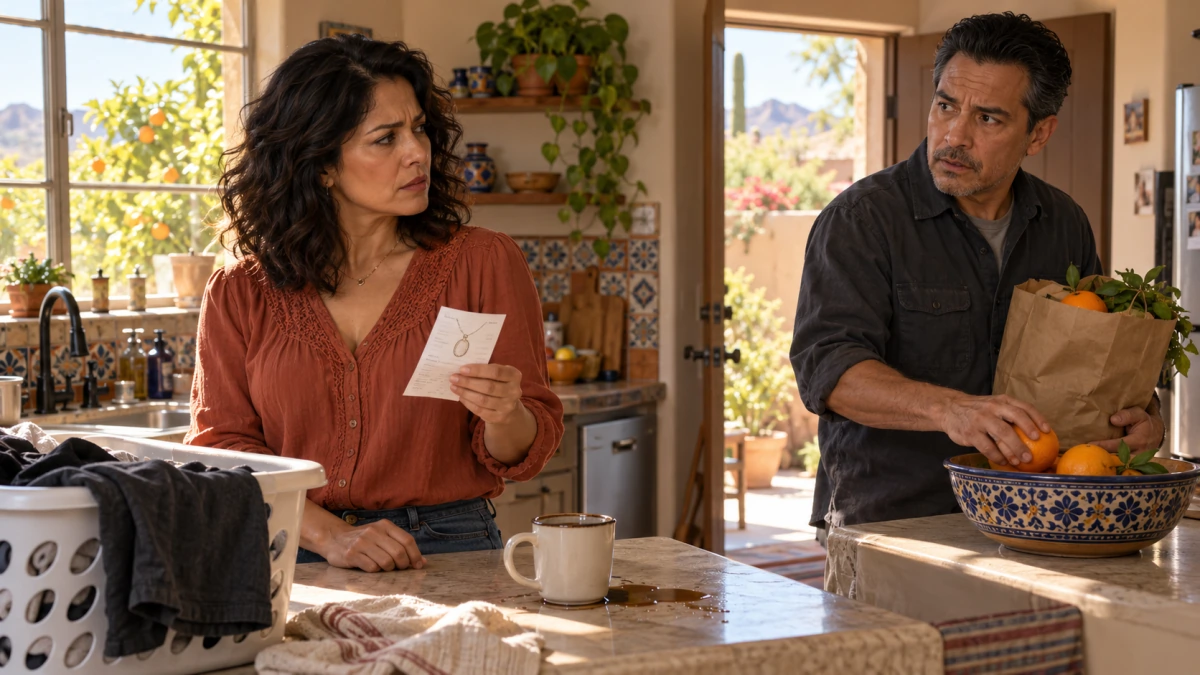
The necklace on the jeweler's receipt wasn't Marisol's. She knew that before she saw the date, before she saw Daniel's name, before the coffee began spilling over the rim of her cup onto the counter.
Twenty years married that morning, and her husband had paid to repair a gold pendant she had never worn.
She found the receipt in his charcoal shirt while sorting laundry in their Tucson kitchen. The drawing was simple: an oval pendant, a small flower pressed into its face, a broken clasp circled in blue. She recognized the flower from a photograph of his mother. That made the discovery worse in a way she couldn't yet explain.
Daniel came through the back door carrying oranges from their neighbor's tree. At forty-five, his black hair had begun to gray at the temples. She usually loved that detail. This morning she noticed how young he looked when he saw the paper in her hand.
"Is this my anniversary present?" she asked.
"No."
One clean answer. Then nothing.
Marisol was forty-three. She had known about Eva since their third date: his daughter from a relationship before their marriage, now twenty-five, living a life Marisol mostly encountered in birthday messages. Last month, when Marisol asked whether he'd heard from her, Daniel had said no.
"Whose is it?"
He set the oranges down one at a time. "Eva's. My mother left it to her. The clasp broke."
That explanation ought to have settled something. Instead, he reached for the receipt, stopped, and said, "She isn't the reason I lied."
Outside, the irrigation timer clicked on. Inside, Marisol put the paper flat between them, smoothing it with both hands so he could no longer pretend it was only a necklace.
Daniel looked at the coffee spreading toward the edge of the counter. He reached for a towel, and she moved the cup herself. For once she didn't want him to clean something up before she had seen the size of it.
"How long?" she asked.
"We've been talking since January. Seeing each other since February."
It was October third. Eight months was not an accidental conversation left unmentioned. She thought of Thursdays when he came home late from the cabinet shop, Saturdays he had called errands, the explanations she had accepted because she liked the life they preserved.
"Where?"
"Coffee. Lunch twice. Her apartment once, to put up a shelf."
"And you told me no contact."
"Yes."
He didn't qualify it. She had wanted an explanation and now resented the plainness that left her nowhere to strike without hitting what was true.
Eva had been five when they married. Daniel and Eva's mother, Celia, had separated before he met Marisol. There had been no affair then, either. That fact had become a comfort Marisol polished whenever the harder history threatened to show through. A clean beginning, she used to call it. Clean for whom was a question she had avoided.
"Did she ask you to hide it?"
"No. She asked me not to."
He said it quickly, as though protecting a doorway. Marisol heard herself ask why Eva needed a necklace fixed now, of all times, and stopped. The anniversary had no authority over a broken clasp.
Daniel's mother, Lucía, had died four years earlier. The pendant had gone directly to Eva, named in a small list of keepsakes everyone had accepted. Marisol remembered putting it in a cloth pouch herself. Nobody had stolen anything from her. That didn't mean nothing had been taken.
"You let me talk about our plans," she said. "The restaurant. The weekend. You sat there listening like we were having the same marriage."
He leaned against the refrigerator. "I wanted us to."
"Then you should have let me be in it."
The oranges rolled slowly against one another in the bowl. He picked one up, put it down, and told her the first message had come after Eva moved back to Tucson. She had accepted a job repairing instruments for a school music supplier. She wanted to know whether he still had her grandmother's recipe for calabacitas, the version with too much corn.
"You told me you didn't know where she was living."
"I knew by then."
Marisol went to the bedroom and shut the door. There was a blue dress hanging on the closet handle for their anniversary dinner. She took it down, hung it inside, and sat on the bed without changing out of her terracotta blouse. On the dresser stood a framed wedding photograph with Eva at the far edge, holding a paper cup.
She remembered that cup. Eva had spilled lemonade on the rental linen. Daniel had knelt to help; someone called him back for another photograph. Marisol couldn't remember whether she had been the person calling. For years she had remembered only the stain.
At noon she came out. Daniel had gone to work after leaving a message saying where he was and when he expected to return. The message was factual, almost painfully so. She wanted to accuse him of performing transparency. She also wanted to know when he would be home.
She called the restaurant and canceled dinner. Their weekend rental in Bisbee had a cancellation charge they couldn't recover. She canceled that too. Losing the money hurt; using the reservation would have cost something she didn't yet have a name for. When Daniel called during his break, she told him what she had done.
"I'll cover the charge," he said.
"It's our money. Don't make this into buying me out of being angry."
He was quiet. "You're right. I don't know what to say."
"Then don't say something useful just to stop feeling useless."
He came home at six and found her making eggs. The anniversary meal became two separate plates and a radio neither listened to. He asked whether he should sleep elsewhere. She said the guest room, for now. They had no children together; the room contained a sewing machine, boxes of old tax papers, and a bed mostly used by visiting cousins. He cleared it without making her watch.
Later she knocked on the door. He sat on the bed in his work trousers, holding his phone facedown.
"Tell me what she thinks happened," she said.
"You'd need to ask her. I can tell you what I did."
The answer irritated her, then remained with her. He was not offering Eva as a witness to improve his case.
When Eva was young, the arrangements had been uneven. Celia worked rotating shifts at a hospital laundry. Daniel sometimes exchanged weekends because of overtime. Marisol had a retail job then, also irregular, and disliked planning around a child whose needs seemed always to arrive already decided. She never said Eva couldn't come. She had made it clear when coming would be inconvenient.
"I used that," Daniel said. "I'd tell myself it wasn't a good weekend, because you were tired or we had plans. Sometimes I hadn't even asked you. It was easier to be the man caught between people than the father choosing not to show up."
"I didn't make you miss her school concert."
"No. I did that."
He remembered promising Eva a Saturday trip to buy a clarinet reed and forgetting until Sunday. Marisol didn't remember the trip at all. She remembered a pleasant Saturday when he stayed home and helped paint the hallway. The same day had lived in two households with entirely different weather.
As Eva grew older, fewer visits seemed to mean fewer conflicts. Birthday calls became messages, then a cake emoji and a gift card. Daniel described the distance as Eva growing independent. Marisol described it as respecting Celia's household. Neither explanation included the work an adult had stopped doing.
"Did you tell her I didn't want her?" Marisol asked.
"I told her things were complicated. I let that mean whatever helped me."
She sat on the sewing chair. She wanted to remember every occasion she had welcomed the girl, and there were some. A movie, a birthday cake, a summer afternoon sewing a torn backpack. They didn't erase the chill she could still summon by asking how long a visit would last before saying hello.
"I was afraid there would always be someone before me," she said.
"There was a child before you. Not a woman I was choosing over you."
He didn't say it cruelly. That made it harder to turn away.
On Saturday morning, Marisol went alone to the hardware store for a replacement hose washer. Their patio tap had dripped for weeks. The ordinary purchase steadied her until she saw a father helping an adult daughter lift a bag of soil into a cart. She had spent years treating a relationship like that as an intrusion into her own.
At home she found Daniel wiping dust from a shelf. She asked whether that was the kind he had put up at Eva's apartment. He said yes. They both looked at the rag in his hand.
"I don't want you doing penance through housework," she said.
"The shelf was dusty."
She almost smiled, then didn't. Ordinary actions had become difficult to read. That was part of what lying had cost them.
He told her he had messaged Eva about the discovery. Not to ask what to say, but because Marisol now knew about visits Eva had been assured weren't secret. He had apologized for putting her in that position. Eva answered that she would talk to him Sunday as planned. She did not offer to mediate.
"As planned," Marisol repeated.
"We usually call Sunday afternoon. Sometimes meet."
There it was: a whole rhythm that existed outside their house. She asked him not to cancel. Saying it felt different from granting permission, though she could not yet have explained how.
On Sunday she left before their call, not to punish him, but because she didn't trust herself not to listen from the hall. She drove to her sister Elena's apartment and told her the story. Elena, fifty, had short black hair and an infuriating habit of waiting before choosing a side.
"He lied," Elena said at last.
"For months."
"And his daughter isn't an affair."
"I know that."
"You know it in the part of you talking to me. Is it reaching the rest?"
Marisol stared at the glass of water between her hands. "I liked being the person he stayed home for."
Her sister didn't console her out of the admission. She asked whether being chosen had felt like love or like winning. Marisol said both. The answer made her tired.
Back home, Daniel was cutting vegetables. Eva had told him she wanted the repaired necklace returned, but not at a dinner in which the pendant became a symbol of everyone starting over. She wanted it because it was hers and she missed her grandmother. She had asked whether Marisol knew the visits were happening. Daniel had told her not until Friday.
"She thought I knew?"
"I said I was handling things at home. I let her think that meant honesty."
Marisol pictured the young woman sitting somewhere across town, discovering that even this small rebuilding had a rotten board beneath it. For the first time since finding the receipt, she felt an anger that wasn't centered on herself.
"You made both of us live in different stories," she said.
He lowered the knife. "Yes."
They found a couples counselor with an opening the following week. Marisol worked scheduling appointments at a dental office and knew how long a wait could be. She resisted treating the availability as fate. It was an appointment, an expense, a chance to talk with someone who wouldn't retreat to the guest room when things grew difficult.
At the first session, she said she wanted honesty. The counselor asked what honesty would allow Daniel to say that Marisol wouldn't want to hear.
"That he wants to see her," she answered.
"I do," Daniel said.
She looked at him. It was one thing to announce a principle, another to hear the sentence it protected.
He said he had hidden contact because he feared another season of cold dinners and remarks about being second. He also said fear was not an excuse. He had enjoyed being admired by Eva without facing what rebuilding would require at home. Marisol had not forced eight months of lies out of him. He had chosen them, one easy sentence at a time.
"I don't want to know everything she tells you," Marisol said, surprising herself. "I want to know whether you're telling me the truth about your life."
Their first usable distinction arrived without making either feel better immediately.
That evening Daniel offered to show her every message. She said no, then asked to see the dates of visits he had denied. He showed her the calendar entries and named the occasions he had disguised as errands or overtime. It hurt more than the receipt. It also ended the shapeless terror that there was no boundary to what she didn't know.
She did not read Eva's private messages. If her father was going to become trustworthy, Marisol could not make his daughter's confidence the price of it.
Afterward, she walked to the mailbox at the end of the block. A neighbor asked about her roses, which had never survived the summer well. Marisol said she might try something else next year. The neighbor recommended a nursery and went inside. It was a relief to have a conversation in which nobody knew what had happened, and a shock that the relief was possible.
On the walk back, she noticed Daniel had left the porch light on. She didn't decide whether that meant he loved her. She simply used the light to find her key. Inside, he asked whether she wanted tea. She said yes, and told him she wasn't ready to talk again that night. He quietly put the kettle on without following her.
The following Tuesday, Daniel brought the pendant home from the jeweler. The repair had cost eighty-six dollars, a small ordinary amount that had acquired monstrous importance. He placed the pouch on the kitchen table and said he was taking it to Eva Thursday after work, if she still wanted to meet.
Marisol looked at the pouch. "Were you going to tell me before?"
"I planned to say I was picking up hardware."
The answer made her grip the chair. She had asked him to stop lying; she had not anticipated the force of hearing the lies that almost happened.
"Thank you for answering," she said, with no warmth.
He accepted that. He did not ask whether she was proud of him.
On Thursday, Eva chose a public coffee shop near her work. She arrived in an olive jacket, black hair in a ponytail, carrying a tote bag with an instrument case tucked inside. Daniel had once thought she repaired instruments because he had bought her a used clarinet. That day he asked how she had learned the work instead of putting himself into its origin.
She told him about a community college program, a supervisor who trusted her with damaged keywork, the satisfaction of making something playable again. He listened without converting every detail into a metaphor for them.
Then she took the pouch.
"Grandma used to catch this clasp in her hair," she said.
"I remember."
"I'm not wearing it to make a point about being family."
"You don't have to make a point."
Eva laid it on her palm, checked the repair, and put it away. She told him she would keep seeing him, but less often for a while. She had moved back for a job and because she liked Tucson, not to become the project of a father afraid of growing old. He would have to learn the life she had without pretending he had always known it.
"And don't tell me things are fine at home unless they are," she said. "You can say it's private. That's different."
He nodded. "It's not fine. We're working on it. The work isn't yours."
He came home later than expected because traffic slowed near road work. At a red light he almost rehearsed an innocuous excuse, then called handsfree and said where he was. Marisol said she was saving him food. Her voice did not become tender because he had managed the minimum. It did become less guarded.
They ate at the patio table under a porch light full of moths. She asked whether the clasp worked. He said it did. She didn't ask whether Eva had forgiven him or whether she had mentioned Marisol. He didn't volunteer a comforting report Eva hadn't authorized.
"Do you want to meet her?" he asked.
"Not if meeting means she has to tell me I'm a good person."
He looked down at his plate. "I might have hoped for that."
"Me too."
They left the question open. It was the first thing they had left open without using uncertainty as camouflage.
At work, Marisol found herself angry at small delays: a patient who arrived late, a printer that jammed, a coworker asking whether they'd enjoyed Bisbee. She told the coworker the trip had been canceled. No explanation. She was entitled to privacy, she realized, without manufacturing a better weekend. The discovery was so ordinary it embarrassed her.
One evening she took their wedding photograph out of its frame. Behind it was a smaller print from the same day. Eva stood beside Lucía, both looking away from the camera at something Marisol couldn't see. The little girl's hair was coming loose from its ribbon. Lucía's hand rested on her shoulder.
Marisol didn't enlarge it, send it, or place it on the mantel as proof of reform. She showed Daniel and asked whether he had a copy. He didn't. She offered him the print to give Eva if he thought she might want it, with no message attached.
He held it by the edges. "She might. I'll ask."
That small question, rather than a grand delivery, felt like learning another language.
Eva wanted the photograph. She asked him to bring it next time, not drive across town that evening. Daniel stood in the garage holding the phone, already reaching for his keys. He had been ready to turn a small request into proof of devotion. Putting the keys down felt foolishly difficult.
At their next coffee, she showed him a picture of her apartment balcony. There were three pots of basil, a drying towel, and a chair she had found at a thrift store. He noticed the shelf he had installed through the open door and began asking whether it was holding up.
"It's fine," she said. "I was showing you the plants."
He looked again. She had started them from grocery store cuttings. One had nearly died when she worked late during the school instrument rush. He asked which one, and she pointed to the crooked stem. The conversation lasted less than a minute. He remembered it afterward because he had managed not to offer a solution or money or a story about himself.
At home, Marisol asked whether Eva had liked the photograph. He said yes. She waited for him to say the picture had changed everything. He didn't. They folded sheets together, lining up corners that had never matched particularly well, and the afternoon went on.
In November, Daniel attended a Saturday open house at the instrument shop. He told Marisol the date as soon as Eva invited him. She wrote it on the kitchen calendar. Then she saw it overlapped with a lunch she'd planned with Elena and almost asked him to choose, though he hadn't been invited to the lunch.
The impulse startled her. She put the pen down.
"I wanted to say we already had plans," she admitted.
"Did we?"
"No. I did."
He waited. She hated how easy the old move would have been, how cleanly it could dress itself in the language of consideration. She told him to have a good time, then corrected herself. He didn't need her blessing to attend. She hoped he had a good time. There was a difference.
At lunch she told Elena she had resisted the impulse. Her sister said that was good, then asked about work. Marisol was grateful not to be applauded for allowing a man to visit his daughter. She was also irritated. Some selfish parts of her had not vanished just because she could finally name them.
Daniel came home from the open house with no photographs of himself standing proudly over Eva. She had shown him a clarinet that needed a pad replaced and introduced him to two coworkers. He had stayed forty minutes because she was working. On the way out, he heard her laugh with someone else and felt a sudden ache for all the laughter he had never known.
He took that ache to his counselor rather than making Eva comfort him for the years he had missed. In their next joint session he told Marisol about it, not as an accusation, but as part of his life. She listened, hands clasped tightly together. Listening didn't feel generous. It felt like putting down something heavy one finger at a time.
Thanksgiving brought a harder test. Marisol's cousin hosted most years. Daniel had always gone, bringing folding chairs and a cooler. This year Eva invited him to have breakfast with her and Celia before Celia's afternoon shift. Marisol learned about it at the kitchen table, not from a receipt.
"Celia too?" she said.
"She'll be there. It's her apartment."
Marisol's face grew hot. She had never liked Celia's dry humor, which could make a complaint sound like a fact no one sensible would dispute. She did not have to like it now. She did have to separate that dislike from evidence of an affair that had never happened.
"I want to ask you not to go," she said.
He sat very still.
"I'm not asking. I'm telling you where my head went."
"Thank you for telling me."
He would attend breakfast and join the cousin's dinner later. He would not bring Eva to dinner without an invitation or present Marisol's difficulty as the reason she wasn't coming. Eva had her own plans afterward. There was no empty chair waiting to accuse anyone.
The morning of Thanksgiving, Marisol woke before him. She could have made pancakes, turned the smell into an argument he had to walk through. Instead she made toast for herself. When he came into the kitchen, she said she was having a difficult morning. He sat beside her for ten minutes, then left when he had said he would.
She cried after the door closed. Then she called Elena, who was chopping onions and complained about the size of the turkey. They talked while Marisol peeled potatoes. The morning did not become beautiful. It became a morning she could survive without making another person pay for it.
Daniel returned before dinner. He said breakfast had been pleasant and awkward. Celia had asked whether he could repair a loose cabinet handle, then said never mind, she had tools. Eva had laughed. He had laughed too. Marisol felt the sting and let it remain a feeling, not a command.
At the cousin's house, someone teased them about being an old married couple. Daniel didn't smile automatically. Marisol touched his wrist under the table, not to reassure him everything was fixed, but to keep the moment theirs. They had told Elena and Tomas, Daniel's friend from work, that they were having trouble. They did not owe the whole table an account.
In December, Marisol asked Daniel to give Eva a short note. He asked whether she wanted to send it herself instead. She thought about how often he had carried messages that made him the central person in every relationship. She asked for a mailing address only if Eva was comfortable sharing it. A week later she had one.
She wrote that she was sorry for treating Eva's presence as a threat and for the coldness that had made visits harder. She didn't take responsibility for every choice Daniel had made, or ask Eva to supply absolution. She said there was no need to answer. Then she crossed out a sentence about how young she herself had been. It was true. It didn't belong in that note.
Eva answered by text nine days later. She appreciated the note. She wasn't ready for a family dinner. Coffee sometime after the holidays might be possible, if it could just be coffee.
Marisol read the message twice and answered, "Yes. Just coffee. You can tell me when you're ready."
She wanted to add a heart, an apology, a suggestion of dates. She sent none of them.
The guest room did not empty all at once. Some nights Daniel slept beside her; some nights one of them needed space. Their counselor asked whether they were building something or simply avoiding another loss. Neither could answer quickly. That seemed healthier than the certainty with which they had once defended their happiness.
One night, after a session that left them both raw, Daniel asked whether she still wanted to be married to him. Marisol sat on the edge of the bed and looked at the indentation his suitcase had left in the guest room carpet.
"Tonight I don't know," she said. "I'm not saying that to keep you scared. I really don't know."
He swallowed, then asked whether she wanted him to leave the house. She said no. She wanted him to understand that staying was not a verdict already delivered in his favor.
The next morning he told her he had a Sunday call with Eva. He said it without first checking whether she seemed cheerful enough. Marisol heard him from the bathroom, a towel over her wet hair. She answered that she had heard. Nothing more happened. He went to work; she brushed her teeth. Later she realized he had trusted her to feel something unpleasant without treating that feeling as a disaster requiring concealment.
She had her own temptation that week. Elena asked whether she wanted company at a craft market. Marisol almost declined because Daniel was free that afternoon. She had been making herself available whenever he was, as if constant proximity could prevent another lie. She called her sister back and went. She bought nothing, complained about the parking, and enjoyed an hour she didn't have to defend as a lesson about independence.
When she returned, Daniel was reading on the patio. He asked whether she had found anything good. She told him about a stall selling tiny ceramic coyotes. He laughed at her description of their offended expressions. For a little while they were simply two people with something to tell each other, not a patient and the person waiting for recovery.
On a cold evening near New Year's, Daniel said he missed celebrating their anniversary. Marisol said she missed believing she had understood their marriage. The sentences stayed between them, neither canceling the other.
"I don't want another dinner to make up for it," she said.
"I wasn't going to book one."
"I know. I'm saying it anyway."
They washed dishes together. His hands were rough from sanding cabinet doors; hers were chapped from the office hand soap. She reached for the towel as he reached for the next plate. For the first time in weeks, the coordination didn't feel like a trick their bodies played on them.
In January, Eva suggested coffee. Marisol arrived five minutes early, then waited outside rather than choosing a table that would force the young woman to approach her. Eva came in the olive jacket, ponytail slipping loose in the wind. The pendant rested inside her collar, visible only when she bent to unzip the jacket.
Marisol saw it and did not mention the repair.
They talked about the dental office, instrument work, a bakery both liked. Eva remembered the backpack Marisol had sewn. She also remembered standing with her overnight bag while adults discussed whether the weekend was convenient. Marisol didn't interrupt one memory with the other.
"I thought if I didn't actually say no, I wasn't doing anything wrong," she said.
Eva stirred her coffee. "It was still pretty clear."
"I know that now. I'm sorry."
There was no embrace afterward. Eva had errands. Marisol had laundry. They said goodbye at the door, two women who had managed an hour without asking the other to become a different person. When Daniel asked how it went, Marisol said they had talked. She left Eva's specific memories for Eva to share.
That evening Daniel told her he was seeing Eva the following Sunday. Marisol felt the old reflex, smaller but unmistakable, reaching for a reason he should stay. She let it pass. He waited for her answer without making himself look persecuted by the wait.
"I'll be at Elena's," she said. "Home around six."
"I'll cook."
"Don't make enough for Eva unless she's coming."
He smiled, then grew serious. "She isn't. Another time, if all three of us want that."
After dinner, Marisol opened the kitchen drawer looking for a rubber band. The receipt was still there, folded beside spare batteries. She took it out. For months she had kept it as evidence against the possibility that he might persuade her nothing serious had happened. Now she knew what had happened without needing the paper to speak for her.
She didn't tear it up ceremonially. She asked whether he needed it for the repair warranty. He said the work was guaranteed through the spring. She put it with household receipts, under the folder marked repairs.
Then she came back to the table. Daniel moved his chair enough to make room, not enough to touch her without asking. Marisol sat. Outside, the irrigation clicked on again, an ordinary sound in the dark. This time neither of them had to pretend they hadn't heard it.
Read next
Two Tickets for Different Cities

The Song He Gave Away
The Address on Our Lease
My Fiancé Asked Me to Hide My Son During His Mother’s Visit—Then I Found the School Form He Had Already Filled Out
Reading notes
A necklace repair exposes a husband's secret contact with his adult daughter.
This is an original work of fiction. Characters and events are fictional. Explore public-domain books at Project Gutenberg or browse more stories on ReadStoryvia.