Original fiction
On this page
The Unsigned Card
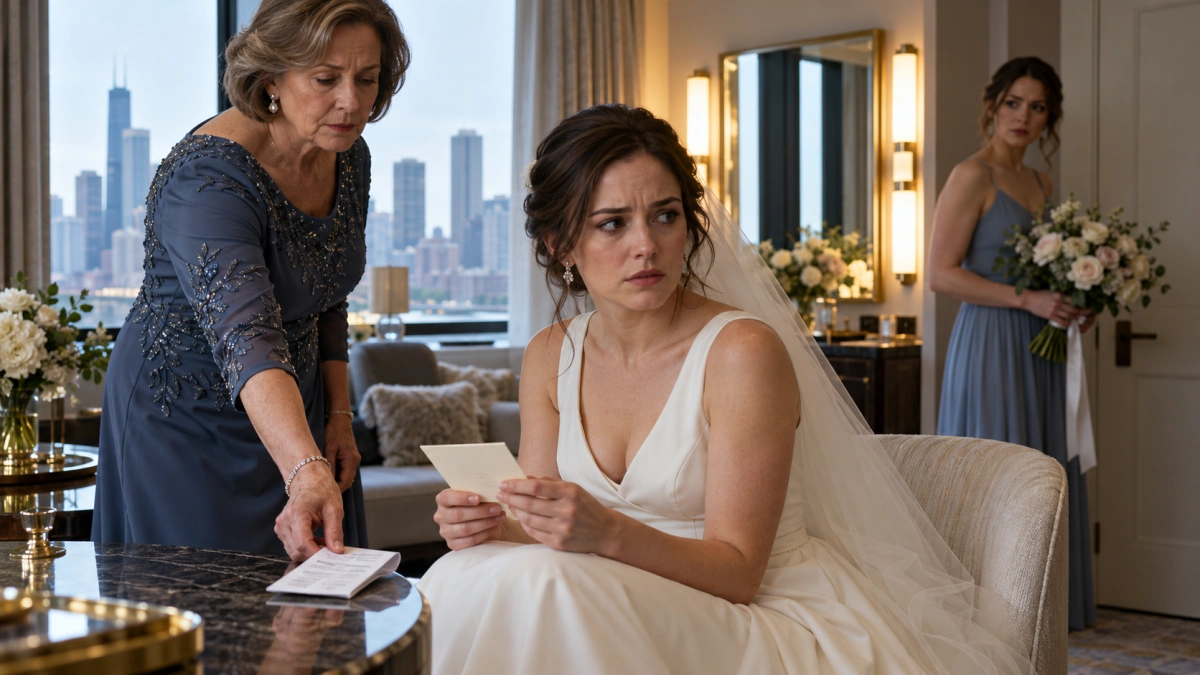
Eight minutes before the wedding, Emily received an unsigned card.
It held only two sentences:
“Ask Daniel about the $1.8 million he owes. He’ll tell you it’s been paid off.”
Emily called her fiancé.
“Do you owe $1.8 million?”
Daniel paused. “Who told you that?”
“Just answer me.”
“It’s from the old company,” he said. “I paid it off.”
Emily looked at the card again. Whoever had sent it knew exactly what he would say.
“Daniel, who paid it?”
A door closed on his end of the call. Daniel lowered his voice.
“Emily, who’s with you?”
“Rachel. And your mother.”
“Don’t ask my mother. I’m coming up.”
He hung up.
Emily looked around the bridal suite. Rachel, the best friend who had urged her to postpone the wedding, stood by the door holding the bouquet. Margaret, Daniel’s mother, was quietly straightening the veil on the dressing table.
“Someone says Daniel owes $1.8 million,” Emily said.
Rachel lowered the flowers. Margaret did not turn around.
“Did you know?” Emily asked her.
Margaret set the veil down. “Have you spoken to Daniel?”
“He says it’s paid off.”
Margaret met Emily’s eyes in the mirror. “Then you asked him the same question I’ve been asking for eleven months.”
Emily’s phone lit up.
Daniel: Don’t make any decisions before I get there.
Downstairs, the musicians began the song Emily had chosen for her walk down the aisle. Margaret reached into her purse, took out a folded sheet of paper and placed it in front of Emily.
It was a receipt for a $16,200 payment made at 9:14 that morning. The sender’s name was Margaret Reed.
“That’s the eleventh payment I’ve made for him,” she said.
Emily stared at the amount. Eleven payments like that were more than Margaret had ever claimed to have in savings. Where had the money come from?
Running footsteps stopped outside. Daniel knocked hard.
“Mom,” he called through the door, “you promised you’d let me tell her myself.”
Margaret looked at Emily before she answered.
“I’ve been waiting eleven months for you to do that.”
Daniel called Emily’s name through the door. He called again, more softly, as though a gentler voice might return the morning to what it had been. Rachel watched Emily, waiting for a signal. Emily nodded for her to open the door. If this was about their marriage, Daniel could come inside and tell the story to the person he meant to marry.
His tie was crooked. Emily had planned to straighten it when she met him at the end of the aisle. The thought was small and cruel. Daniel saw the payment receipt on the table and then looked at his mother. The alarm on his face was not about discovering the debt. He had lived with it for years. He was frightened because Emily had discovered it too.
“Will you let me explain?” he asked.
“Yes. Start with the real number.”
“A little over one point eight million.”
“How little?”
He swallowed. “One million, eight hundred and four thousand, three hundred and seventy dollars as of the end of last month. I don’t have today’s balance.”
Rachel set the bouquet aside. Margaret looked down at her hands. Emily remembered an afternoon spent touring a condo with Daniel, laughing because they could not agree on a blue sofa or a cream one. Daniel had said he wanted an ordinary life with her, one without secrets. Now he could recite the balance of a secret larger than the condo’s price.
“You said you’d paid it off.”
“I lied.” Daniel did not try to soften the words. “I’m sorry.”
“I haven’t asked for an apology. Where did the debt come from?”
Daniel told her about Northline Kitchens, the food delivery company he had started with a friend four years earlier. They had rented shared kitchen space and sold late dinners to people working night shifts. When orders surged, they opened three more locations. An investor pulled out. Rent and delivery costs rose. Daniel believed one strong season would turn things around, and he signed new commitments before admitting what the older numbers showed.
The company closed two years ago. Its equipment was sold, and its name vanished from delivery apps. But Daniel had personally guaranteed a business loan. Margaret had put family property behind part of it. When Daniel could no longer make the payments consistently, she began covering them to keep the situation from collapsing all at once.
Emily had known the business failed. She had held Daniel while he grieved having to lay off his staff. She had listened when he called it the worst period of his life. He had let her comfort him without telling her that its consequences were still arriving every month.
“You told me all the paperwork was finished,” she said.
“The company closure was finished.”
“You knew what I thought you meant.”
Daniel said nothing. Someone knocked outside. The wedding coordinator announced they had three minutes. Rachel told her the ceremony needed to be delayed at least half an hour. After a brief silence, the coordinator said she would tell the musicians. Emily heard her heels hurry down the hallway.
“We could talk afterward,” Daniel said. “Not because I intend to hide it any longer. But everyone is here. Your dad is waiting. We’ve paid for—”
“Do not tell me what the reception cost while you’re hiding a million and eight hundred thousand dollars.”
Daniel stopped. He looked at Emily’s wedding dress as though he had just remembered she was wearing it. They had planned this day for fourteen months. Invitations, seating charts, the processional music, lemon cake because Emily disliked overly sweet frosting: each choice had been made through long conversations. Only the debt had been Daniel’s decision alone. He had decided she did not need to know.
“Where did the money come from?” Emily asked Margaret.
Margaret lifted her head. “I sold the rental house in Evanston. Daniel’s father bought it before he died. I’d meant to keep it as my safety net in retirement.”
“And you sold it to make his payments?”
“I signed on the loan with him. I couldn’t watch the payments fall behind and wait to find out what happened to everything else I owned.” She turned to Daniel. “But I can’t keep doing this.”
Daniel said he had told her to stop. Margaret immediately asked what plan he had given the lender in place of her payments. He had no answer. The short argument made Emily understand that they had been having versions of this conversation for months, always without her.
Rachel picked up the card. “Who sent this?”
Margaret looked at her son. “I did.”
Daniel closed his eyes. Emily was not surprised, yet the admission still hurt. Margaret had hugged her at the dress fitting last week. She had asked if Emily wanted to wear her late mother’s veil. She had known the truth through those conversations and then, at the last minute, delivered it anonymously.
“Why not tell me yourself?” Emily asked.
“Because I promised Daniel one last chance to do it.” Margaret drew an envelope from her purse, identical to the one Emily had received. “I asked him this morning whether he’d told you. He said he’d tell you after the honeymoon. I left the card with the front desk and asked them to bring it up before I came here.”
“After the honeymoon?” Emily looked at Daniel.
“I was going to tell you.”
“After we were married.”
“I was afraid you’d cancel the wedding.”
“So you waited until I couldn’t?”
He shook his head, but he offered no other way to understand what he had done. Emily saw Rachel standing near the door, careful not to interrupt. Months earlier her friend had warned that Daniel avoided every question about money. Emily had asked Rachel not to turn concern into suspicion. She had not wanted to be someone who counted dollars in a love story. Daniel had benefited from her embarrassment about asking.
“I hid it too,” Margaret said. “I can’t put all the blame on him.”
Emily looked at the woman who called her a daughter. She wanted to ask how Margaret could let her choose flowers and songs and plan a shared home while knowing her own home was at risk. But the reasons were already in front of her. Margaret loved her son. Margaret feared the truth. Neither reason made the betrayal smaller.
A knock sounded outside again. This time it was Frank, Emily’s father. “Are you all right, honey?”
Emily opened the door. He wore the navy suit they had chosen together the month before. A white flower sat crooked on his lapel. He saw Daniel and Margaret in the room and understood that something serious had happened. He did not ask for details in front of them. He only looked at Emily.
“What do you need me to do?”
The plain question nearly made her cry. She had answered so many questions in the past few minutes. This was the first one that gave her a choice.
“I need more time.”
“Then you have it.” Frank turned toward the hallway. “I’ll tell the coordinator.”
Daniel moved closer. “I can show you everything. Right now. I have the files in my car.”
“You brought the loan documents to our wedding?”
“I was going to tell you before we flew out.”
“So without the card, I would have married you first?”
Daniel did not answer quickly enough. She did not need him to.
Frank returned. The coordinator wanted to know whether guests should keep waiting or whether she should announce a cancellation. Emily asked for ten minutes. She could not decide the future of her relationship in ten minutes. She could decide not to walk down an aisle while the truth was still sitting in a car trunk.
She took off the veil. Hairpins caught in its netting, and Rachel helped remove them one by one. Daniel stood near the door without speaking. For the first time that day, he let the silence belong to Emily.
“I’m not getting married today,” she said.
Daniel nodded faintly. “Is this the end for us?”
“I don’t know.”
He looked as though he wanted to hold her but stopped himself. Margaret faced the window. Rachel put the veil back in its box. Frank offered his hand, not to lead Emily down an aisle but to steady her. She took it and found that both their hands were cold.
In the lobby, the coordinator spoke with the officiant. Frank offered to tell guests that Emily was ill. She shook her head. She did not want everyone to assume this was simply a bout of cold feet. Daniel heard her. He said he would make the announcement and handle the calls afterward.
“You don’t have to tell them the amount,” Emily said. “But don’t make me the reason.”
“I understand.”
Daniel went downstairs first. Emily stood in the hallway with Rachel and her father, watching the elevator doors close around him. Two minutes later the music stopped. Daniel’s voice came over the speakers, slightly distorted by the microphone.
“Thank you for coming,” he said. “We won’t be having a wedding today. I wasn’t honest with Emily about something important. She needs time, and I’ll respect that. I’m sorry we’ve changed everyone’s plans.”
No long explanation. No mention of Margaret. No million-dollar figure. Emily knew Daniel had chosen words that hurt her as little as possible in that moment. They did not erase the words he had chosen to lie with before.
The reception food was served because the kitchen had already prepared it. Frank and Rachel stayed to help guests leave. Emily went through the hotel’s side exit, still wearing her wedding dress, and got into her father’s car. As they drove along the lake, she saw people walking with their coats pulled tight against the wind. Outside the car, an ordinary day continued. Its indifference made her cry.
That night Emily returned to her old apartment, the one she had planned to give up after the honeymoon. Three unsealed boxes stood on the table, filled with books and mugs ready for the move. She sat on the floor between them. Rachel brought takeout, set it down and sat beside her.
“I’m sorry I thought you sent the card,” Emily said.
“I understand why you did.”
“I didn’t listen to you.”
“I didn’t have proof. I only noticed that every time you asked Daniel about money, he changed the subject.” Rachel handed her a fork. “I wasn’t trying to make you leave him. I wanted you to get an answer.”
Emily could barely eat. She asked whether she had been foolish to trust him. Rachel said trusting someone who loved her was nothing to be ashamed of. Using that trust to keep her in the dark was the wrong choice. Emily did not know whether the words made her feel better, but she remembered them.
By morning, her phone was full of messages. Some guests asked what had happened. Others offered support. A few only wanted to know where to send wedding gifts. Emily turned off notifications. Daniel sent one message: he had placed copies of every document in a shared digital folder and would not call unless she wanted to talk. She waited until afternoon to open it.
Inside were the loan agreement, payment schedule, letters from the lender, the amounts Daniel had paid and the amounts Margaret had covered. He had written a one-page summary in his own words. The company expanded too quickly. He kept borrowing after he knew revenue was falling. He did not tell Emily when they became engaged. He lied twice when she asked him directly. The last line read: “I planned to tell you after the wedding because I was afraid of losing you. Nothing makes that right.”
Emily read each page slowly, sometimes stopping for minutes. She found no signature of hers on any loan. For a moment that eased her fear. Then grief took its place. Daniel had kept her name off the papers, but he could not keep their planned life away from the consequences. They had talked about buying a house, having children someday, helping Frank repair his roof before winter. Every plan had begun with the assumption that they stood on solid ground.
That night she opened the budget they had made for the condo. She had forgotten how carefully they had worked on it. Emily had entered her teaching salary, the amount she could save each month and the cost of helping her father when his roof needed work. Daniel had entered his projected income from consulting and the payments on his car. There was a column for other debt. His cell was blank. He had even changed the color of the header to a cheerful blue because she said gray spreadsheets made every future look like a tax return.
Emily stared at the empty cell longer than she had stared at the loan agreement. A number would have frightened her, but it would have given her something to discuss. A blank space had allowed them to talk about neighborhoods, schools and how much sunlight a kitchen needed. It had let her believe their plans were built on the same facts.
She took a screenshot and sent it to Daniel with one question: “When we made this, why didn’t you put the payment here?”
His reply came after twenty minutes. “Because Mom was making it then. I thought we would have a new arrangement before we bought anything.”
Emily typed several answers and erased them. He had treated his mother’s money as a temporary wall between his old life and their new one. Margaret had been selling pieces of her security to hold that wall up, while Emily drew a picture of a home on the other side. None of them had agreed to the same plan. Only Daniel had known there were three separate plans at all.
She finally wrote, “You knew the payment existed. That was enough reason to put it on the page.” He did not answer. She appreciated the silence more than another apology.
The next day, Emily received a call from the real estate agent who had shown them two apartments. A place they liked had come back on the market. The agent congratulated her on the wedding and asked whether she and Daniel wanted another look. Emily stood in the school hallway, watching students hurry past lockers covered in bright paper. For a moment she was tempted to say she would ask him. It was an old reflex, the answer she would have given a week earlier.
“No,” she said. “We aren’t looking together anymore.”
The agent paused, apologized and ended the call. Emily leaned against the wall. The sentence had felt harsher than she intended, yet it was true. At the bell, she went back to her classroom and wrote the day’s assignment on the board. She did not tell the students why her hand trembled.
At lunch, she texted Rachel to ask if they could meet after school. Rachel replied immediately: “I’ll bring food.” Emily smiled at the message despite herself. Rachel had not demanded a confession, an update, or a decision. She had offered dinner, the same ordinary kindness she had brought to the apartment after the wedding.
A week later, Margaret called. She did not ask Emily to forgive Daniel. She asked whether Emily wanted to hear her side of what she had done. They met in a coffee shop near Emily’s school. Margaret arrived early, without makeup, her hands wrapped tightly around a paper cup.
“The property I sold was a two-story rental house in Evanston,” she said. “Daniel’s father bought it for us years ago. When he died, I kept it because I thought Daniel might need a safety net someday. In the end, he did. Just not in the way I imagined.”
She had used the sale proceeds to make the large monthly payments. She had reserved some for her own future medical needs. After eleven months, even that reserve was wearing down. At first she had believed she only needed to carry Daniel through one bad stretch. Perhaps he would sell what remained of the business or find someone to restructure the loan. Every month he promised the following month would be different.
“You can think I was a fool,” Margaret said.
“I think you were afraid,” Emily replied.
Margaret lowered her eyes. “Yes.”
“But you knew I was going to marry him.”
“I did.”
“Then why wait until the last eight minutes?”
It took Margaret a while to answer. “I wanted him to tell you himself. If he did, I wouldn’t be the person who ruined your wedding. That morning I realized that if I stayed quiet, I’d help push you into a marriage you hadn’t chosen with all the facts.”
Emily looked at her. “You didn’t ruin the wedding. Daniel did that when he lied. But you let me plan it in the dark.”
Margaret nodded. She did not ask for another chance to be Emily’s mother. Before leaving, she said she would not keep making Daniel’s payments without a clear plan. She had told him so. For the first time, she had drawn a line without adding a promise to save him if he crossed it.
Emily went back to teaching. Her students knew little about the wedding, except for one who asked why she was no longer wearing her ring. Emily said she had left it at home. She disliked the answer the moment she spoke it, not because it was false but because it came so easily. She understood how hiding could begin with a convenient sentence.
On Friday evening, Daniel asked to meet. She agreed to a diner near her apartment, where they had once gone on their first date. When she arrived, he was already at a booth with a thin folder. He was not wearing the expensive watch she had given him the previous year. She noticed, then reminded herself that a watch would not fix a seven-figure debt.
“I sold my car,” Daniel said after she sat down. “And the last equipment I had from the company. I’ve taken a full-time job with a food distributor. Next week I’m meeting the lender to discuss a payment plan.”
“What are you trying to prove by telling me?”
“That I’m doing something. I’m not waiting for Mom to rescue me anymore.”
Emily nodded. “Those are things you need to do whether I’m here or not.”
“I know.”
They ordered coffee. Daniel spoke more plainly about Northline Kitchens. It had begun with one small kitchen and four employees. He had loved creating jobs and the nights when the whole team stayed late testing a new dish. When their first location turned a profit, he had believed tripling their size would triple their chances.
He ignored warnings from the person keeping their books. Later he concealed spending that might have made the investors pull out sooner. When they pulled out anyway, he used more credit to cover the gap. Each decision had an explanation. Together they became a habit of refusing to stop.
“I don’t need you to tell me so I’ll sympathize with the numbers,” Emily said. “I need to know how you could watch me plan our wedding and stay quiet.”
Daniel turned his coffee cup. “At first I thought I’d fix it before I proposed. Then before you put down the venue deposit. Then before we mailed the invitations. Every deadline passed, and telling you got harder. I kept telling myself I needed a little more time.”
“Were you planning to use my money?”
“No. I was never going to ask you to pay the debt.”
“You wanted a joint account. You wanted to buy a house with me. If your mother stopped paying, where would your salary go?”
“Toward the loan.”
“Then our life would pay for everything else. You didn’t need to take my card for that to happen.”
He lowered his head. Emily had wanted him to understand that in the bridal suite. Now he did, and she no longer knew whether understanding was enough to build a life together.
She made no decision before leaving. She said they could discuss practical matters, but she needed time to know what she wanted. Daniel agreed. He did not ask how much time. It was a small change, and Emily did not want to turn it into a grand promise.
Frank visited on Sunday. He brought his tools to repair a sticking cabinet door, though Emily had told him not to bother. Working with his hands made conversation easier for him. While tightening a hinge, he asked whether she felt pressure to forgive Daniel because he had admitted his mistake in front of the guests.
“I do,” Emily said. “Everyone keeps messaging him that he was brave.”
Frank set down the screwdriver. “Telling the truth after getting caught is better than lying again. But you’re the one who has to live with everything before that.”
Emily remembered him waiting outside the bridal suite with a crooked flower on his jacket. She asked whether he was angry that the wedding had cost so much. Frank smiled sadly. “I’d rather you regret one reception, if you have to regret anything, than feel trapped because you were afraid to stop it.”
They said little more. He finished the cabinet; she made tea. After he left, Emily unpacked the three boxes meant for her move. She returned the books to their old shelves. She did not know how long she would live in the apartment, but it was her home today.
The next morning, Emily opened the wedding gift list. Coffee makers, dishes and cash envelopes were carefully recorded in a spreadsheet she and Daniel had made together. She had never expected a spreadsheet to make her cry. Daniel offered to handle the returns, but Emily wanted to write to their closest friends and relatives herself. She did not explain the loan. She thanked them for coming, apologized for the canceled ceremony and said the two of them were dealing with a private matter.
An aunt wrote back: “Every marriage has secrets. Don’t throw yours away over one small mistake.” Emily read the message and set down her phone. Her aunt did not know how large the mistake was. Emily did not want to use the number $1.8 million to win an argument. She understood that guests had traveled, booked rooms, bought clothes and arranged childcare. They deserved an apology. They did not earn a vote on whom she should marry.
That afternoon, she visited the small storage unit where Daniel kept a few things from Northline Kitchens. He had asked her to collect a box of her books before someone came for the remaining equipment. Daniel was not there; Rachel went with her. The shelves held menu signs, a photograph of the kitchen staff smiling under fluorescent lights and a notebook of recipes they had tested.
Emily turned a few pages. Daniel had once drawn a small branch next to the name of a soup Emily liked and written, “Emily says more lemon.” Memories of the man she loved were mixed in with evidence of what he had hidden. She set the notebook down, unsure whether to keep it.
Rachel carried the book box to the car, then came back. “You don’t have to erase all the good days to believe what happened at the wedding,” she said. Emily could listen because Rachel was not making the decision for her. She kept a photo taken on the first kitchen’s opening day. One employee in it had once come to dinner at their apartment and checked on Emily after the company shut down. She left the rest for Daniel.
On the drive home, Emily remembered something he had said the night they became engaged: he wanted to build a place where neither of them had to pretend to be okay. He had meant it when he said it, she thought. But whenever things became hard, he had chosen to pretend. That did not turn him into an entirely different man. It showed her a part of him she had not been allowed to see. She could not love a promise so much that she ignored what a person did with it.
A few days later, Margaret mailed back the veil that had belonged to Emily’s mother. She had folded it in tissue paper with a note: “I’m sorry you had to learn the truth from a card. I don’t expect an answer. This belongs to you, whatever you decide.” Emily left it on the bed for a long time.
She had thought canceling the wedding might make everything connected to it unbearable. But the veil had belonged to her family before Daniel, and it would still be there after him. She put it beside an old photograph of her mother. It did not mean she had forgiven Margaret. She simply refused to let someone else’s silence take another keepsake from her.
Two months passed. Daniel sent updates about meetings with the lender without asking when Emily would come back. Margaret moved into a smaller apartment to protect the money she still had. Rachel kept taking Emily out to dinner on Wednesdays, and slowly their conversations stopped revolving around the wedding.
One early winter afternoon, Daniel asked if they could meet once more. He wrote that he would respect it if she declined. Emily agreed because she had an answer, not because he had asked for one.
They met beside the lake, where they had taken their engagement photos. The cold wind drove them beneath a shelter. Daniel looked tired, but he no longer seemed to be searching desperately for the one sentence that would repair everything. He asked about her school. She asked about his new job. They spoke like two people who had once known each other intimately and now had to learn how to tell the truth from the beginning.
“I thought if you saw me trying, you might come back,” Daniel said. “Then I understood I have to do it even if you don’t.”
“I see that you are.”
“Can you forgive me?”
Emily looked at the lake. She had considered the question for weeks. She remembered Daniel bringing dinner to school when she had to grade papers late, the way he always walked on the street side of the sidewalk, the uncomplicated joy on his face when she received a promotion. That love had been real. So had the loan. So had the lies.
“I can,” she said. “I’m working on it. But I can’t marry you.”
Daniel closed his eyes and nodded. He did not ask for another month. He did not invoke the vows they never got to say. Emily took the ring from her coat pocket and placed it in his palm. She had kept it so long because she feared returning it would turn every happy memory into a mistake. Now she knew those memories could remain good, even though they did not lead to the future she once imagined.
“I’m sorry I took your choice away,” Daniel said.
“I have it back.”
They stood together a while longer, listening to small waves strike the seawall. When Emily turned away, Daniel did not call her back. She walked toward the lit street, where Rachel waited in a warm coffee shop. A photo of the unsigned card was still on Emily’s phone. She opened it one last time, looked at the sentence that had stopped her world, and deleted the image.
She did not want to forget. She simply no longer needed a warning to believe what she had seen for herself. For the first time in months, Emily kept walking without waiting for someone else to tell her the truth.
Read next

The Song He Gave Away
The Address on Our Lease

The Divorce Party Invitation
My Fiancé Asked Me to Hide My Son During His Mother’s Visit—Then I Found the School Form He Had Already Filled Out
Reading notes
An unsigned warning before a wedding leads a bride to question a debt her fiancé insists has been paid.
This is an original work of fiction. Characters and events are fictional. Explore public-domain books at Project Gutenberg or browse more stories on ReadStoryvia.