Original fiction
On this page
Two Tickets for Different Cities
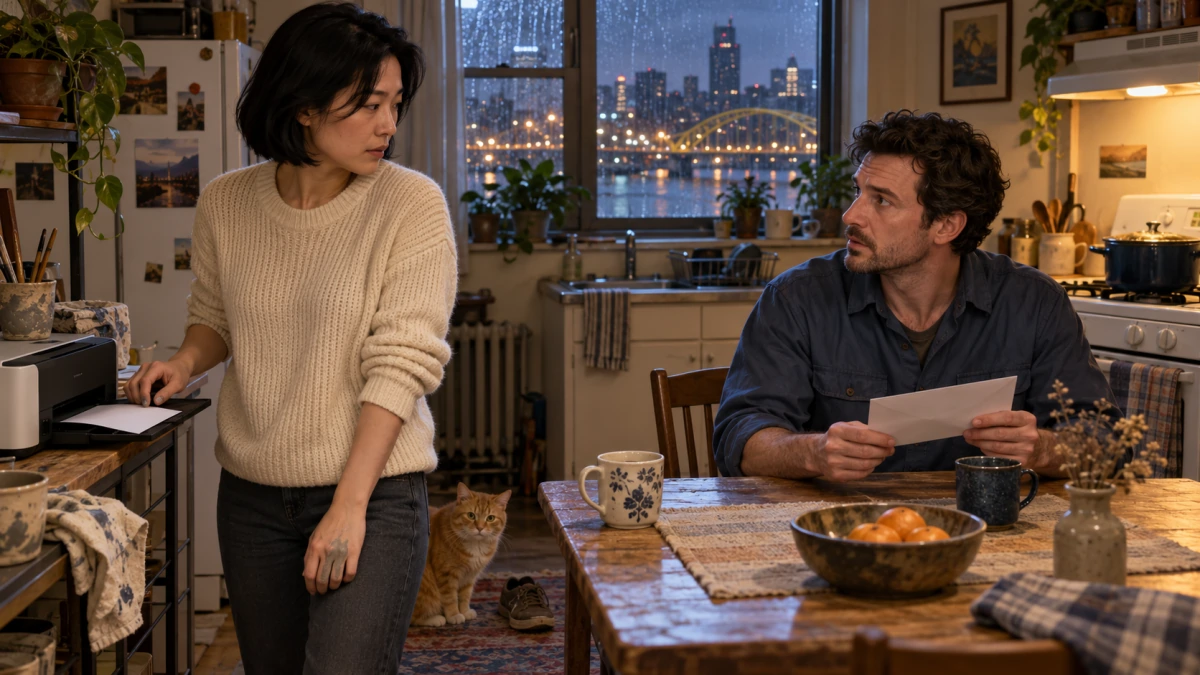
The printer spat out Lena's ticket while Adrian was taking off his shoes. She reached for it too late. Minneapolis lay faceup in the tray between a grocery coupon and the cat's bloodwork, and her husband stood holding an envelope from Baltimore.
For a moment, in their narrow Pittsburgh kitchen, neither of them offered an explanation. The radiator knocked. Clementine, their seventeen-year-old orange cat, put one careful paw on Adrian's abandoned shoe.
"You're going somewhere," he said.
Lena wiped clay from the side of her thumb. She had washed twice at the studio, but the pale crescent beneath her nail remained. "So are you."
He looked down at the envelope as though someone else had brought it home.
They had been married eight years. They knew the sound of each other's car outside, the precise angle of a headache, which drawer contained takeout menus and which contained things they couldn't discuss. They had become remarkably considerate people who no longer asked permission to be unhappy.
"It's six months," Lena said. "A residency. I accepted Friday."
"I signed Tuesday."
She had expected anger, maybe relief. Instead, Adrian set the envelope beside her ticket with the delicate care he used around wet pottery.
His promotion wasn't in Pittsburgh. Her residency wasn't something she could do on weekends. On the refrigerator, beneath a magnet from their honeymoon, their lease renewal waited for both signatures.
"When were you going to tell me?" they asked together.
That almost made her laugh. Then Clementine tried to jump onto a chair, missed, and landed with a small indignant cry. Both of them bent to pick her up. Their hands met under the same frail ribs, and neither knew who should let go.
Adrian lifted the cat. Lena pulled out the chair and spread the towel they kept there for her. The old choreography still worked when there was something smaller than their marriage to protect. Clementine settled heavily, then began washing a paw as if the fall had been deliberate.
It was March sixth, a Thursday made ordinary by lentil soup and freezing rain. Lena was thirty-four; Adrian was thirty-six. Until that evening, each believed the other had postponed the future again. Now the future had arrived twice, with different addresses.
"Tell me yours first," he said.
She took the soup off the burner. The residency began April fourteenth and ended October tenth. A community ceramics center in Minneapolis would give her studio access, shared kiln firings, and a modest monthly stipend. She would teach two evening classes. The furnished room she had found cost eight hundred fifty dollars a month, utilities included, and did not allow pets.
"A room," Adrian repeated.
"Not a loft in an advertisement. A room over somebody's garage."
She had paid a three-hundred-dollar reservation deposit. Her bus ticket left Pittsburgh April eleventh. The center had offered her place to someone from a waiting list last year when she hesitated. This time she had answered before she could invent another reason to wait.
Adrian's new position began April twenty-first. He supervised freight routing for a regional distributor, work she understood mostly through the delays that followed him home. Baltimore meant managing six people, a salary increase, and being responsible when a system failed instead of recommending fixes nobody approved. His employer would cover a capped moving allowance, not two homes.
"I put down money on an apartment," he said. "Eleven hundred ninety. Small place. Near the office. They allow cats."
She looked at Clementine. "You thought about her."
"Of course I did."
"Did you think about where I'd put a wheel?"
He opened his mouth, then shut it. Outside, tires hissed along the wet street.
They ate soup because it was there. Adrian described the apartment's windows, then stopped halfway through a sentence about morning light. Lena had once told him that northern light made her glazes easier to judge. He had remembered the preference without noticing he had imagined her making nothing larger than a windowsill mug.
"I thought we'd talk after I knew it was real," he said.
"It became real when you signed."
"You accepted yours."
"I know."
Neither accusation improved when returned. They sat with that discovery until the soup cooled.
Years earlier, when Adrian's mother had surgery outside Erie, Lena had reduced her studio hours and driven them north on alternate weekends. Afterward he had supported them while she recovered from a wrist injury. Those things had once been gifts. Somewhere between a broken water heater and another canceled exhibition application, they had become evidence.
"I never asked you to quit that class," he said.
"You said you couldn't do the hospital alone."
"I couldn't."
"Then don't make it sound like I wandered away from my work."
He pushed back his chair. "And don't make the year I paid rent sound like I bought the right to decide everything."
She hadn't meant that. She had meant something close enough that she couldn't deny it cleanly.
That night Adrian slept on the couch, not because she banished him but because neither could bear the politeness of undressing together. At two, Lena heard him opening Clementine's food. At three, she brought him the quilt from their bed. He was awake. He thanked her. The courtesy frightened her more than shouting would have.
On Saturday they walked to a diner before either could escape into errands. Lena carried a notebook, then left it closed. Across the aisle, a father cut pancakes into squares for a toddler who objected to every cut. Adrian watched them with an expression she couldn't read.
"We aren't deciding about children today," she said.
"I wasn't thinking about children. I was thinking he gets to know what the argument is."
She smiled despite herself. He smiled back, cautiously.
They agreed on one thing: neither would demand cancellation as proof of love. Adrian could withdraw from the promotion, but his old role had already been promised to a colleague. Lena's deposit was nonrefundable, and the center needed an answer about housing within days. More important, each had said yes because they wanted the life on offer. Calling either choice a misunderstanding would be another lie.
"What if we try the six months?" Lena asked.
He put down his fork. "Try what?"
"Being married in different places. Not waiting for someone to apologize by coming back. Actually trying."
They chose July thirteenth as a day to discuss what they knew, and October twelfth as the end of the experiment. They would call on Wednesday and Sunday evenings, with room for ordinary calls between. One visit each before July, if they could afford it. No surprise arrivals. No searching phones to compensate for all the things they hadn't said aloud.
It sounded reasonable until Adrian asked where they would live afterward.
"I don't know," Lena said.
"I need that to be an answer we get to, not a principle."
The waitress refilled their coffee. Lena watched cream open slowly in the dark cup. She had fallen in love with him partly because he could make a room feel settled. She had never considered that settling might feel different from inside his hands.
They told their landlord they would leave at the end of April. Keeping the apartment would have swallowed the raise and most of Lena's savings. Adrian would stay through the twentieth, then a friend would help with the final cleaning. They divided the physical work, badly at first. Every object seemed to demand a verdict about whose life had taken up more space.
"You can have the bookcase," she said.
"That's not generous. It doesn't fit in your room."
She sat on the floor amid paperback novels. "I wasn't trying to be generous. I was trying to get through a sentence."
He sat beside her. Between them lay a cookbook stained with tomato sauce from their first winter together. Neither had cooked from it in years. Neither put it in a box.
Clementine's veterinarian examined her before the moves. The cat had arthritis, stable kidney disease, and a determined dislike of travel. She needed her regular food, daily medicine, and familiar care, not a rotation devised to make the humans feel fair. Adrian's quiet apartment and predictable schedule made more sense than Lena's temporary room. Lena agreed before the veterinarian finished explaining.
In the parking lot she cried so hard she couldn't unlock the car.
"You can change your mind about Minneapolis," Adrian said, then closed his eyes. "That sounded like a bargain. I'm sorry."
"It sounded like you thought I hadn't counted this."
He took her keys, unlocked the passenger door, and gave them back. He did not reach for her until she leaned against him. For several minutes they stood beside a salt-streaked sedan while people carried pet crates around them.
Lena's friend Priya helped wrap bowls in old towels. She was a high school art teacher with paint on her shoes and no patience for the romance of starving. She asked what Lena's stipend would actually cover. Lena showed her. After rent, food, transit, and studio materials, there would be almost nothing left.
"Then don't call it a vacation when you tell your mother," Priya said.
"I wasn't going to."
"You do that. You make your work small before somebody else can."
Later Lena heard herself explaining the residency to her mother as a little teaching opportunity. She stopped, started again, and said she wanted to make a body of work that wasn't assembled between other people's deadlines. Her mother asked whether Adrian was going. Lena said no. The silence afterward contained concern, but also room.
Adrian told his brother Noah over the phone while taking apart the bed frame. Noah immediately said he could probably find a better job in Pittsburgh.
"That's not what I asked," Adrian said.
"You didn't ask anything. You said your wife's leaving."
"She's doing a residency. I'm moving too."
He heard the difference only after he spoke. That evening he told Lena about the call. She thanked him for correcting it. Neither mistook that for repairing everything.
On April tenth they ate takeout on the floor because the table was gone. The living room made an unfamiliar echo. Adrian had kept a small wooden stool she used while trimming pots. He had planned to repair its loose leg as a surprise, then couldn't decide whether giving it to her would seem like encouragement or an eviction gift.
"It's a stool," she said, touching the smooth seat. "Let it be a stool."
He laughed. It was their first unguarded laugh in days.
Her bus left before dawn. At the station he carried the duffel while she carried a hard case containing three small ceramic forms. She had shipped her tools separately. Pittsburgh was still dark, the wet pavement reflecting lamps under the terminal canopy.
"Call when you get there," he said.
"It'll be late tomorrow."
"I know."
They kissed awkwardly, then again without trying to perform reassurance. Through the bus window she saw him stand with his hands in his coat pockets long after she had found her seat. She wanted him to go home. She wanted him to stay where she could still see him. The bus chose for both of them.
Minneapolis smelled of thawing earth and bus exhaust. Her room had one sloping wall, a narrow bed, and a desk too wobbly for wet clay. The landlord, a retired electrician named Gail, pointed out the laundry hours and offered leftover soup. Lena ate it standing because she couldn't yet bear to unpack.
At the center, nobody knew how many hospital weekends she had driven. They knew whether she cleaned the splash pan and whether her shelves were ready for firing. It was a relief until she realized no old kindness would excuse a weak piece. On her fourth day, a tall vessel sagged into itself. She photographed it, started to send Adrian the picture, and stopped because she wanted him to see success.
He sent a photograph of Clementine asleep in an open suitcase. His apartment had pale walls and a view of a brick building. The cat had refused food the first evening, then eaten at midnight from the chipped saucer Lena had packed. Adrian admitted he had sat beside her bowl for an hour.
Lena sent the collapsed vessel.
"Looks like my first staff meeting," he wrote.
She laughed alone in the studio. For a week, the distance seemed to have returned something they had lost while sharing a kitchen.
Then came the small absences. Adrian called during a class because he had forgotten the time difference. Lena missed Sunday because a shared kiln needed unloading before Monday instruction. She had sent a message, but he read it after cooking enough pasta for two. Neither had meant to injure the other; that no longer seemed sufficient protection.
In May he visited Minneapolis. He stayed at a modest hotel because Gail's room agreement did not include overnight guests. The additional cost made every disappointing hour feel expensive. Lena had imagined showing him the river and her work; Adrian had imagined two days when no one needed her but him.
On Saturday, a student arrived crying because a mug intended for her dead sister's birthday had cracked. Lena spent forty minutes helping her choose a piece to glaze instead. Adrian waited beside the coat hooks with museum tickets in his pocket.
"You could have told her Monday," he said outside.
"Her sister's birthday is tomorrow."
"I know there's a reason. There's always a reason."
They stood at a crosswalk while a cyclist waited for them to notice the light had changed.
At the hotel, he admitted he resented being scheduled. She admitted she had left the studio late partly because the work felt easier than the visit. The confession hurt him. The fact that she didn't soften it hurt her too.
They spent Sunday walking beside the Mississippi. Without a planned attraction to reach, they found an hour of ease. Adrian pointed out a dog carrying an enormous stick. Lena told him about the first bowl she had ever made, its bottom so thick it could have anchored a boat. He had heard the story, but not the part about how ashamed she had been to want to keep going.
"I didn't know that," he said.
"I didn't know it was something I could tell you."
He took her hand. They did not turn that tenderness into a promise they couldn't yet keep.
In June she went to Baltimore. Adrian had stocked the refrigerator with yogurt she liked and cleared a drawer. Clementine recognized her voice before she came around the couch. Lena knelt on the rug and let the cat press her forehead against her knee until Adrian turned away to give them privacy.
The apartment was not a trap. It was pleasant, affordable by their old standards, carefully chosen. That complicated her anger. Adrian's books were arranged beside a blank shelf clearly intended for her. He had found a community pottery studio two bus rides away. He showed her the website, hopeful and embarrassed.
"They have memberships," he said.
"I know you're trying."
"That's what people say before they explain why trying doesn't count."
She closed the laptop gently. "I don't want my work to be the thing we fit in after your life is built."
"And I don't want my job to be the embarrassing thing that pays for the life we call yours."
For once, she heard how much pride he had hidden beneath practicality. His promotion mattered to him apart from money. He liked solving difficult routes, training people, being useful without being invisible. She had treated his work as weather: inconvenient or favorable, never a place where he actually lived.
The next morning she asked him about his team. He answered cautiously, then with animation, drawing a loading schedule on the back of an envelope. She understood more than she expected. Understanding did not make her want to move there. She wished it did. He could see that wish, and the limit of it.
Their July conversation happened by video because neither could afford another trip. Lena moved the laptop onto a stack of books. Adrian sat at his kitchen table with Clementine's tail crossing the screen. They had each written down what they wanted, not what they thought the other could tolerate.
"I want one home," he said. "Not necessarily this apartment forever. One place where we come back. I don't want to spend every spring wondering whether summer means another goodbye."
Lena read her own page twice before speaking. "I want to keep applying for work that may take me somewhere. Not always. But more than once. I want not to apologize before I know whether I even get it."
He nodded as though receiving directions to a place he wouldn't go.
"Could Baltimore be the base?" he asked.
"Maybe a base isn't what I mean by home."
"It is what I mean."
They had once used the same word as if that proved they wanted the same life. Now they described its furniture and discovered different rooms.
They kept the October end date. Lena feared that was cowardice; Adrian said he didn't want to make a permanent decision in the worst hour of a phone call. They would try fewer scheduled calls, more honest ones. It helped with resentment. It didn't produce a future either could inhabit without shrinking.
In August, Clementine stopped jumping even onto the low couch. Adrian took her to the veterinarian, called Lena afterward, and said the arthritis medication needed adjusting. She wanted to come immediately. He wanted her there, then worried he had turned the cat into a summons. They managed to say both things without fighting.
Lena came for a weekend. The cat improved with the change in treatment and a low padded step. There was no deathbed revelation, only a very old animal indignantly accepting assistance. On Sunday afternoon Lena fell asleep on the rug, her hand touching Clementine's warm back. Adrian covered her with a light blanket.
When she woke, he was reading by the window.
"We could do this," she whispered.
He set down the book. "This afternoon? Yes."
She began crying before he finished.
"I don't think we should use one good afternoon to promise all the others," he said.
She had thought herself the braver one because she could leave. His refusal to take an offered comfort taught her something less flattering and more useful about courage.
Back in Minneapolis, Lena began making shallow vessels with a line interrupted before the edges met. Her instructor asked whether the break was structural or decorative. Lena wanted to explain her marriage. Instead, she examined the clay and admitted some of the pieces relied on the story to excuse poor construction. She broke two and started again.
Adrian's first major failure at work involved a route he had insisted could handle an additional stop. It couldn't. He spent a Friday evening arranging a second truck and calling an angry customer. When Lena phoned, he didn't pretend he was simply busy. She listened. She didn't suggest quitting. Afterward he realized she had given him company without offering to make the problem hers.
They were becoming kinder at a distance. It was tempting to call that proof the marriage would survive. Sometimes it was evidence of the opposite: fewer daily expectations left room for the qualities they had buried under them.
One Wednesday they tried eating dinner together on the screen. Lena made rice and eggs on Gail's small hot plate. Adrian reheated chicken. They placed their computers at the empty sides of their tables and described the weather until the silence became unbearable.
"Ask me something you don't know," she said.
He considered. "Do you like being alone?"
She could hear the dangerous answer under the easy one. "Sometimes. I like not feeling that every hour I spend working has been taken from somebody. I don't like waking up and not knowing whether you've slept."
"I sleep better here," he said, surprised by himself. "Not because you're gone. Because I'm not waiting to find out whether you're angry."
Lena put down her fork. She had thought her silence a kindness when she was tired of arguing. Now she imagined him measuring it every night, like a mechanic listening for a fault he couldn't locate.
"I'm sorry," she said.
He nodded. "I did it too. I made being dependable into a way you could never complain without looking ungrateful."
The rice hardened in her bowl. Their dinner failed as an imitation of home and succeeded as something stranger. They stayed on the call while washing dishes, each hearing water run in another city.
In September, Lena was offered a part-time teaching contract at the center for the winter. It wasn't an extension of the residency, and there was no stipend. She would need another job and different housing. She called Adrian before answering. Her hands shook more than they had when she accepted the residency in secret.
"I haven't said yes," she told him.
He looked away from the camera. "Do you want to?"
"Yes. If I can make the numbers work."
He rubbed his eyes. For a moment she saw him deciding whether to be generous at a cost he would later collect.
"I don't want to tell you to take it and then hate you for taking it," he said.
She nodded. "Thank you for not doing that."
He asked for a day before they spoke again. She gave it to him. The next evening he said he would not move to Minneapolis. Not because his offer had beaten hers, or because the weather was wrong. He liked the life he was beginning to build, and he needed a partner who wanted to build alongside it. He didn't want to become a patient man waiting for patience to earn him a wife.
"I love you," Lena said.
"I know. I think that's why we've made this take so long."
They agreed to meet in Pittsburgh October eleventh, the day after her residency ended. Priya offered her spare room to Lena and suggested Adrian stay elsewhere. He booked a small hotel. There were limits to what friendship could shelter without becoming a stage set for reconciliation.
Before leaving Minneapolis, Lena sold two pieces at the center's open studio. The money covered part of another deposit, not a new life. One buyer asked whether the interrupted rim was meant to symbolize healing. Lena said it was meant to hold fruit without looking unfinished. Then she laughed at her own severity and explained that sometimes a break remained a break.
She accepted the winter teaching work and found a room in a shared house that allowed a cat, though Clementine would stay with Adrian. Possibility wasn't the same as a claim. She bought a lamp, arranged extra shifts at a neighborhood framing shop, and let the thinness of the plan be real.
At work, Adrian turned down an optional weekend assignment that would have made their meeting easier to avoid. He told Noah he and Lena were separating. When his brother started to say she'd chosen pottery over marriage, Adrian interrupted.
"Don't make me feel better by making her smaller."
After he hung up, he sat beside Clementine and cried. Defending Lena had not relieved him of anger. It had only kept the anger from becoming a false story.
Before that conversation, he had driven to a furniture store intending to buy a larger table. His new salary made the purchase possible. He walked between staged dining rooms with matching chairs and imagined Lena returning to find an invitation instead of an argument. A salesperson asked how many people the table needed to seat.
"Two," he said, then added, "Usually one."
He went home without buying anything. That evening he ate at the small table they had found secondhand in Pittsburgh, which he had brought because Lena didn't need it. For the first time, he moved it toward the window instead of keeping its old position against an imaginary kitchen wall. Clementine watched him from her padded step.
Meanwhile, Lena visited the shared house. A woman named Beth showed her a kitchen where three separate shelves held three different kinds of tea. There was room for a wheel in the basement, provided she cleaned up and didn't expect anyone to carry clay downstairs. Lena liked the plainness of that condition. Beth didn't need her to prove she was an artist; she needed the drain kept clear.
Walking back, Lena called Priya and admitted she was frightened the winter work might fail. Her friend didn't promise it wouldn't.
"Would that make going a mistake?" Priya asked.
Lena watched a city bus release passengers onto the sidewalk. "No. But I keep wanting a guarantee I can show him."
"He isn't your grant committee."
Lena stood still, then laughed through the sudden tears. She had wanted Adrian to absolve a future nobody could predict. That wasn't a task she could fairly give him, either.
They met at a coffee shop near their old neighborhood. Pittsburgh had turned gold at the edges. Lena recognized the barista, who asked whether they wanted their usual order. Adrian said yes; Lena asked for tea. The change was so minor that she nearly apologized for it.
They talked about the remaining savings, the boxes Priya had stored, the quilt, and how to begin ending their marriage without making each other a permanent enemy. Some decisions needed professional help later. None required them to rehearse a courtroom argument over coffee. They chose what could be chosen that day.
Lena would take the small stool and the cookbook. Adrian would keep the couch, the cat's saucer, and a bowl she had made before they married. She offered to help with Clementine's ordinary expenses through the winter because she wanted to, not to retain a vote over where he lived. He agreed to send news of her health, not daily pictures that would keep every wound freshly open.
"What do we tell people?" he asked.
"That we wanted different lives, and we stopped telling each other soon enough."
"You mean didn't stop?"
She shook her head, then smiled sadly at her own muddle. "We stopped talking before we knew how different. That's what I mean."
He reached across the table, not for her hand, but to move her tea away from the edge. The familiar gesture undid her. She cried quietly. He stayed without promising the tears would change their minds.
That afternoon they walked past their old apartment. Somebody had hung a blue curtain in the kitchen. A bicycle leaned against the porch where Adrian used to leave bags of rock salt. Lena had expected the sight to prove they belonged there. Instead, it proved the house had continued being a house.
They stopped under the bare lower branches of a sycamore.
"I thought if I told you early, you'd talk me out of it," he said.
"I might have tried."
"I know. I should have let you be someone I could disagree with."
She breathed in the cold air. "I thought if you loved me, you'd know I needed to go."
"I knew you needed something. You kept saying you were fine."
"So did you."
This time it wasn't an accusation returned. It was an account they could finally give without demanding payment.
At Priya's house, they sorted the last boxes on the porch. A pair of mugs survived from the first set Lena had ever sold. One handle was slightly crooked. Adrian chose that one because it fit his thumb. She let him choose without explaining the flaw.
They ate dinner with Priya, who talked about a student painting a mural of an outrageously muscular squirrel. Nobody toasted fresh starts. Nobody insisted the separation was secretly a success. It was sad, and there was good food, and for an hour the sadness did not have to run the room.
In the morning, they shared a taxi to the bus terminal. They had bought tickets separately. His train left later from the nearby railway station; hers was an overnight bus back toward the life she had chosen. In March, two tickets had looked like evidence that one of them must stay. Now neither asked the other to surrender a destination.
At a red light, she remembered the first time they had driven this route. They had been going to collect his mother, who brought too much luggage and a cake wrapped in foil. Lena had balanced the cake on her knees coming home. She told him. He remembered the frosting sliding sideways.
"We did have a good time," he said.
"We had a lot of good times."
She needed that said, not to reopen the decision but to prevent its ending from swallowing everything before it. He tapped his knee twice with his thumb, an old habit when words took longer than traffic allowed.
"I don't want to pretend I wish we hadn't met," he said.
The light changed. They passed the turn for their old street without either looking away. Lena felt grief, not punishment, but something with room for the woman who had carried that cake and the man who had made her laugh while she tried not to drop it. Those people had been real. So were they, continuing forward.
Inside the bus terminal, he waited while she checked her bag. She touched his sleeve.
"Tell her I miss her," she said.
"I will."
"And don't make her jump for the bed."
"The step's already there."
They embraced without pretending it was a pause before reunion. When the driver called her route, Adrian stepped back. Lena folded her ticket along its ordinary crease, put it in her own pocket, and went to find her seat. After she boarded, he left the bus terminal to walk to the railway station.
Read next

The Song He Gave Away
The Address on Our Lease
The Divorce Party Invitation
My Fiancé Asked Me to Hide My Son During His Mother’s Visit—Then I Found the School Form He Had Already Filled Out
Reading notes
Two concealed career decisions force a couple to reconsider what home means.
This is an original work of fiction. Characters and events are fictional. Explore public-domain books at Project Gutenberg or browse more stories on ReadStoryvia.