My student portal showed a $0 balance when I paid for my final semester. I took a screenshot to tell Mom that the Degree Completion Grant had been applied. Four months later, three days before the graduation application deadline, the same portal displayed a red button: “Cannot continue. Past-due balance: $2,740.”
I'm Nia Torres, a final-year student at Riverbend Community College. I work evenings at a print shop and have been offered full-time hours once I receive my degree. Mom has taken an unpaid day off to attend graduation. The grant award email is still pinned to our refrigerator. It lists exactly the amount that has now appeared as a debt.
At the cashier's window, a clerk pointed to “Aid eligibility adjustment” and said the financial aid office had removed the grant. Financial aid said its system showed me enrolled in only nine credits, below the grant's twelve-credit requirement. I showed them my schedule: four classes totaling twelve credits. The employee said the schedule on my phone was not the data their system used.
I ran to the registrar's office. Ms. Chen printed my unofficial transcript and pointed to Portfolio Lab, a three-credit course with a grade. “You took enough credits,” she said. But the file sent to financial aid still carried the course's old number from when it had been a noncredit class. One change in the catalog had made three of my credits disappear from the grant calculation.
I asked who could fix it before Friday. Ms. Chen called an internal number, listened to it ring, and left a message. I looked at the line outside her door, each student holding a different stack of papers. My phone lit up with a text from Mom: “If we have to, I can put it on my card and we'll figure it out later.”
I typed “Don't pay” but had not sent it when my classmate Mateo came up behind me with his phone raised. He had the same red button. We had taken Portfolio Lab together. Above his balance was the same line: “Aid eligibility adjustment.”
I saw the check before I saw Dad. It lay beside the household ledger on the kitchen table, made out to Carter Auto for twelve thousand dollars. He had dated it for Monday but left the signature line blank. The account number belonged to the fund we used to pay Mom's in-home aide and build a ramp at the front door.
I had come to take Mom to a final measurement of the front steps. She still made her own decisions, but the three steps had become harder for her since spring. The fund held $17,640. Her aide, who came two afternoons a week, cost $1,760 a month. A $2,900 deposit for the ramp would be due in six weeks. I knew the figures because Dad and I updated the ledger together every Sunday night.
Dad came in and saw the check in my hand. My sister Elise's van had finally died, he said. She needed another one to take a cleaning contract serving six offices. “It's only a loan for a few months,” he said. “She'll pay it back when the client pays her.”
“Has the client signed?” I asked.
He looked out the window. “They said they would.”
Elise appeared in the doorway carrying two bags of groceries for Mom. She had heard the last sentence. “I thought you were lending me your savings,” she told Dad. “You said Mara agreed.”
I laid the check on the table. Nobody had asked me. Dad said he had not signed it, as though that meant nothing had happened. But Elise had arranged to see the van Monday morning and passed up a rental for the following week. If we did not talk now, the decision would arrive as a promise somebody else had already planned around.
Mom stood at the living-room door with one hand on the frame. She had heard enough. Dad hurried to say we were talking about Elise's business and Mom should rest. Mom looked at the check, then at each of us.
“Before anyone decides what to lend,” she said, “show me which part of that money is mine.”
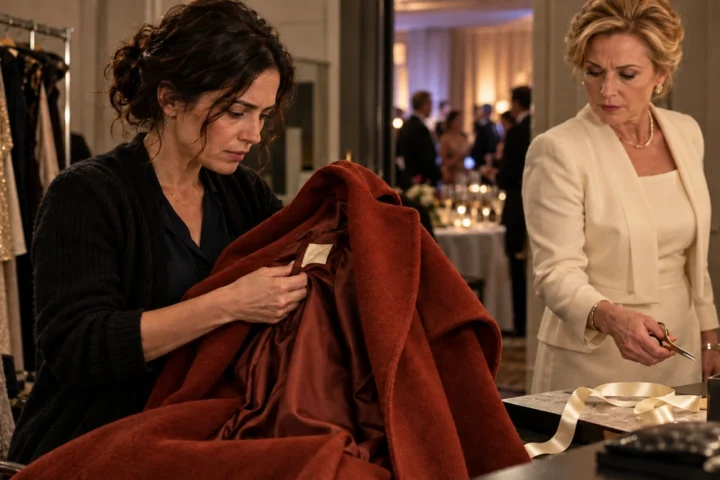
The woman holding Mara Ellis's coat had already cut one stitch from the label when Mara reached across the table and closed the scissors.
"That isn't the washing tag," Mara said.
"I know." Claire Benton kept her voice low. Beyond the dressing room door, volunteers were setting out wineglasses for the Harbor House auction. "We need the lining clean for photographs."
On the hanger beside them waited a cream ribbon printed with the name Bellwether Atelier. Mara had never worked there. She had spent six evenings making this coat at her kitchen table in Cleveland, moving her daughter's homework whenever she needed room for the sleeves.
"Did they design anything?"
"They're lending us their reputation."
The coat was rust red, with a deep inside pocket positioned for a hand that couldn't easily reach across a chest. Mara had developed that pocket for her mother after shoulder surgery. The auction card described the garment as an exclusive Bellwether creation. Under estimated value, somebody had typed twenty-four hundred dollars.
Mara had donated her labor because Harbor House had given her daughter, June, a free place in its summer art program. She had paid a hundred and eighty-six dollars for wool and lining. At home, the refrigerator held a renewal notice for June's bus pass and a gas bill she had turned facedown.
Claire put the scissors down.
"There's private work afterward. Six coats for the committee. Six hundred each. Materials supplied. But they want discretion. No maker tags, no photographs, no discussing clients."
Thirty-six hundred dollars. Mara could hear the radiator knocking in her apartment even here.
"And if I leave my name in this one?"
Claire looked toward the door, where the auctioneer had begun testing his microphone.
"Then I can't promise either opportunity survives."
Mara slid her hand inside the coat and found the loose thread beneath her name.
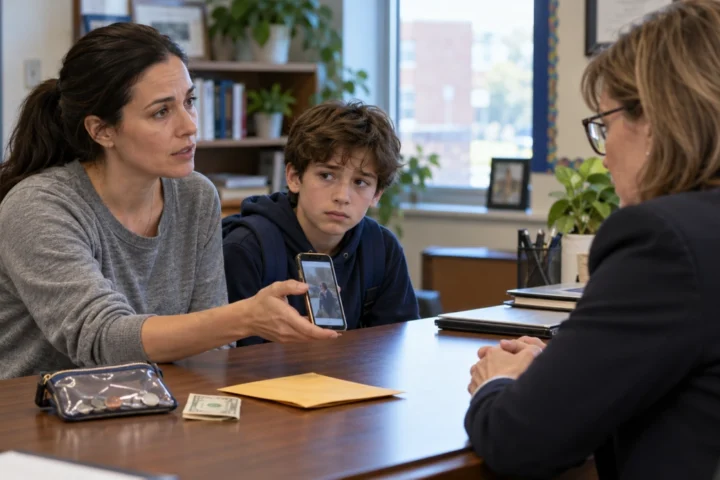
The principal put a bag of coins on the desk beside my son's backpack.
“We need you to explain why fundraiser money was in Noah's things.”
I had clocked out of the packing warehouse at six that morning. There were still adhesive marks on my wrist. Noah sat beside the window with his coat on, watching me as if my arrival could turn this into a small misunderstanding.
The bag contained a twenty-dollar bill and loose change. I'd given him exactly that much for snacks at the school fair the night before.
“That's my money,” I said.
Vanessa Cole, the parent association's treasurer, pushed a handwritten total toward me.
“We're missing four hundred eighty dollars. Your son was the last student beside the cash table.”
Three days earlier, that same woman had watched me count coins to pay for Noah's field trip.
“Next time, you could exchange those first,” she'd said with a smile. “We're all busy.”
I hadn't argued. I didn't want Noah remembering his trip as the time his mother fought at school.
Now he gripped his backpack strap.
“I only helped carry her box of cookies,” he said. “She gave me an envelope.”
Vanessa shook her head immediately. “You're confused.”
I opened my photos and found the picture Noah had sent after the fair. In one corner, a yellow envelope rested beneath a cookie box. Two handwritten words were visible: BUS MONEY.
I turned the phone toward the principal.
“Before you ask what my son took, we need to know what an adult handed him.”
On Monday morning, a man in a reflective vest stuck a label reading 4C on my apartment doorframe. My son, Mateo, thought the building was changing its numbers. The man said he was marking units “ready for delivery” to the new owners. I had never agreed to move.
An envelope from management lay under my door: four thousand dollars if I gave up the apartment in twenty one days. It called the offer voluntary. I looked at the boxes of books Mateo had stacked for a school presentation, then at my night shift schedule. Three weeks was not enough time to find a two bedroom apartment in his school area, save a new deposit, and take days off to move.
Ruth from 4A heard us in the hall. She had received an envelope too, but hers offered twelve thousand dollars and two months. Her apartment was the same size as mine. Both our leases ran into spring.
I went downstairs to ask why the letters were so different. The property manager said every offer was calculated individually and I should sign before mine expired. I asked about the label on my door. She called it a survey crew mistake, then pushed a paper across the counter. “This only confirms you received the notice,” she said.
Under the signature box, in smaller type, the paper said I agreed to terminate my lease and hand over the empty apartment on the twenty eighth. I put down the pen. My phone buzzed with an automated email from the company: “Pre-delivery inspection scheduled.” The inspection was set for Friday.
Mateo stood beside me with a box of books in his arms. “Did you say yes?” he asked. Behind the counter, the manager watched me over her monitor, waiting for me to pick up the pen again.