Original fiction
On this page
The Zero-Dollar Bill
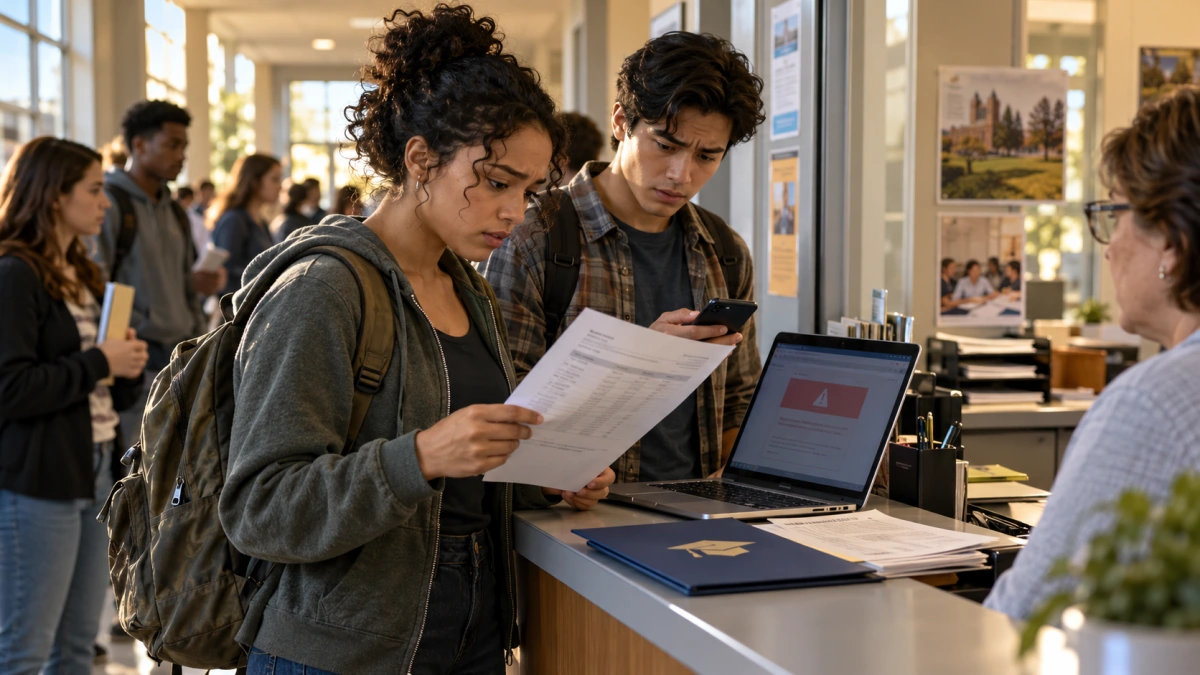
My student portal showed a $0 balance when I paid for my final semester. I took a screenshot to tell Mom that the Degree Completion Grant had been applied. Four months later, three days before the graduation application deadline, the same portal displayed a red button: “Cannot continue. Past-due balance: $2,740.”
I’m Nia Torres, a final-year student at Riverbend Community College. I work evenings at a print shop and have been offered full-time hours once I receive my degree. Mom has taken an unpaid day off to attend graduation. The grant award email is still pinned to our refrigerator. It lists exactly the amount that has now appeared as a debt.
At the cashier’s window, a clerk pointed to “Aid eligibility adjustment” and said the financial aid office had removed the grant. Financial aid said its system showed me enrolled in only nine credits, below the grant’s twelve-credit requirement. I showed them my schedule: four classes totaling twelve credits. The employee said the schedule on my phone was not the data their system used.
I ran to the registrar’s office. Ms. Chen printed my unofficial transcript and pointed to Portfolio Lab, a three-credit course with a grade. “You took enough credits,” she said. But the file sent to financial aid still carried the course’s old number from when it had been a noncredit class. One change in the catalog had made three of my credits disappear from the grant calculation.
I asked who could fix it before Friday. Ms. Chen called an internal number, listened to it ring, and left a message. I looked at the line outside her door, each student holding a different stack of papers. My phone lit up with a text from Mom: “If we have to, I can put it on my card and we’ll figure it out later.”
I typed “Don’t pay” but had not sent it when my classmate Mateo came up behind me with his phone raised. He had the same red button. We had taken Portfolio Lab together. Above his balance was the same line: “Aid eligibility adjustment.”
I sent Mom a message: “Don’t use the card. The college is checking a course-code error. I’ll tell you when I know more.” Mateo read the course name on my screen and opened his own schedule. We had taken Portfolio Lab on Tuesday mornings, submitted the final assignment the previous week, and received grades. He held the same Degree Completion Grant.
His balance was $1,980 because other aid covered part of his tuition. The shared fact was not the amount; it was the adjustment time: yesterday at 4:12 p.m. I asked whether he could save a screenshot of his own page. He already had. I did not ask to see his other aid. We compared only the course code and the time the error appeared.
Ms. Chen brought us both to the counter. She opened my course record and printed another page. Portfolio Lab was now a three-credit course in the communication design program, listed as ART 248. The previous summer, Riverbend had used CE 248 for a short noncredit class.
When the catalog changed, the registrar moved the course to ART 248, but the nightly export to the financial aid system still carried “CE” in an old field. I did not understand every step the data took. I understood that two screens were saying opposite things about a class I had attended for sixteen weeks.
“Can you fix that field now?” Mateo asked.
“Not from this desk,” Ms. Chen said. “If I change one line in your record, tonight’s export may overwrite it. I need our data administrator and financial aid to agree on the calculation.” She wrote our case numbers on forms and asked us to consent to sharing the records between offices. I asked whether the form mentioned Friday’s graduation deadline. She added it in red pen. “I will send these before I leave today,” she said. It was not a promise that everything would be fixed. It was a specific action with a person’s name attached.
I was twenty-four and had taken classes in fits and starts while keeping up with rent. This semester I took three classes during the week, one on weekends, then worked evening shifts at Ash Street Print. Riverbend’s grant supported students close to completing a degree if they carried twelve credits and kept the required grades.
It had not been a secret award appearing at the last minute. In December, I received a letter stating the $2,740 amount and its conditions. In January, the credit appeared in my account and covered the remaining balance. I saved the $0 screenshot to show Mom that my final term would not require the money she needed for rent.
Mom, Elena, worked in an elementary-school kitchen. She had requested one unpaid day in May so she could attend commencement. When I told her about the debt, her first response was to offer a credit card. She was still paying off a car repair from the winter. I did not want an error in Riverbend’s data to become interest in our household. Yet saying “don’t pay” was easier than looking at the red button on my screen. I needed a way to do more than wait while Friday approached.
Mateo and I went to financial aid. The line reached the vending machines. A notice said graduation applications had to be filed by five on Friday to make the printed degree list. I remembered telling Mom we would take a picture in front of the college sign; she had said to forget the picture and look up into the audience so I could see her. Now the notice felt like a clock in a room where nobody in line controlled the pace.
When we reached the counter, an employee named Ava Moore read Ms. Chen’s printout. She did not deny it. She showed us financial aid’s screen: nine eligible credits and a grant automatically reversed. She could open a review case, but could not restore the money while the registrar’s export marked one course incorrectly. I asked who could temporarily lift the graduation application block while they fixed it.
Ava said that belonged to the graduation office, not her counter. Mateo sighed. I asked for the name of the person handling the case and an email confirming we had reported it before the deadline. Ava typed two lines, sent them to both of us, and copied Ms. Chen. She looked tired, but she gave us a timestamp that would outlast her shift.
Outside, Mateo said he might borrow from his roommate and pay temporarily. Did he have enough to carry the balance if the college took weeks to refund it? No. He worked receiving at a bookstore, and his pay did not stretch that far. His younger sister was waiting to find out if she could use one of the family’s two commencement tickets. I had no reassuring answer that was certain. We agreed to compare our award letters that night and not post each other’s account screens online. Sharing a problem did not make his private financial details mine to distribute.
I reached the print shop ten minutes late. Mrs. Owens, the owner, asked whether I needed a different shift. I explained that a billing error might delay my graduation paperwork. She told me to handle what I needed but give clear notice so somebody could cover the presses. She had offered me full-time hours after my degree, coordinating production and simple design orders.
The offer was in an email, not a contract tied to this Friday. Still, the degree felt like a final door out of a patchwork schedule. Would the hours remain if the college delayed my diploma for a few weeks? She could adjust, she said, but needed facts rather than my guesses. She did not rescue me. She gave me room to state something uncertain without losing my shift immediately.
During my break, I opened every college file I had. The grant letter required twelve graded credits, not classes beginning with a particular prefix. My registration and unofficial transcript both showed Portfolio Lab as a three-credit course. I arranged four images by date: the award letter, January’s $0 bill, the transcript, and the new $2,740 bill.
I wrote one sentence without an adjective: the aid system was receiving CE 248 although the official record was ART 248. I sent it to Ms. Chen and Ava, asking who could confirm that a graduation application filed during the review would count as on time.
Mom called as I locked the shop. Did the school think I had dropped a class? No, I said. The class and grade were on my transcript. She was quiet, then said the family would find the money if we had to. I knew “the family” meant her card and a few aunts with bills of their own.
I told her I was not asking her to find money yet. What I needed was for her to keep the day off in May if she still wanted to come; if things changed, I would tell her. She said she would keep it. I could hear dishes in the background and wanted to add a promise that it would all work out. I did not have one.
That night I sat at our kitchen table with my bills. Rent came due at the start of the month. I loaded bus fare by the week. My savings could cover a dead laptop or a few days without work, not a tuition charge of this size. Paying $2,740 to make the red button disappear would mean asking Mom for the difference while both of us waited for Riverbend to return it.
I did not think another student would be foolish to pay. People had different deadlines, shifts, and families depending on them. But the college had given me a grant in writing. Why was my household expected to advance the money before it checked its own course code? I wrote the question down so I could ask it tomorrow without dissolving into tears at a counter.
Mateo called close to ten. His roommate said to put the charge on a card and argue later, because missing graduation would be worse than paying interest. Mateo was unsure. He had set aside part of this semester’s pay to help his sister buy books. We compared what we actually knew: two grant letters, two transcripts showing ART 248, two red buttons appearing on the same day.
We did not know which office would move first or whether a temporary payment might complicate a refund. I told him if he decided to borrow, he should ask how reimbursement worked and keep the receipt. It was his money, and I had no right to order him to follow my choice. He decided to wait for a morning email. We wished each other sleep, knowing we would both check our phones again.
The next morning I met Ava by the elevator carrying a stack of files. She recognized me and said she had forwarded Ms. Chen’s form and our documents to the reviewer. She gave no names of other students and no guarantee. Had the cashier’s office been told the charge was under review? Not yet, she said, but she would call before lunch.
I thanked her. Many students saw a red screen and went home thinking they had done something wrong, she said. She wanted the portal’s notice to say more clearly where to ask if the data was disputed. I did not know whether she could change the wording. She had at least noticed how it affected people, not only the balance sheet.
On Wednesday morning, Ava emailed: she had opened reviews for both of us and found three more Portfolio Lab students whose grants had been adjusted on Monday. She did not send me their names. I was relieved my record was not uniquely broken, then immediately imagined three more households looking at red buttons.
Ava said financial aid would meet with the data administrator at one. The graduation office would hold application places for affected students through Friday, but we needed to sign paper forms in person. A held place did not erase the balance. At least the clock would not run out while the people fixing the system were still at work.
Mateo and I went to the graduation office during lunch. Ms. Ellis handed each of us a paper form. We filled in our names, programs, and expected completion dates and attached Ava’s email. She stamped our copies with the time they were received. “This counts as a timely application,” she said.
“We cannot clear it for the degree list until the account hold is resolved.” If the error was corrected after Friday, would the paper application proceed without another exception? She pointed to the relevant sentence and read it with me. I asked her to add her office number to my copy so I knew whom to call. I left with a page that was not a solution, but it kept the college from later saying I had missed the deadline.
After we left Ms. Ellis’s office, Mateo asked whether filing on paper would make our names disappear from the online list. I did not know. We went back to her window instead of inventing an answer. She showed us where the stamped applications were entered and said the portal might display them a day later. She wrote the case number on each copy. Mateo folded his sheet into quarters until I suggested he photograph it first. He laughed without much humor and took out his phone.
We stood in the hallway comparing pictures to the paper in our hands. None of this was the coursework we had enrolled to learn, yet it required the same attention we gave a final project: dates, version numbers, and a record of who had accepted the work. I wished the college did not require us to be so careful just to keep a place in line. I was grateful that Ms. Ellis had shown us a concrete route through the deadline instead of telling us to wait for the portal to become friendly again.
That afternoon I met Celeste, my design program advisor, before our final class. She knew Portfolio Lab had changed codes; she had requested the change so the course would count toward the degree. “We have to make the systems say the same thing,” she said. Why had a summer change caused an error in April? Celeste did not guess.
She checked the catalog history and saw a financial aid software update over the weekend. It might have read the old field again when it recalculated the term. She sent the question to technology staff, but said only they could see the processing logs. I was grateful for an adult who could say “I don’t know” instead of sending me to another counter with a confident wrong answer.
In class, we hung our final projects on the wall. Mine was a set of signs and cards for a small bicycle repair shop: directions, a warranty card, and opening hours. I had spent weeks asking the owner what customers misunderstood when they looked through his front window. People always asked whether the rear entrance was open, he said, so I put that information on a sign instead of hiding it in small print.
Standing in front of the project, I felt the same frustration with the college portal. The information people needed to make a decision was not where they had been told to look. I did not turn my final design into a campaign about Riverbend’s software. I still wanted to do the work I had studied, not let an account adjustment become my entire identity.
Mateo received the same email I did. We sat on the stairs outside class, comparing timestamps. Should we ask everyone in the course to post their bills in the group chat? It might find other students, I said, but it would also expose their balances and types of aid.
We asked Celeste to send a general notice instead: anyone who took Portfolio Lab and saw an unexpected aid adjustment should contact Ava directly, without sharing account details in the class chat. Celeste included the graduation office phone number and the paper-form deadline. I felt better having someone with legitimate access send official directions while we remained free to tell our own stories if we chose.
At one, financial aid met with Ms. Chen and a data technician named Evan. I was not in the room. Ava called afterward to explain what they had found. When the college moved its aid software, an older version of the course-mapping table had been loaded. ART 248 remained a three-credit course in the academic record, but the grant filter read CE 248 from the old map. Monday’s eligibility check then withdrew aid.
Evan needed to correct the table, test the calculation on sample records, and have financial aid approve a new run for every affected student. Ava would not promise when the money would return. If they rushed and made another error, another group could be affected. I wanted her to say there was a button she could press for me. I also knew five students should not inherit a second mistake because I wanted certainty that night.
What would happen to the displayed past-due balance while they worked? Ava had asked the cashier’s office to pause late notices and fees on those five accounts. She had not received confirmation yet. I asked her to email me when she had it. She paused, then said it was the right question: the billing system did not automatically know the balance was disputed because of an internal error. I did not need every line of Evan’s code. I needed to know nobody would send a collection notice to Mom while Riverbend decided who owed whom.
The next day Ms. Ellis said two more students had filed paper graduation applications. The fifth had not come in. I could not call someone from a college record I was not allowed to see. Celeste said she would send an individual reminder through the course channel, and financial aid would contact the student directly. The limit of what I could do made me restless.
I could speak with Mateo, compare my own screenshots, and write questions. I could not open everyone’s records because the problem happened to them too. For the correction to protect all of us, the people responsible needed to use their authorized systems rather than ask students to collect private information for them.
At lunch, Mom brought a container of food to the print shop. She had traded hours with a coworker so she could stop by. I told her not to lose pay just to bring food. She said she needed to see my face more than I needed lunch. I gave her the real update: the graduation form was stamped, the cause had been found, and the grant had not been restored.
Should she give back her day off so she did not lose wages if commencement remained uncertain? I told her that was her decision. I did not want her hope to become an expense I could approve or deny. She would wait until Friday, she said. We ate at the small table beside the paper cutter while the presses ran. Neither of us said “Everything will be fine.” We did not yet have the evidence for it.
On Thursday afternoon, my portal still showed $2,740. I went to the cashier’s window to ask about late fees. The clerk read an internal note and printed a slip: five accounts were flagged for review and would not accrue an automatic fee for seven days.
Did that mean I had to pay after seven days even if the error remained? No, he said. Financial aid would need to update or renew the note. I wrote the expiration date in my calendar. Seven days was not a resolution, but it was a point when I could ask again rather than assume “under review” would protect me forever.
That evening Mrs. Owens asked whether I wanted to go home early and sleep. I wanted to finish the business-card run, I said, but asked to trade Friday’s morning shift so I could be at the college when offices opened. She agreed and showed me a draft of the full-time schedule after graduation. I held it without knowing whether to feel pleased or afraid.
It was only a plan, she said. If the college needed more time, we would adjust the start date. I felt gratitude and caution together. An employer might wait a few weeks, but I did not want my future to depend on anyone’s endless patience. I needed Riverbend to correct my record, not just other people to be understanding.
On Friday morning, Evan had updated the mapping table, but the test run produced a list longer than five. Three students who had taken Portfolio Lab under the new code had not lost aid, yet their records were marked incorrectly in the report. Financial aid chose to review all eight, not only the students who had come to the counter.
Ava sent us an update: the grants had not returned, the paper applications were timely, and none of the eight students would have to refile because of the mapping error. Mateo sent a weary-face emoji. I felt worn out too, but this was a clearer path than the word “wait.”
Could my grant be restored that day? Ava said the aid director had to approve the tested calculation, then the cashier’s office had to post the credit. Those were separate steps. Who would notify students after each one? Ava would email when the first was done, and the cashier would issue a new statement. I wrote down both offices. I disliked having to follow each handoff, but it was between offices that three of my credits had disappeared. I wanted to see them travel all the way back.
At the shop on Friday, I tried to check a stack of menus for a restaurant while I waited for the cashier’s update. I read the same line three times and missed a doubled word. Sasha, the other evening worker, caught it before we printed the run. I thanked her and told her I was watching for a college account correction. She did not ask for the whole story. She took the proofing task and left me to load paper, which my hands could manage while my mind counted minutes.
We had traded jobs for one shift before, when her child needed to be picked up early. I had not thought of that as rescuing her. I let the same ordinary cooperation help me now. When Ava’s email arrived, I did not shout across the shop. I read it in the break room, washed my hands, and walked back to tell Sasha the menu proof was hers to finish. The workday kept moving while the account moved toward zero.
At two, the first email arrived. The aid director had approved the corrected mapping. All eight students met the credit requirement according to their actual academic records. I read “eligible” three times. The portal still showed the balance. Ava said the cashier’s office would receive the restoration file at four, near closing.
I was at the print shop. Mrs. Owens told me to use the break room to call the college. I did not want every ring of my phone to make coworkers wait for me to change paper. They knew the situation, she said, and I had handed off my shift. I called. Ms. Ellis answered and confirmed that my graduation application was still on the timely list.
At 4:17, the balance changed from $2,740 to $0. I took a screenshot out of habit, then stopped. In January, the $0 picture had persuaded me all parts of the system agreed. This time I opened the transaction details. A Degree Completion Grant restoration line showed the date, reference number, and $2,740.
Beneath it, the cashier’s office confirmed the financial hold had been cleared. I downloaded the new bill and asked Ava whether she could confirm in writing that the correction was complete on my account. Five minutes later she did, adding that I should contact Ms. Ellis immediately if the portal still blocked graduation.
The red button was gone, but the online application showed “submitted” because Ms. Ellis had entered the paper form. I called before clicking anything else. No second application was needed, she said. Wednesday’s paper form was the official submission and had now cleared financial review.
She sent a final receipt with the expected degree-review date. I forwarded it to Mom and Mrs. Owens, sharing only what each needed rather than my whole transcript. Mom replied, “I’m keeping the day off.” Mrs. Owens wrote, “We’ll look at the schedule Monday.” I put my phone down and realized how long I had been holding my breath.
On Saturday Mom asked to see the corrected statement, not because she doubted me but because she had offered her card and wanted to understand why she no longer needed it. I showed her the grant credit and the cleared hold. She touched the screen where the reference number appeared.
“So somebody signed off on this,” she said. I told her two offices had, and the graduation office had kept my Wednesday application. She took the card from her wallet, put it back, and asked what I wanted for dinner. We chose rice and eggs, the same meal we would have eaten if the portal had never turned red.
Mateo’s credit had not returned yet. I sent him Ava’s office number and asked if he wanted company while he called. He already had a cashier’s confirmation, he said, but recalculating his other aid meant his balance would update later. On Monday afternoon he sent a cropped picture showing his name and $0, with the other lines covered. He had his graduation receipt. We met in the class hallway, high-fived once, and asked whether we had both submitted the final project in the right format. Student life did not pause because an incorrect charge had finally vanished.
The following week, the aid director sent a letter to all eight students. It explained the mapping-table error during the system update, confirmed the grants had been recalculated, and gave a contact number for any remaining holds. She apologized that the first portal notice had made it appear students had lost eligibility without saying Riverbend was investigating its own data.
Celeste read the letter and proposed a cross-check of course codes before the next automated run. I did not know whether they had closed every gap in the software. I knew that financial aid, the registrar, and the cashier’s office had finally agreed on one record instead of sending students around a circle of counters. I kept the letter with the receipt. Paper was most useful when I no longer needed to use it to prove I deserved to be heard.
Celeste also prepared a small guide for the next class on checking aid. It showed where to find credit codes, how to save an award letter, and where to report a mismatch. She asked me to read the student-facing version. I crossed out “contact the relevant offices” and suggested naming one intake person. Guessing which office counted as relevant had cost me two days. Celeste made the change before sending it. I did not want the next students to memorize a building’s desks before they could say a number might be wrong.
A student from the following Portfolio Lab class later wrote to ask whether I could check her account. She had heard about the error and was scared by a different charge. I sent her Celeste’s new guide and Ava’s office contact, then told her I could not interpret her private bill from a screenshot. It would have been easy to become the person everyone forwarded an alarming number to.
I understood why she had tried me first; I had stood at the same counter with no idea whom to ask. But a student who had solved one problem did not become the college’s unpaid account reviewer. I did tell Celeste that the guide should be linked directly from the billing screen. She said she could request it, not promise it. I recognized the difference and thanked her for stating it plainly.
On commencement day, Mom wore the yellow blouse she saved for rare days away from work. She sat near Mateo and his sister; I could see them from the student rows. When my name was called, the portal was not my first thought. I thought of the opening-hours sign in my final project, Mrs.
Owens waiting at the print shop, and the years I had fitted school between shifts. After the ceremony, Mom wanted the picture in front of the college sign we had talked about. I handed her my phone. She took three: one cut off part of the sign, one caught me blinking, and one held both of us. I kept all three.
That evening I opened the portal once more to download the final statement. The corner still read $0. It looked like January’s screenshot, but now I knew which transaction put it there and who had confirmed it. Mom asked why I was checking after I had already walked across the stage.
I wanted the paperwork for my first day of full-time work, I told her. She nodded and did not ask again. I closed the laptop and put the receipt in my bag beside my new schedule. Zero was not magic. It was a grant returned to the right account soon enough for a door I had spent years approaching to open on the date promised.
Read next
The Unsigned Check
The Price on the Coat
The Field Trip Envelope

My Cousin Sold My Mother’s Funeral Flowers for “Charity”—Then the Florist Recognized the Delivery Address
Reading notes
A tuition debt threatens a student’s graduation until an error in a course code can be traced and corrected.
This is an original work of fiction. Characters and events are fictional. Explore public-domain books at Project Gutenberg or browse more stories on ReadStoryvia.