Original fiction
On this page
The Field Trip Envelope
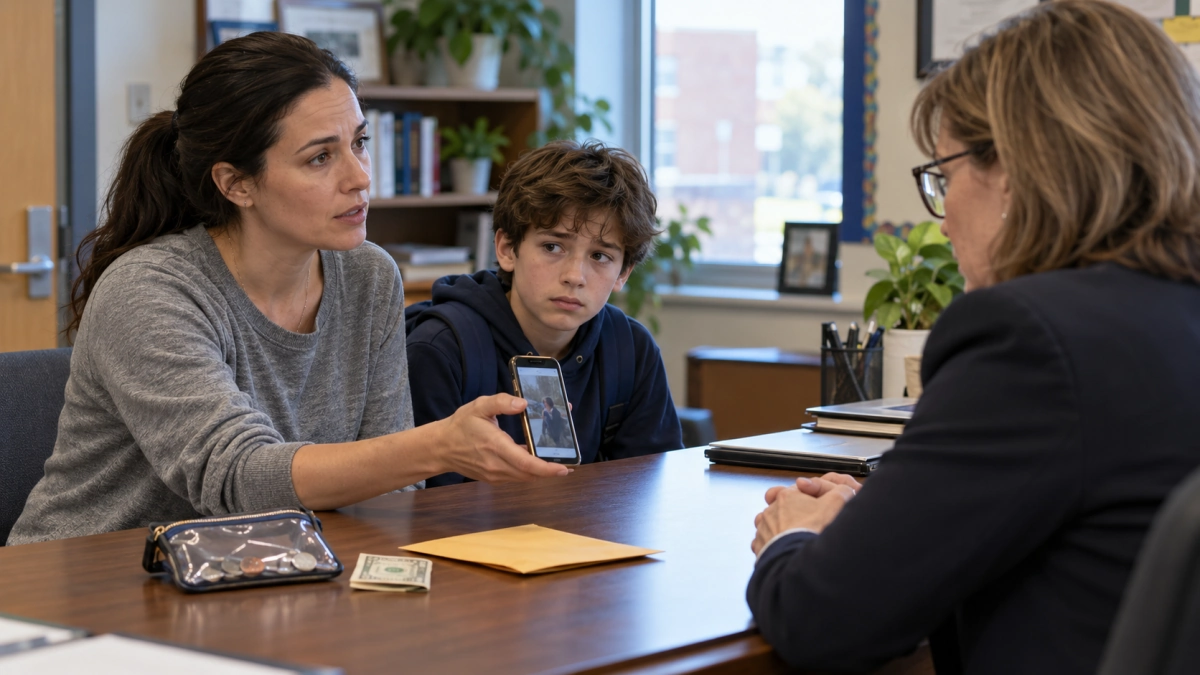
The principal put a bag of coins on the desk beside my son's backpack.
“We need you to explain why fundraiser money was in Noah's things.”
I had clocked out of the packing warehouse at six that morning. There were still adhesive marks on my wrist. Noah sat beside the window with his coat on, watching me as if my arrival could turn this into a small misunderstanding.
The bag contained a twenty-dollar bill and loose change. I'd given him exactly that much for snacks at the school fair the night before.
“That's my money,” I said.
Vanessa Cole, the parent association's treasurer, pushed a handwritten total toward me.
“We're missing four hundred eighty dollars. Your son was the last student beside the cash table.”
Three days earlier, that same woman had watched me count coins to pay for Noah's field trip.
“Next time, you could exchange those first,” she'd said with a smile. “We're all busy.”
I hadn't argued. I didn't want Noah remembering his trip as the time his mother fought at school.
Now he gripped his backpack strap.
“I only helped carry her box of cookies,” he said. “She gave me an envelope.”
Vanessa shook her head immediately. “You're confused.”
I opened my photos and found the picture Noah had sent after the fair. In one corner, a yellow envelope rested beneath a cookie box. Two handwritten words were visible: BUS MONEY.
I turned the phone toward the principal.
“Before you ask what my son took, we need to know what an adult handed him.”
Principal Ellis leaned toward the phone without touching it. She read the words on the envelope and looked at Vanessa. The clock above the office cabinet made a dry sound with every second. I pulled my chair beside Noah's and rested my hands on the desk. I didn't put them on his backpack. I didn't want him thinking I needed protection from his belongings, too.
“Did anybody question him before I arrived?” I asked.
Mrs. Ellis said she and Vanessa had spoken with him. No police had been called. Nobody had found the missing four hundred eighty dollars. They wanted to clarify things before the matter went further. I asked why my son had heard the word stealing. He looked at his knees. Mrs. Ellis said she hadn't used that word. Vanessa said we all needed to stay calm.
Calm was apparently something required of the person who had just been asked to prove her child innocent. I was tired enough to feel my heartbeat behind my eyes, but I could understand the difference between finding money and deciding what it meant. The bag held pocket money. The page held a deficit. Someone had placed them together and expected the space between them to close itself.
My name is Lena Brooks. Noah and I lived in a two-bedroom apartment on the east side of Columbus. I worked nights at a food distribution warehouse. There was no secret account waiting to save us, no wealthy relative about to walk through the door. Near the end of each month, I calculated laundry money before buying coffee. Noah's father sent support inconsistently. I had learned to budget around money received, rather than money promised.
Noah was eleven. He loved maps and read museum labels before looking at the exhibits. His class's science trip cost sixty-two dollars. For a month, I put coins into a separate jar along with tips from weekend housecleaning. I knew the money would be heavy when I carried it to school. I hadn't known that heaviness could be used to suggest something about the people carrying it.
“Where did his snack money come from?” Vanessa asked.
I explained that I'd exchanged some of the coins at the grocery service desk, keeping a twenty and change for Noah. I had a grocery receipt, not a certificate proving ownership of every dollar. Other parents weren't being asked to document their children's pocket money. I said that aloud and asked Mrs. Ellis to record my explanation, rather than simply the amount Noah had in his bag.
She opened a notebook. For the first time, she asked him to start at the beginning. After the fair, Ms. Patel had asked several children to help clear tables. Vanessa gave Noah a box of leftover cookies with an envelope tucked beneath it. She told him to take both to the art room, where the association was collecting supplies. He did. When he returned for his jacket, he saw her carrying a black bag through the side exit.
“Did you open the envelope?” Mrs. Ellis asked.
“No. She told me not to drop it.”
Vanessa said there had been many envelopes. Children could get confused. She didn't remember handing over that particular one. I asked whether the envelope marked BUS MONEY contained cash. She said it might have held a quote from the bus company. I asked who had checked. The association handled those details, she said. Her missing-money sheet had no second counter's signature and no recorded handover time. Just a total in blue ink.
“I want a written summary of this meeting,” I said. “And I need to know whether Noah is suspended.”
He wasn't. He could return to class. I asked who would explain to Ms. Patel that nobody had caught him taking money. Mrs. Ellis said she would. I asked her not to send him alone through a hallway full of children who had watched him being called out. They were already making names for what happened. She walked him back while I waited for the written record.
Vanessa followed me toward the exit afterward. She said if I returned some money, everybody could keep the matter private. I asked how much she was requesting. Whatever portion my family could manage, she said. I opened a note on my phone and wrote that down in front of her. She immediately said I had misunderstood. I asked her to explain her request by email. I wasn't accepting another conversation in a hallway.
In the parking lot, I called the warehouse to trade that evening's shift. I needed sleep, but my mind kept counting. Four hundred eighty. Twenty. Sixty-two. Numbers could make someone look suspicious if the person telling the story knew where to put them. I saved Noah's photograph separately, then emailed the principal asking that records be preserved and that everyone with access to the money after the fair be identified.
Ms. Patel called around noon. Noah had been asked to help because he was dependable. She remembered assigning the cleanup group but hadn't witnessed the envelope changing hands. She would document exactly what she had seen. I thanked her for not trying to make her evidence stronger to help us. She said a child's account belonged in the record even when an adult didn't remember. I finally drank the water I'd left beside the phone.
That afternoon, Noah came home on the bus as usual. He washed his hands and lined up his shoes before asking whether the trip could be returned. I said we'd already paid. He asked whether I could get the money back if he didn't go. I sat beside him. Two boys had asked whether he'd taken the fundraiser cash because our family was poor. I wanted to call every parent immediately. My son was waiting for something else.
“We have less money than some families,” I said. “That doesn't make you someone who takes things.”
“But they think it does.”
“People can be wrong. I won't make you pay to correct their wrong idea.”
He nodded without looking relieved. I asked whether he wanted me to tell his teacher about the boys. Yes, he said, but please don't tell the class about the coins. I promised. The details of our life weren't an illustration adults could borrow whenever they wanted to teach a lesson. He was entitled to privacy, even if somebody else might find our story inspiring.
That evening, a message appeared in the parent group. It didn't name Noah, but it said a student who helped at the last table was being questioned about a shortage. Someone asked whether families should contribute more so the bus could still run. Vanessa replied that organizers were handling it and asked people not to speculate. Her answer didn't undo the suggestion that had already been planted. I saved it and didn't respond while angry.
The next morning, I requested a correction. There was no evidence Noah had taken fundraiser money. His pocket money didn't match the shortage. According to his own account, adults had accessed the supplies after him. I didn't call Vanessa a thief. I wanted the check to include every person who handled the envelope. Mrs. Ellis scheduled a meeting for three, with a district administrator joining by phone.
Vanessa arrived with a spreadsheet printed in color. She had served as treasurer for four years, organizing fairs and book drives. Nobody else wanted the job, she said. That might have been true. I'd seen her at school before seven. But somebody who did useful work could still be asked about an envelope. I asked which entry produced the four hundred eighty dollars, and waited while she turned the pages.
The sheet listed a four-hundred-eighty-dollar cash advance for the bus. Fair proceeds were supposed to replace it. Vanessa had totaled sales, deducted expenses, and compared the result with money in the safe. The difference became the shortage. The district administrator asked whether the cash advance had an invoice. Vanessa said the bus company discounted cash payments. She would find the receipt later. It wasn't attached to the paperwork.
I didn't know who had taken money. I knew the arithmetic hadn't established that sales cash disappeared. If the bus advance was an entry without an actual payment, the discrepancy could have existed before Noah approached the table. I said so. Vanessa looked at me as though she had only just discovered a warehouse worker might read a spreadsheet. I checked thousands of receiving slips at work. I didn't need to offer that credential to deserve an answer.
Mrs. Ellis paused the inquiry into students and asked the association to submit its records to the district's independent reviewer. She would tell the parent group there was no basis for assigning responsibility to any child. I asked whether the notice could explicitly correct the earlier implication. The administrator said the wording shouldn't leave children looking like suspects awaiting evidence. This time, Mrs. Ellis wrote the sentence down exactly.
Vanessa posted that evening that accounts were being reconciled and no student had been identified as involved. I requested clearer language. Her sentence still sounded like they hadn't caught anyone yet. After consulting Mrs. Ellis, she replaced it with an apology for suggesting student responsibility without grounds. It didn't erase what Noah heard. It created a public record people could refer to instead of continuing to repeat the first version.
Two days later, another parent called. Marcus worked as a kitchen assistant. His daughter was in Noah's class. He wasn't offering a rumor. He had a receipt for eighty dollars paid the previous month, although the school's trip notice listed sixty-two. Vanessa told him the difference was a required contribution to the assistance fund. He wondered why I'd been allowed to pay less. I hadn't heard of a required contribution at all.
We sent both receipts to the reviewer, Ms. Torres. Marcus agreed to use his name but didn't want his daughter brought into meetings. Ms. Torres said she would compare collections with the official notice. She didn't ask which of us was poor enough to qualify for a reduced price. She asked whether the association had authority to impose another charge. A properly framed question could preserve more dignity than a dozen assurances that nobody intended offense.
I had often called not asking politeness. When money was short, I worried that inconveniencing people would make them reluctant to help. Marcus understood. He paid what the treasurer requested because he didn't want his daughter marked as owing a balance. We didn't establish a competition over whose family had been treated worse. We submitted records and asked the district to review the notices and collection practices together.
On the fifth day, Ms. Torres called about Noah's photograph. She wanted the original file, not only a screenshot. He had sent it while asking me to collect him later because cleanup was taking longer. The message still had its time stamp. She asked whether he could locate the art room on a floor plan. I said yes, provided I attended and he could take breaks. She agreed without suggesting those conditions meant we weren't cooperating.
Noah explained using the drawing. He didn't add details he couldn't remember. When asked about the black bag, he pointed to the side exit. Asked who kept the safe key, he said he didn't know. Ms. Torres wrote didn't know, rather than didn't see. Adults sometimes push a child's uncertainty into a guess, then treat the guess as unreliable testimony. In that room, he was allowed to be uncertain without becoming dishonest.
Ms. Patel found the leftover cookie box in the art room. There was no envelope. Ms. Torres didn't treat its absence as evidence against Noah. She checked the key log and spoke with everyone who had cleared that area. A custodian remembered Vanessa entering after the students left. He hadn't seen inside her bag, and said so. An honest review wasn't like a television scene where each witness arrives with a perfectly timed answer.
Meanwhile, I still worked nights. Packaging machines rattled, and cold air found its way through my gloves. I read emails during breaks and returned calls from the parking lot. My supervisor offered a few days of unpaid leave. I thanked him but couldn't accept. Proving my son hadn't taken money cost time we couldn't spare. I recorded missed hours, not because I knew anyone would reimburse them, but because I didn't want to call them worthless myself.
Noah stopped drawing buses on his calendar. He did his homework and ate the meals I left in containers, but didn't mention the museum. I didn't tell him to be brave or resilient so his suffering would look better. I asked whether he wanted to see the school counselor. He wanted to ask someone who wasn't his mother why adults believed bad things so easily. I signed the permission slip and went to bed with a question hugging him couldn't answer.
That weekend, Vanessa came to our apartment. She carried a white envelope and said a parent wanted to sponsor Noah's trip. I didn't invite her inside. Everyone was exhausted, she said; letting the matter go would be best for children. I asked whether the money came with conditions. She said she only wanted to help. The fee was already paid, I told her. My son needed the accusation corrected. I didn't take the envelope.
“You could make people stop wanting to donate,” she said.
“People who donate deserve to know where their money goes.”
She glanced along the hallway, where our neighbor's television could be heard through a door. I watched her notice the worn mat and my work clothes. I didn't explain that I'd once attended college or why I'd left. Those weren't qualifications for asking about public money. I said further contact should go through the principal, and closed the door before the conversation could become another account she would remember differently.
I reported the visit by email, quoting the words I remembered and marking what I wasn't sure of. Ms. Torres thanked me and asked Vanessa not to approach involved families privately during the review. That helped more than being called a courageous mother would have. I needed to sleep without worrying that the person under review might appear at my door. Admiration wasn't a substitute for a boundary someone would enforce.
The preliminary findings arrived the next Monday. The bus company had not received a cash payment of four hundred eighty dollars. It invoiced after trips and didn't offer the cash discount Vanessa described. The advance was recorded before the fair without a recipient's signature. Once that unsupported entry was removed from the reconciliation, the safe's cash matched the documented fair sales and expenses. The alleged loss during cleanup had never been established.
Noah hadn't taken fundraiser money. The missing amount was cash withdrawn before the fair began. Ms. Torres informed the school in writing and requested an explanation for that withdrawal and the additional fees. I read the sentence clearing my son several times. I'd known he was telling the truth. Seeing an institution put that truth on paper still let my shoulders fall after days of not realizing I was holding them up.
Vanessa met with the association and reviewer. I wasn't present. The later summary said she admitted using the advance for rent after her husband lost his job. She meant to replace it with fair proceeds, then collect additional money to cover the remaining gap. There hadn't been stolen cash hidden in Noah's backpack. An adult needed another person suspected long enough to find a way to replace money she shouldn't have used.
I thought about the sponsorship envelope at our apartment. I didn't know its source and didn't add a conclusion of my own to the record. The established facts were serious enough. The association removed Vanessa's account access, transferred its records, and referred the matter to the appropriate authorities for review. The amount didn't become harmless because it was smaller than the losses people read about in newspapers. Families had trusted her with it.
Additional collections had to be reconciled and refunded. Marcus received a notice about his eighteen dollars. Some parents chose to donate refunds to the assistance fund. Others accepted them. This time they had a choice, rather than a donation disguised as a requirement. The new ledger had two signatures. It wasn't exciting enough for a viral post. It could prevent another child from sitting in a principal's office beneath a total nobody had properly checked.
Mrs. Ellis invited Noah and me back. She apologized to him for allowing a volunteer with an interest in the matter into the first interview, and for presenting pocket money as evidence. The source of the discrepancy should have been checked first. I asked whether the apology would reach families who received the earlier implication. Yes, she said, with our agreement on how Noah was named. He thought about it before answering.
“Use my name,” he said. “They figured out it was me. I want them to know I didn't do it.”
I checked that he was sure. He was, but didn't want anyone mentioning the coins. Mrs. Ellis recorded that. The notice said Noah wasn't involved, apologized for the speculation, and asked families to stop spreading it. Ms. Patel spoke privately with students who had repeated the rumor. She didn't make him stand before the class to receive applause he hadn't requested.
That afternoon, a mother stopped me in the parking lot and said she'd always known Noah was a good child. I remembered her asking the group whether parents should make another payment because of the lost funds. I didn't want to argue with everyone. I also didn't want to accept a correction that cost the speaker nothing. I said if she heard the original account repeated, she could explain that its conclusion had been wrong.
She nodded and asked whether I needed somebody to drive Noah home one afternoon. I said I would ask if I did. We didn't become friends immediately. Her offer might turn into something useful later. For now, it was an offer. I was learning to let things have their actual size instead of making each kindness a rescue and each awkward conversation a permanent judgment.
At home, Noah asked whether Vanessa was poor. I said her family was having money problems. He asked why I hadn't taken money if we had money problems, too. If I answered simply that I was good, I would be turning poverty into another character examination. I told him not having enough made many things frightening, but adults were still responsible for their choices. She needed help. She didn't have the right to use other people's money or let him take the blame.
“Do I have to forgive her?” he asked.
“Nobody gets to make you. You might feel differently later. You might not.”
He wanted to know what to do if we saw her at the grocery store. I said he could keep walking beside me. He didn't have to speak to her. That seemed to settle something more practical than the word forgiveness had. He took his calendar from the drawer and drew one small wheel on the date of the trip. He didn't color it. I left the pencil on the table without asking whether the wheel meant he wanted to go again.
The school held a meeting about fund procedures. It wasn't a hearing on which families deserved to be trusted. I arrived after work, and Marcus had saved a chair. Someone argued that parent volunteers were already overburdened. Too many checks would discourage participation. Ms. Torres answered that volunteering didn't make money less important to document. One person shouldn't collect, store, count, and reconcile cash alone. Those tasks needed separation, not simply a volunteer everybody liked.
All fees would need a consistent official notice. Assistance would be confidential and optional. Donations would be described as donations, with no suggestion that a child's place depended on making one. The association would publish summarized accounts without exposing individual families' financial circumstances. Nobody needed to see a list of parents receiving help in order to know that a bus invoice had been paid.
I asked how parents who worked nights or didn't use banking apps were expected to pay. Until then, people kept saying online payment was easiest, as though easiest for them meant easiest for everyone. The school agreed to provide a cash collection time with two adults present and immediate receipts, plus appointments for parents who couldn't attend. Asking for assistance wouldn't require describing household income in front of other parents.
The changes didn't put new money in my pocket. They removed some humiliation from spending the money I already had. Nobody announced that I had taught the room a valuable lesson. Mrs. Ellis wrote the arrangements into the notice. Marcus asked when families would receive it. A date was added. I preferred that ordinary answer to being thanked for raising awareness while the same problem waited for the next parent.
Two weeks later, Vanessa sent a letter through the principal. She apologized for calling Noah the last person at the table when she knew she'd entered the art room afterward. She acknowledged that mentioning cash in his backpack encouraged an accusation without evidence. She also apologized for the remark about my coins. The letter didn't ask us to keep quiet or prove our kindness by forgiving her.
I read it alone at the kitchen table. Some sentences were difficult because they named exactly what she had done. Others were difficult because I could imagine how desperate she had been before she did it. Both reactions could exist without requiring me to invite her into our life. When Noah came home, I asked whether he wanted to hear the part addressed to him. He said not yet.
I put it in the document drawer instead of reading it aloud over dinner. I didn't know how the referral would end. I knew she was no longer managing the funds and had to address the missing money through the review process. I didn't tell him she'd learned her lesson. I wasn't inside her head. I could describe what happened, what needed repair, and what remained unknown.
Our ordinary financial problems continued. My car needed tires. Weekend warehouse hours were reduced. One evening, Noah asked whether he could ask his father for museum money. I reminded him the fee was paid. He said if Dad sent extra, maybe I would worry less. I explained that support was an adult responsibility. He didn't need to sound cheerful on the phone to persuade his father to send something. He could love his dad without managing his dad's bank account.
He listened, then asked whether he could still tell his father about the trip. Of course he could. I wasn't asking him to stop sharing his life. I was asking him to put down a job he hadn't been hired to do. We called at the usual time. I left them to talk while I washed dishes, resisting the urge to listen for every mention of money.
The old coin jar had developed a crack, so I replaced it with a lidded box. Noah helped count what remained. He arranged little stacks on a dish towel while I wrote down totals. We didn't turn the task into proof that we were more deserving than families who couldn't save. It was work we needed to do to know what we had. When a coin rolled beneath the cabinet, we used a ruler to retrieve it and laughed because both of us ended up on the floor.
The envelope I'd used to pay the trip fee was still tucked behind a grocery list. I considered throwing it away because I didn't want to remember the school office. Instead, I kept it with the receipt. Keeping a record wasn't the same as remaining frightened. I could keep useful paper without keeping every person's opinion. I didn't tell Noah that. Some thoughts were mine to work through before becoming another conversation for him to carry.
The following week, I used the new collection time to pay for class photographs. An office employee and a parent counted together, issued a receipt, and asked whether I preferred paper or email. Nobody asked why I paid cash. I chose paper and folded it into my wallet. Beside the counter, Noah read a notice about the science club instead of watching the hands counting money. Outside, he asked whether he could submit his registration form himself next time.
I said yes; I'd sign the parent section. Something ordinary was ordinary again without anybody announcing that we were welcome. On the drive home, I wanted sleep more than I wanted to check my phone. The emails were saved in a separate folder instead of greeting me every morning. I still kept the record. I didn't need to read it again to know my son belonged at school and could ask about a science club without having to explain what was inside his own backpack.
Three days before the trip, he asked whether I could go with the class. I said I would check my work schedule. Ms. Patel explained that chaperone places had already been assigned through the regular registration and screening process. She couldn't add one because of what had happened. I appreciated the honest answer. Repairing harm to my child shouldn't mean another family lost an agreed place. I requested the end of my shift off so I could see the bus leave.
The night before, he packed twice. First he included his museum map, a notebook, and three pencils. Then he removed one pencil and added his sweatshirt. He asked whether Ms. Patel might need help carrying supplies. I said she could ask, and he could decide. Helping hadn't been his mistake. He didn't have to stop being useful because an adult misused the trust that made him useful.
On the morning of the trip, I packed an apple and a sandwich. Admission included lunch, so he didn't need spending money. I gave him five dollars anyway for an unexpected need, refusing to let a rumor become the reason I controlled his pockets. He checked his bag and asked whether we should photograph the money. I said no. He didn't have to record every ordinary act to deserve belief. If a problem arose, adults needed to investigate properly.
At the school gate, Ms. Patel handed out name tags. Marcus arrived with his daughter and waved. There was no photograph of a sponsorship envelope changing hands, no speech about the mother who worked nights. Another parent offered coffee to everybody standing there and asked whether I wanted a cup. I accepted because I wanted coffee, not because the offer solved what had happened. Noah climbed aboard and chose the seat beside the friend who had stayed with him through the hardest days.
Before departure, he lowered the window and asked whether I'd sleep while he was gone. I said yes. He told me he'd describe the rocks and minerals first that evening because the museum had a meteorite. I nodded. I didn't need to call this a new beginning. A child was thinking about a rock from space. His mother could go home to bed. Those small possibilities had been taken from us, and that morning we were getting them back.
When the bus returned, he searched the crowd, found me, and began talking before reaching the curb. The meteorite was heavier than it looked, he said. Some stones changed color under special light. He'd written down a question the guide couldn't answer and planned to research it at the library. I carried his lunch container while he carried his own backpack. Neither of us looked at the bag as though it contained something that needed explaining.
At home, he handed me a postcard he'd bought with the five dollars. It pictured the meteorite. On the back he'd written that you could hold something very small and still know how far it had traveled. I asked whether he had change. He produced two coins and a bill, then continued his story. I put the money in our box and left the card on the table. None of those dollars had to establish our worth.
Read next
The Fourth-Floor Offer
The Bridesmaid Budget
The Scholarship Interview They Wanted to Film
My Cousin Sold My Mother’s Funeral Flowers for “Charity”—Then the Florist Recognized the Delivery Address
Reading notes
A bag of coins in a child’s backpack turns a field trip fundraiser into a family’s fight for a fair hearing.
This is an original work of fiction. Characters and events are fictional. Explore public-domain books at Project Gutenberg or browse more stories on ReadStoryvia.