Original fiction
On this page
The Price on the Coat
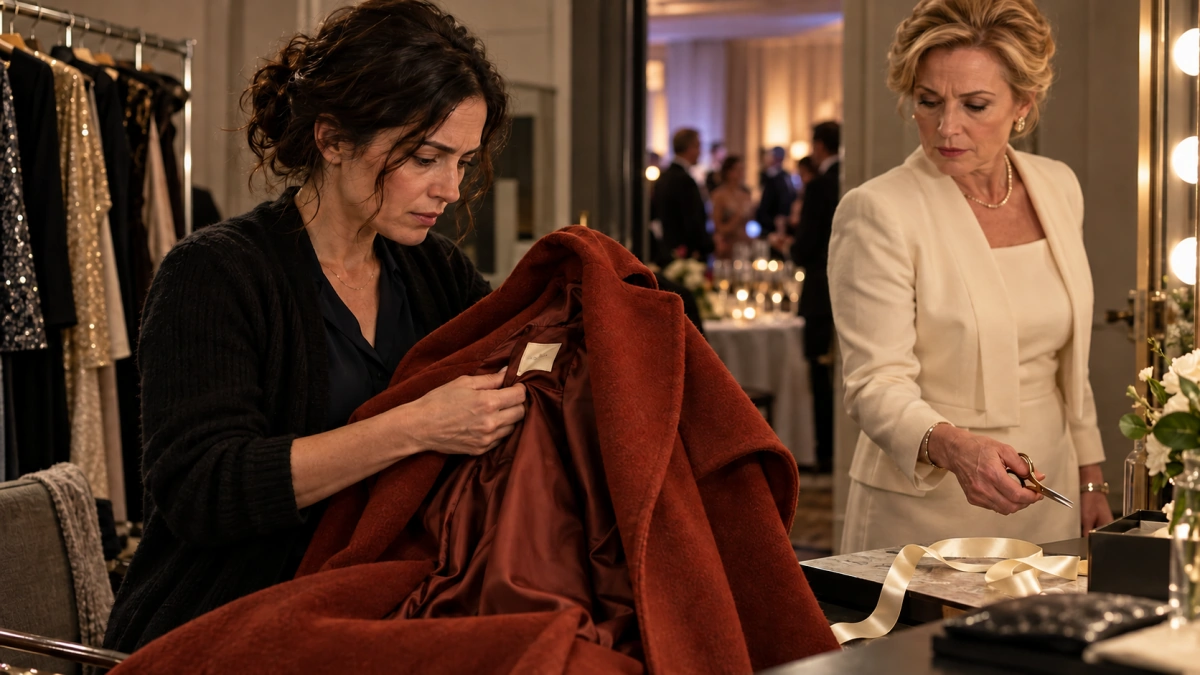
The woman holding Mara Ellis's coat had already cut one stitch from the label when Mara reached across the table and closed the scissors.
"That isn't the washing tag," Mara said.
"I know." Claire Benton kept her voice low. Beyond the dressing room door, volunteers were setting out wineglasses for the Harbor House auction. "We need the lining clean for photographs."
On the hanger beside them waited a cream ribbon printed with the name Bellwether Atelier. Mara had never worked there. She had spent six evenings making this coat at her kitchen table in Cleveland, moving her daughter's homework whenever she needed room for the sleeves.
"Did they design anything?"
"They're lending us their reputation."
The coat was rust red, with a deep inside pocket positioned for a hand that couldn't easily reach across a chest. Mara had developed that pocket for her mother after shoulder surgery. The auction card described the garment as an exclusive Bellwether creation. Under estimated value, somebody had typed twenty-four hundred dollars.
Mara had donated her labor because Harbor House had given her daughter, June, a free place in its summer art program. She had paid a hundred and eighty-six dollars for wool and lining. At home, the refrigerator held a renewal notice for June's bus pass and a gas bill she had turned facedown.
Claire put the scissors down.
"There's private work afterward. Six coats for the committee. Six hundred each. Materials supplied. But they want discretion. No maker tags, no photographs, no discussing clients."
Thirty-six hundred dollars. Mara could hear the radiator knocking in her apartment even here.
"And if I leave my name in this one?"
Claire looked toward the door, where the auctioneer had begun testing his microphone.
"Then I can't promise either opportunity survives."
Mara slid her hand inside the coat and found the loose thread beneath her name.
She didn't pull it. She tucked it beneath the label, where it scratched her fingertip, and asked Claire for ten minutes.
"We have seven."
"Then don't spend them cutting."
In the hall, June was folding auction programs into crooked tents. At fourteen she had recently decided that adults who whispered were either planning surprises or doing something they knew was wrong. She looked at her mother, then at the coat.
"Did the button come off?"
"No. I need to fix the description."
June offered her a black marker. That simple confidence made Mara want to sit down. Her daughter still thought a wrong sentence could be crossed out and replaced before it injured anybody.
Mara passed the marker back and went into the empty classroom beside the kitchen. Through its window she could see the bus shelter on Detroit Avenue. Her mother, Ruth, used to wait there after teaching ceramics, before arthritis made the basement stairs difficult. Harbor House wasn't an abstraction. It was Ruth's clay under its sink and June's charcoal fingerprints on the door.
She called her sister, Tessa, who answered over the hiss of a restaurant dishwasher.
"Tell me somebody bought it already."
Mara explained. Tessa listened without interrupting until she reached the six coats.
"Is six hundred what you usually charge?"
"For alterations, nobody asks me to make six identical anything."
"That's not what I asked."
Mara admitted she hadn't calculated it. She knew the wool, the hours drawing, the Saturday ruined by a collar that wouldn't sit. She didn't know a clean number for everything she had learned before that Saturday.
Tessa said, "I have eighty dollars until Friday. If you refuse, don't do it imagining I can float you. But if you say yes, say yes to something you can actually finish."
It wasn't the speech Mara wanted. It was why she had called her.
Back in the dressing room, Claire was staring at the cream ribbon. Up close she looked exhausted, with a patch of foundation rubbed away beside her mouth.
"You wrote Bellwether creation," Mara said. "That's not discretion. That's a different story."
"I used what people recognize."
"They could recognize wool. They could recognize a coat."
Claire's shoulders dropped. "Last year we barely covered the catering. People will pay more when a name reassures them. The boiler doesn't care whether I like that."
Mara knew about the boiler. June had worn gloves during February drawing classes. That knowledge complicated her anger without making the scissors acceptable.
"Leave my label. Change the card to designed and made by Mara Ellis. If Bellwether wants to sponsor the auction, put their name somewhere else."
"I already sent the catalog."
"Then say the correction out loud."
Claire touched the loosened label, not quite apologizing. "What about the commission?"
"Tomorrow. In writing. I won't decide that in seven minutes."
There were four left. Claire went to the sound table. Mara threaded a needle from the emergency kit beside the steamer and repaired the stitch. Her hands shook enough that she pricked herself. She pressed her finger against a scrap of muslin until it stopped bleeding.
When the coat came up, the auctioneer glanced toward Claire. She stepped to his microphone herself.
"There's a correction to lot twelve. This coat was designed and sewn by Cleveland maker Mara Ellis. Bellwether Atelier has supported tonight's presentation, but did not create the garment."
Supported was generous. Their contribution was the ribbon and permission to use their name. Still, the correction was clear. Mara didn't go onstage. She stood beside the kitchen, where the floor smelled of orange cleaner.
Bidding opened at four hundred dollars. Someone offered five. Another paddle lifted at six, then stopped. The auctioneer tried a joke about Cleveland winters. Finally an older woman at the rear offered seven hundred and twenty-five.
The coat sold for that amount.
Mara felt relief first, then a hot, unreasonable shame. She had wanted proof that her own name could carry twenty-four hundred dollars across the room. Instead, she had watched its price come down in public, although nobody could tell her what would have happened with another label.
Claire thanked her afterward with the careful politeness of somebody returning a damaged borrowed dish. June said the woman who bought it had tried the inside pocket and smiled.
"She didn't even ask who Bellwether was," June added.
Mara said she was glad. She was. It didn't untie the knot under her ribs.
On Monday, Claire emailed an introduction to Vivian Shaw, the committee chair. Vivian ran a small public relations firm, not a mansion, and suggested a video call during lunch. She appeared on Mara's phone between a pot of rice and the sewing machine, wearing reading glasses attached to a bright orange cord.
"First, I liked your coat before anybody explained it," Vivian said. "Second, I don't want six copies. Six women, six sizes. Same general style, different fabrics. We'd need them by the first week of December."
It was October nineteenth. Seven weeks sounded long until Mara counted her booked alterations, two Saturdays at the laundry counter, Thanksgiving, and the school concerts she had promised to attend.
"How many fittings?"
"Ideally one. These are busy people."
"Bodies tend to be busy too. They change when they sit down."
Vivian smiled. "Tell me what you need."
That invitation almost made Mara careless. She nearly said she could manage it all.
Instead she asked why there could be no tags.
"Some committee members don't want their spending discussed. One doesn't want a seamstress using her photographs in advertising. And Bellwether sometimes arranges private production. They prefer the finished work to look consistent with their business."
"Are these their clients or mine?"
Vivian paused. "That hasn't been settled."
"It has to be."
They agreed to meet Wednesday at Bellwether, with its owner, Daniel Mercer. Vivian said the six hundred dollars had been her starting point, not a punishment for the auction correction. Mara believed she meant it. A starting point could still leave somebody standing on the wrong side of a cliff.
That evening she spread paper across the kitchen table. June slid her homework onto a tray without being asked. Mara told her to leave it where it was. They divided the table down the middle with a measuring tape.
For years Mara had priced work by anticipating the expression on the customer's face. A zipper replacement got one number if the person wore hospital scrubs, another if the handbag looked expensive, and often an apologetic discount before anyone complained. She called it being flexible. Sometimes it was generosity. Sometimes it was fear wearing generosity's clothes.
She wrote down thirty-two hours for a new coat, including pattern adjustments and two fittings. Then she added cutting, pressing, correspondence, shopping for lining, and correcting the parts a customer's body revealed only after the first fitting. The number became forty.
At six hundred dollars, that was fifteen an hour before thread, needles, machine repairs, rent, and the time when nobody paid her at all. Supplied materials sounded like generosity until she remembered that expensive wool still required somebody to cut it.
Ruth came upstairs from the apartment below carrying soup in a saucepan. She studied the arithmetic over Mara's shoulder.
"When I taught, they called preparation a privilege," she said. "Like I got to eat clay."
Mara laughed, then pressed her palms against her eyes.
"I need the money now. Not when I become good at asking."
Ruth put the soup down. "Then let the asking be part of the work now."
There was no family emergency fund. Ruth's pension covered her apartment and medication; Tessa's car needed tires. They ate soup and calculated a deposit large enough to buy time without pretending it could buy a new life.
On Wednesday Mara wore the black trousers she used for customer fittings and a sweater with a repaired elbow. She carried a folder, though most of its pages were handwritten. Bellwether occupied a narrow storefront with beautiful lighting and no prices in the window.
Daniel Mercer was younger than she expected, with chalk on his cuff. He offered coffee in mismatched mugs. Through an open door she saw two industrial machines and a woman pressing a jacket, not the sprawling workroom she had imagined behind the name.
"I heard there was an awkward moment," Daniel said.
"There was a wrong description. It got corrected."
He nodded. "Claire thought we were lending credibility. I should have asked exactly how."
Mara waited. He didn't turn that admission into a declaration that everything had been his fault. Claire had chosen the words; he had been comfortable not looking.
Vivian arrived carrying fabric samples. One was a loose ivory boucle that Mara immediately knew would need support. Another was a tightly woven navy wool she would have enjoyed cutting if she weren't afraid of agreeing too quickly.
Daniel explained private label production. His shop designed some pieces and subcontracted others. He couldn't promise every maker public credit on every garment; clients bought the shop's coordination and responsibility too.
"I understand making somebody else's design," Mara said. "This is mine."
"The clients like the silhouette. There will be changes."
"Changes don't mean I never drew it."
Vivian laid the samples flat. "Can we separate the questions? What do you charge for making, what do you charge for the design, and what names go where?"
Mara opened her folder. Her proposed price was eleven hundred dollars per coat, excluding materials. A five hundred dollar deposit would reserve each production slot. She offered two fittings, one agreed design revision before cutting, and a written approval for any later changes that increased cost. She could deliver three coats before December fifth, not six.
Nobody spoke for a moment. A bus hissed outside the glass door.
"That's a substantial difference," Vivian said.
"It's also half the quantity."
"The others will expect an explanation."
Mara looked at her paper rather than at their faces. "Forty hours. Sometimes more."
Daniel said his shop would need a margin if it handled fittings and customer problems. Eleven hundred to Mara would put the final price beyond what some committee members wanted to spend.
For a moment she heard only the word beyond. Beyond her place, beyond her customers, beyond what a woman working beside a refrigerator was allowed to ask.
Then she made herself hear his actual sentence. He was describing his business, not necessarily her worth. His margin couldn't come out of hours she pretended not to work. Hers couldn't depend on pretending his shop did nothing.
"Then these should be direct commissions," she said. "I manage the fittings. You don't have to sell my coat."
"And the design?" he asked.
"Mine stays mine. No pattern copying, no additional coats from it without another agreement. You can refer people. You can't call it your design."
Daniel rubbed his jaw. "I can't put an outside designer's label into a Bellwether order."
"Then it isn't a Bellwether order."
The coffee had gone cold. Mara wanted, absurdly, to apologize for making it cold.
Vivian asked about privacy. Mara said she didn't need photographs or customer names. A client could request no sewn name label for comfort or preference. That wasn't permission to attribute the design to another business. Her receipts would identify her work, and any public description would be truthful or absent.
Daniel leaned back. "You would accept an unlabelled coat?"
"If we agree before I make it. I'm not asking somebody to wear my business card. I'm asking not to have my work reassigned after I give it away."
He looked at the navy wool, then at her. "Those are different things."
It wasn't surrender. It was the first sentence that made the room feel large enough for all three people.
Before they left, the woman at the pressing table came out with a question about a jacket lining. Daniel introduced her as Beth, his employee of eleven years. Beth examined Mara's sample pocket and asked whether the opening stretched after use. Mara showed her the narrow stay hidden underneath. They spent three minutes talking about cloth instead of reputation.
Beth earned an hourly wage, Daniel said after she returned to work. His shop carried slow weeks, insurance, and a lease. He wasn't telling Mara that to win the argument; she had asked why the margin mattered, and he wanted her to understand it. Mara said she did understand. She also understood that his costs were visible in a storefront while hers disappeared into the word home. The machine at her kitchen table still wore out. Her electricity still arrived as a bill.
Vivian asked them both to send separate proposals rather than fold one business inside the other. It meant she would have to tell her friends that a committee title didn't purchase a discount. She didn't look delighted by that prospect. Mara was grateful she didn't pretend to be.
They left without an order. Vivian would take the proposal back; Daniel would decide whether he wanted a referral arrangement at all. Mara walked past a pharmacy and almost went inside to cry among the shampoo bottles. Instead she called the gas company from the bus shelter and arranged two payments. The arrangement cost a fee. Dignity had not paid that fee.
Two committee members declined by Friday. One already owned a perfectly good winter coat. Another wanted the convenience of Bellwether and chose a different design from its rack. A third didn't answer. Mara found herself resenting the woman with the perfectly good coat, then recognized how often she herself had used that sentence to survive a store.
Vivian ordered one navy coat. Another member, Elena Ortiz, wanted the ivory boucle, but her budget was nine hundred dollars. Mara almost accepted. Instead she offered a simpler version without the shaped back vent or bound buttonholes, at nine hundred and fifty. Elena said she'd think about it.
On Friday Tessa came by after her shift and read the proposed terms over leftover rice. She circled the sentence about deposits with a greasy pencil. What happened if Mara got sick? What if a client cancelled before she cut anything? Mara had written a firm number without deciding what it meant.
They changed the wording together. Part reserved the appointment and covered measurements and pattern work already performed; the remainder would be returned if the client cancelled before cutting. Once expensive fabric was cut with approval, the client owed for work completed. If Mara cancelled, she would return anything she hadn't earned and arrange collection of the client's materials. Nothing guaranteed payment for work that never happened.
"I want protection," Mara said.
"So does the person handing you five hundred dollars."
Tessa wasn't good with sewing. She was good with being a customer whose money had taken a long time to earn. Mara rewrote the terms in ordinary sentences and sent the revision before accepting any deposit. Vivian replied that the explanation helped. Elena asked one question about cancellations, then thanked her for answering without sending a wall of legal language.
Only Vivian's five hundred dollar deposit arrived that week.
Mara stared at the payment confirmation until June asked whether something was wrong with the phone. She had imagined relief as a door swinging wide. In reality it was enough money to keep the door from closing entirely.
They bought groceries. Mara paid the first gas installment and put the rest in a separate envelope for the work ahead. She didn't buy the discounted boots June had shown her. On Sunday, June came home with the soles of her old pair glued neatly by Ruth.
"They're fine," she said too quickly.
Mara hated that sentence in her daughter's mouth.
"They'll get us through November," she said. "That isn't the same as fine."
June sat beside her at the table. "Did keeping your name cost the boots?"
Mara could have given an easy answer about self respect. Instead she said, "Maybe. I don't know what those six coats would really have paid after everything. But choosing this has a cost. You get to be annoyed about it."
"I'm not annoyed about your name. I'm annoyed about wet socks."
They laughed, and then neither did. Mara measured June's feet on a grocery receipt so she could look for a used pair that actually fit.
The next week, Vivian came for her first fitting in the unfinished navy shell. Mara had cleared the kitchen and borrowed a full length mirror from Ruth. Vivian looked around without making the bright, excessive compliments people sometimes used when they were uncomfortable in a small home.
She stood on the marked square of floor and lifted her arms when asked.
"I thought the price would include a belt," she said.
Mara showed her the signed sketch. No belt. She could add one, but it would require more material and time.
Vivian frowned. "It seems such a small thing."
Mara's stomach tightened. This was where she usually gave something away to repair the room.
"It looks small when it's finished. I would need to construct it, cover a buckle, and reinforce the waist. I can price it before you decide."
Vivian looked at herself in the mirror. "No. Leave the line clean. You were right in the drawing."
Mara hadn't been right about Vivian's shoulder. The sleeve twisted when she reached forward. She unpinned it, studied the angle, and admitted she needed to adjust the pattern. That work belonged within the agreed price. Charging fairly wasn't a promise never to make mistakes; it meant knowing whose responsibility a mistake was.
While Mara repinned the sleeve, Vivian said Claire was upset about the auction.
"With me?"
"With herself. With the boiler. With the fact that I told her to keep donors comfortable and didn't ask what she thought that meant."
"Is she going to call?"
"I don't know. I'm not carrying an apology in my handbag."
Mara liked her better for that.
Elena eventually accepted the simpler coat. The third slot stayed empty. Daniel sent no referrals, but emailed a short confirmation that Bellwether would not use Mara's pattern or represent either commission as its own. There was no grand partnership. Mara saved the email with the sketches and went back to replacing a broken zipper on a mail carrier's jacket.
In November, Ruth developed a respiratory infection. She wasn't hospitalized, but Mara spent two mornings bringing groceries, collecting prescriptions, and arguing gently about opening windows in cold weather. Her schedule lost its narrow margin.
At midnight on a Thursday she cut a facing from the wrong side of Elena's boucle. There was enough fabric left to replace it, barely. She put the shears down before fatigue could make another decision for her.
June found her sitting beside the silent machine and asked whether the fabric was ruined. Mara explained the mistake and showed her the remaining piece. June suggested working faster tomorrow. Mara heard her own old solution coming back in her daughter's voice and felt suddenly protective of them both.
"Tomorrow I need to work awake," she said. "That's different."
They put the scraps into a bag for the art classroom. Mara labelled the replacement piece so she wouldn't cut the wrong side again. Then she washed her face and went to bed with work unfinished, something that felt less like wisdom than leaving a stove on. In the morning, the apartment was still standing. The cloth was still waiting. Ruth answered the phone sounding a little better, and Mara let that be good news without converting it into permission to exhaust herself.
The next morning she called Elena. She needed to move the second fitting by three days. The coat would still be ready before the agreed date, provided the fitting showed no major changes.
"I took time off work for Tuesday," Elena said. "I can't keep doing that."
Mara offered an evening visit to Elena's home, within the same fitting fee. That meant two buses and carrying a garment bag in November rain, but it solved a problem she had caused. Elena accepted without thanking her for being honest, because honesty didn't restore her Tuesday.
On the ride home, Mara thought about all the times she'd imagined contracts as shields that would stop disappointment reaching her. They weren't shields. They were a place to stand while people were disappointed, a way to tell the difference between what she owed and what she merely feared.
Claire called that Saturday. Harbor House needed thirty costume hems for a children's performance, and she wondered whether Mara could donate a few hours.
The request landed badly enough that Mara said nothing.
"I'm sorry," Claire added. "That sounded worse out loud."
"What were you hoping it would sound like?"
Claire exhaled. "Like before."
Mara watched June at the sink, rinsing paint from a jar. Before had included free art classes, friendly conversations, and Mara volunteering before anyone could decide whether she belonged.
"I liked parts of before," she said.
"So did I."
They sat with that for a moment. Then Claire said she had ninety dollars from the costume budget. Could Mara do anything useful for that?
Mara could run a ninety minute workshop for parents on safe temporary hems, if Harbor House supplied tape, needles, and a room. She would bring examples. She couldn't take thirty costumes home.
Claire agreed. Then, awkwardly, she apologized for cutting the label. She said she had been afraid of losing a bidder and had treated Mara as the easiest person to disappoint.
"I didn't think you mattered less," Claire said.
"You counted on me acting like I did."
"Yes."
It was not a beautiful conversation. Claire didn't explain away the choice, and Mara didn't make forgiveness into a free service available immediately. They arranged the workshop for the following week.
Eight parents came. One grandfather brought a tin of sewing supplies older than Mara. June demonstrated pinning on a pair of stage trousers while Mara explained why a hem that looked level on a hanger might tilt on a moving child. Claire stayed to stack chairs. They talked about the rain, not the auction.
Before leaving, Mara asked whether the scholarship committee would still consider June for next summer. She hated asking. She hated more the possibility of June losing something because the adults preferred an easier version of her mother.
Claire said scholarships were based on family income and availability, not donated work. She offered the application date, not a guarantee. Mara wrote it down. Neither woman pretended that uncertainty felt like reassurance.
At the second fitting, Elena asked whether the simpler coat looked cheaper. Mara resisted saying no automatically. It had fewer details, she explained, but the decisions could look deliberate rather than missing. She turned back the cuff to show where the lining met the wool. Elena studied the stitching, then asked to try walking down the hall.
When she came back, she said her mother used to remove store labels before giving clothes to relatives. Not to hide a bargain, but to prevent anyone from feeling indebted for an expensive gift. She had thought no label always meant kindness.
"Sometimes it can," Mara said. "It depends who gets to choose."
Elena nodded, still wearing the coat. She didn't offer a larger budget or promise a stream of friends. She asked for the cuff to be shortened a quarter inch. Mara marked it. They were learning to discuss a garment without requiring either woman to turn into a lesson. That was slower than agreement and more likely to last beyond the fitting room and its flattering mirror, into the ordinary weather waiting outside their separate front doors.
By December fourth, both commissioned coats were finished. Vivian's had the deep pocket adjusted for her left hand because she carried her phone while walking her elderly dog. Elena's had a smooth lining that wouldn't catch on the brace she sometimes wore at her wrist. Neither detail appeared in an advertisement. Both were part of the work.
Vivian paid her balance after the final fitting. Elena needed until her next payday for the last two hundred dollars. Their agreement allowed delivery after payment, so the ivory coat stayed in its garment bag for nine days. Mara didn't scold her, and she didn't release it early while privately nursing resentment. On payday Elena arrived with the balance and a bus transfer folded inside her glove.
"I know you wanted to take it last week," Mara said.
"I did. I also wanted a dentist appointment. Being able to buy a nice thing doesn't mean everything else goes away."
Mara thought of the perfectly good coat and felt something inside her loosen. Class wasn't a room containing only two kinds of people. That didn't make its doors imaginary. It made it important to notice who was carrying what through them.
Elena wanted no name label because the rough edges bothered her neck. Mara sewed in the soft care tag they had agreed on. On the receipt she wrote: original design and construction, Mara Ellis. Elena folded it carefully, not ceremonially, and put it in her wallet.
After she left, Mara counted the season's earnings against her time. The two coats had taken longer than estimated. She had earned more per hour than the proposed six coat arrangement, but less than she'd hoped. The empty third slot had gone partly to alterations, partly to caring for Ruth. She couldn't quit the laundry counter. She booked its January Saturdays before someone else could take them.
She also changed her estimate for the next original coat. Not because a motivational sentence had made her brave, but because she now knew how long the sleeve work took. She wrote a separate price for design development instead of hiding it inside sewing. The number looked blunt on the page. She left it there.
The woman who bought the auction coat came into Harbor House during the last week before winter break. Her name was Joan Price. She had retired from driving a school bus and was dropping off donated drawing paper when Mara arrived to collect June.
Joan recognized her from the little maker card tucked inside the pocket. "You're the reason I can find my keys without getting undressed," she said.
She showed Mara how her right shoulder stopped halfway up. The coat's pocket opening sat exactly where her hand could reach. She hadn't known about Ruth, and Mara hadn't known about her. The detail had crossed the room without a speech.
"Would you change the button?" Joan asked. "It's lovely, but my fingers fight it. I'll pay."
Mara examined the buttonhole. A larger, flatter button would work without altering the front. She named a small price that included the button and fifteen minutes of labor. Joan agreed. They arranged for Thursday, not right then, because June was waiting and Mara had promised they would look for boots.
Outside, the sky was already dark. June showed her a drawing of Ruth's saucepan, with its dent rendered so carefully Mara could almost feel it under her thumb. On the back, a teacher had written June Ellis, charcoal study. No famous name had been needed to explain why it was worth keeping.
They found boots at the resale shop two blocks from the bus stop. Good soles, one rubbed heel, enough room for thick socks. June walked three impatient laps around the shoe rack before admitting they fit. Mara paid without calculating aloud what else the money might have covered.
At home she hung Joan's appointment slip above the machine, beside the January laundry schedule. The new price sheet went below it. There was still a gas balance, still an uncertain summer application, still no queue of people waiting to buy her name.
Mara took the rejected cream ribbon from her folder. Claire had given it back after the auction, embarrassed to throw it away in front of her. It was good ribbon, strong enough for a hanging loop. She turned the printed side inward and pinned it inside her own old coat, where its useful part could finally do some work.
Read next
The Field Trip Envelope
The Fourth-Floor Offer
The Bridesmaid Budget
My Cousin Sold My Mother’s Funeral Flowers for “Charity”—Then the Florist Recognized the Delivery Address
Reading notes
A handmade coat’s label becomes a battleground over whose work deserves a name and a fair price.
This is an original work of fiction. Characters and events are fictional. Explore public-domain books at Project Gutenberg or browse more stories on ReadStoryvia.