Original fiction
On this page
The Fourth-Floor Offer
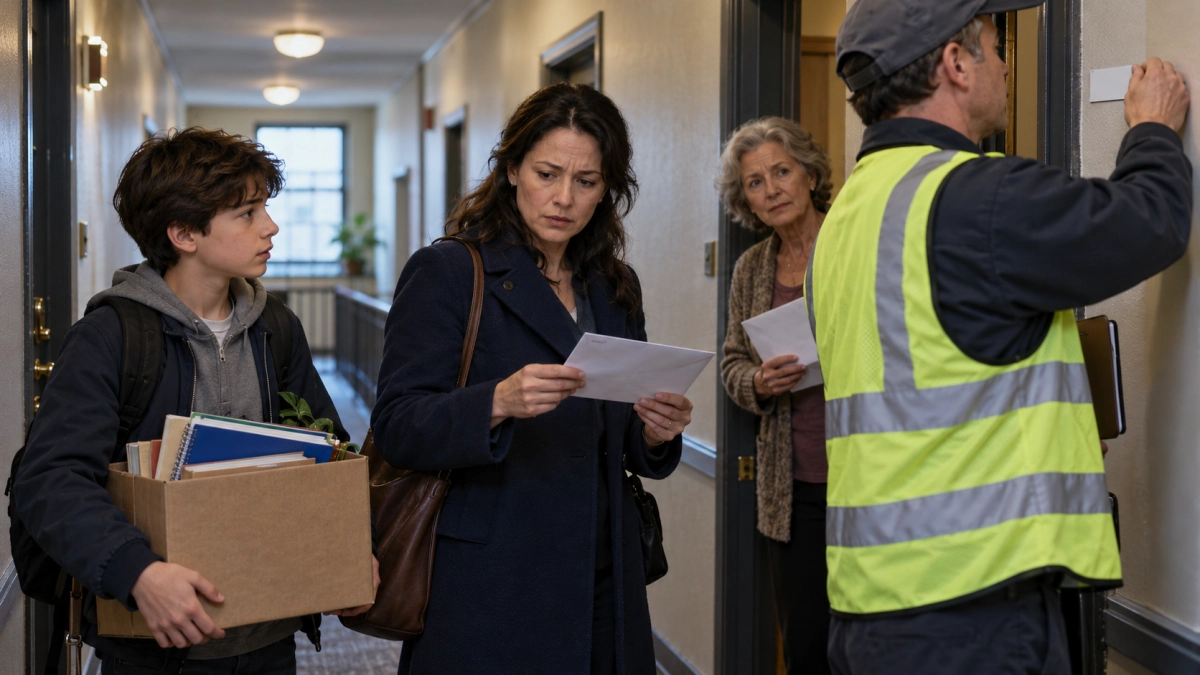
On Monday morning, a man in a reflective vest stuck a label reading 4C on my apartment doorframe. My son, Mateo, thought the building was changing its numbers. The man said he was marking units “ready for delivery” to the new owners. I had never agreed to move.
An envelope from management lay under my door: four thousand dollars if I gave up the apartment in twenty one days. It called the offer voluntary. I looked at the boxes of books Mateo had stacked for a school presentation, then at my night shift schedule. Three weeks was not enough time to find a two bedroom apartment in his school area, save a new deposit, and take days off to move.
Ruth from 4A heard us in the hall. She had received an envelope too, but hers offered twelve thousand dollars and two months. Her apartment was the same size as mine. Both our leases ran into spring.
I went downstairs to ask why the letters were so different. The property manager said every offer was calculated individually and I should sign before mine expired. I asked about the label on my door. She called it a survey crew mistake, then pushed a paper across the counter. “This only confirms you received the notice,” she said.
Under the signature box, in smaller type, the paper said I agreed to terminate my lease and hand over the empty apartment on the twenty eighth. I put down the pen. My phone buzzed with an automated email from the company: “Pre-delivery inspection scheduled.” The inspection was set for Friday.
Mateo stood beside me with a box of books in his arms. “Did you say yes?” he asked. Behind the counter, the manager watched me over her monitor, waiting for me to pick up the pen again.
“I did not agree,” I said, loudly enough for the man waiting to pick up his keys to hear. I photographed the paper on the counter without touching the signature line. The manager, Ms. Voss, pulled it back and said the inspection email was a system error. I asked her to confirm that in writing and cancel the appointment. She said she would have to speak to her supervisor. I wrote down her name and the time on the back of the envelope, then took Mateo upstairs.
He asked whether we were losing our home. I wanted to tell him, without qualification, that we weren’t. But my lease had only seven months left, and an investment company was negotiating to buy the building. “We don’t have to go anywhere today,” I said. “I’m going to read everything before I decide.” At thirteen, Mateo was old enough to hear the honest part of that answer and young enough to study my face for the rest.
We had lived in the brown brick building on Mercer Street in Milwaukee for four years. I worked nights as a lab technician at a hospital on the south side. From our apartment, Mateo could walk to school after I got home. Ruth watched the hall from her window on mornings I slept through my alarm. I paid twelve hundred seventy five dollars a month, hardly a bargain, but nearby apartments were being listed for several hundred more. Four thousand dollars looked substantial in a letter. Subtract a deposit, a moving truck, and unpaid time off, and it shrank fast.
That evening Voss emailed, “Friday’s inspection has been canceled. We apologize for the misunderstanding.” She said nothing about the label on my door. I took a picture before someone peeled it away. Mateo sat beside me, stacking his book boxes into a tower. “If we have to leave, can I take all of them?” he asked.
I said his books would be the last things we gave up. “I wasn’t asking about the books,” he said. I looked at the cardboard robot he had built with a friend, the bus pass clipped to his mirror, and the pencil marks beside the closet showing how tall he had grown. I had no answer ready.
Ruth knocked the next morning with two coffees. She had driven city buses before she retired and had lived in the building for twenty two years. She did not believe that letters with matching stationery and different terms were an accident. She suggested we knock on a few doors together. I worried we would be called troublemakers. “They scheduled an inspection before you touched a pen,” she said. “The trouble did not start on this side of the counter.” It was the first time I had laughed since Monday.
We did not ask anyone whether they needed the money or why they might move. Ruth introduced us and asked if our neighbors wanted to compare the terms in their letters. Some shut their doors. A student in 3B said management had called her three times in one week to ask whether she had found a new place.
A family in 2D had received no offer at all, only a notice that prospective buyers would tour the apartment during their toddler’s nap. Yusuf in 4B, who lived with his father, had been offered twenty five hundred dollars and fourteen days. His lease ran longer than mine.
In a notebook, I recorded only what each person chose to share: unit number, size, lease expiration, rent, offered amount, and deadline. I asked whether their name could appear in a summary. Yusuf wanted his apartment number listed without his name. Ruth agreed to use hers. Another neighbor said we could write down the amount she read aloud but could not photograph the letter. Until then, I had imagined solidarity meant telling one another everything. A day of knocking on doors taught me that people could only stand together if they kept the choice of how much to tell.
At 4D, Hannah and Peter invited us in. They had moved in the same month as I had. Their apartment was the same size, their rent twenty five dollars less, and their lease also ended in spring. Management had offered them thirteen thousand dollars and eight weeks.
Peter was the first person in the building to call and ask whether there was additional relocation money. An hour later, Voss came back with the larger amount. Their first offer had been seven thousand. Hannah looked troubled when she saw my four thousand. “We thought everyone could negotiate,” she said. “They didn’t tell us it was a contest.”
On Wednesday evening, eleven households squeezed into the basement community room. The vending machine buzzed behind Ruth. No one appointed a chair. I laid my summary on the table and said it did not prove anyone had broken a law. It showed that we were being asked to make decisions with different information.
One man said the money would vanish if we waited. Another parent said she could not move even for twice the offer because her son was in his final year at the school across the street. A couple wanted the cash so they could move closer to family in St. Paul. A single solution was already looking unfair to half the room.
Sam, the maintenance worker, came to check the heater. He stopped outside the open door when he heard the discussion. I invited him in. He shook his head. The next day he met me by the mailboxes and said he wasn’t allowed to discuss the sale.
He could confirm one thing: repair requests were still being accepted, even though some residents had been told repairs could wait because they were “leaving soon.” Anyone told that should email the request and keep the ticket number, he said. I thanked him. He told me he needed this job, and I promised not to attach his name to our group letter.
I took my lease, the offer, and the inspection email to a tenant support clinic in the city. An adviser named Avery read each page. She did not promise that we could compel the owner to offer everyone the same amount. She did point out that the form Voss had asked me to sign was an agreement to end my lease, not an acknowledgment that I had received a notice.
She told me to save every communication, ask for explanations in writing, and not assume two apartments had identical rights when their lease terms differed. The clinic could schedule individual appointments for anyone who wanted one. I left with fewer certain answers than I had hoped for, but less fear about what to ask next.
Nobody inspected my apartment on Friday. On the way to Mateo’s school, though, I saw a notice taped to the elevator announcing a buyer tour of “floors to be delivered vacant before winter.” Ruth read it beside me and took a picture. “They’re selling a promise we haven’t made,” she said. We did not know how many empty units the sale required. We did know that our names and dates should not be supplied for a sales pitch we had not accepted.
That night I wrote a group email in plain English. I asked Yusuf to read it for anything that made him feel dragged into a lawsuit he had not chosen. He crossed out “threat” and wrote “inaccurate information.” Hannah added that any earlier, higher offer should remain available.
Ruth added the option to stay until the current lease ended and a single contact for repairs. We sent the draft to each household before asking anyone to sign. Thirteen signed; three wanted a copy but chose not to join; two did not answer. I removed the names of those who had not signed, even though they might benefit if something changed.
Our letter asked management to explain how offers were calculated, confirm that nobody was recorded as agreeing to move without a signature, and hold a meeting with written minutes. We attached a comparison table using only details people had agreed to share. Email addresses and children’s names were removed. When I clicked Send, I did not feel brave. I heard the basement vending machine buzzing in my head and wondered whether Voss would be at my door the next morning. For the next two nights at the hospital, I kept checking my inbox between specimen runs.
Each tube came with a label that had to match the person and the test exactly. If something did not match, I set it aside and asked before processing it. I wished housing paperwork worked with the same care. The letter under my door had called a lease termination a receipt. A computer had scheduled an inspection for a move I had not chosen. On paper, those errors were small enough for Voss to call misunderstandings. For Mateo and me, they had meant two days of wondering whether someone would open our apartment while I was at work.
My coworker Nia asked why I looked so tired. I showed her the first offer and the list of apartments I had bookmarked. She did not tell me four thousand dollars was a fortune, or that I was foolish to question it. She pointed to the line for time off. I had allowed only one missed shift for the move.
She reminded me that setting up utilities, collecting keys, and unpacking with a teenager would take more than one afternoon. I changed the number. That single addition turned my rough budget negative. It also made me less willing to treat the company’s deadline as if it were a fact of nature.
The company acknowledged our letter the following morning and proposed a meeting on Tuesday. In the meantime, some neighbors began treating me as if I had every answer. Yusuf asked whether his father had to let buyers into their apartment while he slept in the afternoon. I told him to check his lease and speak with Avery, because I did not know the rules that applied to his unit.
The student from 3B asked whether she could still take the money if she signed now. I said probably, but I could not tell her whether to stay or go. I felt as though I was letting them down. Ruth reminded me that sending a letter on behalf of the building had not turned me into a free lawyer and moving coordinator.
What worried me more arrived Sunday evening. A notice slipped under my door said management would inspect my unit after a “complaint about belongings obstructing the passage.” Mateo’s four book boxes were against the wall, clear of the door. I photographed the hallway, carried the boxes into his room, and emailed Voss asking what the complaint concerned and what the inspection was for.
She called it routine and said it had nothing to do with our letter. I had no proof otherwise. I saved her answer and forwarded the exchange to Avery. She said to keep responding to legitimate requests, document everything, and avoid signing anything I had not understood.
Mateo overheard me tell Ruth and asked if the building wanted us out because he built his robot in the hall. I said no. At school, he told me, sometimes a teacher called on the quietest kid when a whole group was noisy. I wanted to say adults did not do that. I had just photographed four boxes to prove the passage was clear.
I sat beside him and promised that if we moved, I would explain the decision. It would not be his fault. He asked whether we could bring the height marks from the closet. I said we could tape a strip of paper beside them and copy each line. “We don’t need to,” he said. “The new place can have new marks.” It made me sad and relieved at once.
Before the meeting, Hannah admitted she felt guilty about the larger offer. Peter wanted to accept it before it expired. I told them they had every right to sign if they needed to. All I asked was permission to say accurately that their offer had risen from seven thousand to thirteen thousand after they questioned it.
That fact showed the first number was not the last word. Hannah sent me the email confirming the increase and allowed me to use the figures without their names. I understood her caution. A group negotiation could easily make the tenant who received more look greedy, while the people creating the differences stayed out of sight.
The meeting took place in the community room. Voss came with Mr. Reed, a regional director, and someone to take minutes. Reed began by thanking us for “cooperating with the transition.” Ruth raised a hand. “We haven’t agreed to a transition.” Reed changed his phrase to “considering available options.” It was a small correction, but I saw a few people in the room relax.
He said the offers reflected unit type, lease duration, possible turnover date, and “likelihood of completing a transaction.” I asked what the last factor meant. Some residents had reached out first, he said, and the company had adjusted its terms to fit. I put redacted copies of my letter and 4D’s side by side.
Same unit size, nearly the same rent, leases ending within weeks of each other. “One person asked and got six thousand more. The other was asked to sign a lease termination without being told that was what it was. Is your formula about the apartment or about who knows how to question you?”
Voss said the conversation at the desk had been a misunderstanding, and that she had apologized in her email. I said I had received the apology, but the record still showed a pre-delivery inspection scheduled for an apartment I had not agreed to surrender. Reed turned to the note taker and asked for that item to be flagged for review. I could not tell whether he was genuinely surprised. At least it was now part of a written record heard by three people from the company.
Yusuf spoke next. He did not ask why his offer was lower than a white resident’s, or a resident who spoke English without an accent. He asked whether the company could publish its calculation without anyone’s name attached. Reed said they did not want to disclose individual terms. “We are not asking for names,” Yusuf said. “We are asking for the rule.” People nodded. Someone clapped twice. Yusuf let out a long breath, as though that short sentence had weighed more than his entire workday.
Another resident stood and said she wanted to stay. She did not want a higher offer. She wanted the weekly calls to stop. Reed said the company would honor existing leases but could not promise renewal after they ended. Avery had come as an observer at the request of several residents. She told us to record Reed’s exact answer. It was not a guarantee about the future. It was also not a demand that we leave within twenty one days. That distinction mattered to families who needed time to look for somewhere else.
The meeting ended without new numbers. Reed promised a written policy within a week. Outside, two people told me I had talked too much and made the company defensive. Three others thanked me. I climbed four flights because the elevator was crowded, thinking that a building did not become a community just because people signed the same page. Every household still had its own bills, fears, and calendar.
Ruth knocked later with a packet of crackers she said she had bought by mistake. We both knew she wanted to see whether I was all right. She told me that driving a bus had taught her not to mistake the loudest passenger for the entire route. At the meeting, the loudest voices had wanted either everyone to stay or everyone to take the money.
She could hear a quieter group in the middle: people waiting for a school term to end, people whose parents needed an elevator, and people who could move if they had enough notice to keep their jobs. I said it was hard to write one letter for all of them. “Then write a letter that leaves room for more than one answer,” she said.
Before she left, Ruth stood beside the pencil marks in Mateo’s closet. Her late husband had helped carry the dresser into that room when we moved in. I had forgotten. She remembered Mateo reaching the third mark by standing on his toes until I made him try again barefoot. Ruth did not say we had to stay because of those memories. She knew that a familiar room could be precious without being affordable forever.
That afternoon my supervisor at the hospital asked if I could pick up two extra night shifts that month. I almost said no because I planned to take Mateo apartment hunting. Then I remembered that, whatever we negotiated, my lease would end in spring and I would need money.
I accepted one shift and asked Ruth to take Mateo to robotics club after school. She said yes, but told me to say when I needed help instead of making the boy guess how much I was carrying. I had wanted to keep every worry off his shoulders. It turned out that also required learning to lean on someone else.
A week passed before management’s letter arrived. Its chart gave broad ranges: six to eight thousand for a one bedroom, eight to ten for a two bedroom, depending on when the unit could be returned and how much of the lease remained. It did not explain why 4D had thirteen thousand or why I had been offered four.
Earlier offers, it said, would stay valid until their original deadlines. I called Hannah. Their thirteen thousand was about to expire, but signing meant they would leave before their son’s school term ended. She and Peter decided to wait two more days. I did not tell them to wait. I sent them the offer they had shared so they could see the deadline beside the amount.
Ruth said we needed a proposal more concrete than “be fair.” Twelve households met that evening; one had already signed to move closer to her mother and no longer wanted to take part. We wrote two paths. People who stayed would receive written confirmation that their current lease and repair requests would continue to be handled, and that they were not recorded as accepting a buyout.
People who left would get a clear baseline tied to unit size and remaining lease time, a reasonable move date, return of their deposit under the ordinary inspection process, and documented moving expenses. Anyone offered more could keep that offer. Nobody would sign for anyone else.
I wanted to demand thirteen thousand for every two bedroom unit. Ruth pointed out that some leases had a month left and others a year. A single flat number would create another argument about fairness. Yusuf proposed a minimum for two bedroom units with at least six months remaining and a published formula for other situations. We spent two hours editing each line. At times I hated the spreadsheet more than I hated Voss. But the spreadsheet was what showed us who would be left out if we told only my story. Reed did not answer the proposal right away.
Three days later he called me privately. If I signed for eight thousand by Friday, he said, the company could prioritize returning my deposit. I asked why he wasn’t sending that to the whole group. Every household was different, he said. Mine included thirteen people who had signed a letter together, I told him.
A response to that letter should go to all thirteen. After I hung up, my hands shook badly enough that I spilled coffee across my calendar. Ruth did not tell me I was brave. She handed me paper towels and said, “Now email him what he offered.”
I wrote four lines: the time he called, the amount, his deadline, and my request that he send any group proposal in writing. He confirmed receiving the email without disputing my summary. Avery told us to keep it. She also reminded me that a private call did not, by itself, prove bad intent. What mattered was that, before anyone decided, we could say who had offered what. I was beginning to value Avery’s careful phrase “by itself.” It kept me from turning every unwelcome thing into a conspiracy while still letting me name what had happened.
The following week, Reed came back to the community room with a representative of the company buying the building. The buyer wanted most units empty by the end of January so crews could replace plumbing floor by floor. They could buy a building with active leases, the representative said, but the construction schedule and purchase price would change. I understood why the seller wanted people to leave voluntarily and quickly. I also understood that we had something to negotiate with, though no one could promise us an easy search for housing when our leases ended in spring.
This time Reed put numbers on paper: ten thousand for a two bedroom with at least six months left on its lease, six thousand for a one bedroom, sixty days to move, and five hundred in moving expenses. Ruth said she would stay, but wanted a written contact for repairs after the sale.
Yusuf said his father needed time to find an apartment with an elevator; sixty days might not be enough. Hannah asked whether her thirteen thousand still stood. Reed said it did. The questions no longer revolved around me. That was when I believed the meeting belonged to everyone in the room.
After two more revisions, the parties settled on twelve thousand for eligible two bedroom units, eight thousand for one bedrooms, and a written schedule based on months remaining for other leases. Higher existing offers stayed higher. Residents taking the money had until the end of January to move, with up to fifteen hundred in documented moving costs.
Anyone who did not sign continued under the existing lease. Everyone would receive repair instructions and contact information for the new management. Avery reviewed the final terms with each household that wanted advice. We did not call it a victory for every resident. It was a clearer set of choices that each household could make for itself.
Seven households decided to stay at least until their leases ended. Ruth was among them. She did not want to leave her bus route or the people she knew on the fourth floor. Eleven households took relocation money, including Hannah and Peter. I waited before signing. I took Mateo to see four apartments. Three were too far from school; the fourth smelled damp inside the closet.
The fifth was smaller and cost a hundred seventy dollars more each month, but it was on the same bus route. The new landlord agreed to a move-in date at the end of January. I added the deposit, higher rent, missed work, and an emergency reserve. Twelve thousand dollars did not make us secure forever. It gave me room to choose where we were going instead of running from where we had been.
When I signed, Mateo asked whether I had lost because the new apartment was smaller. I told him I had accepted a different offer after learning I could read it, question it, and refuse it. I could not turn it into a cheaper home, but I could get us there without borrowing against a credit card. He thought about that and asked whether he could keep the 4C label if someone peeled it from our door. I said that might be better left behind. “Then I’ll take my robot,” he said.
During the weeks before our move, the comparison spreadsheet stayed in a shared folder, but we deleted personal amounts once households had their own agreements. A first floor resident suggested posting every offer online for more pressure. I understood his anger. Yusuf did not want his father’s name before strangers.
Hannah did not want the new owner to know everything her family had negotiated. Ruth did not want people asking why she had chosen to stay. We shared our joint demands and the joint result, and kept private letters with the people they belonged to. It drew less attention, but the neighbors who had trusted me at their doors could keep trusting me.
Avery came to our last gathering and reminded everyone to read the individual paperwork. The group terms did not replace each lease or guarantee renewal when it ended. Ruth did receive a repair contact and a mailing address for requests after the sale. The family in 2D got buyer tours moved away from their toddler’s nap. Yusuf secured additional time to look for a place with an elevator through a separate addendum. Those provisions did not make everyone a winner. They turned some of the shapeless dread into dates and names of people who would have to answer.
I went to Mateo’s school to report our new address. The robotics teacher checked the bus route and said he could still stay for Thursday practices. I had been preparing to choose between a workable apartment and his friends. When she told me I didn’t have to, I stood in the hall for a minute to breathe. Mateo only wanted to know whether the new place had outlets for his chargers. I said there were two beside the window. “Okay,” he said, and went back to class, as though a future could begin with a place to plug something in.
I packed slowly enough to decide what we actually wanted. Mateo found a drawer of permission slips, birthday invitations, and broken robot wheels. He wanted to keep nearly all of it. I wanted to throw half away before the truck came. We made two piles and a third for things neither of us could decide about yet. The third pile grew fastest. It was ordinary moving day work, but for weeks every box had seemed like evidence that management was winning. Now I could put a label on a box without feeling that I had agreed to their first letter.
Before moving day, I made a checklist for the final walk through. I would photograph the rooms, record the meter readings, and keep a copy of whatever management signed. Avery had suggested those steps when we reviewed the deposit terms. Voss did not have to admit that she had pushed too hard for me to protect myself. The signed agreement and our emails would matter if we disagreed about a charge. I put the checklist beside the keys, where I could not lose it under another box.
On moving day, Ruth stood in the hall holding a roll of packing tape. Yusuf and his father helped carry the bookcase, though they still had not decided what they would do after their lease expired. Sam fixed a stuck wheel on the moving dolly, then completed the repair ticket for a leaking faucet in 4A before the truck pulled away. Nobody played the hero. Each person did one thing the person beside them needed, then returned to the rest of their day.
That evening, Mateo set his cardboard robot on the windowsill of the new apartment. I received an email confirming the old company had our keys and would send the relocation payment under our agreement. I saved it in the same folder as the first letters.
Ruth texted me a picture of the fourth floor: someone had peeled away the 4C label, leaving a clean square on the old doorframe. She said she would keep her key until she decided for herself to leave. I watched my son choosing a shelf for his books. No one had given us an easy choice. At least the final one had our names beneath it, signed in our own handwriting.
Read next

The Bridesmaid Budget

The Scholarship Interview They Wanted to Film
The Price of the Old Table

My Cousin Sold My Mother’s Funeral Flowers for “Charity”—Then the Florist Recognized the Delivery Address
Reading notes
An offer on the fourth floor exposes the assumptions people make about money, status and opportunity.
This is an original work of fiction. Characters and events are fictional. Explore public-domain books at Project Gutenberg or browse more stories on ReadStoryvia.