Original fiction
On this page
The Address on Our Lease
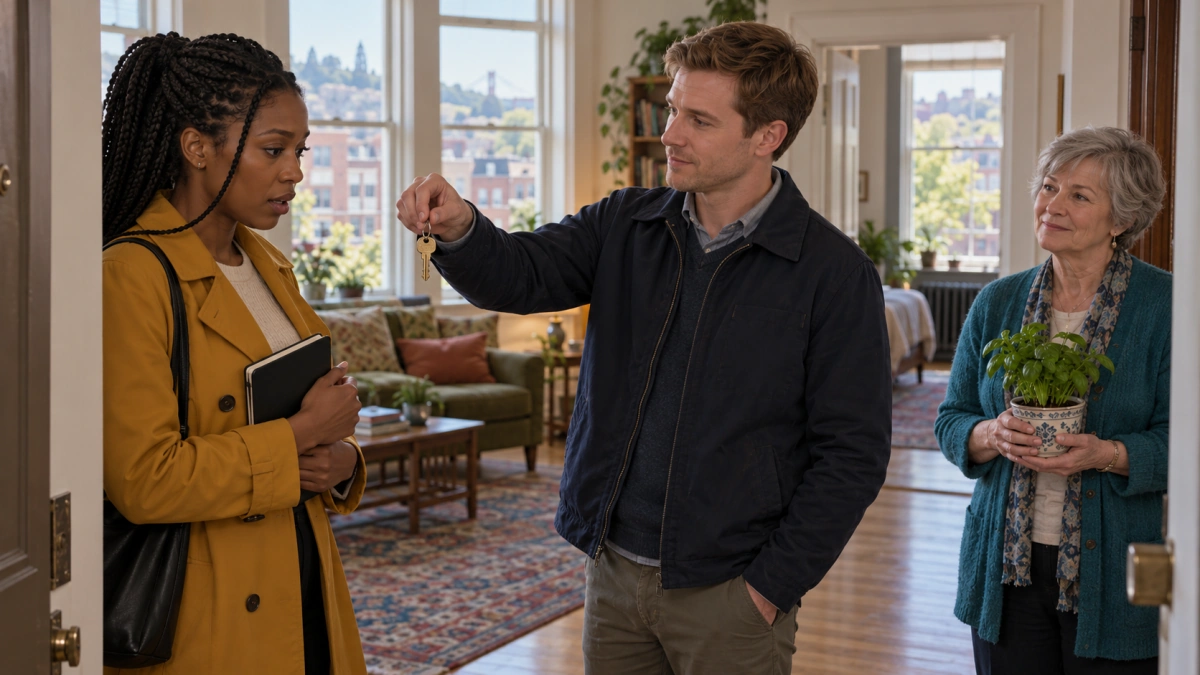
The leasing agent handed Wesley a key before she asked my name.
"Your mother already put a plant outside 2A," she said. "It makes this floor feel like home."
I looked at my fiancé. We had come to see an apartment in Cincinnati, not collect one. In my purse was a notebook containing twelve questions, including whether the second bedroom could hold my sewing table and whether the rent included water.
Wesley tucked the key into his navy jacket.
"I wanted you to see it first," he said.
"Before what?"
The agent stopped smiling. Behind her, an empty room smelled of fresh paint and somebody else's decision.
We were supposed to tour a first-floor apartment overlooking the courtyard. This one was upstairs. Across the hall, a door opened, and Adele Pike appeared in a teal cardigan with a basil plant cradled against her chest.
"Keira! Did he tell you about the Saturday market?"
He had not told me his mother lived here.
Adele was sixty-three, worked three afternoons a week doing alterations, and had recently sold the house where Wesley grew up. She needed fewer stairs, less yard, and somewhere to put a dining table that nobody wanted. None of that explained why her son's key was already warm in his pocket.
"Whose name is on the lease?" I asked.
"Mine," Wesley said. "We can add yours."
The agent quietly stepped toward the kitchen.
I had signed nothing. Paid nothing. Given notice nowhere.
Then Adele said, "I'm glad we can work out those evening errands together. I told him Tuesdays wouldn't suit me."
Wesley looked from his mother to me, still expecting this to become a happy surprise.
I closed my notebook.
"What evenings," I asked, "did you promise her?"
He reached for the notebook as if the answer might be among my questions. I moved it against my chest. Adele set the basil on the hall windowsill, carefully protecting the leaves from the sash. That small deliberate movement kept the moment from becoming a scene in which everyone spoke at once.
"Not every evening," Wesley said.
"I asked which ones."
"Monday groceries. Wednesday if she needs something picked up. Maybe a ride on Fridays. You pass the cleaner anyway."
I passed the cleaner on my way to a community arts room where I taught a six o'clock mending class. He knew that. He had carried a box of donated denim there in February and eaten the last orange from our refreshment table.
Adele's expression changed. "You told me Keira offered."
The agent returned with a folder. "Would you like some privacy?"
I thanked her and asked only one thing first: was there any document with my name or signature on it? She checked the folder and said no. Wesley was the sole applicant and sole signer. I did not ask her to explain my relationship or rescue it. She gave Wesley her office number and went downstairs.
Outside the windows, someone wheeled a shopping cart along the sidewalk. A bus sighed at the corner. Everything ordinary continued while the apartment I had not chosen became very quiet.
"I thought proximity would help," Wesley said. "We talked about helping Mom."
"We talked about helping her move. Last month."
"And being there after."
"Being there isn't an address."
Adele pulled her cardigan closed. "I asked him to come measure my shelf. I didn't ask him to move next door."
That surprised me enough to look at her properly. She wasn't glowing with a plot's success. She looked like a woman discovering that two conversations she had trusted were not the same conversation at all.
Wesley said the apartment was a good deal, the building was quiet, the second bedroom had morning light. He delivered these facts quickly, little steppingstones he hoped would carry us across the thing he had done. I had loved that optimism when a picnic got rained out. Here it made my hands cold.
"How long?" I asked.
"Twelve months. Starting May first."
It was the second Saturday in April. Our wedding invitations lay in a cardboard box under my kitchen table, addressed but unstamped. September had seemed far enough away to absorb any ordinary mistake.
"And what did you pay?"
He looked toward his mother before answering. "Deposit and the first month. Fourteen fifty each. Fifty for the application."
Two thousand nine hundred fifty dollars. His money, from his account. We had kept separate accounts and planned to decide on a household arrangement after choosing a place. I made him say that too, not because I doubted arithmetic but because he kept using we for decisions made by one person.
"I haven't used the wedding money," he said.
"That isn't the only money that counts."
Adele picked up her basil. "Come sit in my kitchen. Nobody needs to stand in a hallway for this."
I could have left. Part of me wanted the clean satisfaction of walking past both of them with my coat swinging. But I wanted to know what he had promised, and I didn't want to learn it later through a softened version. I followed Adele across the hall.
Her apartment contained unopened boxes, a striped chair, and the dining table that had survived the house sale because she finally admitted she liked it. Three chairs stood around it. The fourth was upside down waiting for a screw. On the counter, a paper calendar listed work shifts in thick blue ink.
She offered coffee. I asked for water. Wesley remained standing until his mother told him to stop making the room look like a waiting room.
"I said I'd need help with heavy shopping while I get used to this neighborhood," she told me. "And I wanted company sometimes. Apparently that became a transportation department."
"Mom."
"No. You let me think she'd suggested it."
He rubbed his palms together. At thirty-five, Wesley had a way of looking briefly sixteen when Adele used that voice. Usually I found it tender. Today I saw the convenience in becoming a boy whenever the adult explanation grew difficult.
He said he had been worried about her since the house sale. The evenings there had been too quiet after his father's death three years earlier. She sometimes called to ask questions she already knew the answers to. He had heard loneliness in those calls, and then every vacant apartment had begun to seem like an emergency.
Adele stared at her water glass. "Sometimes I called because I wanted to hear you. That isn't the same as asking you to organize my life."
I understood his worry. I had listened to him talk about her empty garage, her careful lists, the strange cruelty of selling the height marks on a kitchen doorframe with the house. Understanding did not make the lease ours.
"Were you going to tell me before I gave notice?"
"Of course. Today."
"After I loved the light? After your mom showed me the market?"
He didn't answer quickly enough.
The water tasted faintly of the new filter Adele had installed herself. I noticed its empty box by the trash. There were so many things she could do. He had made her small in order to make his solution necessary, then made me useful in order to make it possible.
"I'm going home," I said.
Wesley stood. "I'll drive."
"I'll take the bus."
He said my name, quietly, almost pleading. I had come in his car, and accepting the return ride would mean twenty minutes trapped beside his explanations. Adele gave me the route number without telling me I was overreacting. At the door she said, "I am sorry he put my face on this."
I wanted to reassure her, but reassurance had started to feel like unpaid work. "I'm sorry too," I said, and left it there.
At my apartment, I took off the mustard trench and hung it on the hook Wesley had installed crookedly last winter. Sunlight touched the radiator, the dented brass lamp, the stack of fabric by the couch. My place was small. The kitchen drawers stuck when the weather changed. It had never looked so distinctly like something I had chosen.
My friend Marisol arrived with dumplings because I had sent her a message consisting of the words lease, mother, and not a joke. She waited while I ate before asking what had happened. That patience nearly made me cry.
"Do you want him back here tonight?" she asked when I finished.
I shook my head. "I want yesterday back."
She didn't call him names. Instead she asked where his belongings were. A toothbrush, two sweaters, the coffee grinder he preferred. I had no urgent need to put them outside. We weren't playing a game where the winner was whoever made the largest gesture first.
I texted him that I needed the weekend without visits. We could talk Monday at a coffee shop. He sent six messages. The first explained the rent. The next apologized for how it looked. The third asked if I wanted him to cancel everything. I put my phone in a drawer before reading the others.
Sunday morning, I opened the box of invitations. Cream paper, green ink, our names looking certain. I had chosen the typeface at midnight while he washed dishes. Nothing about that memory was false, which made it harder. A relationship could contain real tenderness and still be unsafe to build a household on.
I called the woman renting us the small reception room. She explained what postponement would mean under our reservation. I wrote down the deadlines and the amount already paid. I did not cancel while angry or pretend there would be no cost. Then I set the notes beside the invitations and went to teach my afternoon class.
One student, a retired bus driver named Vernon, had brought a shirt with a torn pocket. He wanted an invisible repair. The fabric was too worn for that. I showed him a contrasting patch and let him choose the color. We spent ten minutes finding a green he liked. I was grateful for a problem that could be held flat under a lamp.
Monday, Wesley was already at the coffee shop when I arrived. He had bought my usual drink, then pushed it away from my chair as though realizing even coffee could become another unwanted assumption. I ordered tea instead. Neither of us made the symbolism a speech.
"I signed because I thought you'd say no if I asked first," he said.
There it was, without the floor plan or the sunlight in front of it.
"Then you knew it was something I needed to decide."
He nodded. "I told myself you'd say no because you worry about losing independence. Like I could get us past that part."
"That part is my life."
He looked down. For the first time since Saturday, he wasn't preparing the next explanation while I spoke. I told him I would keep my apartment, would not move in May, and would postpone the wedding. I wasn't announcing a punishment with a date on it. I didn't know whether I could marry someone who treated my refusal as an obstacle to work around.
He asked whether we were breaking up.
"We're not getting married in September. That's the answer I have."
He pulled an envelope from his bag. Inside was a copy of the lease and the payment receipt. He had called the office that morning. They had told him to send any request about changing his arrangement in writing; there was no cancellation they had agreed to, no promised refund. He would follow up himself.
"I'm not asking you to pay," he said.
"Or your mother."
"Or Mom."
We went through what he actually owed and what remained unknown. The monthly rent was fourteen hundred fifty dollars. His deposit was not spending money waiting to be reclaimed on command. He would have to budget around the agreement he had signed, not around an imaginary version where regret erased it.
His current room rental ended in April. Moving into 2B was the practical choice available to him. I told him I wouldn't interpret living there as proof that nothing had changed. What mattered was whether he kept trying to make me live there too.
He asked if we could tell our families together. I said we could write a short message together, but he would need to explain his own decision when people asked. I wasn't going to stand beside him smiling while everyone assumed I had developed cold feet over napkin colors.
At home, I reread his later messages. One said he was afraid our lives would become separate if we didn't live together soon. I wondered how long he'd thought togetherness meant one life swallowing another. I wondered why I hadn't asked that question when he called my late classes optional.
On Wednesday Adele called. She asked whether I had ten minutes, and when I said five, she used four. She wanted me to know she had declined Wesley's offer to make a grocery schedule for her. She had arranged one larger delivery a month and planned to walk to the market for produce.
"My knees dislike those steep bags of potatoes," she said. "They haven't filed for retirement."
I laughed despite myself. Then she said she had also told him not to come through her door whenever he worried. They could have dinner some Sundays. She would invite him.
"You don't have to give me reports," I told her.
"I know. I wanted to correct what he told you, with my own mouth. After this, I'll leave you room."
Before hanging up, she asked about my mending class. Not whether it paid enough to justify an evening, but what people were making. I told her about Vernon's green patch. She said visible repairs often lasted better because you stopped pretending the fabric hadn't changed.
I almost wrote the sentence down. Then I resisted turning her into the wise mother who would mend her son's mistake for him. She was allowed a good observation without becoming responsible for the ending.
The first Saturday in May, rain rattled my kitchen window while Wesley moved into 2B. He had asked once if I wanted to help. I had said no. At noon he sent a photograph of a bookshelf with the message that it had survived the stairs. He did not send a picture of the empty second bedroom.
I spent that morning at a fabric warehouse with Marisol, choosing remnant cotton for the summer classes. My phone stayed in my bag. Under fluorescent lights, among improbable orange prints, I felt something besides hurt for the first time in days: an appetite for my own afternoon.
When I got home, an aunt had left a voicemail asking whether Adele was ill. Someone had interpreted the postponement as a family health issue. I called Wesley before responding.
"I said Mom needed me closer," he admitted. "I didn't say she was sick."
"You left a space people could fill."
He was quiet. "I'll call her. And the others."
"Don't tell them my private feelings to prove you're sorry. Tell them what you did."
He called that evening. I knew because my aunt sent a brief apology the next morning, not because I supervised his calls. Her message said she had misunderstood and hoped we each had support. It asked nothing from me. I let that count as one thing done correctly, not as the beginning of forgiveness I now owed.
The reception room could move our reservation to an unspecified later date only within a limited window. We chose to release the date. Some money would not come back. We split that wedding cost according to the arrangement we had made when booking, while Wesley took responsibility for the lease expenses himself. I could be fair without paying rent on his apology.
Packing the invitations hurt more than making the call. He came over to collect his sweaters, and we sat on the floor with the box between us. He picked up an envelope addressed to my grandmother and traced the corner with his thumb.
"I thought getting the place handled would make you feel taken care of."
"I like being taken care of. I don't like being handled."
He nodded, but his face crumpled enough that I almost reached across the box. I wanted to comfort him. I also wanted him to survive being uncomfortable without receiving my agreement as a sedative. I handed him a tissue instead.
He left the coffee grinder because it was mine now, he said. I told him gifts weren't evidence. He could leave it if he genuinely wanted to. The small negotiation exhausted us both, and afterward I slept for an hour with my shoes still on.
The next day my younger brother Darius came to fix the loose latch on my kitchen window. He brought the wrong screwdriver and a bag of pretzels, then admitted he had mostly come because my mother wanted somebody to look at my face. I told him my face was still attached.
"She knows," he said. "She wants to know whether you're eating through it."
I gave him the right screwdriver. While he worked, he asked whether Wesley had ever expected me to take care of his mother before. I remembered Christmas, when he had volunteered us to wash dishes after everyone else left. That had seemed ordinary. I remembered him saying I was better at difficult phone calls, then handing me his insurance problem. Each memory changed shape under attention, but I didn't want to turn our entire history into evidence against him.
"Some things were just things," I said.
Darius tested the latch. "And this one wasn't."
He stayed for lunch. We talked about his daughter's school play and the outrageous price of replacement tires. The window closed properly now. When he left, I cried, not because of anything he had said, but because someone had helped with the exact thing I had asked for and then gone home.
Later that week, Wesley called to ask whether I wanted the little table we had found at a yard sale. He had stored it in his rented room while we hunted for apartments. I had paid half. We both wanted to avoid an argument over furniture, which nearly produced another agreement neither of us meant.
"I actually do want it," I admitted.
"Okay. I'll bring it Saturday."
"Can you leave it downstairs? I'm having people over."
There was a pause. I could hear the old impulse forming: who, and why hadn't he been invited? Then he said, "Sure. What time won't interrupt?"
Saturday, he arrived at ten with the table wrapped in an old blanket. He waited outside while Marisol helped me carry it up. It fit beside my kitchen window, smaller than I remembered, one leg darker than the others. I put my sewing basket underneath. An object intended for our future had become useful in my present without making a declaration about the rest of my life.
That afternoon my guests painted sample patches for the summer workshop. Someone spilled blue paint on a paper plate and we all lunged to save the floor. For almost an hour I forgot to wonder whether I was being too hard or not hard enough. I was a person laughing with paint on her wrist. That should not have felt like a discovery.
On Sunday, Wesley told me he had eaten dinner with Adele. She had asked him to move a box from a high shelf, then said she wanted the rest of the evening to herself. He had gone home and assembled his kitchen cart instead of inventing another reason she needed him.
"I felt useless," he said. "Then I realized I was just alone."
I knew that feeling too. Being needed could feel like love because it arrived with instructions. Choosing each other without instructions was slower, and nobody could claim to be indispensable. I didn't tell him that understanding this solved anything. I said I was glad the cart had all its wheels.
We also had to tell my grandmother about the wedding. I called her alone, sitting at my newly useful table. She listened without interrupting and then asked whether I wanted her opinion or her company. I chose company. She talked about the stubborn tomato seedlings on her windowsill until my shoulders lowered.
Before hanging up, she said she would keep the dress she'd bought. Not for a wedding she expected me to provide, but because she liked it and might take herself somewhere. I pictured her in dark blue, boarding a bus to lunch with a friend. The future widened a little beyond the ceremony we had stopped.
When Wesley asked afterward how she had taken it, I said she was disappointed and kind. He didn't ask me to pass along an apology on his behalf. He said he would write her himself, briefly, without asking her to speak to me for him.
Two weeks passed without a dramatic improvement. We met for a walk beside the river and argued about whether he had ever listened to my plans. I accused him of never asking what I wanted. He reminded me of a job offer in Dayton I had declined, of conversations where he'd listened for entire evenings. He was right about those evenings.
I stopped walking. Tugboats moved past us carrying dark heaps under tarps. "You have listened," I said. "That's why this wasn't a misunderstanding. You knew enough to know better."
He leaned against the railing. "I think I wanted credit for being a good son before I'd done the work of being one. Renting next door was something I could show people. Asking Mom what she wanted wasn't a story."
"And marrying me?"
He took a long time. "Sometimes I talk about us like something I've accomplished."
The honesty was ugly and useful. It didn't make me want to kiss him. It made it possible to keep walking beside him without feeling that every word was another coat of paint.
At work the following week, my supervisor offered me a summer workshop series on Thursday evenings. Before April, I would have called Wesley to coordinate our hypothetical household. Now I checked my own schedule and accepted. Then I told him, not seeking permission, but because I still wanted to share good news with him.
He said congratulations. Two days later, he asked whether I would still be free for dinner that Thursday. The old familiar irritation flared. I said I had just explained the workshops. He apologized, checked his calendar, and suggested Saturday lunch instead. A small correction, but small was where our life would actually happen.
Adele and I met unexpectedly in a hardware store aisle near the end of May. She was comparing cabinet pulls, wearing jeans with a chalk mark near one knee. She had repaired her fourth chair and wanted to replace its mismatched handle with something equally ridiculous on purpose.
"You're allowed to hate this," she said, holding up a brass bird.
"I think the bird deserves a chance."
We laughed. Then the conversation paused where Wesley's name might have gone. Adele looked at the display instead. "He offered to pick me up from work Friday. I said I'd already arranged a ride with Patrice. He looked disappointed. I let him."
She said it without asking me to reward him. I asked if the new place suited her. She liked the windows, disliked the laundry machines, and had found two women who played cards without insisting on a fixed weekly commitment. She missed the garden. Downsizing wasn't a tragedy or a solution. It was a change with inconvenient parts.
"I liked my house," she said. "I also got tired of taking care of it. Both things can be true."
I told her I liked Wesley and didn't trust him with a shared address. She turned the brass bird over in her palm. "Then don't give him one to make the first part easier."
We left through different checkout lanes. She did not invite me to lunch, and I was grateful that she understood an accidental meeting could remain exactly that.
Wesley's apartment acquired curtains, a used kitchen cart, and a leak under the bathroom sink that he reported himself. I learned these things slowly, in conversation, not through tours designed to make me feel excluded. He stopped referring to the second bedroom as my room. He used it for his desk and a drying rack.
One evening he called from a grocery store. Adele had invited him for dinner, and he'd offered to bring dessert. He couldn't remember whether she disliked lemon or merely preferred chocolate. For a second I expected him to ask me to solve it.
"I called Mom," he said. "She said she'd already made pudding. So I'm buying myself a terrible frozen pizza instead."
I smiled into my phone. It wasn't transformation. It was an adult man making a phone call to the person whose preference mattered. The fact that this felt noteworthy made me sad too.
We tried one counseling appointment together. The room had a clock loud enough to interrupt our silences. When asked what I wanted from the hour, I said I wanted to discover whether staying curious about him was different from abandoning myself. Wesley said he wanted a way to become trustworthy that wasn't a performance I graded.
There was no verdict. We left with another appointment offered and no obligation to make it a ceremony of reconciliation. Outside, he asked if I wanted company to my bus stop. I said yes. Halfway there, I took his hand for a minute, then let go to adjust my bag. Neither of us treated that minute as a contract.
At the beginning of June, the arts center held an open workshop. Families brought torn cushions and jackets, and Vernon came to show off his green pocket, which had survived three washes and a granddaughter's birthday party. I had invited Wesley because I wanted him there, then spent the morning wondering whether that was a mistake.
He arrived carrying only the folding table I had asked him to borrow. Adele came separately after her shift with a little tin of extra buttons. She checked with me before setting it out. There was no family tableau, no whispered promise that we looked married already.
Near closing, a woman asked whether Wesley and I ran the class together. He said, "No, this is Keira's. I'm helping carry things today."
It was such an ordinary sentence that the woman immediately turned back to her cushion. For me, it landed with the weight of everything he had previously tried to claim through usefulness. He could stand inside my life without naming it his achievement.
Afterward, we ate sandwiches on the center steps. Adele left early for cards, cheerfully refusing a ride because Patrice was waiting around the corner. Wesley watched her go and did not look abandoned. Then he asked how the Thursday workshops were filling.
I told him about the registrations, the woman who wanted to mend a child's costume, the budget for thread. He listened. When I finished, he didn't turn the conversation toward when we might live together. He asked whether I wanted mustard on the other half of his sandwich.
That night, back in my own kitchen, I opened the notebook I had carried to the apartment viewing. The first page still held twelve questions. I read them without crossing any out. Water charges, window screens, sewing table, bus route. Sensible questions. Not signs of a woman afraid of commitment, as he had decided. Signs of someone intending to live in a real place.
On the next page, I wrote a different question: What happens when I say no?
I didn't write his answer for him.
Beside the notebook lay a rent reminder from my own landlord. I paid it before making tea, grateful for a bill whose meaning I understood. This money bought another month in rooms where my work could stay spread across a table. It didn't prove I was lonely or brave. It simply kept a promise I had made to myself, one ordinary payment at a time, with nobody else's signature required.
Eight weeks after the viewing, Wesley and I met at the Saturday market Adele had mentioned. Not with her. Not as a rehearsal for married life. We bought peaches too early in the season to be much good and argued companionably about which bread would survive my crowded bag.
He told me the next rent had been paid. He had adjusted his spending, declined a weekend trip, and taken responsibility for the apartment without making each sacrifice a message to me. I appreciated knowing the practical truth. I didn't congratulate him for paying an obligation he had chosen.
"I'd like to ask you to dinner next weekend," he said. "At that little place you like. Not at my apartment."
I considered my calendar, and more than my calendar. "Saturday. Seven."
His relief was visible. He didn't ask what this meant for September. I didn't offer an answer to a question he had finally learned not to smuggle into another one.
At the bus stop, he kissed my cheek after I leaned toward him. Then he went back toward his building, and I rode across town with bread on my lap. Through the window, Cincinnati unfolded in brick walls, laundromats, new leaves, apartments containing other people's unfinished lives.
Mine waited at the end of the route, with its stubborn drawers and crooked hook. I would let myself in, put the peaches in a bowl, and decide what to make for supper. There was room in that evening for hope. There was also room for the possibility that love would not become trust again.
For now, neither possibility required surrendering my own key.
Read next
The Divorce Party Invitation
The Ring at Reception
The Dress With the Tags Still On
My Fiancé Asked Me to Hide My Son During His Mother’s Visit—Then I Found the School Form He Had Already Filled Out
Reading notes
An apartment viewing reveals a lease and a future arranged without the woman expected to share them.
This is an original work of fiction. Characters and events are fictional. Explore public-domain books at Project Gutenberg or browse more stories on ReadStoryvia.