Original fiction
On this page
The Divorce Party Invitation
The invitation to my divorce party arrived while I was waiting for my husband to come home with dish soap.
It appeared between a grocery receipt and a reminder from the dentist: Saturday, seven o'clock, a celebration of Evan's fresh start. Under the cheerful artwork was a line inviting me to join if I felt comfortable.
I stood beside our empty kitchen counter in Minneapolis and read it three times. We had argued about our marriage. We had discussed counseling. We had never agreed to separate, never divided our bills, never decided who would leave this apartment. No divorce had been finalized.
The host was Jules, our friend who always brought too many folding chairs. I could already imagine her arranging snacks, believing she was helping somebody survive a hard season.
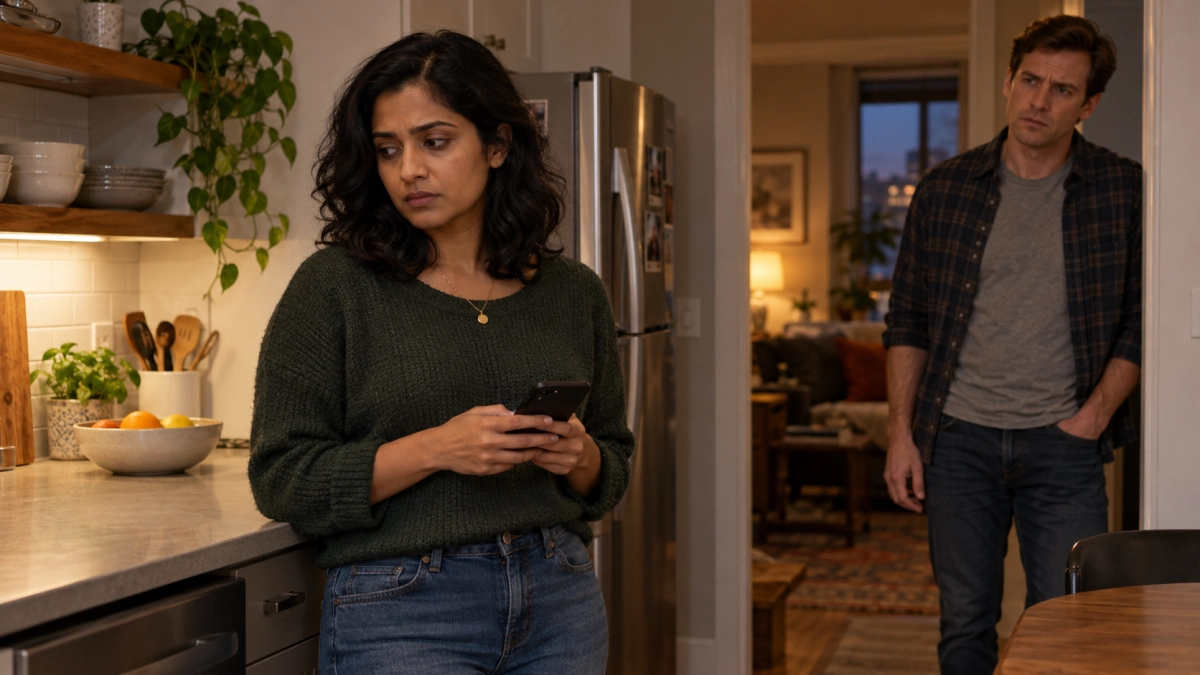
Evan came through the doorway with brown hair flattened by his hat. He was thirty seven and suddenly looked younger, like someone hoping a broken window would be blamed on the wind.
"What's wrong?" he asked.
I held my phone with its screen facing me.
"Apparently we're having a party."
He set down the shopping bag. Something glass clinked inside it.
"Jules shouldn't have sent that to you."
Not: What party? Not: There has been a terrible mistake.
My wavy black hair had fallen across my face. I tucked it behind my ear so he would have to look directly at me.
"What did you tell her?"
He glanced toward the living room, where his shoes were still under the couch and his half finished puzzle covered our coffee table.
"That we're moving on."
"Who is we?"
Evan didn't answer until I lowered the phone. Then he said we'd been unhappy for a long time, as if duration could turn a discussion into a decision.
"That isn't what I asked."
He pulled out a kitchen chair but didn't sit. The grocery bag remained between us. It contained dish soap, a jar of mustard, and the tea he liked. I noticed he had remembered the mustard after forgetting to tell me our marriage was apparently over.
"I told her you wanted space," he said. "That we'd talked about separating."
"We talked about whether counseling might help."
"You said you couldn't keep doing this."
"And you said we'd make an appointment."
He looked down. That conversation had happened on a Tuesday after an argument about his habit of saying yes to everyone except me. He had canceled dinner with my visiting brother to help a coworker move, then called me inflexible when I was upset. I had said I couldn't keep being the plan he changed first. It was not a request for a party.
"How long have people thought this?"
"A few weeks."
"How many?"
"Since the lake weekend."
He had gone away with friends five weeks earlier. I stayed home because my library branch was short staffed. That Sunday he came back sunburned and carrying the wrong cooler. We argued about whether the chicken in it was still safe to eat. Apparently there had been another story happening beside ours.
I asked for Jules's number even though I already had it. Some part of me wanted him to participate in opening the door he had closed behind my back.
"Please don't call her angry," he said.
"Then you should have given me different news."
I went into the bedroom and shut the door. My hands shook enough that I missed her name twice. Jules answered brightly, then heard my voice and stopped.
"Talia? Did the invitation upset you? I told Evan we shouldn't leave you out if things were friendly."
"What things?"
She was quiet. I could hear a dog drinking water in the background, a little domestic sound that made the absurdity worse.
"He said you wanted to separate. That you'd agreed to be supportive, even if you weren't filing everything immediately. I thought the party was a joke between you."
"It wasn't. We haven't agreed to any of that."
Jules said my name once, softly. Then she apologized without asking me to consider how difficult this must be for Evan. I sat on the edge of the bed.
"Who is coming?"
She named several friends. Then she paused.
"Audrey Kline. Do you know Audrey?"
I didn't. I asked why she was invited.
"Evan said they were seeing each other. I understood it started after you separated."
The room became very clear. The laundry basket, the crooked curtain hook, the receipt on his dresser. I could see each thing with a precision that felt almost calm.
"We are not separated," I said. "Whatever he told you, he still lives here as my husband."
Jules drew a breath. "I'm canceling it."
"Please don't send a message explaining my marriage. Tell people the event is canceled and the invitation was based on inaccurate information. That's enough."
She agreed. I asked her to send me whatever Evan had actually told her, not other people's guesses. She forwarded two messages. In one, he said I had asked for the split. In the other, he wrote that we were both relieved and that celebrating might make it less weird for everyone.
I read the word relieved until it no longer looked like an English word.
When I came out, Evan had unpacked the groceries. The tea stood in its usual place. He was wiping a perfectly clean part of the counter.
"Who is Audrey Kline?"
His hand stopped.
"She's a friend."
"Jules says you're seeing her."
He put down the cloth. "It's complicated."
"No. It's unpleasant. Those aren't the same thing."
He said Audrey was thirty four, a designer who knew a man from his cycling group. They had started talking at the lake weekend and gone out twice afterward. He said nothing physical had happened until he already believed our marriage was over.
"You believed it was over while asking whether I wanted you to pick up dinner?"
"I didn't know how to say it."
"So you said it to everybody except me."
He started to object, then stopped. He didn't confess to more than I could verify. I noticed that too. His sentences kept circling the edge of what I knew, landing only where the ground had already been exposed.
I asked whether she knew he slept here. He said she thought he was staying in the apartment temporarily while we worked out logistics. That word, logistics, seemed to offend me more than almost anything else. It made my life sound like a delivery waiting for a convenient window.
"Did you tell her I wanted this?"
"I said you weren't happy."
"That's not the same answer."
He looked toward the bedroom. "Yes."
I was thirty five, Indian American, the daughter of people who could turn any difficult subject into a practical question about whether I had eaten. My mother had warned me that marriage required patience. She had not told me how to recognize the point where patience became unpaid work maintaining somebody else's reputation.
I wanted to throw the mustard jar. Instead I took it from the counter and put it in the refrigerator. The restraint did not make me feel noble. It made my arm ache.
"You need to sleep somewhere else tonight," I said.
"This is my home too."
"I know. I'm asking, not changing the locks. I don't want to lie beside you while you decide which version of me to tell next."
He stood in the doorway for a long time. Then he called his brother. I heard him say we were having problems and stepped closer so he could see me listening.
"Tell him why," I said.
He swallowed. "Because I lied about being separated."
His brother said something I couldn't hear. Evan packed an overnight bag. He tried to kiss my forehead before leaving, a habit so old he seemed surprised when I stepped back.
After the door closed, I took the invitation off my calendar. It had arrived as an event I could accept or decline, but there was no button for refusing the story underneath it.
I called my friend Mei, who lived ten minutes away. She asked whether I wanted her to come over or stay on the phone. I said come over, and please bring something salty. She arrived with crackers, cheese, and no theory about why men did things.
We sat on the kitchen floor because I didn't want the couch where Evan had been working on his puzzle. I showed her the messages. She read them once and returned the phone.
"You don't have to decide the rest of your life tonight," she said.
"I think he already decided it for an audience."
"An audience isn't you."
I cried then. Not beautifully, not with a sentence that explained the tears. Mei moved the crackers out of the way and stayed.
The next morning the party cancellation appeared. Jules had written exactly what we'd agreed: the gathering was canceled, and the invitation had relied on inaccurate information. She didn't identify Audrey or describe a scene in our kitchen. Two people texted asking whether I was okay. One sent a row of question marks. I answered the first two and ignored the punctuation.
At work I shelved returns because it gave my hands something finite to finish. A little girl asked where the books about volcanoes were, then informed me that some mountains were sleeping. I found her a book and wanted, absurdly, to ask how she could tell.
During lunch I made a list of things I needed to know. Lease. Shared account. Credit cards. Health insurance. The list was not a substitute for grief. It was a way to keep grief from making every decision while I was hungry and exhausted.
I didn't empty our account or cancel his cards. I downloaded statements I was entitled to access and put copies somewhere I could find them. Our incomes were ordinary: mine from the library, his from operations at a food wholesaler. Neither of us could pay for two comfortable households without changing how we lived.
That afternoon Evan asked if we could talk. I agreed to meet at a coffee shop, not because public places prevented pain, but because I wanted to be able to leave without asking him to go.
He arrived early and had ordered my usual drink. I bought my own. The extra cup sat between us like a small assumption neither of us knew how to remove.
"I didn't plan for it to happen this way," he said.
"Which part did you plan?"
He rubbed the cardboard sleeve. "I thought we were finished. I couldn't bear another conversation where nothing changed."
"So you changed the facts without telling me."
He said he had felt lonely. He said our arguments had made home tense. Some of that was true. I had been tired and impatient. We had missed each other in a dozen ordinary ways. None of those truths authorized him to recruit friends into a version of events where I had released him from a promise I was still trying to keep.
"If you wanted to leave, you could have said so," I told him. "I might have cried. I might have been angry. You chose to avoid my reaction by erasing my part in the decision."
His eyes filled. I believed he was ashamed. Shame wasn't the same thing as understanding, but I didn't need to pretend it was fake to refuse to fix it for him.
"What do you want me to do?"
"Correct what you told people. Without blaming a misunderstanding. Without explaining our private arguments. And tell Audrey the truth."
He looked away at her name. "I haven't spoken to her since last night."
"That's a decision you can make. I'm not managing that relationship for you."
I left before the untouched drink cooled completely.
Jules called that evening. She offered to reimburse me for something, then stopped because there was nothing I had paid for. I almost laughed. We both wanted a transaction that would make the harm easy to locate.
"I should have checked with you," she said.
"Yes."
"I wanted to believe he was handling it kindly."
"So did I."
She told me she had canceled the food order before the shop began preparing it. A small deposit wouldn't be returned. She wasn't asking me to pay it. I was grateful she said that plainly, because I had spent enough of my marriage absorbing costs nobody named.
I asked whether she could correct the story if friends repeated it, just say I hadn't agreed to a separation. She said yes. I didn't ask for a public apology video or a list of everyone who had heard. I wanted the falsehood stopped, not a touring exhibition of my humiliation.
On Friday, Audrey sent me a message through an account that included her full name. Jules had asked whether I would accept contact, and I had said one written message was okay. Audrey wrote that Evan had described a mutual separation, said I was relieved, and told her we were only sharing the apartment until one of us found somewhere affordable. She apologized for being part of pain she hadn't understood.
I stared at the message for a long time before answering. I didn't want details about their dates. I didn't want a stranger's guilt to become another job.
I wrote that no separation had been agreed and no divorce finalized. I thanked her for checking. Then I said I wasn't available to discuss my marriage further.
She answered that she understood. There was no demand for absolution. I did not know what she would do next, and knowing wasn't necessary for my next decision.
That evening Evan sent the correction he intended to give his friends. The first draft began, Things got confused. I sent it back with one sentence: Things didn't speak. You did.
An hour later he sent another. He had told people we were mutually separated when that wasn't true. Talia had not agreed to the arrangement he described. There was no finalized divorce. He was sorry for making others part of the false account. He would not discuss private details.
I said that was accurate. I did not add a heart or tell him I was proud.
Saturday arrived without a party. Mei invited me to her apartment to help make dumplings. I almost refused because doing something pleasant at seven felt like competing with the canceled event. Then I realized I was still arranging my evening around it.
We folded dough badly and ate the misshapen ones first. Her younger brother came by for a borrowed drill. He asked whether I was staying for the movie. He knew something was wrong but did not ask me to perform it. I said yes.
Halfway through the film, my phone lit up. Evan asked whether I was home. I typed no, then stopped before adding where. I owed him information needed for shared responsibilities, not a live report of my movements. I wrote that I would be back later and we could arrange a time for him to collect more clothes.
When I returned, the apartment smelled faintly of the tea he had left in the cupboard. I put the kettle on and chose a different kind. This wasn't a declaration. I simply wanted to taste something I had picked.
In the following week I spoke to a legal aid intake worker, who explained what help they might offer and what information I should gather. I also arranged a consultation elsewhere to understand my options. Nobody promised a particular outcome or a quick date when everything would be over. I asked questions about the lease and joint expenses, took notes, and admitted when I didn't understand a term.
The first practical surprise was that leaving the apartment didn't automatically remove either of us from the lease. We needed to speak with the landlord and understand the agreement, not hand back a key and imagine the obligation vanished. I hated needing to think about it. I was also relieved to have something real to ask.
Evan wanted to keep the apartment. His commute was shorter from there, and his brother's couch was not a long term solution. I didn't want the place enough to fight for it. But wanting to leave and being able to afford leaving were different questions.
We met with our statements open on separate laptops. I brought Mei to wait downstairs, not to argue for me. Evan knew she was there. I found it easier to speak when leaving had a shape.
The shared savings weren't enough for two deposits plus every current bill. We agreed not to move money from the account without documenting it and discussing the purpose. That was an interim arrangement while we sought advice, not a final settlement made over reheated coffee. We wrote down what each would pay that month. I kept my own copy.
There were ugly minutes. He said I was being formal. I said being informal had left me invited to a divorce I hadn't had. He flinched and called that unfair. I let the silence remain until he said he was sorry.
"I'm not trying to win the apartment," I told him. "I'm trying to stop finding out about my life after you announce it."
He nodded. For once he didn't ask whether we could put the conversation behind us before we had finished it.
My mother called the next day. I had delayed telling her because I didn't want her to blame herself for liking him. When I explained, she asked whether I had eaten. I nearly snapped, then heard her voice shake.
"Ma, I need you to listen before we talk about food."
She did. I told her what was necessary: Evan had lied about our status and pursued someone else. We were separating now, by an actual decision rather than his announcement. I didn't describe our last arguments or repeat the invitation wording.
"Do you want to come here?" she asked.
"For dinner. Not to move in."
She accepted that without sounding relieved or hurt. At dinner my father handed me the good chair because its back didn't wobble. Neither of them said they had known all along. My mother packed leftovers in containers she wanted back. I liked being trusted with a future ordinary enough to include returning them.
One friend called to ask whether Evan's version was true, even after seeing his correction. I said no. She began, There are always two sides, and I felt myself preparing a courtroom speech.
Instead I said, "There are different feelings about a marriage. There isn't a second version where I agreed to something I didn't agree to."
She went quiet, then apologized. I didn't know yet whether I wanted to see her. I was allowed not to know.
Jules and I met for a walk by the river. She didn't bring flowers. She brought the folding stool she'd borrowed months earlier and carried it awkwardly for six blocks because we couldn't stop laughing at how late the return was. The laughter was not forgiveness arriving on schedule. It was a moment that belonged to us without Evan in the middle.
At a bench she said she had mistaken confidence for honesty. He sounded certain, so she assumed the difficult conversations had happened elsewhere. I told her I had made the same mistake many times. Then I asked her not to turn the walk into an inquiry about Audrey.
"I won't," she said. "What do you want to talk about?"
I told her about the library girl and the sleeping mountains. She knew a documentary about volcanoes and recommended the wrong title so confidently that we both noticed. She pulled out her phone to check.
Finding a place took longer than the first hopeful listings suggested. One studio had a window facing a brick wall so close I could have cleaned both buildings with the same cloth. Another advertised laundry that turned out to mean a laundromat several blocks away. I visited a small one bedroom with old radiators and a kitchen drawer that stuck. It cost less than the brighter place I'd saved on my phone, and the bus route worked for my shifts.
I stood in the bedroom, which would barely fit my bed and a narrow shelf. The landlord waited in the hall instead of narrating how cozy I should find it. I appreciated that. I asked about heat, repairs, and the total move in costs. I took the application home rather than signing while I was still flooded with the pleasure of imagining a door Evan wouldn't open.
Before applying, I compared the rent with my actual take home pay. There would be less room for takeout and almost none for careless shopping. The deposit was money held under the rental terms, not rent I could spend twice. I made a budget that included the bus, groceries, and the expense of moving, then asked Mei to check whether I'd forgotten something obvious.
"Light bulbs," she said. "And toilet paper. Independence uses both."
I added them, laughing. We didn't turn the numbers into a test of courage. If the apartment hadn't worked, I would have needed another plan, not a speech about believing in myself.
Evan asked to meet again before I committed. He said he had ended things with Audrey, then corrected himself: she had ended contact after learning the truth. I was glad he caught the difference without making me pull it from him.
"I want to try counseling," he said.
I had wanted those words desperately a month earlier. Hearing them now felt like receiving a train ticket after the platform had burned.
"You can go," I said. "I hope you do. I'm not going as a way to restart this."
He looked older than he had in the kitchen. "Is there really nothing?"
I thought about our good years. The time he drove through sleet to bring my father his forgotten medication. The way he made terrible pancakes when I was sick. The fact that a person could do those things and still choose this betrayal. I didn't need to erase the good to know I couldn't live inside his account of what happened.
"There was a marriage," I said. "You needed to speak to me while we were still both in it."
He cried. I stayed until he could speak, but I didn't hold his hand. Kindness did not require giving him back the part of me he wanted.
The move happened on a gray morning. The landlord had agreed to a documented change in our old rental arrangement after reviewing what was required. I kept copies and checked what obligations remained rather than assuming a handshake solved everything. Other separation questions were still being handled with advice. Moving a box was easier than resolving an entire shared life, and I stopped demanding they happen at the same speed.
Mei rented a van for the afternoon, and I paid my share of the cost. My brother carried the bed frame. Jules arrived with sandwiches and exactly enough folding chairs. Evan had left while we worked, as agreed. He had put my books in boxes but hadn't taped them, so I could check them before taking them away.
In one box I found the little wooden bird we'd bought on our first trip together. I stood holding it longer than I meant to. Then I packed it with my things. A good memory didn't have to be surrendered as evidence against my decision.
At the new apartment, the stuck drawer opened if I lifted its left corner. My brother wanted to repair it immediately. I asked him to help set up the bed first. I wanted one place ready to rest before we made the whole apartment into a project.
That night, after everyone left, I washed a plate and placed it in the rack. The kitchen was too quiet. I missed him with a force that made me sit down. I let myself miss the man who had existed in some moments without inviting the rest of him through the door.
My phone showed a message from Evan: Did you get settled?
I answered the next morning. Yes. Please email about the remaining bills. It wasn't revenge to choose a time when I could think.
The first weekend alone, I discovered that the radiator knocked at night and the bathroom mirror made everyone look slightly green. I bought a warmer light bulb from the hardware store. The clerk asked what kind of fixture it was for, and I showed him a photograph instead of pretending to know the name. He found the right bulb. For the price of something ordinary, I could stop beginning each morning with the face of a seasick stranger.
There were boxes I didn't open immediately. One held holiday decorations, another the serving dishes we had received as wedding gifts. I labeled them accurately and put them on the closet shelf. I didn't have to smash them, sell them, or prove I could host dinner before I was ready. Leaving them closed was not the same as waiting for Evan.
He called once about a missing charger. I knew where it was and nearly offered to drive it over. The old reflex was so quick that I had already glanced toward my keys. Instead I told him which box to check when we next exchanged things. He said okay. Nothing terrible happened because I hadn't solved his inconvenience before supper.
At work, Celia from another branch asked whether I wanted to cover an evening shift. I checked my calendar and said no because I had planned to unpack the kitchen. I almost explained the whole move to make the refusal legitimate. Then I remembered that having plans was enough. She thanked me for answering and asked someone else.
On Sunday my mother came over with the containers I had already returned, now full again. She stood in the small bedroom and looked at the narrow shelf without commenting on its size. Then she asked where I wanted the wooden bird.
"On the windowsill," I said.
She placed it there with its beak pointing toward the street. We ate at the little table Mei had helped me find secondhand. One leg was shorter than the others. My mother folded a piece of cardboard and tucked it underneath, solving the wobble without turning it into a metaphor for my life.
After lunch she washed while I dried. I waited for advice about giving Evan another chance. Instead she asked whether I had enough towels. I said yes. She believed me, which felt like a kind of help neither of us had always known how to offer.
Later, when I called to thank her, she said she was sorry she had spoken so much about patience when I first married. I told her patience hadn't been the problem by itself. Being expected to use it without information was different. She listened. We didn't settle every old conversation, but we found a way to have this one without arguing over what she had meant years ago.
I still checked the old invitation sometimes, though the event was canceled. I had kept a screenshot with the other records, not because I intended to show it at dinners, but because I knew how easily an outrageous thing could begin to feel imagined. One evening I moved it out of my photo gallery into the folder where it belonged. I wanted photographs of my actual life to appear when I opened that screen.
The next picture I took was of the radiator, to send with a maintenance request about the knocking. The one after that was of my first attempt at a proper meal in the new kitchen. The rice stuck to the pan, and the chicken needed more salt. I sent that picture to Mei. She answered with a photograph of dumplings stuck together in a shape that resembled a wounded turtle.
We made plans to cook again. Not to celebrate survival or prove anything about being better off. We both needed dinner, and cooking with her made the evening less lonely. I bought ginger on the way home and remembered to check whether there was enough oil. The ordinary preparation steadied me more than the messages telling me I was brave.
Before bed, I opened the window a little and heard someone downstairs practicing a trumpet. The same four notes failed several times, then came out clean. I stood listening until the player started over. There would be noise here too, other people's lives entering mine through the walls. I was glad the apartment wasn't silent after all.
Weeks later, Jules asked if she could invite me to dinner. Six people, no occasion. I said yes, then changed my mind and asked whether we could make it four. She changed the plan without asking why. I brought bread and stayed until I wanted to leave.
On the way home I passed a community studio offering a beginner printmaking class. I had saved the listing before the lake weekend, then forgotten it while trying to repair something alone. At home I checked the cost against the budget. I could manage one class if I skipped takeout twice. I registered under my own name and chose the evening that suited my schedule.
I didn't tell anyone immediately. For once, an event could belong to me before becoming news for somebody else. I read the supply list, checked the bus route, and set aside an old shirt I wouldn't mind getting covered in ink.
The confirmation arrived without confetti or promises of a new self. I put it on my calendar. Then I went to the kitchen, lifted the stubborn drawer, and found the sharp pencil I had bought for making things that didn't yet exist.
Read next
The Ring at Reception
The Dress With the Tags Still On
A Table for Three
My Fiancé Asked Me to Hide My Son During His Mother’s Visit—Then I Found the School Form He Had Already Filled Out
Reading notes
An invitation to a divorce celebration arrives before a wife has agreed to end her marriage.
This is an original work of fiction. Characters and events are fictional. Explore public-domain books at Project Gutenberg or browse more stories on ReadStoryvia.