Original fiction
On this page
The Ring at Reception
The woman who called before sunrise said my husband's wedding ring was at the hotel reception desk.
I was standing in our Baltimore kitchen, holding the coffee Miles had promised to drink with me before another early meeting. His cup was still upside down on the rack.
"He asked me to call his emergency contact," the woman said. "His phone isn't working. He said you could collect it on your way to work, if that's convenient."
She didn't offer a room number. I didn't ask for one. For three weeks, my husband had been leaving after dinner and coming home with explanations that seemed prepared while I was still forming questions. Inventory trouble. A client in another time zone. A meeting that couldn't wait.
Last Thursday, a charge from this same hotel had appeared on our shared card. When I asked, he said it was parking near the office.
I put on my navy coat without finishing the coffee.
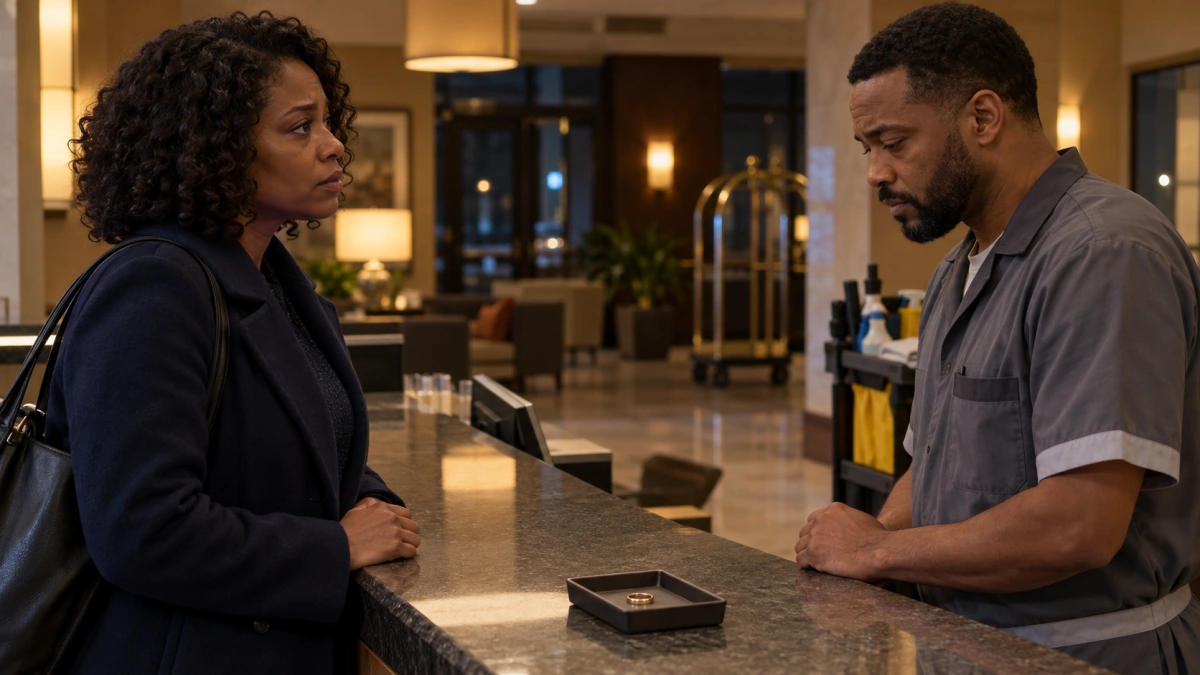
At reception, a small plain tray sat beside a stack of blank envelopes. His ring lay in it, the shallow scratch from our honeymoon catching the light. Then Miles came through a door behind the counter.
He wasn't wearing the charcoal suit he'd carried out of our bedroom the previous evening. He wore a gray housekeeping uniform. His close cropped hair was damp at the temples, and his short beard couldn't hide how tired he looked.
"Rowan," he said. "I thought you'd come later."
I looked from his uniform to the ring.
"Later than what?"
He reached toward the tray, stopped, and folded his hands.
"I need to tell you where I've been working."
Behind him, someone pushed a cart toward the elevators. Its wheels made a soft knocking sound over the seams in the tile. Miles stepped aside automatically so the woman steering it could pass. She nodded at him, then at me, and kept going. Whatever had happened to our marriage, her shift still had rooms left in it.
The receptionist slid the tray toward us. Her name tag said Denise. She addressed Miles, not me.
"You checked the staff desk already?"
"That's where I left it. Thank you for holding it."
"And for calling," I said. I heard the sharpness in my voice and made myself soften it. "I understand you were doing what he asked."
Denise nodded once. "He couldn't get his phone to turn on after the spill. We had your number on his contact form. He gave permission this morning."
Miles picked up the ring. There was a pale groove around his finger. He put it on and turned it until the scratch faced his palm.
"Can we sit?" he asked.
"Are you finished working?"
He glanced at the clock. "In twenty minutes."
"Then finish. I'm not asking somebody else to do your job so you can explain lying to me."
That sounded harder than I intended, but it was also true. He looked relieved and wounded at once. I took a chair near a potted plant and texted my clinic supervisor that I would be late. I handled appointments for a physical therapy practice. Moving someone else's morning required a reason. I wrote family problem and hated how much that phrase could conceal.
For twenty minutes I watched people leave with rolling bags and damp hair. A little boy dropped a mitten. His father went back for it without putting down the sleeping baby on his shoulder. I tried not to turn every ordinary kindness into evidence against my husband.
Miles returned wearing his own jacket over the uniform. He held a paper cup but didn't drink from it.
"I lost the job six weeks ago," he said.
I counted backward through dinners, laundry, a Sunday walk when he had complained about his manager. "Six?"
"The company cut the regional support team. There was a small severance payment. I thought I'd find something before you needed to know."
"Before I needed to know what was happening in my own home?"
He looked at the cup. "Yes. That's what I told myself."
He had worked in dispatch administration for a medical supply company. People assumed that meant he drove deliveries; he used to explain the scheduling software and the hospital contracts until their eyes wandered. I had listened because he was my husband, but I wondered now whether I had also enjoyed having an answer that sounded important.
"This job started three weeks ago," he continued. "Temporary nights. A guy from my old department knew they were hiring."
"And before that?"
"Library. Applications. Sometimes sitting in the car."
I thought of the packed lunches he'd brought home untouched. I had teased him about his terrible lunch meetings. He had laughed.
"The hotel charge?"
"Last Thursday's shift. Parking in the garage because I'd forgotten my staff parking pass again. I paid at the desk."
"So it was parking. Just not near your office."
"Right."
The precision made me angrier than an outright denial would have. He had built his lies from pieces that might survive inspection. I could picture him selecting each one while I heated soup.
"And the ring?"
"The glove caught on it. I took it off before cleaning a bathroom. Put it in my pocket, then left it at the staff desk when I changed gloves. I remembered after the shift supervisor found it. My phone got soaked when a bottle leaked in my bag."
"Why ask them to call me?"
He rubbed his forehead. "Because I couldn't lose the ring too. Because you pass here on the way to the clinic. I thought I'd change before you arrived. Tell you something about a client meeting."
He closed his eyes after saying it. A new lie, planned while an old one was waiting in a tray.
"There isn't somebody else," he said.
"You don't get to say that as if it settles everything."
"I know."
"No, you know what I found. You don't know what I spent three weeks imagining."
He set the untouched coffee down. I wanted him to argue, partly because I knew how to be angry at an argument. Instead he asked whether I wanted him to come home. The question frightened me. Our home had never been something either of us needed permission to enter.
"After you sleep somewhere safe," I said. "You're not driving behind me like that."
His car was in the staff lot. I offered to drive him. He accepted without calling it unnecessary, which was the first useful thing he had done all morning.
In my passenger seat his knees looked too large for the space. He was forty, only two years older than me, but exhaustion had changed the way he lowered himself into a chair. At a red light I saw a raw spot above his wrist where the glove ended. He followed my gaze and pulled down his sleeve.
"Don't," I said. "I'm not disgusted by your hands."
"I didn't say you were."
"You've been answering things I haven't said for six weeks. Maybe let me speak."
He nodded. We drove the rest of the way with the heater blowing too loudly.
At home I found the charcoal suit hanging behind the laundry room door. He had carried it out the previous evening in a garment bag and brought it back while I slept. Its sleeves were neatly arranged, almost tenderly. I couldn't stand the sight of it. I shut the door rather than throw it on the floor.
Miles slept in the bedroom. I went to work with his ring's little tray still visible every time I closed my eyes. My supervisor, Celia, asked if anyone was in the hospital. When I said no, she didn't require a competing tragedy to justify my lateness. She pointed at the schedule and said we could start there.
At lunch I checked our account. The balance was lower than I expected, but not mysteriously emptied. My direct deposit was there. His last company payment was there too, six weeks earlier, labeled in a way I had never bothered to examine. Two smaller hotel deposits followed. I had looked at the total often enough to tell myself I understood our money.
That didn't make his concealment my fault. It did mean I needed facts before inventing numbers to match my fear.
I sent him a message: Tonight. All accounts, all bills, all income. No summaries.
He replied after four: Yes. I have the paperwork.
Then another message: I'm sorry I made your morning happen that way.
I read it twice. It was not enough. It was at least about something he had actually done.
When I got home, the dining table held envelopes, his laptop, and a bowl of oranges. The oranges made me furious for no reasonable reason. He had arranged them in the center as though we were expecting company.
"Move the bowl," I said.
He did. We sat down.
The numbers were worse than his reassuring tone during the past month and better than my worst afternoon. We had rent, a car payment, utilities, groceries, and a credit card balance accumulated partly when our refrigerator failed. His severance had covered the missing wages for a while. It was not a continuing paycheck, and he had allowed me to mistake it for one.
The hotel wages covered less than his former salary. He had charged groceries and gas to his separate card to keep the shared checking account looking familiar. That balance was new debt, not money he had somehow saved us. He showed me the statement before I asked a second time.
"How much did you think you could hide?"
"Until I got hired."
"That's not an amount."
He looked at the screen. "I didn't have an amount."
There it was: not a plan, just a deadline he kept moving without telling me. Every application had become a lottery ticket for his escape from the conversation.
We listed the next month's obligations. I canceled a weekend trip we had discussed but hadn't booked. There was no refund to count because nothing had been purchased. Miles suggested selling the car. We needed to compare its remaining loan with what a sale might bring before calling that a solution.
"You don't have to punish yourself into sounding serious," I said.
He leaned back. "I don't know what serious sounds like right now."
"Try telling me something before I discover it."
He opened another tab. There were applications with dates, rejections, two interviews that hadn't led anywhere. I recognized a job posting I had sent him. He had thanked me and said he'd forward it to a friend. In fact, he'd applied for himself.
The shame on his face didn't make me want to comfort him. It made me tired. There would be time to feel for his humiliation. I was still trying to find a room inside this story where my own humiliation could sit.
"Did you tell anybody?"
"Darius."
His cousin. They watched basketball together on Sundays.
"He knew you were lying to me?"
"He told me to tell you. He offered to sit here while I did. I said that would make it worse."
I took my hands off the table. "You turned down help telling the truth."
"Yes."
I asked him to sleep in the living room. Not forever, not as a test he could pass with flowers. I needed one night when I didn't have to decide what his breathing beside me meant.
He folded a blanket over the couch and left for work at nine. At the door he said his shift ended at seven, with a possible delay if someone called out. I could have kissed him for the plain information. I could also have slammed the door. I did neither.
The next morning, he sent a photograph of his schedule. I answered that I didn't need a picture every day. A calendar we both could see would do. I wasn't volunteering to become the guard at the entrance to his life.
On Saturday we retrieved his car. Denise was at the desk again. I thanked her without making her a witness to our marriage. Miles asked whether she had found the owner of a missing blue scarf. They talked about the lost property shelf for half a minute. He knew where things went here. He belonged to a set of tasks, coworkers, small obligations. This was not a costume he had put on to fool me.
Outside, I asked why housekeeping had been harder to tell me about than unemployment.
He stood beside the car with the keys in his palm. "My father used to say he cleaned floors so I wouldn't have to. I heard that as an order instead of a wish."
His father had died before our wedding. I remembered the photograph of him in a school custodian's shirt, smiling with one hand on Miles's graduation gown.
"Your father wanted you to have choices," I said. "I don't think he wanted you to lie to your wife about a paycheck."
"No."
"And I have said stupid things too. About people who didn't move up. About being stuck. You heard me."
He looked at me then, fully. "I did."
It hurt to hear that. I didn't get to make his deception acceptable by finding something of mine to confess. But I could refuse to pretend my own assumptions were harmless.
"I need to change how I talk," I said. "You still needed to tell me."
"I know. Both are true."
That afternoon my sister called to ask whether we were still coming to dinner. I almost said Miles had a meeting. The lie arrived in my mouth already shaped by habit, and I hated him briefly for putting it there.
"He's working nights at a hotel," I said. "His old position ended. We need to figure out sleep before we make plans."
I didn't tell her about the ring or my drive through the dark. Those belonged to me, and I wasn't ready to hand them around.
She said she could pack us food. I started to refuse, then asked whether she could leave out the peppers because Miles's stomach had been bothering him. Practical kindness was easier to accept when it had instructions.
Miles heard the end of the call from the hallway. "You told her?"
"That you're working. Not everything. I won't invent an office for you."
He rubbed the back of his neck. For a moment I thought he would accuse me of embarrassing him. Instead he said, "Okay. Thank you for not telling her everything."
The first week was clumsy. I moved around the kitchen quietly while he slept, then resented the quiet as though sleep were another privilege he'd taken. He washed dishes at midnight on his night off and woke me. We snapped over a pan, apologized badly, and tried again in daylight.
On Wednesday I found him searching for the folder with our lease. He said he'd put it somewhere safe before the budget conversation and couldn't remember where. My body reacted before my judgment did. I heard myself ask what else was in the folder.
"Just the lease," he said, too sharply.
"That's what you said about the parking. Just parking."
He stopped opening drawers. "You're right. I'll look with you."
We found it under the printer. It held exactly what he said. I didn't feel victorious. I felt how expensive a lie could be after the facts were all out, charging interest in ordinary rooms.
We made an appointment with a counselor whose reduced fee we could manage. The appointment was not a promise that we would stay married. I told Miles that before we went, because I didn't want participation mistaken for an acquittal.
In the waiting room he held a clipboard on his knee. His wedding ring tapped the metal clip each time he changed his grip. I stared at a framed photograph of a lake and considered leaving. Not because counseling frightened me, but because arriving together looked so much like agreement.
Inside, the counselor asked what each of us wanted from the hour.
"I want her to trust me again," Miles said.
"I want him to stop making trust something I owe him because he's scared," I said.
He looked down. The counselor didn't rush to soften my sentence. She asked him what telling me earlier would have risked.
"That she'd look at me differently."
"And what did hiding it risk?"
He took a breath. "That she wouldn't know who she was looking at."
I cried then, unexpectedly and without grace. It wasn't the neat answer. It was that for once he had described my loss instead of his fear.
Driving home, we bought sandwiches with the grocery cash we had set aside for that day. There was no money for an expensive reconciliation dinner, and I didn't want one. We sat on a bench near the harbor with our coats zipped up.
"I'm sorry I let you think there was someone else," he said. "You asked me directly why I kept leaving. I made you feel unreasonable for noticing. That was cruel."
I remembered his weary laugh when I had asked whether he even wanted to be home. He'd said I watched too many television dramas. At the time I had apologized.
"You let me apologize to you."
"Yes."
The water beyond him looked like dull sheet metal. I held my sandwich untouched until the bread cooled against my fingers.
"I need that part to matter even if your reason was fear."
"It matters."
This time he didn't ask what he could do to make the afternoon end happily. We ate. A gull stalked the bench with insulting confidence. When it stole a crust, I laughed once, almost against my will. Miles smiled but didn't treat the laugh as permission to touch me.
Two weeks later an interview came through for a scheduling position at a smaller distributor. Miles told me before replying. We checked the hours against his hotel shift so he wouldn't arrive without sleep. He asked his supervisor about a shift exchange instead of pretending to have a medical emergency.
He didn't get the job. The email arrived while I was folding towels.
"They went with someone else," he said from the doorway.
He looked so disappointed that I wanted to manufacture hope. Instead I put down the towel. "Do you want company or space?"
"Company. Not advice yet."
We sat on the floor with the laundry between us. He talked about the interview question he'd answered poorly. After a while he said he would ask a former colleague to practice with him. I didn't have to turn myself into his recruiter to prove I believed in him.
The next hotel paycheck arrived on Friday. He transferred his agreed share to the household account and left a small amount for gas and meals. We had decided the amount together. We also set aside a modest payment toward the separate card. Paying it reduced debt; it did not erase what had been charged, and we stopped speaking about available credit as though it were savings.
Our life became smaller in visible ways. We borrowed movies instead of renewing another subscription. I took my lunch more often. Miles gave up an expensive sports package and complained about the radio announcer as if the man had personally designed our budget. One night his complaint made me laugh hard enough to spill rice. For several seconds we were only ourselves, not two people tending a damaged marriage.
Then my phone rang and he flinched. A hotel number still meant something different to both of us. It was a spam call from somewhere else entirely. We didn't pretend the moment hadn't happened.
On his next day off, Miles asked if he could show me the walk he took after applications. I expected a park. He drove us to the public library and parked beneath a tree dropping little yellow leaves onto the windshield.
"I sat here after the first interview," he said. "I thought if I waited until traffic got bad, getting home late would look normal."
I looked at the building's broad windows. People inside were doing homework, checking email, warming their hands around paper cups. He had made the library into a hiding place when it could have been a place to start again.
"Did you ever type a message?"
He nodded. "Three times."
"What did it say?"
"I need to tell you something."
We sat with those seven words. They were so ordinary. They would have changed everything if he'd sent them.
Inside, he showed me the desk where he'd worked. We didn't reenact anything. I picked up a novel I had been meaning to read. He asked a librarian about a job search workshop and wrote the date on his phone. His replacement phone was used, with a case that didn't quite fit. It rang loudly in the quiet and made him jump. I touched his elbow before I could think about whether we were touching again.
That evening he moved the garment bag from behind the laundry door. I watched him hang the suit in the bedroom closet where it had always belonged. He left the gray uniform beside it, clean and ready for the next shift.
"I don't need a ceremony," I said.
"Neither do I. I need to find my clothes in the morning."
It was a small joke, and a better answer than a speech. We made supper. He chopped carrots while I browned chicken. At the sink he removed his ring and put it in a little dish we used for keys.
My chest tightened before I could stop it.
He noticed. "Chicken on my hands. I'll put it back after I wash."
"You don't have to narrate every movement."
"I know. This one seemed worth explaining."
He washed, dried his hands, and put the ring back on. The movement didn't fix anything by itself. But it happened in front of me, without an invented meeting waiting behind it.
We were not back to normal. Some evenings I wanted the bedroom to myself. Some mornings he mistook my quiet for accusation, and I had to decide whether to reassure him or let him carry his own discomfort. We were learning the difference between sharing a burden and handing it back to the person already hurt.
There was another conversation we had been avoiding. His mother had invited us to Sunday lunch, and Miles had answered for both of us before checking whether I wanted to go. I saw the message on our shared calendar and felt the old anger return in an unexpectedly fresh shape.
"You told her we'd be there?"
"It's just lunch."
He heard himself. I watched him stop beside the refrigerator, one hand still around the handle.
"Sorry. It isn't just lunch if I decide for you."
I wanted to stay home. I also wanted to see his mother, who had mailed me a ridiculous birthday card every year since we started dating. Missing her felt like another loss charged to the account of his silence. I said I would come for an hour, and he could stay longer if he arranged his own ride.
His mother opened the door wearing slippers and carrying a wooden spoon. She asked about my clinic, then told Miles there were leftovers he could take to the office. His face changed. I reached for the dish towel beside the sink, giving my hands something to do while he chose.
"I'm not at the office anymore," he said. "They laid me off. I'm working nights at a hotel while I look."
She put the spoon down. "When did that happen?"
"Six weeks before Rowan found out."
I hadn't expected him to include that. His mother looked at me, and I shook my head slightly. I would not explain him while he stood there.
"You didn't tell your wife?"
"No. That was wrong. We're dealing with it."
She sat at the table. For a moment I feared a family speech about standing by a man during hard times. Instead she asked whether his shoes were comfortable enough for the work. He said they were, mostly. She told him his father had ruined his knees wearing shoes until the soles were crooked.
"Don't do that part like him," she said.
We ate chicken and green beans. She didn't ask how much he earned or tell me I was lucky he wasn't doing something worse. When Miles went to refill the water pitcher, she touched my sleeve.
"You can be mad here," she said quietly. "You don't have to keep my lunch pleasant."
My throat closed so abruptly that I could only nod. I had spent the whole morning preparing not to embarrass her. She had noticed the effort and given it back to me.
We stayed fifty minutes. On the drive home Miles said he had almost told his mother that everything was fine. The phrase was his favorite little trapdoor. He could drop an entire room of trouble through it and stand smiling above the empty space.
"What stopped you?" I asked.
"You were standing there. I didn't want to make you disappear again."
I watched a bus pull away from the curb. His answer mattered more to me than the lunch, though I didn't know how to tell him without making it sound like praise for the minimum.
"Keep doing that," I said eventually.
Later that week his supervisor offered an extra overnight shift. He wanted the money. I wanted him awake for the appointment we had made to review the car loan. Both needs were real, which made it harder than our earlier arguments, when one of us had simply hidden the facts.
We sat with the schedule instead of raising our voices across separate rooms. The appointment could move, but not indefinitely. The additional pay would help with the new card balance. Sleep had to go somewhere, not merely disappear between boxes on a calendar.
He called the lender to ask what information we needed for an accurate payoff figure. I rescheduled the appointment for his next afternoon off. He accepted the extra shift after we had done both things. There was nothing romantic about the sequence. I trusted it more because neither of us tried to make it romantic.
When he came home after that shift, he found me at the table repairing the torn lining of my coat. I had been putting it off for months because buying another coat sounded easier. Now I had a needle between my teeth and a small pile of uneven stitches across my lap.
"My mother would do that better," he said.
"Your mother is asleep."
He sat down, smiling. "She would still do it better."
I handed him the scissors. He trimmed the loose threads while I finished. Then he asked if I wanted breakfast. I said I wanted him to take a shower first because the cleaning solution smell was giving me a headache.
He stood without looking injured. I realized how often I had softened ordinary requests lately, afraid that any discomfort might push him back into hiding. That was work I couldn't keep doing. He needed to survive being told he smelled like his job without hearing a verdict on his worth.
When he returned, his hair was wet and his own shirt was buttoned crookedly. He cooked eggs while I put the coat away. We ate at opposite ends of the table because the sewing things still occupied the middle. He asked about a patient who always arrived an hour early and brought newspaper puzzles for the waiting room.
I told him the man had finished a whole puzzle without his glasses and accused the newspaper of making them easier. Miles laughed. Then he asked another question, one that wasn't about our finances or his guilt. I had missed being interesting to him for reasons that weren't an emergency.
Before he went to bed, I asked whether he wanted the curtains closed. He said yes, please. I closed them. It was such an ordinary kindness that I nearly cried again, but this time I didn't need him to see it. I could keep something for myself without making it a secret that endangered us. Outside, a truck backed toward the neighboring building, and he fell asleep before its warning beeps stopped.
At the end of the month we paid rent on time. There wasn't much left. I stared at the balance until Miles asked whether I wanted to walk to the corner store for milk. I said yes, then put on the navy coat I had worn to the hotel.
Outside, the air smelled of rain and somebody's burned toast. He offered his hand. I looked at it, the raw place on his wrist nearly healed, the familiar ring turned a little sideways.
I took it because I wanted to, not because the numbers were settled or because fear had become an excuse. At the crossing, he told me his next shift had changed. Thursday instead of Wednesday. He had already marked the calendar, but he wanted to say it aloud.
"Thanks," I said.
At the store, he reached for the larger carton, then checked the date. We would finish it before it spoiled. I picked up bread and put back the expensive jam, not silently, but with a complaint about how much it cost now. He agreed. The cashier asked whether we needed a bag. Miles looked at me, and I pulled the folded one from my pocket. Its handle had a knot in it from the last time we'd carried too much. He took one side. I took the other outside again.
The light changed. We crossed together, carrying no promise larger than the truth he had just told me and the milk we still needed to bring home.
Read next
The Dress With the Tags Still On

A Table for Three

The Speech He Rehearsed

My Fiancé Asked Me to Hide My Son During His Mother’s Visit—Then I Found the School Form He Had Already Filled Out
Reading notes
A hotel callback reveals a husband’s hidden job loss and a different betrayal from the one his wife expected.
This is an original work of fiction. Characters and events are fictional. Explore public-domain books at Project Gutenberg or browse more stories on ReadStoryvia.