Original fiction
On this page
The Dress With the Tags Still On
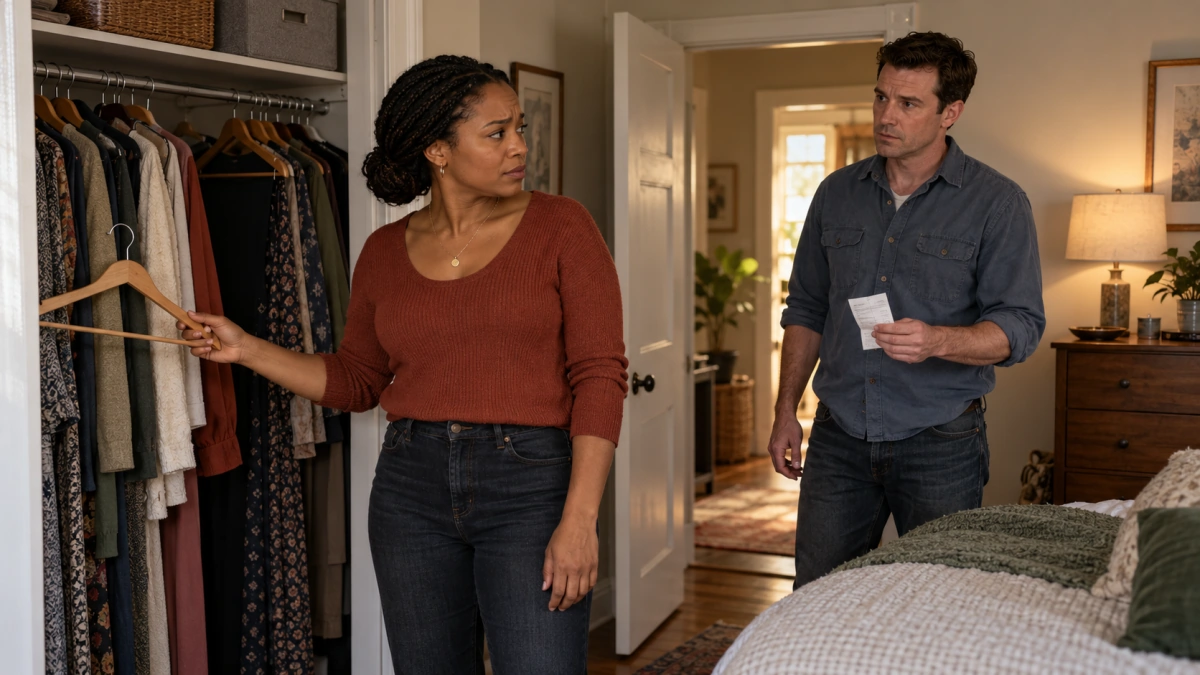
Leah found the empty hanger before she found the receipt.
The dress had hung between her winter coat and the blouse with the loose cuff button, dark teal, sleeves long enough for an overcooled conference room. She had left its tags on because her payroll training did not begin until Monday. Buying something specifically for the first morning had felt extravagant, even after she checked their budget twice.
Now the hanger knocked against the closet rail in her hand.
Owen stood in the bedroom doorway wearing his faded blue work shirt. He looked at the hanger, then at her rust-colored sweater, as if either object might suggest a better beginning.
"I returned it," he said.
Their Columbus apartment was quiet except for the neighbor's vacuum cleaner coming through the wall.
"You went into my closet?"
"It still had the tags. You hadn't worn it."
"I hadn't gone to the training yet."
He took a folded receipt from his pocket. Leah reached for it, expecting the amount she already knew: eighty-nine dollars and tax. Instead she noticed the last four digits beside the refund. They belonged to neither the household card nor the account where she kept her small personal allowance.
"Whose card is this?"
Owen rubbed his thumb along the doorframe.
"Mine."
"I paid with our card."
"I know. They let me put the refund there because I didn't bring it."
She looked at him until he stopped studying the floor.
"There's a balance," he said. "I needed to get it down."
Leah set the hanger on the bed.
"How much?"
He gave her a number. Then, before she could speak, he added, "And I canceled Monday. We couldn't afford you being gone."
The number was seven thousand four hundred and sixty dollars. Leah repeated it, not because she hadn't heard but because she needed Owen to hear it outside his own mouth. He nodded. The receipt in her hand had softened along its folds.
"Canceled what?"
"The training. Your registration."
"You called them?"
"I used the confirmation email on the laptop. There was a link."
Their shared laptop sat on the kitchen table, where she had finished her application after dinner three weeks earlier. She had asked Owen to read it for typos. He had said the program sounded useful. She remembered how pleased she had been that he understood why she wanted it.
"Did you pretend to be me?"
"I just filled out the form."
"With my name."
He looked away. "Yes."
Leah's hair was pulled into its usual low braided bun, and a pin had begun to press against her scalp. She removed it carefully. There were limits to how many kinds of discomfort she could manage at once.
The training was a weeklong introductory payroll course offered through a local workforce partnership. It would not turn her into a specialist by Friday. It would give her structured practice and a way to apply for additional responsibilities at the medical supply office where she worked as an administrative assistant. Her manager had approved leave, but not paid the fee. Leah had saved for months.
"When did you cancel?"
"Yesterday."
She picked up her phone and searched for the confirmation. The cancellation notice was in the email archive rather than the inbox. She stared at the small word until it stopped looking like a computer feature and began looking like a decision someone had made about her.
"You hid this too."
"I thought we'd talk tonight."
"After the office closed. After you returned the dress."
"I panicked."
Leah put the phone down before she threw it. "Then sit in another room while I find out what you did."
He remained in the doorway for a moment, perhaps waiting for a softer instruction. She did not give one. When he moved, she closed the bedroom door without slamming it. The restraint was for herself, not for him.
The program office had closed at four. Its automated message listed an email address for registration questions. Leah wrote that a cancellation had been submitted without her permission and asked whether her place could be restored. She did not invent an emergency. She did not explain her marriage to a stranger who could only answer a scheduling question.
Then she checked the refund policy. The full refund deadline had passed. Part of her fee would return to the original payment method; the nonrefundable remainder remained transferable credit. The next session was months away. She reread the page, hoping ordinary words might rearrange themselves into a less expensive result.
Owen knocked. "Can I bring you water?"
"No. Bring the statements. All of them."
At the kitchen table, he opened the account on his phone. She asked for a larger screen. He used the laptop, turning it toward her. The balance was real, the limit nearly reached. Several minimum payments had come from their household account under transfers she had assumed were reimbursements for work supplies.
He had opened the card fourteen months earlier, after the transmission repair. His hours at the appliance service company had dropped soon afterward. They had discussed the reduction, but he had told her he could make up most of it with extra appointments. Sometimes he had. Other weeks, he had put groceries and gasoline on the card and said nothing.
There was no second household, no hidden vacation, no gambling site waiting to explain everything in a single dramatic line. There were car parts, a dental bill, supermarket purchases, late charges, interest, and a replacement phone he needed for work. There were also takeout meals and hardware purchases he could not honestly call necessary.
"Why didn't you tell me when it started?"
"You were already worried about rent."
"So you made the situation worse where I couldn't see it."
"I thought I'd catch up."
"For fourteen months?"
He closed his eyes. She waited for him to open them. She would not conduct the conversation with a man retreating behind his own shame.
They had a shared budget on a spreadsheet, updated more faithfully by Leah than Owen. It included small personal allowances for both of them. She had bought the dress with hers, after setting aside the training money separately. The household had still been contributing to her savings because they had agreed the course was worthwhile. That did not mean every dollar belonged to a private island. It meant they had made a decision together, and he had changed it alone.
"We might really need to change the plan," she said. "But you don't get to change it by erasing my name from a class."
"I thought the dress was something we could give up."
"You thought I was something you could edit without asking."
He flinched. She did not apologize for the accuracy.
They stopped after an hour because neither was listening well anymore. Leah took photographs of the statements with his knowledge and asked him not to use the card again. He agreed. She moved her documents into a folder with a password he did not know. This was not a declaration that they would never share anything again. It was a boundary around things he had already shown he might alter.
That night, she slept in the bedroom. Owen used the couch. She heard him turn the television on, then off. For a moment she wanted to go out and tell him she knew he was scared. She stayed where she was. His fear had been recognized often enough to become an excuse; hers had not yet had a room.
On Friday morning, the program coordinator replied. Leah's seat had already been offered to someone on the waiting list, who had accepted. The coordinator could not displace that person. She would put Leah first on the cancellation list and explain options for a later session.
Leah read the message at her desk before the office opened. A delivery driver asked where to leave three boxes of filters. She pointed him toward the stockroom and realized she could still answer ordinary questions while something inside her felt newly broken. There was no requirement that the room notice.
She asked her manager, Denise, for ten minutes. Explaining the canceled training felt humiliating in a way discovering the debt had not. Debt was arithmetic. This explanation required saying that someone had overridden her.
Denise listened without asking for details Leah did not offer. The approved leave could be withdrawn, and Leah could work the coming week. Any later leave would need a new request. Denise would support it if coverage allowed, but could not guarantee dates months in advance.
"I don't want you to think I wasn't serious," Leah said.
"I think something happened," Denise replied. "Tell me the next dates when you have them."
The kindness was measured and practical. Leah returned to her desk grateful that her manager had not promised what she could not control.
At lunch, she called the store. The teal dress in her size had sold that morning. The associate remembered it because there had been a question about the refund. Leah did not ask anyone to reverse a completed sale. She thanked the woman and hung up, surprised by how much the missing dress still hurt when the larger loss was so obvious.
It had been more than fabric, but it had also been fabric. She liked the color. She liked sleeves that did not pull across her shoulders. She did not want to turn it into a sacred symbol in order to justify being angry that it was gone.
Owen texted that he would buy another when they could. She answered: Don't replace what you took before we discuss why you thought you could take it.
That evening, they worked through the household budget with paper statements and a notebook. Leah refused to do all the calculations while Owen supplied regret. He listed the card transactions, identified the automatic payments, and wrote down the actual average of his last three months of pay. It was lower than the number in their spreadsheet.
"I didn't want you to feel like you were carrying me," he said.
"You let me make decisions with money we didn't have. That's not protecting me from carrying something. It's taking away the handles."
They found expenses they could reduce: a subscription neither used, takeout ordered when both were tired, a storage unit containing furniture they had postponed sorting. None of it erased the debt. The car repair had happened. Rent was still due. Interest would not become sentimental because they were finally honest.
Owen suggested she skip the later training until they were clear. She looked up from the notebook.
"That is the same decision again."
"I'm asking this time."
"You're asking me to make my future the first thing we remove. What are you changing?"
He began to mention more appointments. She asked what appointments existed, not what work he hoped to find. He admitted he could not count on extra hours. They crossed the imagined income out of the plan.
After that, the conversation grew slower and more useful. He would sell the unused tools he had bought for a side business that never became regular work. She would review their grocery spending with him, not for him. They would empty the storage unit together over two weekends. Both personal allowances would shrink equally, but neither would become subject to the other's permission.
For shared bills, they would keep the joint account. For discretionary money, they would use separate accounts, each visible in the budget only as an agreed amount. The debt would be listed plainly rather than hidden in vague transfers. They would make no new borrowing decisions without discussion. Leah insisted on a small emergency reserve before every spare dollar went to the card. One flat tire should not restart the same secrecy.
"Do you trust me with any of this?" Owen asked.
"Not automatically. That's why the plan needs to work without automatic trust."
He nodded, unhappy but listening.
On Saturday, Leah called her friend Tasha and asked to borrow the black blazer she had worn to a job interview. If a seat opened on Monday, Leah intended to attend in trousers and a blouse she already owned. Tasha offered to lend her a dress too. Leah thanked her and declined. She wanted something that fit, not a replacement ceremony.
Tasha arrived with the blazer and sandwiches. Owen was out getting an estimate for the car's slow tire leak. Leah told her about the debt, the cancellation, and the receipt.
"Do you want to stay with me?" Tasha asked.
"Not tonight. Maybe later. I want to know I can ask."
"You can."
They ate without deciding what kind of marriage this would become. Tasha did not call Owen a monster. She did not remind Leah that he had been good to her in other ways. Both omissions were a relief.
No seat opened. On Monday, Leah went to work in the rust sweater she had worn when she found the hanger. Around nine, she imagined the class beginning without her. She allowed herself ten minutes in the supply room at lunch, then washed her face and returned to the front desk.
That evening, Owen asked whether work had distracted her.
"I didn't need distraction. I needed to be in the class."
He sat down across from her. "I'm sorry."
"I know you're sorry. I don't know yet what you do after being sorry."
The answer began with unglamorous work. He contacted the card company to ask what repayment arrangements were available, writing down what they actually offered instead of guessing. Leah sat nearby for part of the call because the household needed accurate information, but she did not take over when he became embarrassed. They compared the figures afterward and chose a payment they could sustain while continuing to cover essentials.
It was not a favorable bargain discovered at the perfect moment. The balance remained large, and the timeline discouraged them both. Still, it was a real timeline rather than Owen's recurring promise that next month would be different.
He also called the training office, at Leah's request, to acknowledge that he had submitted the cancellation without her consent. She did not expect the call to restore her seat. She wanted the record corrected without having to prove her own account alone. The coordinator accepted the information and repeated the available options. Nobody delivered a speech about what kind of husband he should be.
At their first weekly budget meeting, Owen arrived with coffee and a carefully arranged pile of bills. Leah appreciated the preparation and disliked how much he seemed to hope she would appreciate it. She said thank you for the coffee and asked about the missing gas statement. He fetched it without explaining how busy he had been.
By the third meeting, the coffee had become ordinary. That was better. They could talk about a late invoice without making it a referendum on whether he had transformed. Leah wanted a husband who could find a statement, not a weekly demonstration of a husband finding one.
Emptying the storage unit was harder. Inside were chairs from Owen's father, a boxed exercise machine, and two shelves they had intended to refinish. His father was alive, living in a smaller apartment across town. Keeping the chairs had allowed Owen to imagine he was preserving something his father needed preserved.
Leah asked him to call and find out. His father said he had never liked those chairs. They sold them for less than Owen expected, enough to cover part of a payment but not enough to turn the afternoon into a triumph.
The exercise machine went to a neighbor who could move it himself. They kept one shelf and donated the other. When the unit was empty, Leah swept it while Owen checked the agreement about ending the rental. Neither spoke for several minutes. They were tired and cold, and honesty had not made furniture lighter.
On the drive home, he said he had thought needing the card meant he had failed at being a husband.
"Needing help wasn't the failure," she said. "Deciding I couldn't be trusted with the truth was."
He kept his eyes on the road. "I thought you'd be disappointed."
"I would have been worried. Maybe disappointed too. I was allowed to have a feeling without you managing it out of existence."
He nodded. She looked out at the strip malls passing in the rain. She did not want a marriage where every hard truth arrived only after the evidence fell out of a pocket.
In November, the program coordinator sent the dates for the next training. February. Leah printed the message and put it beside the budget notebook. The nonrefundable credit from her canceled registration could be applied, but there would still be an amount to pay. They had to decide whether to commit before all the debt was gone.
This time, Owen did not begin with no. They calculated the cost, including transportation and the wages she would lose if some leave was unpaid. Denise had not promised coverage yet. Leah asked her, got approval for the dates with one unpaid day, and brought the actual figure home.
There was room in the revised budget if they continued the reduced spending and nothing major changed. Nothing major changing was not a guarantee. They agreed what they would revisit if it did: nonessential purchases first, payment timing where possible, then a conversation about training. Not a secret cancellation. Not a decision made while one person was at work.
Leah registered herself. She used her own email login and saved the confirmation somewhere Owen could not access. He watched her close the laptop.
"I hate that you have to do that," he said.
"I hate that I learned I had to."
He accepted the distinction without asking when the password would become shared again.
The course did not solve her career before she attended it. Denise explained that additional payroll tasks would depend on accuracy, staffing needs, and what Leah could demonstrate afterward. There was no guaranteed promotion. Leah was disappointed for an afternoon, then grateful to have expectations she could actually plan around. She had not saved for a magical new life. She had saved for a chance to become more capable.
On a quiet afternoon at work, Denise showed her a blank practice sheet, without employee information. Leah could work through the sample before the course if she wanted. It was not an extra assignment and would not count as a qualification. Leah took it home folded inside a library book. After dinner, she spread it on the table and discovered that wanting to learn something did not make the first attempt comfortable. She confused two columns, erased a total, and started again.
Owen asked whether she wanted help. She said she wanted quiet. He moved to the living room and lowered the television. Twenty minutes later, she called him back to check an ordinary addition problem, not the payroll instructions. He checked it, found her missing line, and left the paper where she had placed it. The small exchange should not have felt significant. She noticed anyway that he had helped with the thing she requested rather than taking ownership of the whole task.
At the next budget meeting, she asked him to explain the return itself. They had discussed the money repeatedly, but not the moment he had taken something from her closet.
He said he had seen the tags while putting away a clean shirt. He had thought of the minimum payment, then of the dress as money waiting to be recovered. He had not imagined her reaching for it on Monday. Saying that made him stop.
"I didn't think past getting through that afternoon," he said.
"I need you to learn to think about the person who comes after your relief."
He looked at the notebook. "You."
"Usually. Sometimes both of us."
She asked him to replace the money he had diverted from her allowance as part of their written plan. Not that night, when doing so would only move a shortage into groceries, but through smaller transfers from his own reduced spending over the coming months. The debt was a household reality they were confronting together. The return was a specific decision he had made about something she owned. She wanted them to recognize the difference.
He agreed, then asked whether that meant the dress could eventually be forgotten.
"It means I won't have paid for you taking it," she said. "It doesn't purchase an ending."
They wrote the amount beside the other figures. Leah felt no pleasure in seeing it there. She felt the relief of not having to turn every boundary into a metaphor before it could be respected. Sometimes eighty-nine dollars and tax was simply an amount that needed to come back.
Later, she told Tasha about the conversation. Her friend asked whether Owen understood. Leah said she thought he understood the amount. Understanding the rest would have to show up somewhere other than his answer at the table. Tasha nodded and changed the subject to a broken zipper on a coat. Leah helped her compare repair options, glad to be useful in a problem that did not describe her marriage.
That night, Owen left the practice sheet untouched when he cleared dinner. He asked where she wanted it. She pointed to the shelf, and he put it there. She knew that one careful evening could not settle anything. But she also knew what an incautious evening could take away. The difference was not grand enough for an announcement. It was worth observing, and she did, without turning observation into a promise about the future.
December tested the budget with gifts they could not afford and invitations that assumed they could. Owen told his sister they would not join the family weekend at a rental cabin. He started to say Leah was focused on saving for school, then stopped himself while she stood beside him.
"We have debt we're paying down," he said. "The trip doesn't fit."
After the call, Leah asked why he had almost used her training as the explanation.
"Because it sounded better than debt."
"For you."
"Yes."
She did not reward the correction by saying the first instinct didn't matter. It mattered that he had nearly made her ambition the inconvenient thing again. It also mattered that he had stopped. Both facts went into the work ahead.
For Christmas, they agreed to exchange no purchased gifts. Owen wrote her a letter. She read it alone. It named the dress, the card, and the canceled registration without calling any of them an unfortunate misunderstanding. Near the end, he wrote that he hoped she could forgive him soon.
Leah put the letter on the table and asked him what soon meant.
He looked confused, then embarrassed. "I don't know."
"I think you want me to make the waiting easier."
"I do."
"I can't promise that."
He took the letter back only long enough to cross out the sentence. The crossing out did not remove the wish. It did show that he could recognize a request she was not obliged to grant. She kept the letter in her drawer without treating it as a receipt for repair.
In January, his hours increased slightly, not enough to make the debt small. He told Leah the new schedule before the first paycheck arrived. They put part of the additional income toward the card and part into the emergency reserve. There was no argument about whether the increase entitled either of them to a reward. They were both relieved, and neither mistook relief for being finished.
Then a water bill arrived higher than expected. Owen opened it at the kitchen table and stared too long. Leah saw the old calculation cross his face: say nothing, solve it later, protect the evening.
"What is it?" she asked.
He handed it over. They checked the dates and realized the amount covered a longer period than they had entered in the spreadsheet. It was not a catastrophe. The important part was that he had given her the paper while the problem was still ordinary.
Afterward, Leah admitted she sometimes checked the joint account twice a day. She hated how surveillance had begun to feel like prudence.
One evening, she had opened it while waiting for the kettle, although she had checked only an hour earlier. There had been nothing new. She had stood in the kitchen feeling foolish, then angry that foolishness had become another thing to manage. Telling Owen this was harder than asking for statements.
It required exposing the continuing effect of his choices without knowing whether he would receive it as information or accusation. This time, he did not explain that he had already apologized. He listened until she finished and asked what arrangement would reduce the work rather than merely reassure him about himself.
"Would it help if I sent you everything?" he asked.
"For a while. But I don't want monitoring you to become my second job."
They agreed on a weekly summary that he would prepare, with both retaining access to the source statements. Leah could check them whenever she chose. She was not required to check them to make his honesty count.
She also told him there were evenings when she did not want to sit close on the couch, even if the day's budget conversation had gone well. He looked hurt. She let him look hurt without changing her answer. They could not rebuild consent by limiting it to purchases.
A week before the training, Tasha brought the blazer back after having its loose button repaired. Leah protested that it was still Tasha's blazer. Her friend said she knew, and that was why she wanted it returned in decent shape. They laughed. Borrowing something with an understood ending felt unexpectedly reassuring.
Leah tried it on over a cream blouse and dark trousers. The outfit was ordinary, suitable, and already available. For a moment she pictured the teal dress, how the skirt had moved when she turned before the fitting room mirror. She allowed herself to miss it without changing clothes again.
Owen came to the bedroom doorway but did not enter until she said he could. He asked whether she needed the car all week. They compared schedules. He could take the bus two days and arrange his appointments differently on another. It was inconvenient. He did not call the inconvenience a sacrifice.
On Sunday evening, Leah laid out her notebook, lunch container, and registration confirmation. Owen asked whether she wanted him to pack lunch. She said she preferred to do it herself, but he could finish the laundry and make sure the household bills were ready for their next meeting. He said okay.
The next morning, she woke before the alarm. The apartment was still dark. She dressed quietly and checked the route once more. Owen came into the kitchen while she was pouring coffee.
"I hope it's useful," he said.
"Me too."
He did not say he was proud of her in a way that made attendance sound like his permission. He did not ask her to reassure him that they were all right. He handed her the car keys from the hook and moved his lunch bag out of the way.
At the training room, Leah found a seat near the middle. The woman beside her introduced herself and asked where she worked. Leah answered without mentioning the lost place in October, the returned dress, or the card balance written in a notebook at home. Those things were part of how she had arrived, not the only things anyone needed to know about her.
The instructor began with a sample timesheet. Leah opened her notebook. Her hand shook slightly when she wrote the date, then steadied as the first explanation became a task she could follow. There would be mistakes. There would be corrections. She could ask questions before pretending to understand.
At lunch, Owen sent a photograph of the laundry folded on the bed, then immediately followed it with a message: You don't need to respond. Bills are ready for Thursday.
Leah looked at the picture for a moment. She did not send praise for clean towels. She wrote that the class was going well and put the phone away.
That evening, they ate leftovers at the kitchen table. She told him about an exercise she had found difficult and the satisfaction of getting it right on a second try. He listened. When he asked whether the course might lead to more work, she said perhaps, but she wanted to finish the week before predicting anything.
The debt was still there. The balance had decreased, slowly, and the emergency reserve was modest. Their separate allowances remained separate. Leah still kept her own password. Owen still slept on the couch some nights when she needed space, and they had not agreed on a date when that would stop being necessary.
After dinner, she hung the borrowed blazer beside her coat. The wooden hanger from the dress lay on the closet shelf. She had considered throwing it away, then decided it was only a hanger. It did not have to become either evidence or a lesson. She used it for the blouse she would wear on Tuesday.
From the kitchen, Owen asked whether Thursday at seven still worked for the budget meeting.
Leah checked her calendar. "Seven thirty. I want time to get home."
"Seven thirty," he said.
She closed the closet and returned to her notebook. There was homework to finish, work she had chosen and could now do. In the next room, Owen began washing the dishes without announcing it. The ordinary sound did not erase what had happened. It gave the evening something useful to hold while tomorrow remained, finally, a day she had not been canceled out of.
Read next

A Table for Three

The Speech He Rehearsed

The Unsigned Card

My Fiancé Asked Me to Hide My Son During His Mother’s Visit—Then I Found the School Form He Had Already Filled Out
Reading notes
A returned dress reveals debt, canceled training and decisions a husband made about his wife’s future.
This is an original work of fiction. Characters and events are fictional. Explore public-domain books at Project Gutenberg or browse more stories on ReadStoryvia.