Original fiction
On this page
The Car Behind the Restaurant
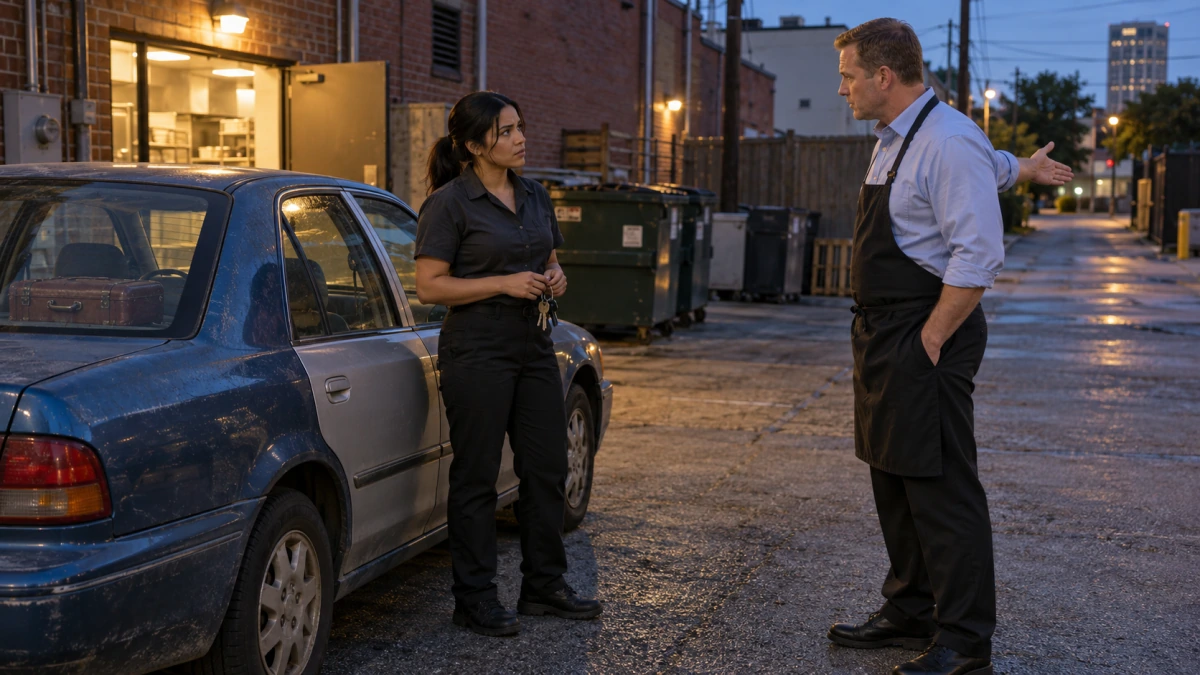
Grant Bell waited until Elena Ruiz had locked her car before telling her it could not stay behind the restaurant.
"We're trying to present a different image," he said.
Elena looked at her faded blue sedan, then at the grease barrels beside the service door. The passenger door was silver because a matching replacement had cost more than she could spare. The engine ran. The lights worked. Nothing leaked onto the cracked Richmond pavement.
"It's behind the building," she said.
"Guests can see it from the patio entrance."
She held her keys between two fingers. Through the rear window she could see her mother's brown sewing case. Rosa had asked for a ride after finishing a curtain repair nearby. Elena would collect her after the dinner shift; until then, the tools were safer locked inside than carried through a crowded kitchen.
Grant, clean shaven in a pale blue shirt and dark apron, gestured toward the alley. "Use the overflow lot tomorrow. Tonight we're already late."
Elena went inside. The staff board still showed the parking instruction she had followed for nineteen months: rear spaces after four, leave the loading area clear. Her car occupied the farthest marked space, nowhere near a delivery door.
At ten seventeen, a dishwasher came looking for her. He had seen a truck pulling a blue car out of the lot.
Grant reached for a folder instead of his phone. "The rule changed this afternoon. There was a notice."
"You just told me tomorrow."
"I meant the overflow arrangement."
Elena walked outside. The empty space seemed smaller without her car in it. A new sign stood near the gate, turned toward arriving drivers, where she would not have passed it on her way into work.
Her mother called then. Elena answered before Rosa could ask where she was.
"Don't leave the library steps," she said. "I'm finding out where they took your tools."
The woman at the towing office answered in a voice that suggested she had already explained the same thing all evening. Elena gave her plate number twice. Yes, the car was there. No, the woman could not tell her what agreement the restaurant had made. Retrieval required the usual identification and ownership information, and payment before release. The office would remain open another hour.
Elena wrote the quoted amount on the back of a guest check. Two hundred eighty five dollars. Her tips that evening totaled sixty three, not including the portion she would share with support staff. She asked about collecting personal belongings without paying for the car. The woman told her to call again in the morning if she could not arrive tonight; access arrangements needed the yard attendant, who was busy unloading another vehicle.
Nothing about the answer sounded like a rescue. It sounded like an office with a gate, a closing time, and her mother's working life locked behind it. Elena asked Grant for the restaurant's copy of the authorization. He said the owner had approved a new parking arrangement and he had followed instructions.
"Then show me the instructions," she said.
He pointed to the folder but did not open it. There were still two tables waiting for checks. Elena finished them because leaving guests without payment would become another accusation. She counted the support staff's share twice. She would not fund the tow by borrowing money from people who had not agreed to lend it.
Outside, her coworker Malik offered a ride. He cooked the late shift and had seen the tow truck from the kitchen window. Elena called Rosa, who said she could wait. Elena heard the effort in her mother's cheerful tone and asked Malik to stop at the library first.
Rosa stood under the entrance light in a rust cardigan, her salt and pepper braid resting over one shoulder. She carried a small bag containing the curtain offcuts she meant to use for practice repairs. When Elena explained the fee, her mother reached for her wallet.
"Not on the sidewalk," Elena said. "Let's get warm first."
In Malik's car they added what they had. Elena could transfer part of her rent savings. Rosa had cash from the curtain job. Together they could pay, although that did not mean they could afford it. Elena photographed the posted office hours when they arrived, then put her phone away. The woman behind the glass had not towed the car because it looked poor.
"I know you didn't set the restaurant rule," Elena told her. "Please give me the itemized receipt."
The woman slid one across. Elena checked the plate, paid, and kept every slip. A yard attendant walked them between parked vehicles to the sedan. The silver passenger door caught the floodlight. Elena checked for obvious new damage, found none, and unlocked the rear door before starting the engine.
The brown case was still there. Rosa opened it on her knees. She counted fabric scissors, seam ripper, measuring tape, needles, small pliers, and the attachments she used with her sewing machine at home. A wrapped repair bundle lay beneath it. Elena had not realized her mother had left a customer's wool trousers in the car too.
"All here," Rosa said.
The relief made Elena angry enough to shake. The tools were not valuable in the way an insurance form might measure value. Rosa knew the pressure of those scissor handles, the feel of each screwdriver against the machine's stubborn screws. Losing them would have meant replacing money and familiarity together.
Malik followed them home to make sure the sedan started and stayed running. It did. At their apartment Rosa put the tools on the kitchen table rather than away. Elena opened her banking app, saw what remained for rent, and closed it before her mother could look over her shoulder.
"We got the car back," Rosa said. "Tomorrow we talk about who pays."
It was a practical sentence, but Elena could not sleep. Every time she closed her eyes, Grant's hand moved toward the alley. Tomorrow. She had heard it. She had relied on it. In the dark she wrote down his exact words and the time she arrived, before doubt or anger could improve the memory into something less useful.
The following morning Rosa called the customer whose trousers were in the bundle. She had intended to finish them after Elena collected her, using the right matching thread from home. Now the evening was gone and her hands were tired. The customer needed them that morning for travel and arranged another repair. Rosa returned the deposit and lost the small job.
Elena began adding that loss to the tow receipt. Rosa stopped her. "Write what I actually lost. Not what the whole evening felt like."
They settled on the modest amount Rosa would have earned after materials. She had not lost every future customer. Her business was not destroyed. The event was bad enough without borrowing a larger disaster to make it visible.
Before her next shift Elena photographed the old staff notice. It still hung beneath a schedule with coffee stains. Rear spaces after four. She took a wider photograph showing the whole board, then asked Malik whether he would write down what he had seen. He agreed to describe the tow, not a conversation he had not heard.
Another server, Priya, showed Elena a message from Grant sent to the daytime group at two twelve. Rear parking reserved for guest overflow effective immediately. Staff to use lot across Mercer. Elena was in the evening group, which had received no message. Two dishwashers were not in either group because their phones could not run the app reliably.
"He told me he would brief the closers," Priya said.
Elena asked if she could save the message with its date. Priya agreed. Then she asked whether Elena wanted everyone to complain together. Elena said she first needed the owner to know the cost and the conflicting instructions. She did not want coworkers walking into a meeting without knowing what they were supporting.
Grant intercepted her by the clean glass racks. "I heard you're collecting statements."
"I'm keeping a record."
"This doesn't need to become a campaign."
She took the receipt from her pocket. "Then answer a bill."
He looked at the amount and said she could have moved the car. Elena repeated his words about tomorrow. He insisted he had meant she should move it as soon as she could, and tomorrow was when the overflow parking would become regular. The conversation had happened without a witness. Elena said she would not pretend otherwise. But the old notice and missing message did not depend on either person's memory.
Grant offered her fifty dollars from his wallet. She stared at the folded notes. It was enough to make him seem helpful and not enough to restore what she had spent.
"Call it a misunderstanding and let's move forward," he said.
"Is the fifty from you or the restaurant?"
"Does it matter?"
"Yes. If I take it, what are you saying is settled?"
He put the money away. She did not feel victorious. Her rent balance was still short, and refusing cash she needed made her stomach hurt. But she had spent too many evenings watching small favors become obligations nobody could define.
She emailed Denise Park, the owner, using the address on the staff handbook. The message was short. It listed her arrival time, the instruction she remembered, the unchanged staff board, the daytime message she had not received, and the retrieval cost. She asked for reimbursement and a clear parking policy before another evening crew member was towed.
She attached the receipt, photographs, and Rosa's returned deposit record. She explained the separate lost repair income rather than hiding it inside the car charge. She copied Grant. Leaving him out would let him say she had gone around him without giving him a chance to answer the facts.
Denise replied the next afternoon. She was away visiting a supplier and would be back Friday. In the meantime she instructed Grant to suspend staff towing from the rear spaces and confirm the temporary arrangement to both shifts in person and in writing. Elena read that sentence twice before going to work.
The temporary notice appeared beside the old one. Grant crossed out the earlier instruction rather than removing it. At lineup he said the owner was reviewing parking. He did not mention Elena by name. Everyone looked at her anyway.
That night a guest complained that a delivery van blocked the patio approach. Elena watched Grant hurry outside. The van was white, clean, and expensive looking. Its driver had parked across two spaces while dropping off wine. Nobody suggested its appearance was the problem. Grant asked him to move because people could not pass.
The distinction stayed with Elena. She did not mind rules about blocked access. She had moved her car for a delivery before. What she could not accept was a rule that treated a mismatched door as an obstruction while a polished vehicle received a polite explanation.
After closing, she walked to the overflow lot across Mercer with three coworkers. The restaurant leased a few spaces there during busy evenings, but nobody could say exactly which spaces or hours were included. A chain hung loose at one entrance. The shortest route crossed a loading area behind another business, dark except for a lamp over a locked door.
Priya said she usually left after midnight and did not want to walk alone. Malik pointed out that the busier street crossing was farther but lit. Luis, a dishwasher, asked whether anyone had checked if the lot owner allowed staff cars overnight when closing ran late. None of them knew.
Elena took photographs in daylight the next morning rather than pretending the phone could show darkness accurately. She marked the entrances on a simple sketch and wrote questions beside them. Who had permission? Until what time? Who would lock the chain? If an employee needed a ride back to the lot, who would remain to help?
Rosa watched her draw. "Don't let them make you the parking department," she said.
"I'm trying to avoid being the example they solve and forget."
"Then ask the others what they will do. Not only what they want you to do."
Elena brought the questions to lineup. Priya offered to gather the closing times. Malik would ask the delivery drivers which spaces genuinely needed to remain clear. Luis would speak with coworkers who did not read the group messages comfortably. They agreed not to collect unrelated complaints. This meeting was about a car, a cost, and a rule people could follow.
Friday afternoon, Denise arrived wearing a camel coat over restaurant clothes. She sat with Elena and Grant at a table before service. Elena had asked Priya to attend as support. Denise agreed, provided they kept the meeting focused and gave everyone time to speak.
Grant brought the new sign order and an email from Denise approving better control of rear parking. He laid them down as though they answered everything. Denise read the email aloud. It authorized a plan to keep deliveries and patio access clear. It did not tell him to remove employee cars immediately without notifying the crew.
"I told you we needed the place to look better," Denise said. "I didn't tell you to make that mean Elena's car."
Elena noticed the first sentence. She asked what looking better had meant. Denise hesitated. She had complained about clutter, broken planters, and the old sedan visible from the patio entrance in the same conversation. Grant had not invented the idea that the car embarrassed somebody.
"Then I need that in the record too," Elena said.
Denise nodded slowly. "Yes. I helped make that the message."
Grant said he had been under pressure to improve reservations. Two large parties had canceled that month. The patio photographs looked shabby. He had ordered a sign quickly and told the towing contractor that unauthorized vehicles could be removed under the new arrangement. He had not reconciled that instruction with the staff permission still posted inside.
The tow truck had arrived while he was dealing with a dissatisfied table. The driver checked the new sign and the spaces covered by the property's arrangement. Grant had not walked outside to identify Elena's car as temporarily permitted. He said he had not expected the contractor to act that night, although his own instruction had not included a delay.
"You didn't ask them to wait," Denise said.
"No."
"And you knew whose car it was."
Grant looked at Elena. "Yes."
No one offered a dramatic legal verdict. They had enough ordinary failures on the table already. Denise would ask the towing company for its record of the call and the applicable invoice. Elena wanted the restaurant to reimburse her directly rather than tell her to recover the money from a driver who had followed the instruction Grant supplied.
Denise agreed to reimburse the tow after checking the receipt. She also agreed to pay Malik's modest fuel cost for the retrieval trip. Rosa's lost job made her hesitate. She said the restaurant could not pay for every indirect problem attached to an employee's car.
Elena explained the evening plainly. Her mother had waited because Elena was working. The case held the tools for the unfinished repair. The job had been canceled the next morning, the deposit returned. Rosa was asking for the work she actually lost, not punishment money.
"I brought the record so you could assess it," Elena said. "Not because I'm claiming every inconvenience has a price you must accept."
Denise asked to speak with Rosa, with Elena present, and to see the simple job note. Elena agreed. She did not need an immediate answer to everything if there was an agreed date and no demand that she surrender the rest of the claim to receive the tow money.
Grant began saying that reimbursements might encourage staff to ignore parking rules. Priya spoke for the first time. "People can't follow the notice they weren't sent."
She showed the two group lists and the old board photograph. Luis had written that he received instructions at lineup, not through an app. Denise took notes. She asked whether Elena had gathered these materials during paid service time. Elena said she had taken her own notes outside service and asked colleagues to provide only what they were comfortable sharing.
"I'm not asking so I can deduct anything," Denise said. "I want to understand how much extra work this created."
Elena felt the knot in her shoulders loosen slightly. Not completely. She had mistaken a gentler tone for a changed situation before. She waited for the decisions.
The tow reimbursement would be ready Monday. The temporary staff permission would remain until they agreed on a workable arrangement. Denise would meet a small group representing both shifts the following week. Grant would provide the actual overflow agreement, not his recollection of it.
Outside, Priya asked whether Elena was relieved. "Partly," she said. "I still need to know where to park on Tuesday."
At home Rosa took out her job book. The pages showed button replacements, hems, small tears, and a curtain job that had required more measuring than anyone expected. She found the trousers entry and the canceled payment. She would meet Denise, but she would not describe herself as helpless.
"I need my tools because I work," she said. "Not because they want a sad story."
They met at the restaurant before lunch on Monday. Denise listened, looked at the entry, and agreed to cover the documented lost earnings. Rosa accepted. She did not ask for an apology to accompany every dollar, although Denise gave one without looking at Elena to see whether it was enough.
The reimbursement arrived as separate listed amounts, with no sweeping statement that every issue was resolved. Elena deposited it and replaced the rent savings. Rosa put her part toward the replacement foot pedal she had already been planning to buy. Malik accepted the fuel money after Elena reminded him that helping did not require pretending gasoline was free.
Grant apologized during a quiet moment by the service door. "I shouldn't have said that about the car."
Elena waited. He added that he should have checked the towing instruction and given the crew notice. The second part mattered more than the first. She told him so. He looked uncomfortable, then said he would put it in the written summary Denise requested.
She did not assure him he was a good person. She had no useful way to certify that. She said she appreciated a clear record and went back to setting tables. Being civil was not the same as making his guilt disappear.
Before the parking meeting, Elena almost bought a used seat cover from an online listing. She had been searching for something else when the advertisement appeared. The cover was inexpensive, clean, and photographed beside a car much like hers. For several minutes she imagined replacing the worn fabric, vacuuming every seam, and arriving behind the restaurant with nothing anyone could criticize.
Then she looked at the shopping total. She needed new windshield wipers before winter. The seat could remain worn without making a rainy drive dangerous. She closed the listing and ordered the wipers instead. It was not a declaration that appearances never mattered. It was a refusal to let Grant choose the order of her expenses.
At breakfast Rosa asked whether getting the money back had made work easier. Elena said yes, then admitted that she still checked the rear space twice during every shift. Sometimes she walked outside carrying trash that did not need to go out yet, only to see the blue roof beyond the bins.
"That part may take longer," Rosa said.
Elena wished it would not. She wanted a clean ending, a reimbursed receipt, a new notice, and her body willing to believe all three. Instead she was learning that a resolved bill did not immediately change the sound a truck made in an alley.
She told Priya about the checking. Priya offered to look through the kitchen window occasionally, then stopped herself. "Actually, I don't want to make watching your car another unpaid job. Let's get the rule finished."
Elena laughed, the first easy laugh she had managed at work since the tow. They could care about one another without building an entire second system of precautions around a mistake management could prevent.
Luis brought the dishwashers' questions on a sheet of paper folded into quarters. One worker shared a car with his wife and sometimes left it during a double shift. Another was dropped off and waited near the back door for a ride after closing. Neither wanted an exception based on a personal story told in front of everybody. They wanted instructions that included how they actually traveled.
Elena added those questions without the names. It mattered that a practical need did not become a performance of deservingness. She had already told Denise about Rosa's tools because the lost job was part of the cost. She did not want every coworker to have to display something precious in a back seat before receiving ordinary notice.
Denise phoned the afternoon before the meeting. She said she had been thinking about the phrase different image. She had opened the restaurant with savings and a loan, and sometimes treated anything that looked temporary as a threat to what she had built.
Elena listened without answering for her.
"That's an explanation," Denise added. "It isn't a reason to make employees hide what they can afford."
"I agree," Elena said.
The owner asked if Elena wanted her to repeat that at the meeting. Elena said the coworkers needed a policy, not a speech about her car. Denise could acknowledge the error briefly and then use the time to decide something useful.
After the call Elena opened Rosa's sewing case to return a borrowed measuring tape. A small square of blue fabric lay beneath the thread. She remembered it from an old work shirt Rosa had altered when Elena first started serving. Her mother saved pieces because a matching patch could extend the life of a garment. There was nothing shameful about repair until someone made newness a test of character.
She put the tape back in its pocket and closed the case. The car door had been a repair too. It had kept a serviceable vehicle moving after a minor collision, without consuming the money they needed for rent. The silver panel was not a confession of carelessness. It was evidence that a problem had already been solved within the limits they had.
The parking meeting took place Wednesday, with folding chairs around a prep table. Denise, Grant, Elena, Priya, Malik, and Luis attended. They had twenty minutes before deliveries, so they began with the actual lot agreement. It permitted evening use of designated spaces but did not include unrestricted overnight access. The chain could be locked by another tenant's employee.
"Then it can't be our only plan," Priya said.
Denise agreed to speak with the lot owner about extending the access hours and marking the spaces clearly. Until that was confirmed, the rear restaurant lot would retain several staff spaces after deliveries ended, assigned by practical needs rather than the age or price of the vehicle.
Grant suggested reserving the least visible space for Elena. She shook her head. "That's the same rule with a curtain around it."
Malik said a blocked exit was a blocked exit no matter whose car made it. Luis added that staff without cars still needed a safe place to wait for rides, not a loading alley somebody might lock. The conversation moved beyond Elena without losing the reason they were there.
They worked out a trial plan. Delivery lanes remained clear. Staff used marked rear spaces after the usual deliveries, then clearly designated overflow spaces once access was confirmed. Closing workers could leave together, and the manager on duty would check that the last person had a workable route or ride before locking up. Nobody had to justify a car's appearance.
Changes would be posted on the board, sent to both shift groups, and explained at lineup, with a version everyone could understand. Future rule changes would name an effective date rather than say immediately in a message half the crew never received. If towing was ever necessary for a genuine obstruction, the manager would first check whose vehicle it was and try to reach the person when circumstances allowed.
They did not write a promise that no employee could ever be towed. Elena would not have trusted one. They wrote a process intended to prevent the avoidable tow they had just paid for. Denise asked Grant to bring a draft back the next day so they could check it against the discussion.
Elena asked who would review the trial after a month. Denise put the date on the calendar. Priya volunteered to collect specific problems, and Luis said he would make sure closing dishwashers saw the draft. Responsibility moved around the table instead of landing in Elena's lap because she had complained first.
On Thursday, the marked rear spaces appeared as temporary painted lines and cones. The overflow access extension took another week. Until then staff followed the temporary rear arrangement. Denise did not announce a finished solution before the other lot owner had agreed.
There were still inconveniences. On a rainy Saturday, a delivery arrived late and everyone had to shift cars. Grant came into the kitchen with the plate numbers and asked the owners directly. Elena moved the sedan, waited until the truck left, and moved it back. Nobody commented on the silver door.
Rosa finished three repair jobs that weekend. The brown case stayed beside her machine at home except when she needed it elsewhere. Elena no longer left it in the car casually, not because Grant had been right, but because a bad experience could teach a useful precaution without excusing its cause.
Her mother offered to save toward painting the replacement door blue. Elena said they could do that eventually if rust or wear made it worthwhile. They did not have to spend repair money making a working car resemble someone else's idea of respectable.
At the month's review, Priya reported one unclear space number and a night when the overflow gate had closed early. The access contact answered, and Denise corrected the number posted by the staff board. Luis said the translated instructions were clear. Malik asked that delivery exceptions be announced before lineup when possible. They adjusted the plan rather than declaring it a perfect success.
Grant attended without the folder he had once held like a shield. He brought a pen and wrote the changes on the same page everyone else could see. Elena noticed, but did not turn the observation into forgiveness. Trust would be measured in what happened when the next inconvenient car arrived.
During the review, Denise asked whether the new arrangement should be described to the rest of the staff as a special accommodation. Elena said no. The words would suggest someone had received a favor rather than information everyone should have had from the beginning. Priya proposed calling it the parking plan, and that was what they wrote at the top.
The simplicity felt absurd after so many pages. Elena had carried the tow receipt folded inside her wallet until its edges softened. At home that evening she placed it in an envelope with the reimbursement record. She wrote the date outside, not Grant's name. It was an expense that had been repaid, not a souvenir she needed to touch before every shift.
Rosa watched from her machine. She was replacing a zipper in a jacket whose owner had asked whether repairing it was worth the trouble. Rosa had answered that the fabric was good and the fit was already right. A new zipper was cheaper than a new jacket and less uncertain.
"People think repair means you couldn't get something better," Elena said.
"Sometimes it means you know what you have," Rosa replied.
Elena helped hold the jacket while her mother checked the seam. Neither woman tried to turn the conversation into a lesson for the other. They had both spent enough time proving the value of ordinary things. The zipper closed smoothly. Rosa set the jacket aside for its owner and reached for the next job nearby.
Outside their window, the sedan waited beneath a streetlight. Elena had installed the new wipers that afternoon. Their clean edges rested against the glass, ready for weather rather than judgment. She could not control what everyone saw when they looked at the car. She could insist that a workplace rule describe conduct instead of contempt.
One evening a new server asked where to park an old pickup. Grant pointed to the staff notice and walked outside to show the spaces. He did not ask what the truck looked like. Elena heard only the ordinary explanation of lines, hours, and keeping the delivery path clear. It was an unremarkable conversation. That was what she had wanted.
After closing, she found Rosa waiting in the sedan. Her mother had brought a repaired jacket to a customer nearby and finished early. The brown sewing case sat at her feet. Elena slid into the driver's seat and handed her a paper bag with two rolls she had bought from the kitchen.
"Good shift?" Rosa asked.
"Busy."
The silver door reflected the service light. Around them, coworkers were checking their phones, saying goodnight, waiting until everyone was ready to leave. Elena started the engine. It caught on the first turn, the same familiar rough note settling into an even hum.
She backed carefully between the painted lines. Nothing about the car had become impressive. It was simply allowed to be what it was: a way to get two working women, and the things they needed, home.
Read next
The Missing Storefront Deposit
The Zero-Dollar Bill
The Unsigned Check
My Cousin Sold My Mother’s Funeral Flowers for “Charity”—Then the Florist Recognized the Delivery Address
Reading notes
A restaurant worker’s towed car exposes a parking rule that values appearances over the people doing the work.
This is an original work of fiction. Characters and events are fictional. Explore public-domain books at Project Gutenberg or browse more stories on ReadStoryvia.