Original fiction
On this page
The Missing Storefront Deposit
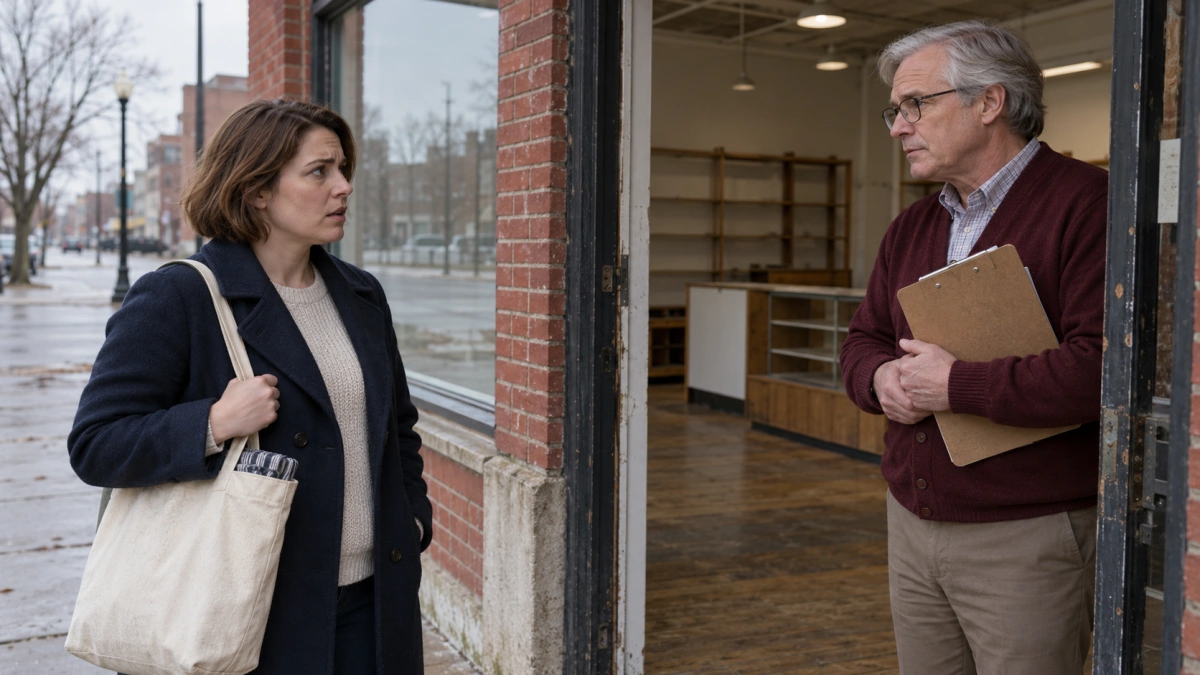
Nora Ellis arrived with a folded apron in her canvas tote and a loaf of bread for the man who was supposed to hand her the keys. Outside the empty brick shop, the October wind pushed a receipt along the Dayton sidewalk. Martin Voss opened the door only far enough to keep the warmth inside.
"I thought Leah called you," he said.
Nora smiled because she did not yet know what else to do. She had spent three years baking before her warehouse shift, saving tips from weekend markets in a separate account. Eight thousand dollars had finally purchased something more substantial than permission to dream.
Martin held his clipboard against his burgundy cardigan. "The reservation was reassigned. You're not taking this unit."
"I paid for this unit."
"Your representative submitted a change."
Leah Moreno was more than a representative. She had held Nora's hair during a stomach virus, helped bury her father, and remembered which market customers needed bread without sesame. She also handled administrative work for small businesses. Nora had paid her to review the shop paperwork because friendship did not make someone's labor free.
Martin turned a page. Nora saw her own last name beside a different address.
Ellis Sandwich Company.
Her brother's company.
Owen had called the previous evening to say that things were finally working out. Nora had congratulated him while scrubbing flour from the seams of her kitchen table. She remembered the relief in his voice now, and the way he had asked whether she had spoken to Leah.
"Don't print anything new," Nora said. "Show me exactly what you already have."
Martin hesitated, then stepped aside. Nora carried the bread inside with her. She had imagined crossing this threshold as a tenant. Instead, she sat at a bare counter and asked to see the record of who had spent her future.
The shop smelled of fresh wall paint and the faint mineral dampness that rose from old buildings before the heat came on. Nora set the loaf between them. Its paper bag slowly opened along a greasy seam. She had brushed the crust with butter while imagining Martin eating a slice after she left.
He laid out three sheets. The first acknowledged an eight thousand dollar reservation payment for the Wayne Avenue unit, subject to a lease they had not yet signed. The second was Nora's authorization for Leah to coordinate scheduling, obtain estimates, and discuss terms. The third requested that the payment be applied to a reservation at a larger corner property on Linden, under Owen's business name.
"I didn't sign that third one," Nora said.
"Leah submitted it as your agent."
"Read what I authorized."
Martin moved his glasses down his nose. Nora watched him reach the sentence she had initialed: no change to payment instructions or reserved premises without Nora's written approval. She remembered asking Leah to add that sentence after a contractor tried to order a different oven on her behalf. Leah had laughed and called it sensible.
"There should have been another approval," Martin said.
There should have been an oven here someday, Nora thought. There should have been her name on a door. She asked him to email copies of the records, including the messages he had relied on. He started explaining that the Wayne Avenue unit was being shown that afternoon.
"I'm not asking you to cancel the showing yet. I'm asking you not to delete anything."
He looked embarrassed by the distinction. She gave him her email address again and waited until the attachments arrived. When he offered the bread back, she shook her head. Carrying it home would feel worse than leaving it with a stranger.
Leah answered on the second call. Behind her voice Nora heard traffic and the clipped announcement of a pharmacy drive-through. Nora described the third sheet without raising her voice. Leah said she needed somewhere quiet. The line rustled, then a car door shut.
"It was temporary," Leah said.
"The paper doesn't say temporary."
"Owen's funding was delayed. He would lose the corner space. Your inspection wasn't scheduled yet. We thought there was room to move things around."
Nora leaned against the cold window. Across the street a man was unlocking a bicycle. Ordinary mornings were continuing without consulting her. "Who is we?"
Leah was silent long enough to answer.
"Did you tell him I agreed?"
"I told him you wanted him to get started."
"I do want that. With his money."
Leah asked to meet. Nora said six at her apartment, and asked her to bring every message and document connected to the change. Then she called Owen. He began with a hopeful "You saw the place?" and stopped when she asked which place he meant.
He admitted he knew the money had come from her reservation. He had believed Leah could arrange it while they waited for a loan from an equipment supplier. He called it bridging. Nora said a bridge had two ends, and asked where the other end was. Owen said the application was still being reviewed.
She hung up before he could apologize in their mother's voice, making himself small until somebody else had to become kind. Then she went to the warehouse, where she missed a label and sent a carton to the wrong loading lane. Her supervisor corrected it without comment. She nearly cried with gratitude at a mistake that could be fixed by carrying something back.
At home, she cleared flour from the table. The proposed bakery menu lay under a jar of pencils. She put it in a drawer, not because she had surrendered it but because she could not bear watching Leah read the prices while explaining why Nora could wait.
Leah arrived in her olive coat, curls coming loose from a low knot. Owen followed with a grocery bag of takeout. Nora told him to put it on the stove. Nobody was hungry. Leah placed her laptop on the table and began with the sentence Nora had expected: she had been trying to help.
"Tell me what you did first," Nora said. "We'll discuss what you meant afterward."
Leah showed them a message Nora had sent two weeks earlier. Help Owen get his paperwork sorted if you have time. I don't want him losing another place over forms. Below it was a separate message about the bakery: If the inspection pushes everything back, tell me before anything moves.
Leah had forwarded the first message to Martin with a note saying the family wanted Owen's reservation prioritized. She had not forwarded the second. Martin had replied asking whether Nora approved applying the existing payment to Linden. Leah had answered, I handle the arrangements for both of them. Please proceed; I'll get the confirmation.
"You never got it," Nora said.
"I thought I'd have the money back before it mattered."
"You thought I'd forgive it once it worked."
Owen shifted in his chair. "I said we should tell you."
Nora turned toward him. "When?"
He checked his phone, although she doubted the answer required a date. The day after the transfer. He had texted Leah that Nora should hear it from them. Leah had said she would explain. Owen had accepted that answer because accepting it let him order a secondhand refrigerator without asking another question.
There was nothing spectacular in the record. No forged signature, no mysterious account, no elaborate conspiracy. There was an authorization stretched beyond its limits, an office that failed to check, and two people who had mistaken Nora's patience for an available line of credit. The ordinariness made it harder to dismiss as something that happened to other families.
"I need the whole eight thousand back," she said.
Owen looked at Leah. It was a tiny movement, but Nora saw how they had practiced distributing the weight between them until neither felt responsible for all of it. She kept her eyes on him.
"The property company has it," he said.
"Then we ask about returning it. Together. Tomorrow."
Leah nodded. Owen said there might be a reservation charge. Nora asked to see his agreement. It allowed a portion to be retained if he withdrew after a specified date. That date had passed three days earlier. He had known the deadline. He had not called her.
Her mother called while they were reading. Owen had apparently told her before arriving. Nora let the phone ring. On the third attempt she answered and heard that familiar worried breath, the one that announced a request to be reasonable before anyone described the facts.
"Your brother finally has a chance," her mother said.
"I had one this morning."
"I know, sweetheart. But you're good at starting over."
Nora stood so abruptly her chair struck the refrigerator. Leah flinched. "That's not a family resource," Nora said. "Being good at starting over. You don't get to spend it."
She ended the call without waiting for agreement. Owen stared at the unopened food. He said their mother had not meant it that way. Nora asked whether he wanted to explain his mother's intentions or his own repayment plan. For once, he did not answer immediately.
They agreed not to discuss the matter through relatives. Leah would send a single chronological folder, with the original messages rather than screenshots cropped to make somebody look better. Owen would provide his current business budget. Nora would contact Martin herself. Nobody would act in her name again.
After they left, she opened the food because wasting it would not punish anyone useful. The noodles had gone soft. She ate standing at the stove, then took out her menu. Beside sourdough she had written, in pencil, enough for rent if forty sell daily. She erased nothing.
Martin's office occupied the second floor above a tax preparer. The next morning he brought his supervisor, a woman named Beth who listened without using the word misunderstanding. Nora appreciated that. Leah sat beside her, not across from her, but Nora moved her chair slightly so it would not look as though they shared a position.
Beth confirmed that staff had applied the reservation funds internally. The money had never gone into a protected account with special rules attached, and nobody claimed a bank had somehow transferred a tenant's lease. It was a preliminary commercial reservation payment, handled under written agreements that should have required a check with Nora. Their office had failed that check.
"We can reverse the application," Beth said. "But Owen's reservation then has an unpaid balance."
"That's accurate," Nora said.
Owen's face reddened. He had expected her to soften that sentence. Beth explained that the original unit was not automatically restored: another applicant had begun negotiations, although no new reservation had yet been accepted. They could pause the showing for two days while Nora decided whether she still wanted it.
She wanted it so badly she could feel the answer in her teeth. But she asked for the inspection estimate first. The rear sink needed work, and the electrician's proposal had increased since her last visit. Eight thousand returned would not cover every consequence of losing two weeks. It would restore the money, not the morning she had planned.
Owen asked whether both reservations could stay open until his supplier replied. Beth said no. Leah began suggesting a split payment, then stopped when Nora looked at her. There was no arrangement to be made until the owner of the money decided what she could afford.
Nora asked for the reversal terms in writing. Beth would return the principal after Owen signed an acknowledgment that his reservation no longer had the payment behind it. The company would waive its administrative charge because its own staff had proceeded without the required approval. Other charges under Owen's agreement needed a separate conversation.
"Sign it," Nora told him outside.
"If I sign, I lose the corner."
"If you don't, you're asking me to buy it for you."
He walked to the curb and stood looking at the traffic. Leah stayed by the stairwell. Nora could see the desperate arithmetic moving behind her brother's eyes. He had already promised a friend kitchen work. He had told their mother which table would be hers. She knew these things because he had shown her photographs, and she had been proud of him.
Owen came back. "Can you give me until tonight? Not for more money. To call the supplier and see what's real."
Nora agreed to six. She made clear that silence was not an extension. He nodded, and this time he typed the deadline into his phone while she watched.
At lunch Leah sent the chronological folder. At the end she included the invoice for her nine hundred dollar arrangement fee, marked for refund, and a separate note: I omitted the message that would have stopped this. That was a choice. Nora read that sentence twice. It did not mend anything. It made the damage possible to name.
The supplier turned Owen down. He called at five twenty, sounding tired rather than dramatic. The refrigerator purchase had used his remaining cash. He had counted future sandwich sales as though they already existed. He would sign the reversal, but he wanted Nora to attend the meeting about his withdrawal charges.
"Not to argue they're my charges," he added quickly. "I need someone to hear what I agree to."
She said she would come if he prepared his own questions. It was a narrow kind of help, and giving it did not make her feel generous. It made her feel wary. Still, it was different from paying, and she wanted to learn whether their family could recognize that difference.
That evening she visited a shared commercial kitchen behind a neighborhood grocery. A market vendor had mentioned it months earlier. Nora had dismissed it because she wanted a place that belonged to her, not another schedule pinned beside somebody else's cleaning chart. Now she called the operator, June, and asked to see the actual numbers.
June was sixty, brisk, and unimpressed by dreams that omitted utility bills. She showed Nora a preparation room, lockable dry storage, and a front counter available three mornings a week. The oven was older than the one Nora had selected, but it heated evenly. Two other food businesses used the space. All were required to leave it ready for the next person.
"You won't have your name over the whole building," June said. "You'll have expenses you can understand."
Nora stood at the counter, picturing a line that might not form. She asked about required approvals, insurance, and whether her existing market setup covered any of it. June told her to check rather than assume, and gave her a plain list of contacts. Nobody promised she could open by Monday.
At home, Nora compared the shared kitchen costs with the Wayne Avenue estimates. The smaller plan left money for ingredients and the slow weeks after Christmas. The larger plan left a beautiful door and almost no margin for illness, repairs, or a customer who praised the bread and bought nothing.
She resented learning something useful through betrayal. For a while that resentment made the smaller plan feel like surrender. Then she remembered the warehouse carton. Moving something back to the right lane did not mean the original route had been wise. She could refuse what Leah had done without proving that every earlier decision of her own was perfect.
She called Martin before the hold expired. He sounded relieved when she said she would not proceed with Wayne Avenue, which annoyed her until he admitted he had been worried she would take on expenses simply to recover the story she had expected. He offered to refund a small application charge as well. She accepted without thanking him for correcting his office's mistake.
Owen signed the reversal. Beth sent confirmation, then negotiated his separate withdrawal obligation down after considering their office's role. He still owed money. He would sell the refrigerator, return unopened equipment where possible, and take additional shifts at the diner where he already worked. His grand opening disappeared from his social page that evening.
Their mother called Nora to say he was humiliated. Nora said she knew. Then she told her mother exactly what had happened, including the message Leah had withheld and the deadline Owen had allowed to pass. She did not use humiliation as a reason he deserved harm. She refused to use it as a reason she should absorb the bill.
Her mother was quiet. Finally she said, "I didn't know there was a sentence requiring your approval."
"Would it matter less if I hadn't known to write one?"
The question stayed between them. Her mother admitted it should not. They spoke for another ten minutes, awkwardly, about things that had long been disguised as compliments. Nora was dependable. Nora managed. Nora never made a fuss. Each phrase had become a way to predict who could be asked to do without.
The principal returned to Nora's account on a Thursday. She looked at the balance before brushing her teeth. It was the same sum she had watched for weeks, but it no longer seemed like proof that careful people could keep bad things from happening. It was simply money, necessary and finite, and she was allowed to decide where it went.
Leah returned the fee separately. Nora sent her receipts for the extra transport, a missed market application, and the nonrefundable consultation she had paid for the wrong location. She did not invent a price for every miserable hour. Leah agreed to cover the documented transition expenses in three installments and wrote the dates herself.
There was also Owen's debt to Nora for two racks and a used mixer she had purchased at his request when he expected their openings to share a delivery. That was not part of the diverted eight thousand, and she kept the figures separate. They made an inventory, sold one rack, and agreed on repayment for what he retained. Clear numbers were less dramatic than forgiveness and more useful.
Leah offered to organize the shared kitchen paperwork free of charge. Nora said no. The refusal hurt Leah visibly. "I don't know how to show you I can be trusted if you won't let me do anything," she said.
"You can do the things you already promised. You can stop asking me to make trusting you part of your recovery."
Leah took off her glasses and rubbed the mark they left on her nose. For a moment she looked angry, and Nora was glad to see a feeling that had not been packaged for her comfort. Then Leah put the glasses back on and said she would send the first payment Friday.
Nora completed the new applications herself, asking June questions when she did not understand a line. It took longer. She made one mistake with a date and corrected it. The world did not collapse because she was not naturally gifted at forms. She had simply been allowed to remain inexperienced while someone else knew where the signatures belonged.
Two weeks before opening, June found Nora measuring the counter with a piece of string. She was trying to work out whether a display case from a closing cafe would fit. The seller wanted an answer that afternoon. Nora had already imagined her pastries behind its curved glass, lit from within like objects in a museum.
June asked where customers would put their bags while paying. Nora moved the string. Then June asked how the other vendors would carry hot pans past the case. Nora moved it again. By the third adjustment, there was barely room for a person to stand.
"I can make it work," Nora said.
"You can make almost anything work if you stop counting the cost to yourself."
The words irritated her because she recognized them. She called the seller and declined. Then she bought two sturdy covered trays, neither beautiful nor regrettable, and left enough counter free for somebody to set down a grocery bag. The first decision she made without Leah's help was not a triumphant purchase. It was an ordinary refusal.
That weekend Owen came to collect the rack he was keeping. Nora had labeled each shelf with masking tape so they could check the inventory against their agreement. He looked at the labels and laughed once, without humor.
"You think I'm going to steal a baking sheet now?"
"I think we should both know what's leaving."
He folded his arms. For a minute she thought he would abandon the rack rather than tolerate the evidence of being watched. Instead, he took out the list. They counted together. One sheet belonged to her market set, and he put it aside without an argument. The work took seven minutes. Nora noticed how little time clarity required compared with the weeks spent recovering from assumptions.
As they carried the rack downstairs, Owen admitted he had known the supplier's approval was unlikely before the reservation deadline. The representative had asked for additional information he could not provide. He had told Leah only that a decision was coming soon.
"So she wasn't the only person keeping something out," Nora said.
"No."
He set his end of the rack down carefully. "I liked being the one everybody was excited about. You had your market customers. I was still bringing home diner leftovers. I thought if I could get the door open, the rest would become true."
Nora understood the temptation. She had wanted Wayne Avenue partly because she was tired of explaining where she baked, tired of seeing people lose interest when her answer included another job. Understanding did not change the ownership of the eight thousand dollars.
"You could have told me you were scared," she said.
"Would you have helped?"
"Maybe. That's the part you took away."
They lifted the rack again. This time he waited for her to say she was ready.
Leah's first installment arrived on the promised Friday. The following Monday, she asked for a short meeting at a library table rather than Nora's apartment. Nora agreed to twenty minutes. Leah brought a printed statement describing the limit she had exceeded and the message she had omitted. She said she had sent the same statement to Martin's office so their records would not describe Nora as a client who had simply changed her mind.
Nora read it slowly. One sentence said Leah had acted under pressure from competing deadlines. Nora drew a line through it.
"There were deadlines," Leah said.
"There are always deadlines. This makes them sound like instructions."
Leah studied the crossed sentence, then nodded. She wrote a replacement: I proceeded because I expected Nora to accept the result once Owen's shop was secure. It was an ugly sentence, and they both looked relieved when it existed on paper.
Nora did not demand that Leah give up every administrative client. She was not an employer or a licensing board, and she would not invent authority simply because someone had misused it with her. She did ask whether Leah understood why future clients needed clear approval boundaries. Leah said she had changed her intake documents and would no longer represent relatives on opposite sides of a payment arrangement.
"That won't prove anything to me immediately," Nora said.
"I know. It's still something I should do."
For the first time in weeks, Nora believed Leah was speaking about responsibility rather than access to forgiveness. They used the remaining minutes to discuss a library sale, carefully and with genuine awkwardness. Their old ease did not return on command. Neither tried to manufacture it.
The night before the counter opened, Nora's mother offered to bring flowers. Nora asked instead for a ride to the kitchen at five, because carrying bread on the bus would be difficult. Her mother said yes, then asked whether Owen should come too.
"Not unless he wants to buy breakfast later. I need room for the trays."
There was a pause, followed by a simple agreement. Nora stood in her apartment holding the phone after the call ended. It was strange how much a practical answer could matter when she had prepared herself for an argument.
At dawn, her mother arrived with an empty trunk. No flowers occupied the back seat. They loaded the trays in silence until her mother said she had been telling herself Owen needed extra help because he struggled more visibly. Nora fastened the last lid before answering.
"I struggle quietly because I learned it makes less work for everybody."
Her mother leaned against the car. "I thought quiet meant you were all right."
"Sometimes it means I'm busy figuring out how to be."
They did not resolve thirty years beside a trunk full of bread. Her mother did not promise to become a different person before sunrise. She asked what time Nora needed to arrive, and drove directly there. At the kitchen, she carried what Nora handed her and left the narrow aisle clear.
Nora unpacked while the oven warmed. On the underside of her first tray, her father's initials were scratched into the metal from an old church supper. Owen had offered to polish them away when he borrowed it years earlier. She had refused then without knowing why. Now she ran a finger over the small marks and set the tray where it could keep doing its work.
The bakery counter opened six weeks after the day at Wayne Avenue. There was no ribbon. June lent her a narrow stand for the menu, and another kitchen user moved a stack of delivery boxes out of the window. Nora wore the apron that had remained folded in her tote. She had washed it twice without wearing it, as though cloth could retain disappointment.
Her first customer bought a loaf and asked whether this was a temporary location. Nora almost said yes. Then she looked at the counter, the clean trays, and the small square of morning light she did not need to own to work inside.
"This is where I'm starting," she said.
Owen arrived after his breakfast shift. He waited until the line was gone and bought two rolls at full price. He did not ask for the family discount. He handed her a payment receipt for the mixer and said the refrigerator had sold for less than he hoped. Nora told him she was sorry about that. She could be sorry without reaching for her checkbook.
He asked whether she wanted help taking the empty trays back. She said yes, and showed him which shelf they belonged on. He followed the instructions. It was such a small thing that she might once have missed its significance.
Leah came the following week, after asking whether Nora wanted her there. Nora said she could come as a customer, not as an unpaid assistant trying to become indispensable. Leah bought a loaf and left before closing. That night she sent the final installment. No long apology accompanied it, only a receipt and a note that the amount matched their agreement.
Winter pressed early against the grocery windows. Some mornings Nora sold out; others she took bread home and made croutons until she could not bear the smell. She adjusted quantities, kept her warehouse job part time, and stopped measuring success by whether she could quit immediately. The counter was not a consolation prize. It was a business whose losses she could survive while learning to make it work.
On the last Saturday before Thanksgiving, her mother came to help fold bags. She asked where to stand, then waited for the answer instead of choosing the place that seemed most useful. Halfway through the morning, she told a customer that her daughter had built this herself. Nora corrected her gently: June had provided the space, other vendors had shared advice, and customers kept returning.
"I mean you made the decisions," her mother said.
Nora let that stand. It was different from saying she needed nobody. She needed people who understood that helping did not mean holding the right to rearrange her life.
After closing, Owen called about a sandwich stall at the spring market. He had made a budget with rent, supplies, and a column labeled money actually available. He wanted her opinion, not her signature. Nora agreed to read it the next day. She did not promise approval, and he did not ask for it in advance.
Before leaving, she entered the day's expenses in a notebook. There was a column for rent, another for ingredients, and one for what she paid herself. At first that last column had embarrassed her. She had treated her own labor as whatever remained after everyone else received a proper figure.
June had pointed at the blank space. "If this business only works when you disappear from its costs, it doesn't work yet."
Now Nora wrote a small amount there, not enough to replace the warehouse wages, but enough to make the work visible. The number would change. Its existence would not.
She photographed the page for her records, then closed the notebook. Owen's proposed budget could wait until tomorrow. Leah's next visit could happen when they both had time. Her mother's opinion could be heard without becoming an instruction. None of these boundaries made Nora feel invulnerable. They made the next decision a little easier to recognize as hers.
In the sink, the last bowl held a soft ring of dough. She washed it before the next kitchen user arrived, dried the rim, and returned it to its shelf. Shared space deserved care, too. So did the woman working inside it.
She turned off the counter lights and lifted her tote from its hook. The apron was dusted with flour now, the pocket stretched by a pencil and a roll of labels. Outside, the wind moved dry leaves along the pavement. She checked the kitchen door, put her own key in her pocket, and went home with the day's unsold bread.
Read next
The Zero-Dollar Bill
The Unsigned Check
The Price on the Coat

My Cousin Sold My Mother’s Funeral Flowers for “Charity”—Then the Florist Recognized the Delivery Address
Reading notes
A baker arrives for her first storefront keys and learns her deposit was redirected without clear permission.
This is an original work of fiction. Characters and events are fictional. Explore public-domain books at Project Gutenberg or browse more stories on ReadStoryvia.