Original fiction
On this page
The Name Tag in the Trash
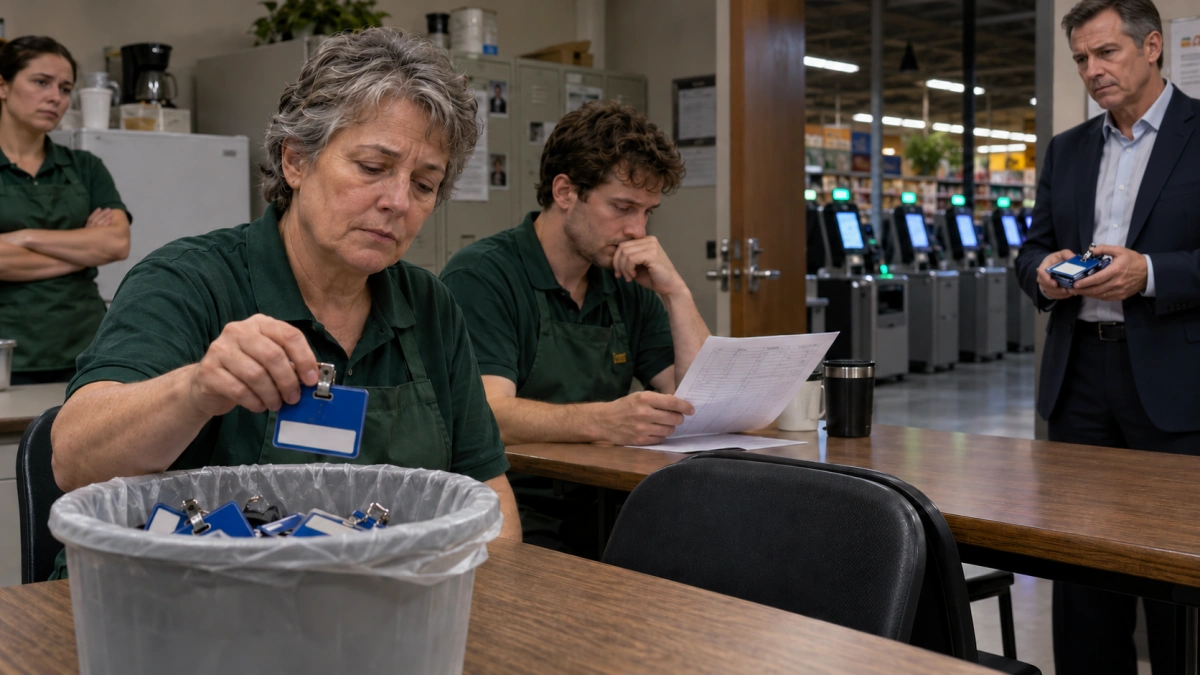
I found my name tag in the trash just before the “new technology training.” The blue plastic still had a scratch through the E in EVELYN. Beneath it were Paula’s, Dev’s, and nearly every other cashier’s badge.
The night before, Mr. Price, the regional manager for Bellwood Grocery, had emailed us to say everyone would have a job after the self checkout lanes were installed. The store was closed for three hours of training this morning. I thought the old badges had been thrown away because we were getting new uniforms. Then I saw next month’s staffing plan on the printer: six self checkout host positions, two at the service desk, and no cashier line for the eighteen people working those jobs now.
I had scanned groceries at Bellwood for nineteen years. I knew Mrs. Chen wanted her eggs placed at the end of the belt and Mr. Harris checked every receipt before leaving. But this month, what I most needed to know was whether I would still work enough hours to keep our insurance. Price’s email gave no hours. The staffing plan had no names.
Dev, who had joined us two years earlier, looked over my shoulder. He was better with computers than I was and hoped for a host position. “If there are only six,” he asked, “what are they training all of us for?”
I folded the page, planning to ask our store manager. The break room door swung open. Price walked in carrying new badges printed with just two words: SERVICE HOST. He looked at the old tag in my hand, then at the staffing plan.
“Where did you get that?” he asked.
I could have told him I had found it in the trash. But Paula stood just behind him, holding her husband’s medication bag and appointment calendar. I asked what we both needed to hear before going into the training room: “How do six positions work for eighteen people?”
Price reached for the staffing plan. I kept one hand on its edge. He said it was only a projection, not a final schedule. Employees might move to another Bellwood store or to the online order team. I asked how many openings there were, where they were, how many hours they offered, and whether the hourly rate would stay the same.
The training would explain our “new opportunities,” he said. I told him those answers determined whether an opportunity was possible for us. Paula set her medication bag on the table. The room went quiet enough that the air conditioner sounded larger than all the new checkout machines together.
Price said nobody was being laid off that day. It was the only clear sentence he gave us. He gathered the new badges and went into the training room. I put the staffing plan back on the printer and photographed it with the print time visible in the corner. I was not planning to post it online. I wanted to be able to tell someone what I had seen without trusting a memory already bent by fear.
Bellwood was a family owned chain of four grocery stores around Racine. I started after my daughter went to kindergarten. Back then, scanners often rejected vegetable labels if they were damp, and I learned the price codes by hand. Nineteen years later, I still liked the work, though my knees ached after long shifts.
I knew the checkout lane was not the only place people bought food anymore. My daughter Lucia ordered milk from her phone and picked it up on the way home. I was not angry at a screen that gave her more time with her own child. I was angry at an email promising to keep our jobs when the actual plan had far fewer places for us.
My husband, Martin, drove a school bus part time. His income changed with the school calendar, and our health insurance came through my job. I worked about thirty eight hours a week. If I had fifteen or twenty hours next month, we could not look at the hourly rate alone and say nothing had changed. We still had a mortgage and an old car loan. At my age, I did not need a speech about loyalty. I needed dates, hours, and dollars clear enough to make a budget.
The store had changed in smaller ways all through my years there. We stopped writing checks into a ledger, learned new coupon rules, started packing pickup orders, and put price lookups on handheld devices. Each change arrived with a few weeks of irritation before we learned it.
I had even suggested moving the receipt printer on register three after watching customers reach across hot coffee to collect their bags. Miriam had listened and moved it. That was why Price’s email bothered me more than the machines themselves. Bellwood knew its employees could adapt. It had decided to tell us the happy part and leave the cost of adapting outside the sentence.
At the training table, I watched the vendor describe a “host” as someone who watched screens for alerts. The diagrams showed a person in the center of six machines, all green. Real customers arrived with wrinkled coupons, tired children, questions about returns, and sometimes a week’s grocery money divided among two cards and cash.
I wondered who had counted the seconds spent helping them without making them feel in the way. Dev noticed me looking at the diagram and asked what I would add. I said a chair for a customer who could not stand through an error. He said the machines had no reason to prevent that. For a moment we were not competing for a role; we were describing how to do it well.
The training room held eight self checkout units in two rows. A trainer from the equipment company showed us how to ring up items without barcodes, verify identification for beer, and fix a scale error. Dev asked how to correct a purchase split between two cards. He learned quickly. When I hit the cancel button by mistake, he showed me the right one without laughing. I was relieved to discover I was not afraid of learning the machines. I was afraid that after we all learned, I would have to compete with my friends for one of six identical badges.
At break, Price passed out “transition preference” forms. We could mark self checkout host, service desk, online order picking, or “flexible according to business need.” There was no place to ask for a minimum number of hours. Paula asked whether “flexible” might send her to a store forty minutes from home.
Price said the company would try to find a fit. Dev asked whether online picking paid the same. HR was still finalizing it, Price replied. I asked whether signing the preference form meant accepting fewer hours. No, he said, but that answer was not written on the form. We took the forms back to our seats without signing.
Miriam, our store manager, stood by the break room window watching us. She had worked at a register beside me before becoming a manager twelve years ago. I asked whether she had known about the six host positions. She said she had seen a draft three weeks earlier, but Price told her not to discuss it until the placements were final.
“I asked him about other stores,” she said. “He said he was looking.” I was angry with her, then remembered that the person who approved her pay was the same man who had told us not to worry. I still asked, “Do you believe eighteen people will be offered equivalent work?” Miriam paused. The pause answered me.
I got home later than usual. Martin was repairing the kitchen faucet. I showed him the staffing plan and Price’s email. He thought they might add host jobs once customers struggled with the machines. Maybe, I said, but we could not pay for insurance with maybe. We opened our household budget.
If my hours fell by a third, his bus wages could cover some of the gap during the school year, but not in summer. He offered to take an extra morning route. I said I needed to know what my employer was actually offering before he rebuilt his whole schedule. I had spent the day listening to “nothing is final.” I would not use that phrase to make him work more.
Lucia video called while I was still in uniform. The self checkout lanes near her apartment were convenient when she bought three things, she said, and awful when she bought a full week of groceries. I laughed. She asked if I had to learn a new job. Yes, I said, and Bellwood had not yet told us clearly what it would pay for that job.
Lucia offered to help with the budget spreadsheet. I accepted but told her she did not have to turn my problem into hers. “I just want someone to look at the numbers with you,” she said. I thought of Dev pointing out a button for me and saw that younger workers were not automatically my rivals, even when there were fewer positions than people.
The next morning, the scheduling app showed only two more weeks. After that, when the new lanes would open, every cashier’s name disappeared. Below were eight empty slots: six hosts and two at the service desk. Miriam said the final schedule would follow the evaluation. I asked what evaluation. The equipment vendor would score our work on the machines, she said, and Bellwood would review performance and availability.
Nobody had told us that training was also a round of rehiring. Miriam rested a hand on the counter and apologized for not being allowed to tell us sooner. “You’re allowed to tell us now,” I said. She looked at her screen, then emailed the whole group with the selection process and date of decisions.
The email reduced the guessing but made the break room louder. Paula could not drive farther because she took her husband to appointments. Simone, raising two children, would pick online orders if her shift began after day care opened. Dev wanted a host position and thought he could do it, but he did not want the rest of us calling whoever was selected a traitor. I wanted to apply too, though I had pressed the wrong button twice. “Then let’s learn it together,” Dev said. “It won’t add positions, but we don’t have to eliminate one another before they decide.”
We met after work in a room at the public library. Twelve of the eighteen cashiers came. Two texted that they wanted information but did not want to join a group effort. Four did not answer. I brought the schedule picture, the emails, and the preference form. Dev made a table comparing current jobs with the announced openings.
Paula wrote questions about insurance. Simone added shift start times and child care. We did not have to decide whether self checkout was good or bad. The machines would be installed by Saturday. We needed to know our choices before “training” turned into “no shifts.”
Someone wanted to post a picture of the name tags in the trash. I understood why. It told a story faster than any spreadsheet. But customers might conclude we had all been fired, while the company would say, truthfully, that the badges were old uniforms. We kept the picture within the group and drafted a letter to Miriam and Price.
We asked for the number and location of positions, hourly pay, expected hours, selection criteria, notice dates, and the plan for people without a placement. We asked them not to call an on call list with no guaranteed hours “keeping a job.” Ten of us signed at the library. Two took the letter home to read again.
Price replied late Monday. He thanked us for our interest, reminded us that Bellwood was “investing in the future,” and listed four stores that might take transfers. He did not say how many openings or hours any of them had. At the end, he asked that personnel questions go through direct managers rather than as a group.
I read that sentence to Martin. Had we broken a rule by signing together? he asked. I said I did not know and did not want to guess. I messaged our group to keep discussions outside working hours and save copies of every reply. Miriam had received the letter. She could no longer say she did not know what we were asking.
On Tuesday morning, Price came to my lane. The old badges had been discarded because the vendor had sent new ones, he said. Nobody meant it as a personal insult. I said I believed the badges might just be part of a uniform change. The staffing plan printed the same morning was the problem.
He said the plan was still changing and he could not make offers before evaluations. Why, then, had his email said everyone would have a job? “A job” could include another department, another store, or a place on an on call list, he said. Would the on call list guarantee paid hours? I asked. Price glanced at his watch and said he had a meeting.
I wanted to shout after him past the bottled water. Instead, I rang up the next customer’s dog food and two bananas. I gave him the right change. The ordinary precision of that work made me angrier. Bellwood needed me at this register today, yet talked about next month as though I were a square on a chart that could be moved without carrying a house, a car, and a husband who depended on my insurance.
Wednesday brought the evaluation. Each of us had ten minutes of simulated problems: a vegetable that would not weigh, a declined card, an item left in a cart. Dev moved quickly and whispered reminders before my turn. When I began, the first screen froze. The evaluator said the clock would keep running. I stopped, called for help as we had been taught, and moved the customer to another machine.
He made a note. I did not know whether I earned credit for handling it safely or lost points for taking too long. In the final exercise I explained why a customer needed employee approval to continue. I had used the same tone hundreds of times with people afraid of pressing the wrong button. The evaluator looked only at his timer.
Paula came out unhappy. The questions had been in small print on a screen, though she had said she needed her reading glasses. The evaluator had told her everyone took the same test. Dev said helping customers could not be measured by button speed alone. One host might have to move among six machines, calm a frustrated shopper, notice an unscanned item, and know when to call a manager.
Miriam heard him and wrote it down. That afternoon, she emailed Price that a machine had failed during the test and that the exercises did not measure the whole job. I could not tell whether she did it for us or because she feared a chaotic opening. Perhaps those were the same reason.
On Thursday, I received an interview invitation for the north store. The job was online order picking, a thirty minute drive without traffic, a dollar less per hour, and “up to twenty four hours according to need.” The email opened by saying how pleased Bellwood was to offer a chance to continue my career. Martin read it and asked whether they had counted the cost of gas.
The numbers were clear enough for me to answer no. Paula was offered a place on a west store’s fill in list, with no fixed schedule. Simone was invited to interview for a four a.m. shift, hours before her children’s day care opened. Each offer had its own way of looking like a job without fitting the life of the person receiving it.
Miriam called me into her office. Grace Bellwood, the chain’s owner, would visit Friday afternoon to see a trial run of the new lanes. Miriam could arrange fifteen minutes afterward for us to speak. Had Price agreed? I asked. She had told him, she said. He disliked the idea, but Grace wanted to hear us. I thanked her.
Miriam asked that we not turn the meeting into a personal accusation. I said we would bring documents and questions. As I reached the door, she said, “I should have told you sooner that there weren’t enough names on the post-conversion schedule.” I told her the apology would help if she stopped letting people call empty slots opportunities.
The trial began with six machines and ten members of the store’s loyalty program. The vendor expected it to take fifteen minutes. A bag of apples triggered a scale error. Someone buying cold medicine needed an ID check. Mrs. Chen could not hear the speaker. An older man dropped a bag of potatoes on the floor.
Dev fixed the machine errors. I helped Mrs. Chen choose a payment method. Paula picked up the potatoes and asked whether the man needed a chair. We did not do those things to prove machines were useless. They were fast when everything matched. When it did not, a person had to see what was happening beyond the screen.
Grace Bellwood arrived midway through the trial. She was about my age and wore a coat without the store logo. She watched before introducing herself. In the meeting room, Price opened a presentation about labor costs and the four stores’ difficulty competing. Grace did not deny the pressure. If they did not change the way they sold groceries, she said, they might have to close one store within two years.
I had no figures to dispute that. I asked whether this plan kept all eighteen cashiers at our store employed, as Price’s email had promised. Grace looked at him. He said there would be “several placement paths.” I laid out the offers: twenty four hours at a distant store, a list with no hours, and a shift beginning before day care opened. “Would you call these equivalent jobs?” I asked.
Grace read each page. She said the email had made too broad a promise. She could not guarantee identical positions or enough hours for everyone. Beneath the table, Paula squeezed my hand. We were not asking Grace to remove the machines. They were installed. We wanted a decision date, a written offer stating pay, location, and projected hours, paid training before selection, and support for people left without a placement.
Dev added that a test should assess how we helped customers, not just how fast we pressed buttons. Grace wrote down who would answer each item. Price said the grand opening was in two days. “That’s why I need to know who will be standing beside these machines,” Grace replied.
The meeting lasted thirty minutes and produced no agreement. Outside, a coworker named Keith said I had made Grace think we were unwilling to change. I showed him the form where I had chosen host and my notes from training. He fell quiet, then said he needed more hours at the south store, not an argument.
We were asking about those hours too, I said. I did not push him to sign. In the break room, Dev said he would take a host position if offered. He needed tuition money and liked the new work. He should take it if it suited him, I said. We would not help one another by demanding identical endings.
Late Friday, Grace sent a revised staffing plan to Miriam and those of us who had signed the letter. Six hosts would be scheduled for roughly thirty to thirty two hours a week. Two service desk workers would get thirty six. Four online picking positions at other stores offered eighteen to twenty eight hours, depending on location.
The remaining six people would be placed on a fill in list or separated. The email no longer said everyone would keep a job. I read it three times. The clearer version hurt more than the old promise, but at least we knew we were discussing missing hours and positions, not a misunderstanding about a name tag.
I printed the revised plan and took it to the library room where we had first met. Some had already begun applying elsewhere; some were exhausted by meetings that happened after a full day on their feet. I read out each category and asked people to correct anything I misunderstood.
The four online picking jobs were real, Dev said, but a maximum of twenty eight hours was not the same as a guarantee of twenty eight. Paula circled the words “fill in list” so hard her pen tore the page. She said she wanted Price to stop saying the list counted as employment.
Keith came in late. He had not signed our letter, and he expected us to resent him for that. He had spoken with the south store manager and learned that one extra shift was available only until the holidays. He needed to know what would happen after. We added the question to the sheet without asking him to explain why he had waited to join us. People joined conversations when they could, not on a schedule I controlled.
At home, Martin studied the plan while I made tea. He asked whether I would take an online picking role if the service desk rejected me. I said I would consider any offer with real hours and travel costs I could manage. Then I admitted something smaller and less practical: I wanted Bellwood to say my work with customers counted. Martin said it did, whatever Grace decided. I still wanted it written into a job description.
The new lanes opened Saturday, but the old cashiers were still on their previous schedules for another two weeks. Lines shortened on one side of the store and grew on the other. Self checkout helped people with a few items. Full carts still found their way to staffed lanes.
Price walked past while Dev moved between six screens and called for my help when three machines signaled errors at once. I was not pleased to see Dev overwhelmed. I wrote down the time and the number of employees needed, then sent the notes to Miriam after my shift. If Bellwood wanted to staff the store using data, it needed data on the moments people kept the system working.
Our group met again Sunday. We did not all want the same outcome. Dev wanted a host role with enough hours and a path to management. Simone needed a shift that started after day care opened. Paula wanted time to find work near home without an immediate break in her husband’s insurance. I wanted a fair chance at the service desk or a host role and hours I could predict.
We proposed transition terms: an individual written offer for every employee, paid training for anyone changing roles, six weeks at recent average hours for those without a suitable placement, then separation pay. We asked that insurance continue through that period where the plan allowed and that HR explain each person’s end date privately. I did not know whether Grace could afford all of it. I knew that if we did not ask, each person would face an ambiguous letter alone.
Grace met us again by video, with Miriam in the store office. Six weeks for every unplaced worker would cost more than the quarter’s projected savings, she said. Paula asked how the savings were calculated if experienced staff left just before the holiday rush. Dev brought the trial day’s error count and the number of customers who needed help. I did not insist Bellwood keep every old job. I said it had to pay some of the real cost of changing, instead of transferring all of that cost to families in the form of weeks with no hours.
In the end, Grace agreed to four weeks at recent average hours for employees without a new position, followed by two weeks of separation pay if they left. Employees placed in new roles would have a minimum schedule for their first three months and retain their current hourly rate. HR would give each person written information about insurance eligibility and dates.
The evaluation would be repeated with a customer interaction component and time to learn the machines. It was less than we had asked for. Paula wanted more time; Simone still needed an interview for a workable shift. But the agreement contained dates and figures. It did not disguise a list with no hours as a job.
I had not been selected for a host position on the first evaluation, and that kept me awake one night. Dev had been chosen. He came to my house with a laptop, not to show off but to help me practice the steps I had missed. I said he was not responsible for training a competitor.
If Bellwood wanted him running among six machines all day, he said, he needed coworkers who understood them. We practiced for an hour. Then I asked what he was studying. Data analysis, he said, but his favorite part of the job was when a woman thanked him for fixing an error without making her feel stupid. We had the same skill, I realized. We had learned it by different routes.
On the second evaluation, I handled a declined payment, helped a customer check a price that differed from the shelf label, and knew when to call someone authorized to issue a refund. Miriam offered me a service desk position: thirty six hours a week, my old hourly rate, and the first three months of shifts in writing. I read the offer with Martin before signing. He said he could adjust his bus route to take his mother to appointments on my late days. This time we were rearranging our lives around information we had, not a vague promise.
Paula was not offered a position near home. She used the four transition weeks to interview at a pharmacy, but had no answer when we hugged after her last shift. I did not tell her everything would work out. I gave her a copy of the agreement showing when her insurance would end and the name of the HR contact, so she did not have to go through Price and three managers for an answer.
Simone got an online picking shift that began after day care opened. Two other workers chose separation pay and left Bellwood. One transferred to a farther store because it suited their family. We did not get one shared ending just because we had signed one letter.
Before moving to the service desk, I worked my final shift at register three. Mr. Harris asked why my name was missing from next month’s cashier schedule. I told him I would be at the help counter near the exit. He said he would have to learn to find me somewhere else. I laughed, but after he left I realized that regular customers had learned my path through the store as surely as I had learned theirs.
Later, a young woman pushed a full cart into self checkout to avoid the staffed line. Dev was helping someone else when her machine rejected the weight of a bunch of greens. I asked Miriam to cover register three and went over. The woman said she usually chose the machine because she did not want anyone commenting on the groceries she bought with food assistance.
I told her a machine did not have the right to make her feel ashamed either. She laughed, finished paying, and thanked me. Back at my lane, I thought the job was not simply about fast and slow. Sometimes someone needed help without being examined, and the person beside the machine had to know when to say less.
At closing, Miriam asked if I wanted my old badge. I said I had taken it from the trash on the first day and kept it at home. She apologized for letting us find our names discarded before we heard the real plan. The badge was plastic, I said. The blank spaces on the schedule were what scared us. Miriam said future schedule changes would come with an email explaining the reason and naming a contact. I said I would read it carefully.
On my first day at the service desk, a customer brought me a self checkout receipt and asked why she had been charged twice. I checked the transaction, refunded the extra charge, and showed her how to tell when the screen had not finished. Mrs. Chen passed by, placed her eggs at the end of her basket out of habit, and smiled at my new station.
My new badge said EVELYN, not SERVICE HOST. Dev had asked for names to be printed so customers knew whom they were talking to, and Miriam had agreed. The scratched old tag was on our refrigerator at home, held up by an apple magnet Lucia had sent.
That night Martin asked whether I missed the register. I did. I missed the scanner sound, familiar customers, and knowing precisely where I stood during a workday. I also knew that a three month schedule did not solve the rest of our lives. We would have to make another budget after it ended. Paula was still looking for work.
I did not call the new desk a victory for technology or for the people who questioned it. I told Martin that Mrs. Chen had bought eggs, Dev had managed six machines and still eaten lunch, and next month’s schedule carried my name in every slot Bellwood had promised. If a slot vanished tomorrow, I knew whom to ask and which paper to bring to the meeting.
Read next
The Printed Resignation

The Meeting on the Third Floor

The Voice on the Empty Desk

The Hotel Manager Accused Me of Stealing Wedding Linen—Then I Asked Her to Read the Orange Tag
Reading notes
A discarded name tag forces a worker to confront how easily years of service can be overlooked.
This is an original work of fiction. Characters and events are fictional. Explore public-domain books at Project Gutenberg or browse more stories on ReadStoryvia.