Original fiction
On this page
The Printed Resignation
When I walked into Human Resources with a brace on my wrist, my resignation letter was already on the desk. “Marisol Vega” was typed correctly. So was my employee number. Only the signature line was blank.
The day before, a storage rack at our distribution warehouse in Dayton had failed while I was scanning boxes beneath it. Glass jars shattered around my shoes, a metal brace struck my shoulder, and I caught myself on the floor hard enough to hurt my wrist. The doctor told me not to lift anything heavy until a follow-up visit. I thought this meeting was about finding temporary work that fit those restrictions.
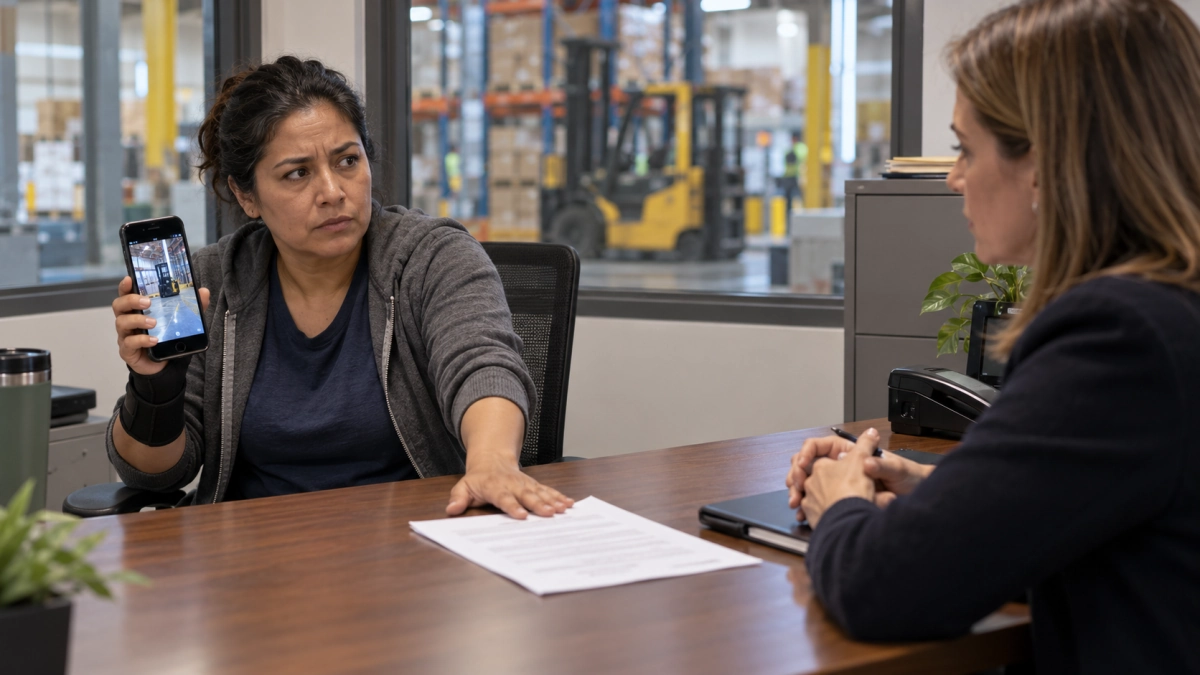
Ms. Ford from HR turned the paper toward me. If I “voluntarily separated,” she said, I would receive a three thousand dollar transition payment and keep my insurance through the end of the month. The offer expired at five that afternoon. I asked about my work injury claim. That was a separate process, she said, pointing again to the signature line.
“Why do I have to resign?” I asked.
“We haven’t found a position within your lifting limits,” she said. “And according to the initial report, there was no warning about the rack before the accident.”
My phone buzzed. Aisha, who worked my shift, had sent a photo of an incident log from eight days earlier. Her handwriting, mine, and Ray’s signatures appeared beneath the words: “Third level support bent after forklift impact. Stop using this rack.” At the bottom, our supervisor had written, “Forwarded for action.”
I looked up. Ford was still waiting. In the hall, a forklift sounded its short, repeated backing alarm. If I signed, I could pay next month’s rent. If I didn’t, I would have to prove a warning the company said had never existed.
I pushed the letter back to the middle of the desk. “I need a copy to read,” I said. Ford said she could email one after I signed. I photographed the page with my phone. She frowned but did not stop me. I asked who had concluded there was no prior warning.
The safety department was still reviewing it, she said, and she could not share internal records. I told her I was also reviewing a decision about my job. She glanced at the wall clock. I looked too, wanting to remember exactly when she had set the five o’clock deadline.
My right shoulder hurt more once I got to the parking lot. I called my mother. She told me to come to her place for lunch, then asked the question parents ask when they hear their child has been hurt: “Why didn’t you get out of the way?” I said I had been bent over a scanner, not waiting beneath a rack for it to fall. She apologized immediately. I knew she was frightened. So was I. I just had no room left in me to carry her fear too.
I had worked at Northline Supply for nearly six years. We packed glassware, kitchen goods, and cleaning products for stores across the region. There was nothing romantic about the work, but I liked the beep when the scanner matched a code and the feeling of finishing a row of orders before the trucks arrived.
My wages supported me and my twelve year old daughter, Lucia, in a two bedroom apartment. Mom helped with school pickup while I worked the six a.m. shift. I knew the people on aisle seven well enough to hear in their greetings whether they had slept or had trouble waiting for them at home.
Eight days before my injury, Ray’s forklift clipped the upright of the rack in aisle seven. He stopped the machine and called Nolan, our shift supervisor. The third level support looked slightly out of line. None of us had been trained to decide whether it could still bear a load.
Aisha took the yellow incident book from the supervisor’s station and wrote down the location, time, and request to stop using that section. I signed because I had seen it. Ray signed because he had been driving. Nolan wrote “forwarded for action” and sent us to another aisle while maintenance checked it. That day, everyone did what they thought safety required.
By the next morning, the warning tape was gone. Aisle seven was full again. I asked Nolan whether maintenance had checked it. He said the ticket was closed and told me to follow the new pick map. I did not ask who had signed off on the repair. A truck was waiting, two people had called in sick, and our productivity board flashed red.
I told myself that whoever had been assigned the repair must have finished it. Sitting in the parking lot after my meeting with Ford, I remembered that choice with painful clarity. I had seen the bent support and gone back to work there. If I wanted to tell the truth, I had to include my part.
Aisha called on her break. She had photographed the log the day we signed it because a report about a slick floor had once disappeared from the desk. I asked if she would send the photo to safety. “I will,” she said. “But don’t make me the only person with a copy.” Aisha had two young children and had just secured a shift that worked for their care. She feared being labeled a troublemaker. My name was on the page too, I told her. Nobody needed to stand alone.
At Mom’s, I laid the envelope from the clinic beside a bowl of soup. Lucia was still at school, so we talked about money first. Rent was due in ten days. I had savings equal to about two weeks of pay, not enough if I missed much more.
Three thousand dollars would cover rent, utilities, and tires my car badly needed. Mom offered a loan. She lived on a school cafeteria wage and a small pension. I did not want to buy myself a few weeks of peace by taking hers. I said I had not decided, then opened the picture of the resignation letter again.
The letter said I was leaving voluntarily for “personal reasons.” It did not mention the accident. Beneath it was another agreement about the transition money, written in sentences I read three times without feeling sure what they meant. I would not sign a document the person offering it refused to let me take home. I emailed Ford asking for a PDF, a description of work available within the doctor’s limits, and separate instructions for the injury paperwork. I attached the doctor’s note but not Aisha’s photo. First I wanted to know what the company believed its own records showed.
Lucia came home, saw the brace, and asked whether my wrist was broken. I told her the doctor had not found a break, but I needed another exam. She brought me water and sat across from me as though we were about to have a parent teacher conference. “Are you losing your job?” she asked. I said I did not know. She frowned.
“Adults always say that when something bad is coming.” I wanted to deny it, but I had just given Mom the same answer. I told Lucia someone had asked me to sign a paper saying I was leaving. I had not signed, and I was asking questions. She nodded and went to do her homework. I did not know how much she understood. At least she was not left to imagine everything in silence.
The next morning, my schedule in the company app was empty from Monday onward. My status still said employee. Ford emailed that they had not found temporary work and I should use my remaining leave while they assessed my restrictions. She attached a PDF of the resignation letter, but no incident report. I took screenshots of the schedule, saved the email, and noted the time of our call. It was not because I suddenly enjoyed gathering evidence. I did not want to wonder later whether the screen had shown what I remembered.
At my follow-up appointment, the doctor checked my wrist and shoulder. The restriction remained at five pounds for four weeks, subject to another evaluation. I asked the clinic about accident paperwork. Staff explained how I could report the injury to Ohio’s workers’ compensation agency.
I did not have to wait for my employer to decide every step. On the form, I described the day, place, and mechanics of the injury, careful not to claim I had witnessed things I had not. Ray’s collision eight days earlier was a fact. I did not know who removed the tape or why the repair ticket had been closed.
That evening Mom found the number for a worker support center. I called and got an appointment for Thursday morning. An adviser named Jo told me to bring my employment papers, the offer, the medical note, and records I was entitled to keep.
Reporting an injury and deciding whether to sign a separation agreement were two different decisions, she said. She did not promise full pay or a guaranteed job. She asked me to name what I wanted: to heal, to have an income, and to make sure a rack did not fall on someone else. Hearing those three things in plain words almost made me cry.
After their shift Thursday, Aisha and Ray met me at a diner near the warehouse. Ray sat facing the door, grease still dark in the creases of his nails. He said he had reported the collision the day it happened. Nolan had told him to keep working because maintenance would isolate the rack. Since my accident, Ray had been quiet because he thought everyone would put the blame on him.
The forklift impact was one part of the story, I said. Eight more days of stacking goods on a bent support were another. He looked down, then showed me a picture taken after the collision. Red tape wrapped around the upright. A photo in our shift group three days later showed new boxes on the third level.
Aisha laid out a timeline of what we remembered. A temp named Tessa had almost been struck by a shifting box two days before my injury. She had not made a report because she was afraid her staffing agency would stop calling. I said we would not use her name without asking. Aisha agreed. We wrote “one reported shift of freight, needs confirmation,” instead of turning Tessa’s account into our own eyewitness statement. Ray seemed to breathe easier.
Maybe he understood we did not need to exaggerate to make the truth heavy enough. We left the diner in three directions. Before she got into her car, Aisha said she used to think writing a report meant the person with the authority to act would read it. Now she wanted to know what had happened between the yellow book and the screen on their desks. So did I. None of us wanted Ray to become a substitute for a department that had had eight days to look at bent metal.
Jo helped me arrange the documents by date. We wrote to Ford and the company’s safety department: I was declining the resignation offer, asking for the basis of the claim that there had been no warning, and requesting that they preserve the incident log, maintenance records, and aisle seven assignments.
I did not attach Ray’s photograph because he had not yet agreed to its use outside our small group. My signature was on the log page, but Aisha wanted to send her copy with her own account. We agreed to describe what each of us had actually seen. Nobody would sign for anybody else.
By five that afternoon, there was no new answer. The offer expired. I sat at my kitchen table and opened my banking app. I had turned down three thousand real dollars to protect options whose value I did not yet know. Mom called. She did not ask if I had signed. She asked whether I had enough food in the refrigerator. I said yes.
She came over with oranges and rice anyway, then sat with me while I counted the rent money. I accepted six hundred dollars from her and wrote in a notebook that I would repay a hundred a month once I worked again. She said I did not have to. I said we would both breathe easier if we called it a short loan instead of leaving it as a promise with no shape.
On Friday morning, Ms. Bell, the regional safety director, called from headquarters. She had received our letter and ordered aisle seven held out of service until an independent inspection. I asked whether goods were still stacked there. After a pause, she said the shift crew was unloading it. Minutes later Aisha sent me a photo of red tape around the rack again. I could not decide whether to feel relief that someone was finally doing it or anger that an injury had been needed to make them act.
Bell arranged separate interviews with me, Ray, Aisha, and Nolan. She could not promise to share every personnel document, but she would record each account and respond in writing about the safety issue. Jo came with me as a support person. I described Ray’s collision, the log, Nolan saying the ticket was closed, and the day I was hurt.
Bell asked why I had not reported the rack again when the warning tape disappeared. I answered honestly: I had asked Nolan, been told the work was done, and trusted the person responsible. Then I went back to picking orders. I wished I had insisted on seeing a completed repair record. I did not want to hide my own choice to make my account cleaner.
Bell wrote it down. She asked what I wanted beyond pay. I wanted to know where a report had gone and who could reopen a rack. I wanted the company to distinguish “request received” from “repair completed.” I did not want the people who signed the log treated as troublemakers. Bell said she could examine the procedure and the investigation, but she could not make broad promises before interviewing everyone. Her answer frustrated me. At least she was not asking me to forget what had happened.
My schedule remained blank. Ford said there was still no work within the five pound lifting restriction. I knew there were label checking and data entry desks at the warehouse; others had rotated through them. I emailed a list of tasks I could do seated or with my left hand and attached the doctor’s note again.
Ford said she was reviewing it. Jo reminded me not to treat delay as certain proof of retaliation until I knew the reasons, but to save the dates and responses. I did, though the more I saved, the more my life felt like a file folder.
Lucia asked when I could take the brace off. I told her the doctor would check. She offered to skip her science trip to Columbus to save money. I said we had paid for it at the start of the year. More than that, she did not have to solve adult bills by making her world smaller. She looked down and said she hated hearing Mom and Grandma whisper in the kitchen.
That evening I showed her the date of my next exam and explained that I had filed an injury claim, had no shifts scheduled yet, and had borrowed a little money from Grandma. I did not read out every dollar. I just removed some of the empty space her imagination was filling with the worst possibilities.
A week later, Bell sent a preliminary summary. Nolan’s ticket did not say the rack had been repaired. He had changed its status from “out of service” to “monitor” after notifying maintenance. The system sent an alert, but no formal repair order had been opened. At the next shift meeting, Nolan saw a green indicator beside the report and believed the matter was closed, or chose to believe it. Bell had not determined his motive. She did confirm one thing: there had been a warning before my accident. What Ford had told me in HR was false.
I printed Bell’s email at the library because my home printer had run out of ink months earlier. Holding the page felt different from seeing it on my phone. The sentence about a prior warning was there in plain type, with her name beneath it. I put the copy in the folder with the doctor’s note and the photograph of the resignation letter. The papers did not add up to a paycheck. They did keep one version of the accident from disappearing while I waited for everyone else to finish reviewing it.
At dinner, Mom asked if Bell’s finding meant I could go back the next morning. Not yet, I said. She asked if it meant someone would send the missing wages. I did not know. She set down her fork and said she was tired of every answer beginning that way. I told her I was too.
We let ourselves be angry for a minute without turning it on each other. Then Lucia reminded us she needed a signature on a school form. Mom signed the line for pickup contact; I signed the one for parent. Ordinary responsibilities had kept arriving throughout the investigation. I was grateful for them and resentful of them in equal measure.
I read the email twice. It did not give me a work schedule, pay my rent, or stop my wrist from aching. But it corrected a sentence spoken across that HR desk. I forwarded the email to Aisha and Ray, then got a message from Tessa. She had heard that we had not used her name.
If Bell needed her account, she would describe the shifting box, provided she could have a separate appointment and her staffing agency knew she was speaking by choice. I called her. She did not owe us a statement, I said; she could decide when and where to tell it. “That’s why I want to,” she replied.
Eight morning shift workers met at a picnic table behind a coffee shop that weekend. Not all of them had seen aisle seven. One recalled another dented rack, another a forklift with a faulty warning light; two worried about their hours if the warehouse shut down temporarily. We did not pour every grievance into one accusation. We drafted four specific requests.
Reported damage should stay isolated until a qualified person confirmed a repair. The person reporting it should receive a ticket number and real status updates. Any worker who found warning tape removed should have a way to reopen the concern. Reporting should not cost anyone shifts. People could sign if they agreed, and read it without signing if they did not. Six signed at the table. Two took copies home.
Ray told the group he had driven into the rack and feared that signing would get him fired. Aisha said he had to accept responsibility for the collision, not for every decision made after it. I watched him nod slowly. We did not want to write “nobody was at fault,” because it was untrue. An accident has several points where it could be stopped. Seeing all of them was the only way to keep it from happening again.
A few days later Nolan waited outside the clinic where I had another wrist appointment. He kept his distance until he saw that I recognized him. Bell was going through the records, he said, and he wanted me to know he had called maintenance. “I never told them to keep using the aisle.” I asked why the red tape had disappeared.
Trucks were late, floor space was tight, and his shift’s productivity board had been red all week. He had changed the ticket to “monitor” rather than report the loss of a whole aisle. “I thought maintenance would get there before anything happened,” he said.
I told him that was not the same as a repair. Nolan looked at my brace and apologized. I believed he regretted it. His regret was not a safety plan for the people who worked under him. I asked whether he had told Bell about changing the status.
He said he had not because he feared losing his job. That was the most important part, I told him. Then I left. I did not know whether he went back to Bell, and I did not take on the job of persuading him to tell the truth. That evening I told Jo about the conversation.
She asked whether I felt Nolan had pressured me to change my account. I said he had wanted me to believe he called maintenance but had not asked me to do anything. Jo made a note. I could send Bell exactly what Nolan had said, she told me, without guessing at his intentions. I wrote a short email. After clicking Send, I felt as tired as I did after a shift of freight. Truth did not travel to the right desk by itself. Sometimes each person had to carry a piece there, and every piece cost something.
Bell replied that she had interviewed Nolan and was checking similar tickets. The same day, Aisha found another aisle with red warning tape even though the pick map still showed it open. She photographed the condition, reported it to the new shift lead, and kept the ticket number. The goods were moved that morning.
With each worker confirming their own notes, we submitted a safety complaint to the agency responsible for workplace inspections. We received an acknowledgment number, not a promise that someone would arrive tomorrow and make the warehouse safe. I still wanted a record outside the company. After my injury, an internal review should not be the only place our warnings lived.
Bell’s final report came almost a month later. It confirmed that four rack tickets had been marked “monitor” without a repair record. Two aisles had remained in use after warnings. The company stopped using them, hired a qualified firm to inspect all its storage racks, and replaced damaged parts. A shift supervisor could no longer change an “out of service” ticket to another status alone.
Maintenance and safety both had to sign before an aisle reopened. Leadership also removed the shift penalty tied to stopping an aisle for a reported hazard. Bell wrote that the incident could not be reduced to one forklift driver or one worker with a scanner. I had wanted those words from the first day. Seeing them in a report still mattered.
Nolan was removed from shift supervision while the company considered discipline. I did not know the final decision and did not ask for his private personnel record. Ford emailed to withdraw the resignation offer, confirm I was still employed, and apologize for saying there had been no warning. She offered temporary label checking work once the doctor cleared me for it, with a schedule in writing.
I read her email with Jo before responding. I did not have to sign anything declaring the dispute over to accept shifts. My injury claim continued on a separate track. Medical expenses were addressed first; more documentation was needed for the time I had missed. The days spent waiting had been expensive no matter how the paperwork eventually turned out.
Before I returned, Bell invited several workers to review the revised reporting procedure. I nearly declined. I did not want my shoulder and wrist turned into a case study on a projector screen for people learning to fill in forms. Jo reminded me I could set conditions about how my story was used. I emailed Bell: no photograph of my injury, no reading Tessa’s name aloud, and a chance for us to see the steps before a companywide announcement. Bell agreed. I went with Aisha and Ray. Two employees from other shifts came too.
A diagram on the wall traced a report from beginning to end: the person who saw damage entered the location, the system issued a number, the area was marked, maintenance inspected it, and safety approved reopening. I asked who could remove the red tape when a truck was waiting outside. Bell pointed to the second signature box.
What if that person was absent? The aisle stayed closed, she said, and the supervisor rerouted the orders. Ray asked who was responsible if a forklift clipped a rack. Drivers still had to report the impact immediately, Bell said, but reporting it did not replace the repair process. I saw Ray sit a little straighter.
Aisha found a gap in the diagram. Temps did not always have system accounts. If a temp was first to see damage, whom could they tell, and how could they verify that a ticket existed? Bell added a phone reporting option and a posted code at each shift entrance. I messaged Tessa right after the meeting with the parts that applied to temp workers. “At least next time I know where to call,” she wrote. A useful process that arrived late still had to face the question of why it had arrived late.
At the end, Bell asked whether we were satisfied. Nobody answered for anyone else. I said I needed to watch the procedure work through several shifts, especially when staffing was thin and trucks came late. Bell put that in the minutes. As we walked out, Aisha said I had delivered the hardest sentence of the meeting in an ordinary voice. “I have to work here tomorrow,” I said. We laughed. I knew that had also been one reason I stayed quiet too long about the bent support.
I returned to the warehouse wearing a smaller brace. The label checking desk was one hallway from aisle seven. On my first day, some people were glad to see me. Others asked quietly whether every conversation was going to be photographed now. I said I had kept records about what I witnessed.
Aisha handed me a new pen and a copy of the reporting instructions posted near the scanners. We read them together. A worker who flagged a dangerous location would get a ticket number, and anyone reopening it would have to sign. Paper could not do a person’s job, but at least it told us where to check.
At the label desk, I learned to slow down without apologizing for it. I could check a package number with one hand, but lifting a stack of boxes to make space sent pain through my wrist. The first time I reached for one, Aisha stopped me and moved it herself. I hated needing that help.
She said she would rather move a box now than cover another month of my shifts later. The supervisor for the desk adjusted the layout so the printer and scanner were within reach. It was a small change, the kind no one would photograph for the safety report. It made the day possible.
People still disagreed about what the investigation had cost. Ray had lost overtime when aisle seven shut down. A picker on the late shift thought the new approval steps would delay every truck. I could not promise they would never cause a delay. I could point to the rack support that had hit me and ask what its old speed had bought us. Some conversations ended there.
Others lasted long enough for someone to ask how the ticket system worked. I tried not to demand that everyone thank me for raising the issue. I had also wanted to keep working when I first saw the tape removed. Knowing that made it easier to listen to people who were afraid of losing hours, and harder to accept that fear as a reason to stop asking questions.
The warehouse had not changed overnight; neither had I, though I could now see where change began.
Lucia picked me up with Mom after that first shift. She saw red tape across a distant aisle and asked, “Did you make the whole warehouse safe?” I told her no one person could do that. Ray had told the truth about the collision. Aisha kept the log. Tessa chose when to speak.
Others signed the request, and someone repaired the racks. There were still problems we had not found. Lucia frowned, as if my answer lacked the ending she had been promised. Then she asked whether fastening the seat belt hurt my wrist. A little, I said. She clicked it in for me and asked nothing else.
Three months later I had repaid some of Mom’s loan. The claim for missed time was being reviewed with the supporting records; it did not make the difficult month disappear. My wrist still needed attention after a long shift. Ray sometimes stopped his forklift to check a blind corner while the productivity board glowed red. Aisha received a ticket number for a newly scraped support and asked me to look with her before the aisle reopened. We did not trust every green mark on a screen. We asked what it meant.
One morning a new worker asked whether she should tell a supervisor every time she saw red tape. I showed her the incident form and how to keep the ticket number. What if the supervisor said it was handled but freight was still there? she asked. I looked toward aisle seven, now empty and waiting for another shipment.
“Ask who inspected it, and when,” I said. “If you don’t know, don’t stand beneath it. Get someone else to look with you.” She nodded and tucked the paper into her pocket. I went back to my scanner. It beeped for a matching code, an ordinary sound. This time I knew a signature on a page was not the end of the story.
Read next
The Meeting on the Third Floor
The Voice on the Empty Desk
The Name Behind the Trophy
The Hotel Manager Accused Me of Stealing Wedding Linen—Then I Asked Her to Read the Orange Tag
Reading notes
A resignation printed in advance leaves a worker facing a choice someone else has prepared for her.
This is an original work of fiction. Characters and events are fictional. Explore public-domain books at Project Gutenberg or browse more stories on ReadStoryvia.