Original fiction
On this page
The Name Behind the Trophy
I had come back for my socket set, not to hear my father become somebody else's father.
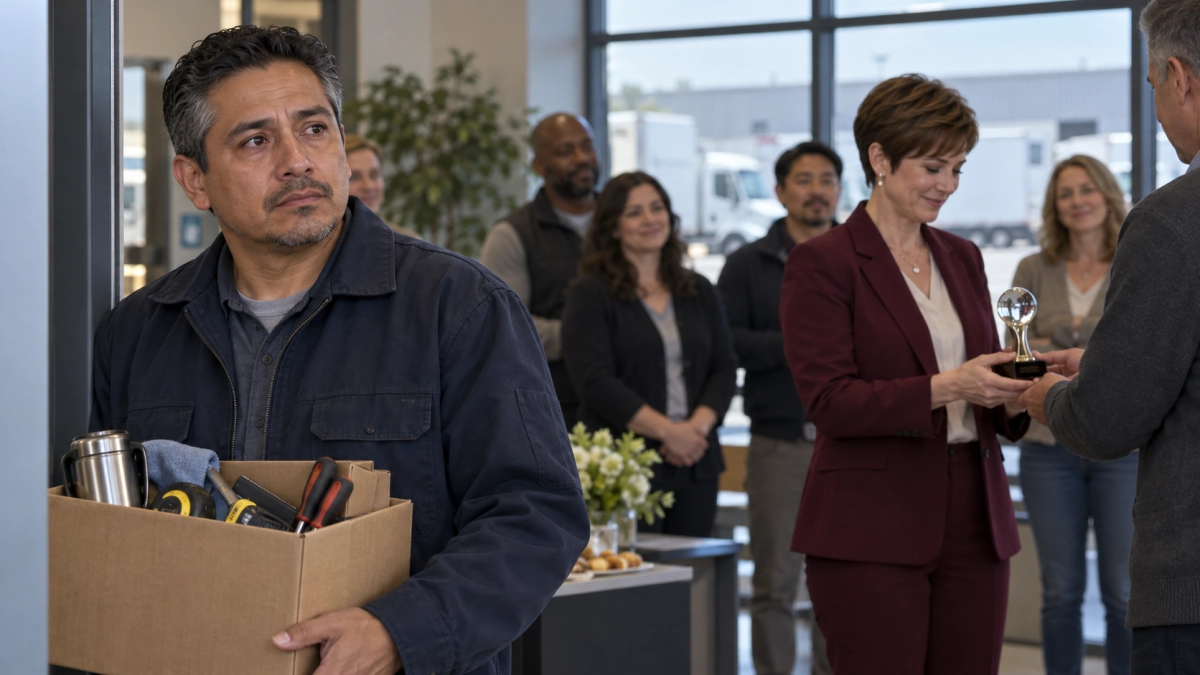
The security desk had already checked my name against the collection appointment. I stood at the edge of the lobby in my navy work jacket, holding a small cardboard box, while my former manager accepted a trophy beside the elevators.
Celeste Wynn's chestnut pixie cut caught the light. Her burgundy suit was the one she wore when visiting executives arrived. The trophy had no writing I could see, just a silver curve rising from a plain base.
“The idea came to me while caring for my father,” she said. “When someone you love can't tell you what they need, you learn to create a better signal.”
I knew the sentence because I had said it to her in a private meeting eight months earlier. My father could tell people what he needed. After his stroke, the words sometimes arrived late. That distinction had mattered when I explained why I wanted a predictable departure time.
Celeste had taken the sentence, removed the difficulty that made it true, and fitted it to her own mouth.
Behind her, Keiko Sato stopped clapping. Leon Ward looked down at his hands. They knew the dock readiness system on the display was not something Celeste had dreamed up alone. Keiko had tested the timing. Leon had found the flaw that could leave a driver waiting beside the wrong door.
My name appeared nowhere that I could see.
Then a communications employee lifted her phone to record the closing remarks. Celeste smiled toward the lens and began another sentence about the man who had raised her.
I put my box down before I could drop it.
The guard beside me shifted his weight. He was new, or new enough not to recognize the expression I used when trying not to swear. He asked whether I needed help carrying the box. I told him no. My socket set was underneath a rolled flannel shirt, and the cardboard wasn't heavy. What was happening across the lobby had nothing to do with its weight.
“My father taught me that patience is a form of engineering,” Celeste said.
That line was hers. I would give her that much. My father had taught me how to mend a screen door, check oil, and apologize before an apology became a performance. He had never described patience as engineering. Usually he called it waiting, then complained that everybody was taking too long.
I wanted to walk into the middle of the gathering and say his name. Ernesto Rios. Seventy three. Still alive. Particular about how his coffee was stirred. Not a vague source of inspiration available for adoption by a manager with a speech to finish.
Instead I picked up my box and asked the guard where I could wait for Keiko. He pointed toward a bench near the entrance. I sat facing the parking lot until the applause ended. My last day had been Friday. It was Tuesday now. I had promised myself I wouldn't leave that building angry twice.
Keiko arrived carrying my insulated lunch bag, which I had forgotten in the dispatch refrigerator. Her black ponytail had come loose near one ear. She looked at the box, then at me.
“You heard it.”
“How long has she been telling it?”
“I heard that version for the first time today.”
I asked whether she had known about the award. She had been told operations was receiving recognition for a scheduling improvement. She expected the team to be called up. When Celeste took the microphone alone, Keiko had thought there would be a second part. There wasn't.
“Did you say anything?” I asked.
The question came out harder than I intended. She glanced toward the elevators. “I stopped clapping.”
It wasn't enough for me then. I wanted somebody else's risk to arrive fully formed, right when my own anger needed company. Keiko had a dispatch shift beginning in twelve minutes and a supervisor who still signed her time. I knew that, but knowing didn't make me generous.
“Thanks for the lunch bag,” I said.
She didn't accept the dismissal. “Send me what you want corrected. I'll answer for the part I did.”
Outside, I called my father. I had meant to ask whether he wanted soup or a sandwich before his afternoon appointment. When he answered, I could hear a baseball discussion on his television and the familiar clink of a spoon against a mug.
“Tools?” he asked.
“Got them.”
“All of them?”
“I think so.”
He knew what a socket set cost and what it meant to leave it behind at a job. He didn't ask whether anybody had begged me to stay. That was one reason I hadn't yet told him the whole story of my resignation. I didn't want him inventing a debt where there wasn't one.
I bought sandwiches and drove to his house. At a red light, my phone displayed a message from Leon: Don't answer anybody while you're driving. Call when you stop. Even in a crisis, he sounded like a driver.
My father stood at the kitchen counter, leaning lightly on his cane, arranging two plates. His silver hair was flattened on one side. He looked at my face and put down the mustard.
“They keep your tools?”
“No.”
“Then eat first. Whatever it is can wait for bread.”
It almost could. We ate without the television, which he considered a concession worth noticing. I told him about the trophy, the process, and the sentence. I avoided quoting the second line until he asked what else she had said.
He was quiet longer than I expected. Since the stroke, I had learned not to fill every silence on his behalf. Sometimes he was finding a word. Sometimes he was deciding whether I deserved the one he had found.
“She knows her own father?” he asked finally.
“I assume so.”
“Then she should use him.”
I laughed once, sharply. He didn't. He wanted to know whether his name was in the recording and whether she had described him as helpless. I said I hadn't heard his name, but she had suggested the person she cared for couldn't communicate his needs.
He rubbed a crumb from the table with his thumb. “I can communicate that I don't like her.”
That was when my anger stopped being clean. I had come home carrying something I thought belonged mainly to me: my idea, my lost credit, my former manager's dishonesty. Now my father was sitting across from me, checking whether strangers had been invited to misunderstand his life.
Eight months earlier, I had requested a consistent departure time on Tuesdays and Thursdays. My father needed help after therapy, and the neighbor who usually checked in wasn't available those afternoons. The meeting was meant to arrange coverage, not provide material for a newsletter.
Celeste had asked why I seemed tired. I had told her about waiting while he searched for words, about learning to ask one question instead of three. “When someone you love can't tell you what they need, you learn to create a better signal,” I had said, then corrected myself. He could tell me. I needed to leave space for the answer.
That conversation helped me notice a problem at work. Drivers came to the loading doors because a screen showed a trailer as ready. But ready sometimes meant the goods were picked, not that the dock was clear or a loader available. Dispatch asked three questions at once; warehouse staff answered the easiest one; drivers arrived at a door nobody could use.
I suggested separating preparation from release. One signal meant the order was assembled. A second meant a specific door, equipment, and person were ready together. It wasn't a revolutionary machine. It was a small change in what we asked people to confirm before somebody else moved a truck.
Keiko turned my sketch into a dispatch sequence people could actually use. Leon tested it on early routes and pointed out that a door number could change after release. We added a confirmation step when that happened. Two warehouse leads adjusted the handoff so nobody had to leave a forklift running to answer a screen.
The trial reduced wasted trips across the yard. It didn't eliminate delays, and nobody had to invent a dramatic percentage to make it worth doing. On a wet Thursday, Leon told me he had stayed in his cab until the right door was ready instead of circling twice. That was the result I remembered.
I had emailed the first proposal from my work account, then sent an approved copy to myself while preparing a skills portfolio. The attachment contained no customer names, routes, prices, or private operational data. Celeste had replied to the original: Good thinking, Daniel. Let's have Keiko and Leon test this with you. I still had that reply in the portfolio exchange she had authorized.
Authorship was the easier question. Consent was harder. I had never written, Please don't turn my father into an anecdote, because that hadn't seemed like something a person needed to specify.
“What do you want?” my father asked.
“The credit corrected. The family part taken out.”
“Then ask for those things. Don't ask them to decide whether I'm a good story.”
At his therapy appointment, I sat in the waiting room with the box under my knees and wrote an email on my phone. The first draft accused Celeste of stealing my life. The second sounded like I was applying to win her trophy. Neither said what I actually needed.
Leon called while I was deleting a sentence. I stepped outside. He had been asked for a quote about the process, he said, but nobody told him the speech would describe Celeste's family. He had already written to his supervisor identifying me as the person who proposed the two signals.
“Include Keiko,” I said.
“Already did.”
He sounded mildly offended that I had to tell him. I apologized. He accepted without making me earn forgiveness, then asked whether my father was all right. I said he was angry, which Leon called a healthy response to the available information.
After therapy, my father wanted to stop at the hardware store. He needed a washer for the dripping kitchen tap. I offered to get it alone. He said he wasn't sending me into a complicated wilderness, but he would like to choose the right size himself.
We spent fifteen minutes examining a drawer of small rubber circles. Nobody recognized him as an inspiration. Nobody needed him to be anything but a man trying to stop a leak. I held the packet while he counted his coins, and the ordinary delay steadied me more than any speech could have.
Before sending anything, I opened the portfolio folder on my home computer. The first page was a sketch of two boxes connected by an arrow. My handwriting looked hurried, as though I had known the idea only long enough to keep it from escaping. Underneath, Keiko had written a question about who would confirm the door assignment. Leon's comment arrived two days later, blunt enough that I could hear his voice: A green light doesn't move the forklift out of my way.
I had forgotten how much of the work happened in questions. The final diagram looked clean. The conversation that produced it was full of objections, corrections, and people admitting they had imagined another person's job incorrectly. I didn't want to replace Celeste's solitary genius with my own. If I asked for credit carelessly, I could flatten the same people who were helping me now.
I called Keiko once more, this time asking whether she wanted her changes named. She said yes, and asked me not to call the dispatch work a small adjustment. She had spent three evenings checking the sequence against actual departures while still covering the desk.
“You're right,” I said. “I was making the idea sound smaller so nobody could say I was bragging.”
“You can stop doing that with my hours.”
I wrote her contribution properly. It stung, but it was the useful kind of sting, the sort that told me where I had been careless instead of where somebody else had been cruel.
That evening I sent the email to Celeste, the site director, and communications. I attached the approved portfolio exchange. I described what I had heard, distinguished the process contributions, and said the personal account came from a private caregiving discussion. I requested that the recording and any draft publicity be paused until those parts were reviewed.
I didn't demand the trophy or threaten to return with a camera. I asked for confirmation of the correction and removal of the personal story. I also asked that my father not be contacted without his agreement. The email was not an invitation to interview him for a more accurate emotional ending.
Piper Dunn from communications replied first. She had curly brown hair and a voice I remembered from arranging staff photographs. She said she had recorded the closing remarks but had not posted them publicly. An internal newsletter draft existed. She would hold both while the director reviewed my message.
I asked whether she could confirm where the recording had already gone. She said she needed to check the internal channel rather than guess. That small refusal to reassure me too quickly mattered. By morning she confirmed that a short clip had been placed in the staff channel and the draft article had gone to three reviewers. Neither had been sent to customers.
Knowing the audience was limited helped. It didn't make the story harmless. My former coworkers were precisely the people who knew my father had been ill. An invented detail could travel through a room without ever reaching the internet.
Celeste called twice. I let both calls go to voicemail. On the second she said there had been an unfortunate impression and she wished I had approached her privately before escalating. She spoke as though I had interrupted a misunderstanding she was already busy fixing.
I wrote back that I would discuss specific corrections by email. I didn't want to debate my memory against her tone, without a record, while she told me she had meant something kinder than the words everyone heard.
Then I made dinner and discovered I had forgotten to buy rice. Small omissions were accumulating. Resignation had given me time, but not the rested mind I imagined would come with it. I was forty two, with savings that could cover a short gap, not an indefinite campaign to make somebody understand me.
That night my father called to check whether I had eaten. I almost told him yes to spare him worrying. Instead I admitted the missing rice, and he said there were potatoes in the cupboard. He was right. I had bought them on Sunday and forgotten them while rehearsing arguments nobody was present to hear.
“You don't have to manage dinner from your house,” I told him.
“Apparently I do.”
After we hung up, I cooked the potatoes and washed the pan immediately, a small effort to keep one bad week from becoming an apartment full of evidence. The cardboard box remained by the door. I hadn't unpacked because part of me still expected to take everything back, as though resignation were a temporary misunderstanding rather than a choice I had made with my eyes open.
I had left because the job kept moving its finish line. A shift ending at four became a request at three fifty five, then a favor, then proof of whether I cared about the team. After my father came home, I arranged coverage on two afternoons. Celeste approved it in meetings and questioned it in crowded hallways.
“We've all got family,” she would say when a load ran late.
She wasn't wrong. Keiko had a son whose school called whenever he wheezed. Leon's wife worked nights. The warehouse leads traded Saturdays around relatives' appointments. That was why I wanted a schedule that didn't depend on whose emergency could win the afternoon.
I proposed cross training another coordinator. Celeste said there wasn't time. When I trained a colleague informally, she said I was interfering with assignments. The dock signals improved movement around the yard, but they couldn't make a manager stop treating a person's departure as a negotiation.
That Thursday, two weeks before my final Friday, she asked me to remain for a late pickup. I reminded her that my father had therapy. She said the team had carried my situation long enough. I stayed until the backup arrived, missed part of the appointment, and submitted my resignation the next morning.
I worked my notice and completed the handover. I hadn't stormed out. That distinction mattered because I knew how readily a departure became evidence that the person had always been difficult. I also knew a careful exit wouldn't make everyone see it fairly.
My father had wanted me to wait for another offer. So had I. But another offer hadn't arrived, and I had begun dreading the little pause before Celeste answered every scheduling request. Leaving cost me money and the familiar company of people I liked. It didn't feel noble. It felt necessary and frightening.
Wednesday afternoon, Keiko sent her statement. She identified my first sketch, her dispatch changes, Leon's revised door confirmation, and the warehouse leads' testing. She copied the director and me. She did not quote my father or speculate about Celeste's motives.
I thanked her, then apologized for asking whether she had spoken at the ceremony as though silence for a minute erased years of help. She replied that she wished she had said something. Both things could be true. She could wish it, and I could stop turning the wish into another debt.
Leon called after reading Keiko's statement. He said one of the younger drivers had asked why a manager was receiving credit for a system dispatch and loading staff used all day. He had answered with the names, not a joke about bosses stealing everything. I asked why he had been so restrained.
“Because he needs to know whom to ask when it goes wrong,” Leon said. “And because I don't want you becoming a rumor.”
He had seen enough people leave a workplace and turn into shorthand. The angry one. The unreliable one. The genius nobody appreciated. Any version could become a way to stop listening to the person. I told him I didn't feel much like a genius. He said that was fortunate, because geniuses were sometimes terrible at answering their phones.
I laughed, then felt unexpectedly close to crying. We talked about his next route until the feeling passed. He didn't ask whether he had cheered me up. He just said he needed to get some sleep.
The director, Owen Fletcher, offered a meeting the next day. I asked whether it could be by video so I wouldn't have to return to the lobby. He agreed. Piper would attend for communications; Celeste could provide her account separately. I sent a short agenda because I didn't want the call to end with everyone praising teamwork and nothing changed.
Before the meeting, my father asked to read my email. He put on his glasses and took longer than I expected. I kept my hands away from the page. When he finished, he tapped the sentence requesting no contact.
“Good,” he said. “I'm not doing a photograph.”
“Nobody asked.”
“They might.”
We both knew that being consulted could become another kind of pressure if the only available answer was one that made everyone else feel relieved. I told him he didn't have to provide a replacement story at all.
On the video call, Owen began by saying the recognition was intended for an operational improvement sponsored by Celeste. Sponsorship, he said, had been confused with authorship in the presentation. I let him finish, then asked what he meant by confused.
“She named herself as the person who had the idea,” I said. “And she told my private experience as her own. Those are separate corrections.”
Piper nodded and made two headings in her notes. Owen looked down. He had supervised Celeste for years and had approved the award. Accepting my account meant admitting something had gone wrong in a process he owned, not merely mediating a personality clash between two other people.
He said the email exchange supported my authorship and the testing contributions. They would update the internal article to name the team and describe the two stages accurately. The clip would be removed from the staff channel. Piper confirmed she had preserved a restricted copy for review rather than leaving it available for casual sharing.
“What will replace it?” I asked.
“A short correction notice and the revised account,” Piper said. “Without family details.”
Owen said Celeste had explained she was speaking about caregiving in a broad sense, not claiming literal events. I felt my jaw lock. Piper asked whether he wanted that explanation in the notice.
He hesitated. “No. It doesn't change what was said.”
I could almost see the moment when defending her intention became less important to him than making the account accurate. It wasn't a transformation. He was still a director managing a problem. But it was a useful choice.
They would not automatically rescind every internal recognition connected to the project. The award committee would review its criteria and the presenter attribution. I said I wasn't asking them to mail me the trophy. I wanted the record to stop saying one person created work that several of us had done, and I wanted my father out of it.
“Would you be willing to approve the revised draft?” Piper asked.
“For factual accuracy, yes. Not as an endorsement of the company.”
She wrote that distinction down too.
After the call, Celeste sent an email with an apology in the third paragraph. The first two described the pressure of speaking without enough preparation and how proud she had been of the team. Then she wrote that she was sorry the remarks had caused distress.
I read it twice, trying to decide whether I needed a different apology to proceed. I didn't. I needed the correction. I answered that the family story had been shared privately to discuss scheduling, not offered for publication or performance. I asked her not to use it again, even with my name attached.
She replied that she understood and asked whether we could put the matter behind us. I didn't promise that. I said I would review the concrete changes when Piper sent them. It wasn't a devastating reply. It was four ordinary sentences, and afterward I had to stand up because I had been sitting too long.
That Friday, the revised article arrived. It opened with the problem of drivers moving before docks were ready, then credited my proposal, Keiko's dispatch design, Leon's field testing, and the warehouse leads' changes. Celeste appeared as the manager who sponsored the trial. My father's illness was gone.
One sentence still said the project grew from my experience caring for a relative. I marked it for deletion. Piper called to say she thought the general wording might be acceptable. I said no, gently, because she was asking rather than assuming.
“It's still an explanation of my family,” I said. “The process can stand without it.”
She removed the sentence. We replaced it with a description of the communication gap at the docks. The article lost its sentimental opening and became clearer about the actual work. Leon later said it was the first company story he had read that explained what a driver was supposed to do.
Piper sent the clean version before the end of the day. I read it aloud, listening for a phrase that would quietly put my father back into the room. There wasn't one. The article was almost plain enough to disappoint an editor looking for tears. I told her the operational description was accurate and the contributor list complete. I didn't write that everything was fine, because it wasn't, and she hadn't asked me to.
Afterward I called my father and told him his part was removed. He asked whether that meant people would stop discussing him. I said I couldn't promise what people would say, only what the company had agreed not to circulate. He seemed relieved by the smaller answer. Too many people had offered him certainty since the stroke, often while speaking over him to somebody else.
“Will you keep the emails?” he asked.
“Yes.”
“Good. Then come Sunday if you're not busy. The back step's loose.”
I wrote Sunday on the calendar. It was a request, not an emergency disguised as a test of affection. I could say what time I would arrive, and he could tell me if that didn't suit him. We had not always been good at that. There were years when we spoke mostly in chores and assumptions. Now he waited for my answer, and I gave one I could keep without changing the rest of my life to prove that I loved him enough that week.
The correction notice acknowledged that the ceremony had incorrectly attributed the origin and included an unauthorized personal account. It didn't identify my father. It named the contributors and linked the revised description. It was less dramatic than the speech, which bothered me. Corrections rarely received the microphone's warm light.
Keiko said she had raised the credit issue in the next operations meeting. Leon had repeated the corrected sequence while training drivers. Neither promised that nobody would ever remember Celeste's version. They were changing the places where the story actually traveled, one practical conversation at a time.
The trophy stayed in the site office while the committee reviewed the recognition. Celeste wasn't escorted out. Nobody offered me her job. A coworker sent a photograph of the silver curve on a shelf and asked whether that made me furious. I told him I didn't want more photographs. The object wasn't the part I needed to carry home.
Before an interview the following Monday, I sat in my car reviewing the process diagram as a work sample. I could explain the problem without a family preface. I could say who had improved it without shrinking myself. For a week, every account of my work had felt contaminated by the ceremony. Looking at the diagram now, I remembered the first successful release: Keiko pointing at the screen, Leon lifting a hand from his cab, a warehouse lead giving a thumbs up through the rain.
Those moments hadn't vanished because Celeste had used a microphone badly. They also hadn't become entirely mine because I was the one who complained. I put the sample back in its folder, checked the appointment time, and walked inside before I could rehearse another answer to a question nobody had asked yet.
The interview was with a smaller freight business for a scheduling coordinator role. The pay was a little lower than my old position, and there was no promise of rapid advancement. The manager asked why I had left. I gave her the work answer, not the lobby speech.
“I need agreed departure times to be reliable,” I said. “I can help plan coverage. I can't make every afternoon an emergency.”
She asked which days. I told her. She looked at their staffing board and said Tuesday was possible, Thursday would require training someone else. I expected that to end the conversation. Instead she described a two week coverage plan and asked whether I could start after it was arranged.
I didn't accept in the room. I asked for the schedule and expectations in writing, including what happened if a truck ran late. She said the late coordinator handled it unless I separately agreed to stay. It sounded almost suspiciously simple. I called two references she provided, with their permission, and asked how that worked in practice.
One said schedules weren't perfect, but people were asked, not cornered. The other described a recent swap and a supervisor who covered a gap herself. I could work with imperfect. I had spent too long being told predictable meant selfish.
My father listened while I compared the pay and travel costs. He offered to cancel one therapy appointment each week until I settled in. I told him no. Then I stopped myself from making the no too sharp, as if accepting his concern meant accepting his proposed solution. He was allowed to worry about me, even when I wished he would save his strength.
“You want to help,” I said. “I know. Let's keep the appointments.”
He nodded. After a moment he asked if I could fix the tap now that we had the washer. I brought the socket set from the box, though the job needed a wrench instead, and he laughed at me for unpacking with an audience.
We worked slowly. He held the flashlight, directing the beam exactly where I didn't need it until I asked him to move. Water dripped into a bowl. When the new washer seated properly and the tap stopped, he turned it twice to test my work. That was a story about us too, but no trophy required it.
On the evening before my new job, I asked what he wanted people to know if I ever wrote about caring for him. He leaned back, considering the question as seriously as a repair estimate.
“That I still make your coffee too weak,” he said.
“Anything else?”
“That you ask too many questions when I'm tired.”
I started to defend myself, then shut my mouth. He smiled. We sat together while the late game began, neither of us explaining what the other had taught him. My tools were home. The next morning's schedule was on the refrigerator. For once, the story in the room didn't need to belong to anyone outside it.
Read next
A Visitor Badge on My First Day
The Envelope in the Locker
The Shift Nobody Covered
The Hotel Manager Accused Me of Stealing Wedding Linen—Then I Asked Her to Read the Orange Tag
Reading notes
A departing employee confronts the difference between receiving a trophy and receiving honest credit.
This is an original work of fiction. Characters and events are fictional. Explore public-domain books at Project Gutenberg or browse more stories on ReadStoryvia.