My name appeared in the bottom corner of the presentation, beside the words “Data reviewed by.” On the title slide, beneath Neighborhood Delivery Plan, was my boss's name: Owen Price. I had proposed the route plan, tested it with six stores, and sent Owen the results. But the missing credit was not what made my hands go cold.
Slide four said, “28% fewer late deliveries.” The correct figure was 8%. During two days when the warehouse scanners failed, dispatchers recorded twenty late deliveries in a paper log. The automated report ignored all twenty. I had attached photographs of the log, marked the problem in the spreadsheet, and warned Owen not to use 28% in front of the client.
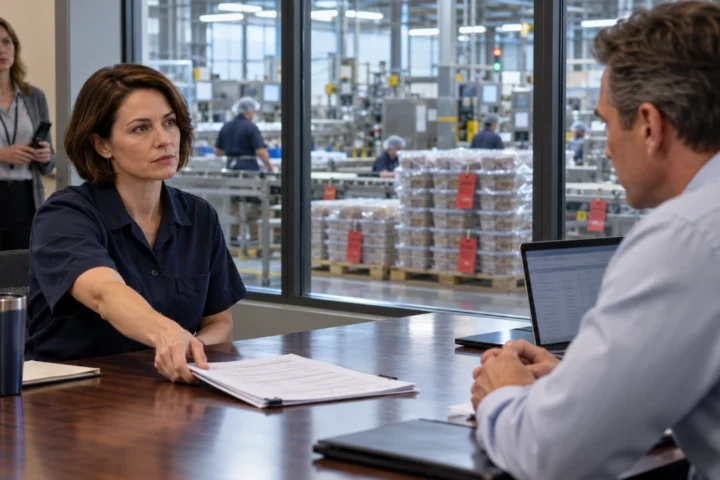
Owen walked into the conference room and set his coffee beside the projector. “This is final,” he said. “Maple & Main will be here in ten minutes.” The eighteen-store bookstore chain was considering moving its replenishment deliveries to our company. If its managers believed our presentation, they might cut receiving staff on the days we promised to arrive on time.
I pointed to slide four. Owen glanced at it. “It's twenty deliveries. The direction is still right.”
“Those twenty deliveries are the difference between eight and twenty-eight percent.”
He lowered his voice. “Don't ruin the pitch over a footnote. I'll tell them the pilot numbers are still being reviewed.”
I opened the email I had sent on Monday. It contained the complete spreadsheet, Tessa's signature from dispatch, and an unmistakable warning. Owen had replied, “Seen.” I asked if he would fix the slide now. He opened his laptop and changed just one word in the heading: “Projected 28% reduction.”
Greetings sounded in the hall. Marisol Vega, Maple & Main's operations director, approached with two store managers. Owen closed his laptop, handed me the clicker, and smiled as if we had settled everything.
“Leah can answer the data questions,” he told them. “She checked the numbers for my plan.”
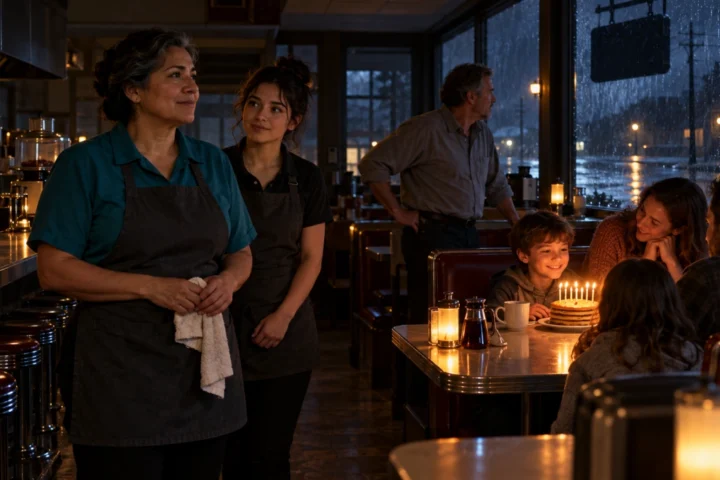
The lights went out while Rosa Medina was showing her replacement where the diner kept its birthday candles.
Across the counter, a little boy inhaled to blow out the seven flames on his pancakes. The exhaust hood stopped. The pie case went dark. Somewhere behind Rosa, a plate shattered.
"Nobody move yet," she said.
She had worked at Cedar Street Diner in Dayton for nineteen years. She knew which stools wobbled, which regulars needed help standing, and how long the emergency lights would last. What she did not know was why the woman she was training had been offered her entire schedule.
That morning, owner Dean Porter had said, "It's coverage, Rosa. You're moving into management. We talked about this."
They had talked about it for three years.
Now the new server, Tessa Ward, stood beside the register with a birthday candle illuminating her frightened face. Through the front windows, rain crossed the parking lot sideways. A dead traffic signal swung above the intersection.
Rosa turned off the coffee warmer and called to Luis in the kitchen. He was already shutting down the cooking line.
"Keep the refrigerator doors closed," she told him. "I'll check the tables."
Dean emerged from his office holding his phone above his head, searching for reception.
"We can still do cash," he said. "Rosa knows how to keep us running."
Tessa looked at her. "He told me you'd be leaving the floor on Monday."
Monday was four days away. Rosa had no new contract, no new pay rate, and no management schedule. At home, her sixteen-year-old son had two tickets to his school concert beneath a magnet on their refrigerator.
Dean moved toward the locked front door.
"Don't turn that sign," he said. "People need somewhere to go."
Rosa put her hand over the switch for the OPEN sign, although it was already dark.
"Then we decide what we're actually offering them," she said.
The plant director put the admission form on the table before I could sit down.
“Sign it. We'll call it a resignation instead of a termination.”
Through the glass, I could see my name on a locker in the packaging plant. After eleven years, that name had never appeared on an office door. Today it appeared beneath a sentence I hadn't written: I authorized shipment despite incomplete test results.
I pushed the paper back.
“I put that lot on hold.”
Mark Delaney, the operations manager, opened his laptop. The lot status read RELEASED. My employee number appeared beside it.
“The system says otherwise.”
Three days earlier, I'd attached red hold labels to eight pallets of food trays after seal testing failed. Mark said the equipment was wrong. I requested a retest. He said the truck was waiting and our customer wasn't paying us to argue.
Now the customer was returning the shipment. The company wanted me to carry the blame through the gate.
I checked the release time: 6:42 p.m.
“I was at the hospital with my daughter.”
My daughter had finally stopped wheezing when somebody at work used my employee number.
Mark folded his arms. “Anybody can tell a story.”
The door opened. Denise from human resources came in carrying the cordless handset from my workstation.
“The customer is waiting,” she said. “They want the person who sent Monday's hold notice.”
I looked at the director.
“Before you tell me what I authorized, you should read what I sent.”
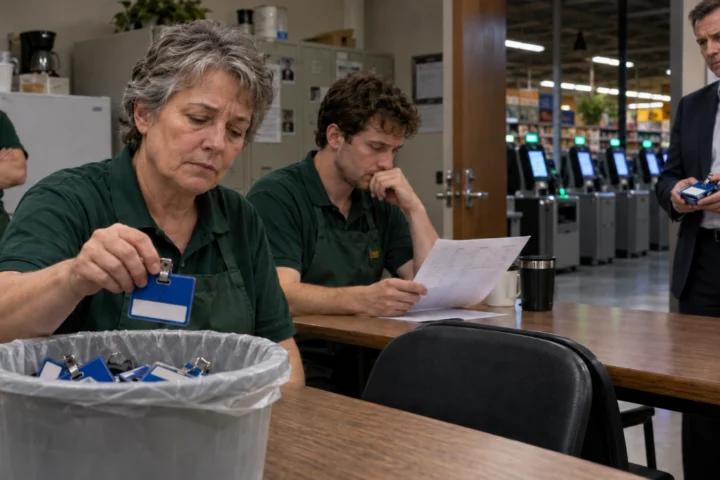
I found my name tag in the trash just before the “new technology training.” The blue plastic still had a scratch through the E in EVELYN. Beneath it were Paula’s, Dev’s, and nearly every other cashier’s badge.
The night before, Mr. Price, the regional manager for Bellwood Grocery, had emailed us to say everyone would have a job after the self checkout lanes were installed. The store was closed for three hours of training this morning. I thought the old badges had been thrown away because we were getting new uniforms. Then I saw next month’s staffing plan on the printer: six self checkout host positions, two at the service desk, and no cashier line for the eighteen people working those jobs now.
I had scanned groceries at Bellwood for nineteen years. I knew Mrs. Chen wanted her eggs placed at the end of the belt and Mr. Harris checked every receipt before leaving. But this month, what I most needed to know was whether I would still work enough hours to keep our insurance. Price’s email gave no hours. The staffing plan had no names.
Dev, who had joined us two years earlier, looked over my shoulder. He was better with computers than I was and hoped for a host position. “If there are only six,” he asked, “what are they training all of us for?”
I folded the page, planning to ask our store manager. The break room door swung open. Price walked in carrying new badges printed with just two words: SERVICE HOST. He looked at the old tag in my hand, then at the staffing plan.
“Where did you get that?” he asked.
I could have told him I had found it in the trash. But Paula stood just behind him, holding her husband’s medication bag and appointment calendar. I asked what we both needed to hear before going into the training room: “How do six positions work for eighteen people?”
When I walked into Human Resources with a brace on my wrist, my resignation letter was already on the desk. “Marisol Vega” was typed correctly. So was my employee number. Only the signature line was blank.
The day before, a storage rack at our distribution warehouse in Dayton had failed while I was scanning boxes beneath it. Glass jars shattered around my shoes, a metal brace struck my shoulder, and I caught myself on the floor hard enough to hurt my wrist. The doctor told me not to lift anything heavy until a follow-up visit. I thought this meeting was about finding temporary work that fit those restrictions.
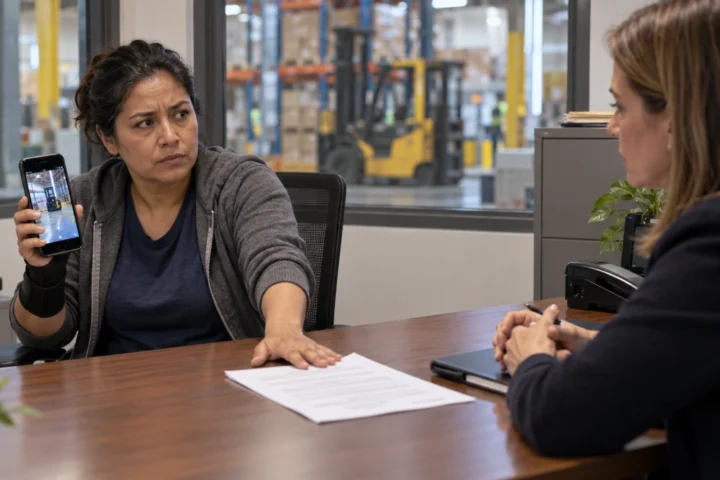
Ms. Ford from HR turned the paper toward me. If I “voluntarily separated,” she said, I would receive a three thousand dollar transition payment and keep my insurance through the end of the month. The offer expired at five that afternoon. I asked about my work injury claim. That was a separate process, she said, pointing again to the signature line.
“Why do I have to resign?” I asked.
“We haven’t found a position within your lifting limits,” she said. “And according to the initial report, there was no warning about the rack before the accident.”
My phone buzzed. Aisha, who worked my shift, had sent a photo of an incident log from eight days earlier. Her handwriting, mine, and Ray’s signatures appeared beneath the words: “Third level support bent after forklift impact. Stop using this rack.” At the bottom, our supervisor had written, “Forwarded for action.”
I looked up. Ford was still waiting. In the hall, a forklift sounded its short, repeated backing alarm. If I signed, I could pay next month’s rent. If I didn’t, I would have to prove a warning the company said had never existed.