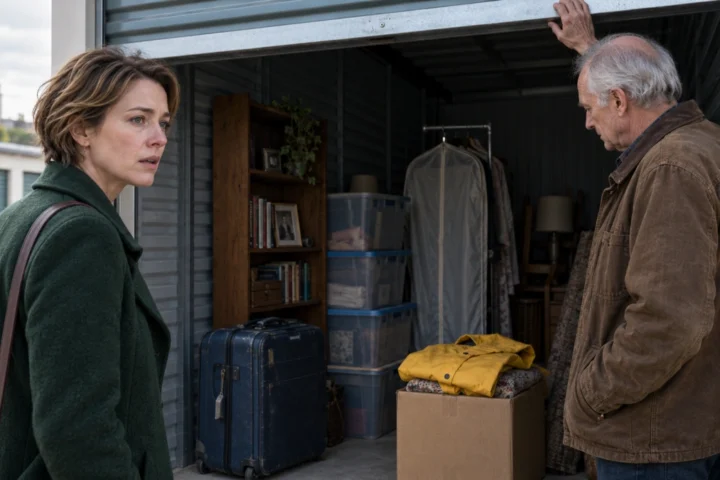
Original fiction
On this page
Mom’s Moving Day
The FOR SALE sign stood in the front yard beneath my old bedroom window. I had just stepped out of my car with a box of roofing tools. My younger brother, Sam, was pulling a ladder from his trunk. We had come to fix the leak above Mom’s laundry room. Nobody had told us the house was going on the market.
Mom opened the door before we could ring. She wore a blue shirt and held a roll of tape and three sticky notes. She glanced at the sign, then at us. “I planned to tell you after the roofer looked at the leak,” she said.
“What roofer?” Sam asked. “I brought a ladder.”
“I hired someone insured. He’s coming this afternoon.”
Sam set the ladder down harder than he needed to. Dad had been gone six years, and Mom had lived alone in the house outside Columbus ever since.
Mom handed me a sheet of paper. It listed a showing schedule starting the following Saturday, an asking price, and the address of a single-level condo near the downtown library. She had seen it twice. She had not signed to buy it, but she was preparing to list the house. Sam read over my shoulder, his expression changing.
“What about Dad’s workshop?” he asked. “My things are still in there.”
“I want you both to choose what to keep,” Mom said. “I texted last month about clearing the attic and shop.”
Sam shook his head. I remembered the message. Mom had asked whether we could help her sort the attic and workshop sometime that month. I had said I would be free after the college admissions rush. Sam had sent a thumbs-up. Neither of us had asked why she wanted to do it now.
A car stopped at the curb. A woman climbed out with a folder, looked at the sign, and asked Mom whether she could take a few photographs of the front yard. Mom said this was Vivian, the real estate agent, due at ten. My watch said 9:57. We were still standing beside the ladder and the leaking roof while an outsider had arrived to begin the move Mom had not finished telling us about.
The woman’s name was Vivian Flores. She did not raise her camera right away. She asked Mom whether she wanted to postpone. Mom said she could photograph the front yard, but the inside would have to wait until after the roofer came. Vivian nodded and walked toward the fence. I was grateful she did not pretend the two adult children beside a ladder were part of the landscaping. Mom led us into the kitchen, where three mugs were already waiting. She had expected a reaction. She had still made coffee.
“Since when?” Sam asked.
“I started looking at condos in August. I called Vivian three weeks ago.”
“And we find out from a sign?”
Mom sat down with both hands around her mug. “I haven’t signed a sale contract. I meant to tell you before the listing went online. The sign arrived sooner than I expected.” She admitted that did not make the surprise easier. I asked whether she had debt she did not want us to know about.
Mom did not take offense. The house was paid off and the bills were current, she said. But property tax, insurance, a roof repair, and yard work were eating into money she wanted for the years ahead. She did not plan to live alone in a four-bedroom house simply because everyone was used to seeing her in it.
I was Claire Parker, thirty-eight, and worked in admissions at a community college. My apartment was a twenty-minute drive away. Sam was three years younger, a heating technician who lived across Columbus with his wife and son. Dad had died six years earlier. After the funeral, both of us kept calling Mom’s house “our house,” although neither of us paid its taxes or slept there every night. Mom had never corrected us. Maybe she knew a comforting phrase was not worth fighting over until we began to use it like a claim.
Sam asked why Mom had not let us repair the roof, mow the lawn, or find cheaper help. Mom pointed at the ladder outside. “You’re trying to do those things right now. A repaired roof won’t make this house smaller.” Last winter, she said, heat ran upstairs all night for rooms nobody used.
In spring she had to hire someone to remove storm-damaged limbs. I offered to turn the office in my apartment into a bedroom if she wanted to live near me. Mom said she loved me but was not asking for a bed in her daughter’s home. She wanted a place of her own.
The condo she liked was on the ground floor, an eight-minute walk from the downtown library and close to her friend Ginny from the book group. She could reach a bakery and a park without driving on the highway. I started to ask whether she was sure about the area, but Mom had a map, the price, the monthly fees, and a list of bus routes she had tried. She did not ask me to trust every number on the spot. She wanted us to see that she had not chosen an address from a photograph and ignored everything else.
Vivian’s camera clicked in the yard. Each shutter sounded like a fingernail tapping glass. Sam looked toward the workshop at the end of the driveway. Dad had built tables, repaired chairs, and kept a long workbench beneath its window. After he died, Sam brought some of his own tools there because the house he rented had no shed.
Some things in the shop had been Dad’s. Some were Sam’s. Other boxes had not been opened since we cleaned up after the funeral. Mom had asked us twice to sort them. I had promised next month; Sam had said when it cooled down. I could not remember ever asking Mom how many boxes she had to walk around to reach her watering can.
“I can’t move all that in one week,” Sam said.
“I haven’t asked for one week. I want to start this weekend and agree on a deadline together.”
“I thought you were letting me use the shop.”
“I was,” she said. “Now I won’t have a shop to lend you.”
Sam stood up. He said he was going to check the leak before the next rain. Mom reminded him that an insured roofer was coming, but Sam still wanted to put a bucket under the drip. I followed him into the laundry room. The yellow stain on the ceiling was larger than when I had seen it the week before.
He set down a bucket, moved a cloth from the dryer, and asked quietly, “Did you know?” I shook my head. Mom could have told us before the sign went up, he said. I agreed. Both things could be true: she had every right to sell, and learning it from the yard still hurt.
The roofer came that afternoon. He climbed up, photographed loose shingles and damp material near a vent, and said the area should be repaired before interior pictures because the leak could spread. Mom asked for a written quote and the earliest available date. Sam asked about the warranty. For a moment they sounded like a team.
Then Sam told the roofer to email the estimate to him. “Send it to me,” Mom said. “Sam can review it with me.” The roofer wrote down her address. Sam flushed but did not argue. Later he said he was used to handling roof problems. Mom said she could welcome his advice and still be the person hiring the contractor.
That night I reread Mom’s texts. Along with the request about the attic and shop, she had said in June that backyard maintenance cost too much this year. I suggested trimming fewer shrubs. Sam had said she should close off the big dining room because nobody used it. We heard each complaint as a separate repair and never asked whether she wanted to maintain the whole house at all.
Mom had not said “I’m selling” when the idea was still new. She wanted to be sure it was her choice before it became a response to her children’s worry. I still wished she had given us more time to be sad. I was beginning to understand why she did not want every discussion of the house to become a vote.
I called Sam from my apartment. He was in a supermarket parking lot, buying a tarp for the shop. Did I think Mom had hidden the plan because she knew we would stop her? Probably, I said. If a buyer wanted to move in quickly, he would have to rent storage, and he had not budgeted for that. I did not say he should throw things away.
Dad’s workbench was not an old carton. I asked which thing he most wanted to save. The bench, he said, though his house had no space for it. Could he measure it and let us look for an option together? He said he would after he was less angry. It was a more honest answer than any plan we had that day.
The next morning Mom sent us photographs of the budget she had made. The house had no mortgage, but taxes, insurance, heat, yard care, and repairs averaged more than the fees for a smaller condo. She planned to sell at a price that did not have to set a neighborhood record, buy a one-level place, and keep the remaining money as a reserve.
She included moving costs and a month of storage so we had time to collect our things. I realized she had put a price on our delay. I called and asked whether she wanted me to check the numbers. Yes, Mom said, if I was looking for anything she had missed rather than trying to prove she should stay.
That evening I looked at Mom’s numbers beside my own rent bill. She had left room for condo fees to rise, for moving costs to exceed the estimate, and for one year’s worth of ordinary surprises. I found an insurance line I did not understand and asked about it. Mom showed me the letter from her agent. Then she asked whether I had noticed the line for occasional travel. I had not.
She wanted to visit a friend in Michigan twice a year, something she had stopped doing because arranging someone to watch the house and yard made every trip feel difficult. Her plan was not merely a cheaper way to sit indoors. It was a budget for the days she hoped to have. I caught myself thinking that travel sounded optional while roofing sounded necessary. Both judgments belonged to me, not to the person whose account would pay for them. I marked the insurance question resolved and left the travel line alone.
That weekend we went into the attic. I brought labels and markers; Sam brought dust masks. Mom had set out three boxes: keep, donate, and ask. She had not put out a trash box because she knew we might spend the whole day debating it. Broken things could wait. The first carton held a program from my high-school concert, an old curtain scrap, and three expired library cards.
Dad had written in the program’s margin, “Claire enters after the second song.” I wanted to keep the whole stack. Mom asked where it would live in my current apartment. I did not know. She did not laugh. She suggested choosing the one page that mattered and photographing the rest if I wanted.
Sam found a box of pictures of Dad standing beside the workbench. He sat on the floor with tape still in one hand. In one photograph, Dad was teaching him to build a drawer that would not close straight. Sam remembered ruining it the first time. Dad had given him a ruler and gone to make tea instead of fixing it himself. Mom remembered the day because the house had been full of the sound of planing wood.
Sam asked whether she truly wanted to sell the place where all that happened. She held the photograph for a moment and gave it back. “I want the picture,” she said. “I don’t need to pay taxes on four bedrooms to remember that your father knew how to make tea.” Sam said nothing. I knew it would take time before he stopped hearing that as leaving Dad behind.
Ginny arrived at lunch with sandwiches. She lived near the condo Mom had seen and knew the downtown librarian by name. Sam asked whether Ginny had talked Mom into moving. Ginny put the sandwiches down. Mom had mentioned wanting to live somewhere walkable two years earlier, she said. Ginny showed her the building only after Mom asked.
Mom looked at Sam. “You can be angry with me. Don’t turn my friend into the person controlling me.” He apologized to Ginny, awkwardly but sincerely enough that she stayed to eat. I realized Mom had conversations outside her two children. That was not evidence that she was leaving us.
After lunch, Mom asked whether I wanted the blue-glazed dishes. I had asked for them when I first lived alone, then brought them back because my apartment was small. Now I wanted them because they were on the table every Thanksgiving. I said I did not know yet. Mom wrote my name on an “ask” label and let the answer wait.
She was deciding about the dining table too. She wanted to take it if the condo living room was wide enough, rather than promising it away because we had eaten around it as children. I touched a dent I had made spilling a baking tray at eleven. For the first time, I imagined the table beside a different window and still belonging to Mom.
In the workshop, Sam measured the bench. It was almost a foot longer than the open wall in his house. He tried removing its legs, but Dad had built them so solidly that separating them would mean breaking the joints. Sam said he could rent a storage unit indefinitely. Mom asked the monthly cost. When he told her, she did not say he was wasting money.
She asked whether he wanted one object to come with a recurring bill, the way she now felt about the house. The question angered him. “You’re selling this place, and I lose my workshop,” he said. “Now I can’t keep the bench either?” Mom said she wanted him to keep it if he chose it. She did not want that choice to become a bill he resented her for every month.
I suggested photographs, another measurement at Sam’s house, and a conversation with a woodworker before we decided whether the bench could be shortened. Dad’s bench was not cheap modular furniture, Sam said. I agreed. That was why we should ask someone who understood wood. Sam called a friend from Dad’s old workshop. The man could come the following weekend. We put an “undecided” label on the bench. Mom said that was enough for the day. A house going up for sale did not mean every object inside needed a fate before dinner.
On Sunday evening, I stayed after Sam left. Mom stood in my old room, now crowded with blankets and an artificial Christmas tree. Did I think she was unfeeling? No, I said, but I was sad she had been preparing longer than I knew. She sat on the edge of the bed. For a while, she too had been afraid the house was the only place Dad still existed.
The first year after he died, she had not moved even one of his mugs. In the second, she began using the workshop to store garden tools. This year, when it rained hard, she realized her first thought was no longer of him. It was of the bucket under the laundry-room ceiling. She did not want a good memory to become the reason she spent another decade on edge.
Why hadn’t she told me that over the phone? She had tried to say she was tired of the yard and roof, she said. I offered a cheaper landscaper. Sam offered a leaf blower. “You love me by solving one task at a time,” she said. “I was asking myself where I want to live.” It stung because she was right.
I told her that finding out from a yard sign still hurt and would not be easy to forget. Mom owned that. She should have invited us over before Vivian put it up, even though her plan did not require our permission. I could accept the apology without asking her to withdraw the decision.
The next week Vivian sent photos of the repaired roof. The laundry-room ceiling had been dried and repainted after inspection, and the roofer provided an invoice and pictures of the repair. Sam reviewed the documents, asked about one layer near the vent, then let it go. Mom paid the bill. Vivian proposed an asking price based on nearby sales, explaining a likely range and time frame.
Mom asked about fees, possession dates, and what would happen if she had not found a suitable condo. I sat with them because she invited me and took notes on unanswered questions. When Vivian said they could “go live now and catch the weekend traffic,” Mom said she would read the paperwork that evening. She was not slow because she was afraid. She was using the time available to the owner of the house.
The first condo Mom liked was gone. Its seller chose another buyer. I waited for her disappointment to make her abandon the whole plan. She was disappointed. She skipped book group that evening and scheduled visits to two other places. One had a bright bedroom but high monthly fees; the other was closer to the library but had an entrance step she disliked. She crossed both off.
I asked whether we should pause the listing until she found somewhere to live. Maybe, she said, if the sale moved faster than expected. She was not going to keep a draining house forever because one condo did not wait for her. She asked Vivian about a closing date that would leave time to move. We were finally discussing an actual risk, not a rumor that Mom could no longer take care of herself.
On the first open-house day, Sam picked Mom up for lunch with his wife and son while Vivian worked. His son Leo asked why strangers were looking at Grandma’s bedroom. Sam said she was looking for another home. Was this one broken? Leo asked. Mom said no. It was still good for people who needed several bedrooms and liked tending a yard.
She wanted something smaller near the library. Leo accepted that and asked whether they could play the old board game at her next place. I looked at Sam. He smiled. A child could ask for what mattered to him without requiring an entire family to stand still around it.
Sam’s wife, Nina, called me after the open house. She said Sam had spent most of the previous year telling Leo that Grandpa’s workbench would someday be his. Sam had not made the promise to take property from Mom; he had wanted to pass on a way he remembered his father. Nina had warned him that “someday” needed an actual plan, but they never found room in their rented house. I told her about the woodworker who was coming to look at the bench.
She said she would measure the wall again, this time including the space Leo needed to move around it safely. We could give him a choice that did not end at a storage unit. When I hung up, I sent him the measurements from Mom’s shop without an argument attached. He replied with a photograph of the wall at home. It was the first message about the bench that looked forward instead of back.
Vivian reported three interested families after the showing. One offered a high price but wanted Mom out within three weeks. A couple with two young children offered a little less, accepted a longer timetable, and wanted a close inspection of the roof. Mom had not decided.
Sam said the higher offer could pay for years of storage for the workbench. I said extra moving time had value too, especially while Mom was still looking for a condo. She listened and asked Vivian to place all the terms on one page. She would not choose based on my excitement or Sam’s arithmetic.
I went with Mom to see another condo on Tuesday. It did not have the wide windows of the first, but the hallway was open, the entrance was level, and the living room had enough space for the dining table with its extension leaves removed. Mom stood in the kitchen, opened every drawer, and tried the light switches. She asked the manager about maintenance fees, elevator repairs, and guest parking.
I waited until we were outside to ask whether she liked it. Yes, she said, but she wanted to walk to the library on an ordinary weekday. She went with Ginny the next morning and called me from the bakery afterward. She was breathing a little hard from the walk, but she sounded pleased. She decided to pursue the condo after reviewing the complete documents.
Mom negotiated with the family of four. She did not choose them because she imagined they would repeat our childhood in the house. Their proposed moving date gave her room to find a place, and their price still worked for her budget. She asked them to inspect the roof before the sale moved ahead so nobody would argue later about the old leak. They agreed.
Vivian tracked the dates. I helped Mom put them on a calendar. When the buyers asked to keep the built-in cabinet in the dining room, she said yes. Sam wanted to know why she would not take it apart. It belonged on that wall, she said, and her new place did not need it. A piece of furniture could stay while the memory of the person who built it traveled with us.
One evening I told Mom what I had not said when I saw the yard sign. After my divorce, I had left a box of clothes in my old room even though my apartment had enough closet space. I liked knowing that if my job or rent changed suddenly, there was a door I could knock on without explaining myself first. Mom said I could always call her. But she did not want to pay for four rooms and a roof so that one box could prove she was willing to help.
She could help me search for a place, sit with me while I worked through a budget, or let me sleep on the couch in her new condo if I needed to. I nodded, sad to lose an image of safety and relieved that love was not written into a sales contract. That weekend I took the box home. At the bottom was a coat that no longer fit. I put it in a donation bag, one small decision I could make without asking Mom to store it.
Vivian once called because the buyers wanted their roof inspector to come a day early. Mom was at a library event. I started to agree on her behalf to keep things moving, but Vivian said she would wait for Mom to call back. Mom checked her schedule and chose another morning when Sam could be there if anyone had questions about the repair invoice. The buyers came, inspected the roof, and asked about the repainted ceiling.
Mom handed over before-and-after photographs and the roofer’s paperwork. They asked a few more questions and continued with the purchase. I had assumed every delay threatened the sale. Waiting a day for the right person to answer made the exchange shorter. Mom did not need to do everything alone. She also did not need us to take ownership of every urgent minute.
Dad’s workshop friend came to look at the bench. He tapped the top, opened a drawer, and pointed to a seam near one end. It could not come apart cleanly the way I had hoped. But he could cut about a foot from the end, move the vise, and turn the offcut into a small shelf. Sam asked whether Dad would have hated that. The friend laughed.
Dad had shortened this very bench when he moved workshops years earlier; the seam was evidence. Sam ran his hand along the edge and said he would do it with the friend. He still regretted losing the old shape. He was also relieved the bench could remain a place to work instead of becoming a storage bill for a memory.
Packing took longer than Mom’s first schedule. One cabinet held charging cables for devices nobody owned. A box of photographs had no dates. Dad seemed to appear in every nail and paint mark. Some afternoons I wanted to throw everything away rather than choose. Mom sent me home early once and hired packers for the dishes. She did not want to spend all her children’s energy proving the house had mattered.
Sam moved the bench first. Leo kept its loose screws in a plastic container. I took the blue dishes after Mom decided to bring the dining table but not the china cabinet. She kept two bowls for her new place and gave the rest to me. We divided things by asking who would use them, not by staging a rehearsal for an inheritance.
When the moving truck arrived, Mom stood in the empty living room and saw the pale rectangle on the floor where the table had been. She cried. I did not say she could change her mind. The sale was far along and that sentence would not make room for grief. I asked whether she wanted to sit for a while. She nodded.
Sam made a final round of the windows and came back to sit on the floor beside us. Leo would miss the stair that squeaked on the fourth step, he said. Mom would miss it too, though she did not want to repair it again. We laughed and then sat quietly. Moving did not make the years in the house weightless. It meant that tomorrow she would live somewhere else.
At the condo, the movers placed the dining table by the window as Mom had marked on her floor plan. It fit, though adding its extension leaves blocked the path to the balcony. Mom stored them and said she would bring them out for a larger dinner. I offered to turn the table, but she tried that and preferred the morning light where it was.
Sam assembled a low bookcase, Leo put the board game on its bottom shelf, and Ginny brought warm bread. The place was not tidy yet. Nobody called it Mom’s temporary quarters. She walked from room to room knowing which things she had chosen to put there.
During the first week, Mom called me because she could not find the scissors. She called Sam about a kitchen light that flickered; he checked it and asked building maintenance to replace the bulb. She called the manager herself when the hot water was slow and walked to the library without us.
I had to stop treating each call as proof her plan was wrong. She had misplaced scissors and had lights fail in the old house too. I simply had not seen every inconvenience. Mom asked for help when she wanted it. She did not send daily reports to make us comfortable.
In the third week, Mom sent me a photograph of her new library card. Its back carried her condo address, not the address of the old house. I looked at it longer than necessary. It did not prove she would never feel lonely, but it showed she was using the new place for something she wanted, not merely sleeping there.
A month after the move, Mom invited us all to dinner. Sam brought salad. I brought a dessert Dad had liked. Mom made a soup she had learned from Ginny. Leo asked whether children really lived in the old house now. Yes, Mom said, though she did not know where they had put their beds and did not need to know. After dinner, Sam asked whether she wanted him to hold a spare key.
She had given one to Ginny because Ginny lived nearby, Mom said. A second was in a lockbox whose code both children knew. She did not want anyone dropping in without calling. Sam nodded. The bench fit his house now, he said, and Leo was learning to measure wood using the little shelf made from the cut end. Mom asked to see a picture, and he handed her his phone.
When we left, I stood with Mom at the condo door. She reminded me to take the remaining dishes from my trunk and asked whether I wanted to go with her to an author talk at the library the following week. I said I would check my work schedule. If I was busy, she would go with Ginny.
I looked down the bright hallway, past her to the table visible through the open door, and at the key in her hand. The old house still stood on another street, with other people to tend its roof. Here Mom had chosen where to place her things and whom to invite in. I promised to answer about the author talk the next evening, then let her lock her own door.
Read next

The Name on the Baby Bracelet

The Stranger in the Will

The Empty Chair at the Wedding
My Sister Gave Away Dad’s Workshop Before He Moved Out—Then His Apprentice Arrived with the Missing Order Book
Reading notes
A mother’s moving day unsettles the future her family thought it had already arranged for her.
This is an original work of fiction. Characters and events are fictional. Explore public-domain books at Project Gutenberg or browse more stories on ReadStoryvia.