Original fiction
On this page
The Stranger in the Will
The attorney had barely said “half the house” when my brother laughed. It was the kind of laugh that comes out when there is nothing safe to say. I had spent the last eighteen months sleeping in a folding chair beside our mother’s bed. Dan came by between repairs at his auto shop. Yet half the house on Alder Street was going to a woman neither of us had ever met.
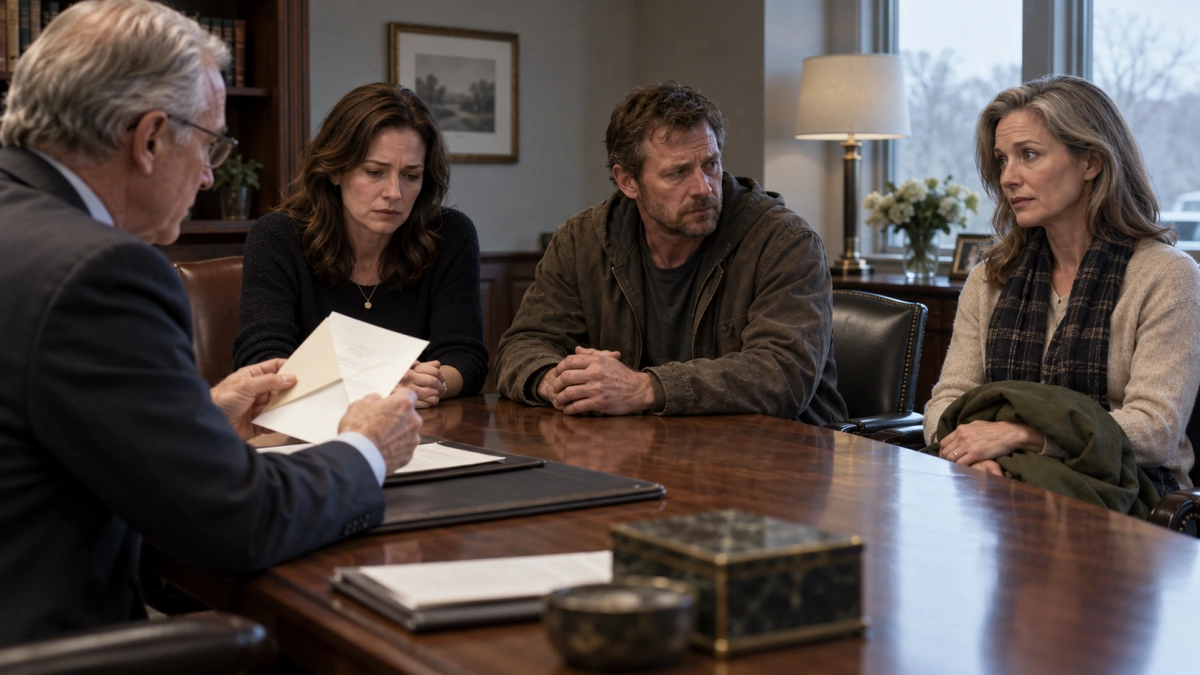
She sat at the far end of the table, a green coat folded across her knees. She didn’t smile when she heard her name. She watched the envelope in the attorney’s hands as though it might contain one more thing she was afraid to learn.
“There’s a mistake,” Dan said. “My mother didn’t know her.”
Mr. Harris took off his glasses. “June Whitcomb signed this will in front of two witnesses after meeting with me alone. She left one quarter of her estate to Daniel, one quarter to Claire, and one half to Maya Ortiz.”
I was about to say that a stranger was not getting a key to Mom’s house. Then Harris opened the letter she had instructed him to read with the will. Its first line made me grip the edge of the table.
“Maya is my first daughter.”
Dan looked at me. I looked at Maya. She had Mom’s gray eyes, but matching eyes could not explain a lifetime of silence. Maya said she had found Mom eleven months earlier through adoption records and a DNA match. She had asked Mom to tell us.
“She promised she’d do it at Christmas,” Maya said. “I waited in my car outside for almost an hour. Then she texted that it wasn’t the right time.”
That Christmas, Mom had sat between Dan and me, opened gifts, and eaten the waffles I made. She had said we must keep the house in the family. Now the woman left waiting in the cold was family too, and each of us held a piece of that promise.
For a while, nobody moved. Outside the conference room window, a city bus stopped in front of the corner pharmacy. People climbed down with shopping bags, waited for the walk signal, and carried on. I hated that the world could keep its ordinary schedule while we tried to understand a single sentence in Mom’s will.
Harris slid a copy of the document toward each of us. He explained that our shares would be calculated only after the estate paid its debts and expenses. Nobody could sell or retitle the house that afternoon. As the executor Mom had named, he would gather records, order an appraisal, and send the same accounting to all three of us. Dan asked whether we could challenge the will. Harris said we could consult our own attorney, but he would not advise an heir on suing the estate he represented.
“This isn’t about money,” Dan said.
“You asked what the house was worth before you asked her name,” I said.
He flushed. So did I. We both had reasons to care about the money. I had taken six unpaid weeks off during the winter when Mom kept falling. Dan had pledged equipment at his repair shop against a business loan. Maya alone sat quietly, perhaps because she didn’t yet know how often our family turned fear into a contest over who had sacrificed most.
Harris handed us a copy of an old birth record and a summary from the adoption file that had been opened under state rules. Maya was born in 1972, when Mom was eighteen. I was born nine years later, and Dan three years after me. Mom married our father in 1979. The dates lined up neatly on paper. In my head, our parents’ wedding photograph had changed into a picture of two people who knew something their children didn’t.
Maya stood first. “I don’t have to go to the house today,” she said. “But I would like to see where she lived before everything is cleared out.”
“We’ll schedule a visit,” Harris told her.
Dan watched her hand settle on the door handle. “Are you really taking half the house?”
“I didn’t write the will,” she said. Then she left us with that answer.
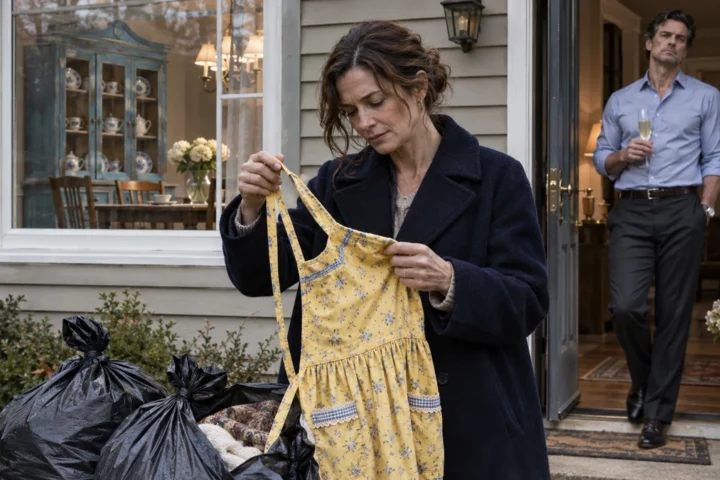
I drove back to Alder Street in the rain. The white two story house had a slanted porch step, a maple planted when I started first grade, and a doorbell that rang only if you pressed its left corner. I had moved back in for my last year of college after Dad died.
Years later, I came back when Mom began forgetting the route home from the grocery store. It had never been a perfect house. Water collected on the kitchen window every winter. Mom rolled up a towel beneath the door. Whenever I suggested replacing it, she said we would do it next year. She always had a next year to offer.
Ellie called from her dorm in Columbus. My daughter wanted to know how the reading had gone. I told her Mom had left me a quarter of the house. There was a beat of silence before she asked who had the rest. I explained about Maya but left out Christmas. I could not yet bear to hear myself say that Mom had kept one daughter waiting in a car outside while the rest of us exchanged presents.
“How long did Grandma know?” Ellie asked.
“Eleven months.”
“So she had time.”
I wanted to argue that Mom was ill, that her memory came and went. But she still remembered every grandchild’s birthday, the door code, and how Dan took his coffee. She had changed her will in March, after Christmas, when her doctor documented that she understood her decisions. I couldn’t use her illness to erase a secret she had chosen to keep.
Dan arrived that evening with cartons of takeout. We sat at the kitchen table beneath Mom’s medication chart and the church calendar. Between mouthfuls of noodles, he said a friend knew a litigation attorney. If we proved that Maya had pressured Mom, perhaps an older will would control. I asked what evidence he had. Maya appeared and got half the house, he said. Wasn’t that evidence enough?
“Mom wasn’t a puppet,” I said.
“You just told me she shouldn’t get half.”
“I said I don’t understand it.”
Dan shoved his carton away. “You live here. You know what this place is worth to you.”
“And you know what it’s worth to your shop.”
We stared at each other. I didn’t know the exact balance of his business debt. He didn’t know I had borrowed from Ellie’s college fund to repair Mom’s roof the previous year. Mom knew both things. Whenever either of us was short, we told her in a voice meant to sound like nothing was wrong.
After Dan left, I opened the drawer beneath the microwave. The electric bills, washing machine warranty, and church envelopes were still there. So was an envelope in Mom’s handwriting: “If something happens, call Harris.” I had once considered that practical. Now it looked as though she had prepared for a confrontation in which she would not have to answer questions.
Two days later Harris called with his preliminary findings. The house had a home equity line balance of roughly fifty one thousand dollars and almost seven thousand in overdue property taxes. The heating system might need work before a sale. He had ordered an independent appraisal. The lender could demand payment after the owner’s death, which meant we couldn’t simply lock the door until we felt less angry.
I asked what Mom had used the line of credit for. “The account is in her name,” Harris said. “I’ll send the statements when I have them. I can’t give you a reliable breakdown yet.”
I looked up at the old water stain on the kitchen ceiling. I could count the nights Mom woke me because she was cold, but I could not explain where fifty one thousand dollars had gone. Maybe that was what stung most. I thought I understood the house because I knew where she kept the cleaning rags.
On Saturday, I texted Maya the address of a diner halfway between our homes. Ten minutes later she wrote, “Two o’clock. I’ll come alone.” I arrived early and took a booth facing the parking lot. When she came through the door, I recognized Mom’s walk from before her knees began to hurt. I resented myself for seeing it.
She ordered hot tea. I asked what she had wanted when she went looking for Mom. She let the tea bag sit before answering. “Medical history, at first. I had a spot my doctor wanted checked, and my daughter had questions about our family. My adoptive parents were good to me. I wasn’t looking for replacements.” She paused. “Then June answered the agency’s letter. She wanted to meet.”
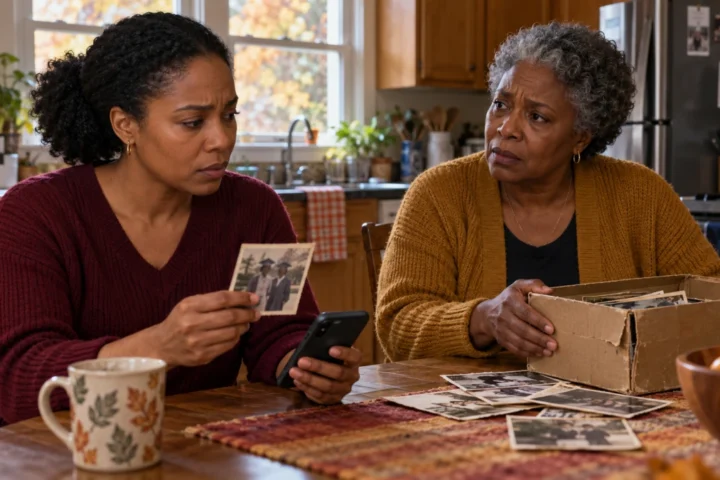
They met in the park beside the public library. Maya brought a picture of herself at ten. Mom brought cookies wrapped in foil. They talked for three hours, but Mom kept asking whether Maya had eaten breakfast, where she lived, and whether she liked flowers. They were a mother’s questions, decades late and unable to fill the missing years. Maya went back the next week anyway.
“Did she tell you about us?” I asked.
“All the time. She told me you worked at the school library, that Ellie played soccer, that Dan had his own shop. She was proud of both of you.”
“Proud, but she wouldn’t tell us you existed.”
“I said that to her too.”
Maya didn’t defend Mom. That made it harder to cast her as someone breaking into our lives. She said she had gone to church with Mom once, entering after the service began and leaving before coffee hour. She refused to do it again. At Christmas Mom invited her over and promised an introduction after dinner. Then the text arrived. Maya drove away, pulled beneath the canopy at a gas station, and cried in the parking space by an air pump. She didn’t see Mom for almost a month.
“Why did you go back?” I asked.
“Because she apologized. And because I wanted to decide for myself whether we could build something truthful, even if she was bad at it.” Maya set down her spoon. “I didn’t know about the will until Harris called. June said she wanted to put right some part of the past. I told her money couldn’t take the place of a hard conversation.”
I must have looked skeptical. She opened her phone and showed me their messages. Mom had written, “I’ll tell Claire and Dan before my birthday.” Maya replied, “I need you to tell them while you’re still here.” Mom’s April birthday came and went. She died in early June. I handed the phone back without asking for screenshots. I had enough proof to be angry without carrying a copy in my pocket.
Outside the diner, Maya asked if she might see the house with me, without making Harris stand between us. I said I needed to speak with Dan first. She nodded. It was the first time I saw her composure slip. A grown woman had just asked permission to enter the home where her mother had lived, and she was preparing to hear no.
Dan objected immediately. “She’ll photograph every spoon and say it belongs to her.” I reminded him that Harris wanted an inventory and that nobody could take property before it was recorded. Maya would have the right to review the list, just as we would. If Dan wanted to be present, he could come. He agreed only after I promised not to hand out a spare key.
Ellie drove down from Columbus on Sunday to help. She brought markers, cardboard boxes, and a long loaf of bread. When Maya arrived, Dan stood at the front door with his arms folded. I introduced Ellie. “This is Maya,” I said, without adding any title. Ellie shook her hand and offered her a glass of water. Maya accepted. Their plain courtesy made me aware of how hard I had made a simple visit.
We started in the living room. Harris had told us to list anything of value and photograph the rooms before we divided personal belongings. Dan recorded Dad’s watch. I listed the china Mom saved for Thanksgiving. Maya paused by the bookshelf and studied a beach photograph from 1996. She didn’t touch it. I nearly told her that Mom hated that trip because sand got into her shoes. Then I wondered whether she wanted another memory of a year in which we had been together and she had been somewhere else.
In a kitchen cabinet I found a blue tin full of recipe cards. Maya asked if she could look. Dan reminded her that they were Mom’s. “I know,” she said quietly. She turned to the waffle card, where Mom had added in red ink, “Claire uses orange zest.” Maya laughed. June had once made waffles at her apartment, she said, and they couldn’t work out why one batch tasted better than another. I told her about the zest. Her smile retreated before it had a chance to settle.
Upstairs, Ellie took a picture of the pencil marks on her old bedroom doorframe. There were marks for her, two cousins, and one low line labeled “M. 1977” in a different hand. Maya stood a step away. “That wasn’t me,” she said. “I lived in Michigan then.” I looked closer. Dad had made that line for our old cat, Mabel, as a joke. For a moment, the three of us laughed. Then we fell silent. I had begun searching for Maya in every object when the truth was that Mom had kept her out of these rooms.
A soft cover notebook lay in Mom’s desk drawer. It wasn’t a diary. She had written down phone numbers, doctor’s visits, and house expenses. On a November page I found, “Dan, shop, 27,000,” and beneath it, “pay back when steady.” Dan was standing behind me.
He said Mom had offered to help when his car lift failed and the landlord demanded rent. I asked why he had claimed not to know how any of the home equity money was spent. He said he knew about twenty seven thousand, not the rest. Shame sharpened his voice, but it did not make his earlier answer true.
Maya closed the recipe tin. She didn’t ask whether Dan had repaid the money. I did. Dan shook his head. “I sent her three hundred some months, when I could.” I found three small payments in the notebook. He had also texted Mom that he would pay her back. The message was still on his phone. I photographed the page and told him to send the text to Harris. Dan glanced at Maya, waiting for her to use it against him. She said only, “I need to understand it because it affects the estate we all share.”
That evening Dan called to say I had humiliated him in front of an outsider. “She’s Mom’s daughter,” I said. The words came out more quickly than I expected. Dan hung up. I sat on the porch step beneath the maple’s shadow. Accepting Maya as family did not mean I was less angry with June. I might have been angrier, because Mom had made that acceptance costly for all of us.
The appraisal came the following week: three hundred ten thousand dollars in its current condition. Replacing the heating system might raise the sale price, but perhaps not enough to recover the cost. After the loan, taxes, estimated broker fees, and estate expenses, Harris projected around two hundred twenty thousand to divide, before accounting for Dan’s debt. It was a lot of money to us, but it could not solve everything each of us wanted the house to solve.
I went to a bank to ask whether I could buy out Dan and Maya. The loan officer reviewed my salary at the school library, my remaining student debt, and the education loan I had guaranteed for Ellie. I would need to finance nearly two hundred fifty thousand dollars, plus repairs to the furnace. The amount she could approve was much lower.
She wrote figures on a sheet of paper without pretending a little more determination would close the gap. “A co borrower would change things,” she said. I thought of Ellie and crossed the idea out before saying it aloud. She was twenty. I would not hold onto a house by borrowing against my daughter’s future.
On my way home I parked across the street. Mom had planted yellow chrysanthemums beside the mailbox because Dad liked that color. I could name a thousand things that had happened beyond the front door. The bank could only see an asset that had to be supported by income. I hated that, then felt relief that someone had finally named a boundary I could understand.
I called Maya and said I could not afford to purchase her share. She asked whether I actually wanted to remain in the house or whether selling it simply felt like abandoning Mom. I nearly told her that someone who had never lived there couldn’t understand. But Maya had lived her whole life with a mother shaped gap. She understood perfectly well that an address could not repair a loss. I told her I needed a few days.
I used those days to sort the records. I had paid fifty six hundred dollars for roof repairs before Mom died. In a text she had written, “I’m borrowing 5,600 from Claire. I’ll repay it when I draw from savings.” Her savings were gone. I gave Harris the invoice and her message.
He said I could make a documented claim for repayment, but it had to be disclosed to the heirs and recorded properly in the estate accounts. I did not want to turn caring for Mom into a bill. Yet the roof money had come from Ellie’s education fund. Separating those two things helped me feel less as though I were putting a price on love.
Harris also asked Dan for the messages about the shop loan. Dan sent them without a note. Harris explained that, if we all agreed, the outstanding amount could be deducted from Dan’s distribution under a written settlement. Otherwise, the estate would have to consider collecting it as a debt. Dan texted me, “I’ll sign. Don’t call me a thief.” I wrote back, “You aren’t a thief. You still have to repay it.”
Ellie found me at the house wrapping cups in newspaper. She asked why I spoke of Mom only as a patient I had cared for or a woman who had kept a secret. “I want to hear about her when she was young,” she said. I told her how, when I was fourteen, Mom had started dancing in a parking lot because her favorite song came on the radio.
She laughed all the way home while I hid my face beneath my jacket. Ellie wrote the story on the back of a picture of us at the kitchen door. She said she would make a book of memories, with room for anyone to add something.
I hesitated before telling Maya that Ellie had invited her to contribute. Maya sent a short story. The first time June met Maya’s daughter, Rosa, she brought three apples and an old gardening book. Rosa liked neither apples nor gardening. She kept the book because June had written inside it, “I’m glad to know you.” I read the sentence more than once. Mom could be awkward and kind, capable of hurting Maya and of trying to move toward her. One truth did not cancel the other. That night I spread the bank papers over Mom’s kitchen table.
The loan officer had circled the monthly payment I would face if another lender somehow financed the buyout. I added heat, insurance, property tax, and the cost of a furnace that might fail in January. The total was more than I could safely pay on my salary. For weeks I had imagined that keeping the address would make every hour I had spent there count. The numbers did not tell me those hours were worthless. They told me I could not make Ellie responsible for proving they mattered.
Dan came by to pick up a tool box he had left in the garage. I showed him the figures. He studied the page and said the shop could not lend me money either. He sat across from me and recalled the winter Dad taught us to play cards during a power outage. Mom had lit candles in soup mugs. Dan remembered the rules wrong, as he always had. I corrected him, and we both smiled before remembering why we were at that table.
“I thought she wanted us to keep it,” he said.
“She did. She also wanted Maya to have half. We can’t make both wishes work by pretending the mortgage isn’t real.”
Dan traced a water ring on the wood. He said that when Mom offered the shop loan, she had told him to be honest with me if the money came from the house. He had promised he would. I wondered whether every person in that room at Christmas had been holding back one conversation. I had not told Dan how much the roof cost me. He had not told me about the loan. Mom had not told either of us about Maya. None of those secrets was equal, but each had made the next conversation harder.
Before he left, Dan asked if I wanted him to stay while I called the broker. I said I would call in the morning. I needed one evening in the house without discussing its price. I washed the mugs, turned off the kitchen light, and sat on the porch until it grew cold. I could hear a neighbor dragging trash bins to the curb. The sound was ordinary, which was exactly what I was going to miss most.
At our next meeting in Harris’s office, nobody asked how to remove Maya from the will. We asked smaller, harder questions. Who would pay to heat an empty house? Should we sell as it stood or make repairs first? Which belongings could be shared, and how could Dan’s debt be recorded without turning every future family dinner into a trial?
Harris walked us through the options and handed us written estimates. We chose to sell the house as it stood after making the minimum heating repair needed for safety. The estate would cover the expense. None of us would have to advance cash we didn’t have.
Dan signed a statement acknowledging the loan from Mom. I filed the fifty six hundred dollar roof claim with my invoice and her text. Maya read both and signed to confirm she had received notice. She did not ask why I needed the money. When Harris left to make copies, she said, “I know you were here when June needed somebody. If she didn’t say that enough, I will.” I thanked her, then said she didn’t owe me those words. “I know,” she replied. “I still wanted to say them.”
Dan apologized to Maya in the parking lot. He said he had called her an outsider because he was afraid she would take his share away. Maya told him she could accept an apology for what he had said, but she could not accept one on June’s behalf. Dan gave an uneasy smile. No one could have photographed that moment and called it a reunion. Still, they walked to their cars without turning away from each other.
During the first month on the market, we got a low offer with a demand that the house be emptied in ten days. Dan wanted to accept it because a payment on the shop was coming due. Maya wanted to wait. I did too, although the thought of carrying an empty house through another winter exhausted me. Together we set a six week deadline and a minimum price based on the broker’s advice.
Dan called his bank and asked for an extension rather than forcing all three of us into a rushed sale. The bank gave him three months if he submitted a repayment plan. He stayed up two nights preparing a cash flow sheet. I checked the numbers for him, the way I used to help with his math homework. This time he did not tear up the page when he got something wrong.
A family of four offered close to our asking price. They asked whether the maple could stay and whether we would leave the height marks on an upstairs doorframe. I told the broker the tree was theirs if they bought the house, and so were the marks. At home I cried over a kind question from people I had not met. Ellie sat beside me and said we could photograph the frame. I told her a photograph was not the wood. “It isn’t,” she said. “But the wood can’t keep Grandma here either.”
Before we left the house, I reread the letter Mom had placed in Harris’s file. She wrote that, at eighteen, she had listened when adults told her Maya would have a better family if June did not look for her. Years later, every time she meant to tell us, she feared Dan and I would think our childhood had been built on our sister’s loss. Mom admitted that fear was no excuse. She apologized to all three of us and asked us not to make Maya responsible for her silence.
I sent copies to Dan and Maya. Dan read it in his truck and texted that he needed time. Maya read it at home. Two days later she said the written apology was clearer than anything June had managed to say in person, but the people receiving it were allowed to find it insufficient. I agreed. While I cared for Mom, I had waited for her to thank me for evenings I missed with Ellie. Now she would never get the chance. I had to decide those evenings had mattered, even if no one put them in a will.
Maya asked whether Ellie would mind if she added a page about meeting June in the park. Ellie said the memory book was not supposed to be a perfect monument to Grandma. If we kept only the lovely stories, whoever read it later would never understand why the three of us had to learn how to sit at one table. Maya wrote her page. Dan added a sentence about the broken car lift. I left in the story of Mom dancing in the parking lot.
On the day we signed the sale contract, we met at the house for the agreed belongings. Dan took Dad’s watch. I carried the recipe tin and a tablecloth. Maya received the sweater June had begun knitting for Rosa. She rubbed the unfinished cuff and said Rosa might never wear it, but she would know who had started it.
I photographed the doorframe and told Maya the story of Mabel the cat. She said her adoptive mother had marked her height on their kitchen wall and copied the lines over each time she repainted. Two houses could hold two real childhoods. Neither had to disappear to make room for the other.
The sale proceeds stayed in an estate account until the debts and costs were settled. Harris sent each of us a statement showing my roof reimbursement, Dan’s repayment, and the remaining inheritance under the will. We checked it, asked questions, and signed. None of us walked out rich. Dan used his portion to cover the most urgent shop bills.
I put the roof money back into Ellie’s education fund and made a deposit on a small apartment near the school. Maya did not tell us what she planned to do with her share. I did not ask. For the first time, I understood that her right to it did not depend on her giving me a reason I approved of.
Three months later Maya texted to ask whether I still made waffles with orange zest. Rosa wanted to try them, but June’s recipe card gave no cooking time. I photographed the back, where Mom had written faintly in pencil, “Until the edges are golden.” Maya sent a smiling face and asked if Ellie and I would meet her and Rosa at the old diner that weekend.
I said yes. I would not call it healing. We still had questions about June and days when we didn’t want to talk about her at all. But I brought the blue tin so Maya could choose a card, and Ellie brought the memory book with its blank pages.
As I got ready, I worried about how to introduce Maya. My sister? Someone I had just met? Was I allowed to use a word that big without pretending I knew her? Ellie caught me practicing in the hallway mirror. She said a relationship did not have to fit inside one introduction. I called Maya and asked what she would prefer. She was quiet for a moment. “If you’re comfortable,” she said, “you could call me your sister.” I told her I would. It was the first time the word did not feel like a debt.
On the way to the diner, I drove past Alder Street. Two small bicycles leaned against the porch, and the maple was beginning to turn. I did not stop. I thought of the woman who had waited outside in her car on Christmas, and of the two children who could now call that place home. When the light changed, I drove on to meet Maya. This time nobody would have to wait outside to hear her name.
Read next
The Empty Chair at the Wedding
My Father’s Plus-One
The Recording Mom Asked Us to Erase
My Sister Gave Away Dad’s Workshop Before He Moved Out—Then His Apprentice Arrived with the Missing Order Book
Reading notes
A stranger at a will reading reveals a family relationship that changes the meaning of an inheritance.
This is an original work of fiction. Characters and events are fictional. Explore public-domain books at Project Gutenberg or browse more stories on ReadStoryvia.