Original fiction
On this page
The Name on the Baby Bracelet
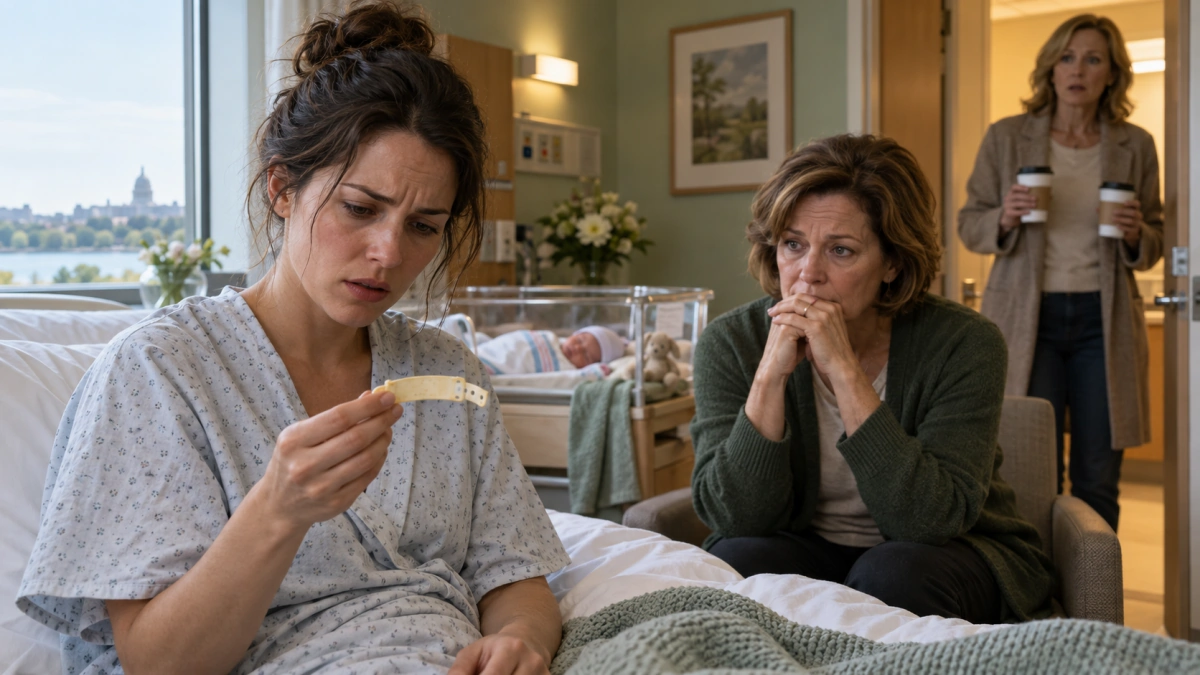
My mother brought the old hospital bracelet while I was learning how to hold my newborn daughter.
“It would look lovely beside her photograph,” she said. “Yours from when you were born.”
I held it beneath the light. The plastic had yellowed, but the date and birth weight were legible. The mother's name wasn't my mother's.
It was Aunt Carol's.
Mom reached for it. I kept it in my palm, safely beyond my daughter's tiny fingers.
“Why is her name here?”
In the hallway, Carol had just arrived with two coffees. She stopped at the question. A lid came loose, spilling coffee across her hand. She didn't look down.
My husband stood and settled our daughter in the bassinet. Nobody spoke while he fetched a towel.
“The hospital made a mistake,” Mom said.
Carol looked at her. “Don't do this again, Helen.”
I remembered birthdays when Carol left before the family photographs. Mom said she didn't like children, although she was the only person who remembered I needed a night-light in an unfamiliar room.
“Do what again?” I asked.
Mom sat, hands folded over her purse like someone in another waiting room years earlier.
“You've just had a baby. We'll talk when you're stronger.”
I looked at my sleeping daughter. All morning, people asked permission to hold her, open the blinds, or call the nurse. Only a question about my own life was being answered with later.
I put the bracelet on the table.
“I'm asking now. Who gave birth to me?”
Carol put the cups on a plastic tray near the door. Her hand was red, but she took the towel and held it herself. I'd known her face for thirty-two years, on Christmas cards, across dinner tables, on my phone. For the first time, I didn't know which person in my family I was looking at.
“I did,” she said. “I gave birth to you.”
Helen made a small sound as if to interrupt. Carol stopped. My husband, Miles, lowered the blind and asked whether I wanted him to stay. Yes. I didn't want a room occupied only by people who'd decided what I should know. He sat beside the bassinet, leaving the space between my bed and the door open. I appreciated the question before I could tell him so.
My name is Emily Foster. We lived in Madison, Wisconsin, where I scheduled appointments for a dental practice. Lucy was two days old. In my bag was a sheet of questions about feeding, with boxes beside each one. The biggest question of my life had no place on it. I turned it over and held a pen as though recording the answer might make it less frightening.
“Does Dad know?”
Helen nodded. Frank was at our house assembling shelves for baby supplies. He'd taken half a week off to help. I pictured the screwdriver in his shirt pocket, the afternoons he'd waited outside dance class in the snow. I didn't want one revelation to erase those things. I didn't want to use them as reasons to stop asking, either.
“Who else?”
Helen's other two sisters. My grandparents, now dead. A family friend. They listed names slowly, not like conspirators reciting a plan. Each name rearranged an old dinner. I asked about adoption documents. There were papers; the adoption had been completed when I was tiny. I wanted copies. A bracelet wasn't enough to explain legal circumstances I didn't understand, however much it changed the room.
Carol was nineteen when she became pregnant. Helen was eight years older, married to Frank, and had wanted a child for years. Their parents said a baby needed a stable home and Carol needed to finish school. She consented to her sister adopting me. That was the first fact. The next was a promise to tell me when I was old enough. Every time old enough arrived, Helen decided it wasn't the moment.
“You were seven when you asked why she didn't have children,” Helen said. “I didn't know where to begin.”
I remembered asking at fourteen why everyone had brown eyes except Carol and me. Mom laughed and said genetics skipped generations. At twenty-three, filling out a family history before an appointment, I'd called home with questions. Not all thirty-two years had been years when I was too young. I wrote the ages down because I could feel myself being pulled toward comforting her instead of remembering.
A nurse arrived and noticed the silence. Did I need fewer visitors? Yes, but I wanted Carol to stay ten minutes. Helen looked as though I'd asked her to leave her own house. I told her to rest and call Frank. I wanted him to know I'd heard. I would arrange a conversation when ready. Could she hold Lucy before leaving? Not now. I needed a little time without sharing my daughter.
Mom cried. I cried because I was exhausted and still loved her. Miles didn't order her out. He reminded her about her bag and offered to call a car. Frank would collect her, she said. After the door closed, the hallway sounds returned. Nobody suggested handing Lucy to Carol as a cinematic return of what she'd lost. I didn't want my baby turned into a way to repair an old decision.
Carol asked permission to sit. I nodded and asked why she hadn't told me. She looked at her cooling hand. At first, she hadn't controlled decisions about raising me after adoption. That didn't explain all the later years. When she'd tried to discuss telling me, Helen said not to come around if she intended to destroy the family. Carol feared losing the small relationship she had. She kept the door ajar instead of pushing it open.
“I'm not asking you to understand immediately,” she said. “I was frightened. I let that decide things for too long.”
Did she really dislike children? No. She hadn't known that was Helen's explanation when I wanted to stay overnight. I remembered calling for another bedtime story and being reminded that my aunt had work. Carol was closeness by appointment, love that left the room before the picture. Understanding that made ordinary memories ache in places I'd never thought to examine.
When ten minutes passed, I said I needed rest. She stood immediately. She didn't request a hug to prove I hadn't begun hating her. She discarded the untouched coffees and asked whether future contact should go through me or Miles. Through me, I said, but replies might take time. She nodded. Someone could arrive when invited and leave when asked. That simple arrangement felt like something I needed to learn again.
Miles asked where to put the bracelet. A separate envelope, not beside Lucy's things as Mom intended. He wrote the date on a corner and let me label it. I wrote old bracelet. I didn't know which mother's bracelet to call it. He didn't correct me. Lucy woke crying and brought us back to present responsibilities: diapers, milk, a child who didn't need family history explained before receiving care.
That night, feeding her under a low light, I imagined Carol at nineteen. I didn't yet know what she'd wanted or everything she'd been told. I pictured Helen sitting through my fevers, tying my shoes, worrying about ice near the lake. Two women could love one child, but only one had been permitted to be her mother publicly. That woman's love had come with control over what the child could know.
I wasn't rested enough to decide what our family should become. In the morning, I messaged Helen, Frank, and Carol together: no unarranged visits, no discussion in the family group, copies of documents and relevant health information, please. The message wasn't a trial. I needed space to bring a baby home without an entire old life lining up on the porch to explain itself. Questions could remain open without everybody being present.
Frank called without leaving a long speech. His text said he loved me, had known, hadn't told me, and would answer when I wanted. I reread it because there was no but. Helen sent a photograph of me at three and wrote that she'd always been my mother. I didn't respond. I wasn't debating whether she was my mother. I was asking why she believed the role entitled her to withhold part of my history.
We went home Wednesday. Frank's shelves stood neatly beside the changing table. There was soup, reheating instructions, and an unopened gift bag. I asked Miles to move the gift into the living room. I wanted the soup. Food wasn't an agreement to forgive. I'd learned young to accept something kind and assume I no longer had permission to mention what hurt. I needed those transactions separated, even if nobody else understood the distinction yet.
During the first week, Lucy often cried as I opened the documents. I folded them away, picked her up, and forgot my question. Miles bought another notebook. This didn't need to be resolved before maternity leave ended, he said. I laughed at the idea of a family without a filing deadline. Then I cried. He held Lucy so I could cry with both hands empty instead of trying to soothe somebody at the same time.
The papers confirmed a legal infant adoption by Helen and Frank. I read Carol's name, dates, and pages I'd never been allowed to know existed. They weren't the whole account. A signature didn't record being nineteen, living with parents, and hearing that a sister's home was better. I decided to consult a counselor experienced with adoptive families. I wanted something beyond turning each conversation into a search for a map none of us carried.
At the first appointment, I kept beginning with Helen being a good mother. The counselor didn't ask me to stop loving her. Could I describe anger without preceding it with praise so I was allowed to speak? I sat silent. I was angry that love had been presented through an edited story. Angry about reassessing memories. Afraid that admitting either would sound like I wanted to return my mother to the past and order another one.
Three weeks later, I met Frank first, in a park while Miles walked nearby with Lucy. Dad brought the remaining copies and asked where to start. Why hadn't he told me when I became an adult? He'd deferred to Helen, believing she would hurt most. What about my hurt? He removed his glasses and admitted he hadn't considered it enough. Silence had been easier than disagreeing with his wife. Nobody had prevented him from thinking differently.
He knew she'd sometimes said Carol didn't like children. He'd treated it as a way to stop me demanding more. I looked at the man who taught me not to lie to avoid trouble. He didn't answer with the shelves, tuition payments, or late drives to the clinic. Those things didn't entitle him to evade the question. I didn't feel better, but I wasn't required to carry a ledger of his good deeds into the conversation.
I didn't start calling him Frank afterward. He remained Dad. Keeping a title didn't remove responsibility; changing it wouldn't automatically repair anything. I invited him to shop for Lucy with Miles the following week. Was I sure? About the shopping trip, yes. I promised no more. We practiced letting an invitation keep its actual size instead of reading it as proof that everything had passed. A Saturday could be one Saturday.
At my request, Carol wrote a letter. She described her room while pregnant, hearing me cry, and returning home without a crib. She didn't claim I'd been abducted. She'd signed, partly believing she was choosing something better, surrounded by what adults called the correct choice. Later, her mother insisted she let Helen be a complete mother. Carol learned to express love by making less space for herself. It hadn't made her stop wanting space.
I paused there. I didn't want the letter used to make Helen entirely bad and Carol entirely powerless. I had questions for both. Had Carol made a concrete plan to raise me? Had she sought advice after starting work? She described periods of doing nothing but waiting, hoping that if she deserved more, her sister would allow it. She knew now that wasn't enough. I didn't have to rename all of that devotion so she could avoid responsibility.
At our first home visit, Carol sat beside the window. Lucy slept in Miles's arms. Did I want to hold her before talking? Not yet. We spent twenty minutes on the letter, then ten on Carol's bookstore job. I knew she loved mysteries but had never asked where she hoped to retire. A large secret had blocked ordinary questions, too. She had a life beyond the role she'd been permitted in mine, and beyond the one I'd just discovered.
Before leaving, she asked to hold Lucy. Yes, after washing her hands. She did, sat down, and received my daughter from me. Nobody took pictures. She didn't claim a grandmother's title or wait for me to supply one. She said the baby had a determined frown. I laughed without trying to rescue an adult from sadness. Ten minutes later, I reached for my child. Carol released her immediately. There was no symbolic struggle inside an ordinary movement.
Helen wanted our first talk at home. Family business belonged inside, she said. My home was where I was learning to parent and sleeping in fragments. I didn't want a conversation I might need to leave happening there. We reserved a small library meeting room for an hour. Miles stayed nearby with Lucy, available if needed. I brought my notebook. Mom brought a thick leather photograph album as if the years inside might answer for themselves.
She opened to my first birthday: rabbit cake, Frank behind my chair, Helen beside it. Carol wasn't in frame. Had she been there? She took the picture. Other photographs placed her behind the camera or in the kitchen cutting cake. I didn't need every image declared part of a plot. I needed Helen to see that somebody had inhabited our life while repeatedly appearing at its margins. An album could preserve love and an omission together.
Helen feared I'd grow up and find my real mother. What meant real? The woman who gave birth, she said, then heard herself. I wasn't denying her years of parenting. I refused a contest that required me to judge, keeping one woman by removing another. She couldn't insist biology didn't define love while treating one biological fact as capable of deleting all her love. The fear was hers. I'd been required to live inside its answer.
Did I still want her as Lucy's grandmother? Yes, if she respected what I needed now. Arranged visits, no using the baby to hurry replies, no explaining away my choices as exhaustion. I wanted specific falsehoods acknowledged and family information corrected after we agreed on wording. Disclosure couldn't become Carol's punishment or a performance of Helen's remorse. People affected needed a voice before the announcement, not merely permission to react afterward.
“Do you want me to say I didn't love you?”
“I want you to say you loved me and still did something that hurt me.”
She closed the album. The heavy cover hit the table. As a child, I'd understood putting something away meant the conversation ended. I stayed seated. Twenty minutes remained. Eventually she admitted telling me Carol disliked children despite knowing otherwise. She'd used fear to keep me close. She didn't know how to continue without looking terrible. I said making her look better wasn't the purpose of our meeting.
She cried and stayed. We used the hour without a closing embrace. I thanked her for answering a question and said I'd send a time to see Lucy. Was this supervised access? It was an arranged visit. If every boundary became a punishment in her account, I couldn't keep explaining by removing the boundary. She didn't like that answer. I could let her dislike it without deciding the answer was cruel.
Two days later came a short letter. Helen named her false answers without blaming dead grandparents. She didn't fully understand my feelings, but that didn't authorize her to decide when questions must stop. She wanted to listen when she answered badly. I read it beside the sink while Lucy lay near Miles. Nothing felt healed. I saw a narrow path on which I might try placing a foot, with permission to stop if it didn't hold.
We invited Helen and Frank for forty-five minutes on Sunday. Mom brought food and asked where to place it instead of reorganizing the refrigerator. She washed her hands and waited for Lucy. Was I sleeping? Not much, but I didn't want fatigue used to invalidate decisions. She understood, she said. I didn't know how much. She didn't argue. Sometimes a changed behavior appeared before the thought beneath it became reliable. I could observe one without announcing the other.
Frank poured tea. He didn't ask me to be gentle because Helen had cried. I knew he lived with her sadness. If he brought it for me to manage, we'd return to our beginning. At the agreed time, he reminded her about her coat. She looked once more at Lucy and handed her back, without introducing another question to extend the visit. I closed the door and exhaled without feeling like a daughter who had failed an examination.
A month later, we agreed on a message to close relatives. Helen and Frank confirmed Carol gave birth to me, they'd adopted me as an infant, and I'd only recently learned it. Questions about other people's reasons weren't to be routed through me. I approved it; Carol reviewed the parts naming her. Calls came immediately. I let them go to voicemail. One aunt wrote that everyone had acted for my benefit. Intention didn't erase keeping the beneficiary outside the truth.
A cousin asked why I was embarrassing the family just after having a baby. I didn't compose an essay to defeat him. Lucy's birth hadn't created the secret; it had made it visible. I wanted her family story told without beginning by hiding someone. Then I muted the group. A shared surname didn't entitle everyone to my maternity leave so they could feel comfortable. I could answer a question later without promising to accept its premise.
I thought about my biological father. Carol named David, someone from school who knew about the pregnancy. They weren't in contact. She had an old address and letters. I asked her to preserve them without sending them yet. I didn't need every door opened in one month. Choosing not to search immediately wasn't consent to the earlier secrecy. This time, timing belonged to me. Not knowing and not being allowed to know were different situations.
Carol supplied the health history she knew. I marked unknown information as unknown for future professional questions. I didn't rename every contact after one evening. Sometimes I changed Aunt Carol to Carol and changed it back. Thirty-two years of language couldn't be replaced like an email address. She didn't need a title as proof of progress, she said. I could believe that without insisting she never wished for one. Complicated feelings didn't require immediate public names.
She had a difficult day after I sent a picture of Lucy in Helen's arms. Her reply arrived late; she admitted jealousy and requested a day without talking. I respected it. A relationship couldn't depend on Carol always being more generous to deserve her place. I could stop sending pictures she didn't want, but couldn't hide Helen's continued presence. She agreed. She needed to carry her feelings without setting them in my hands to arrange.
Helen began her own counseling. I learned through a request to change a visit time, not an account of her efforts presented for credit. I didn't request session details. Could she keep the new time? Yes. I didn't want to manage the repair work of every adult. Kept promises mattered. I didn't need to inspect each mental step. My time with Lucy wasn't a case conference with breaks for diapers, even when family history occupied much of my mind.
Miles asked what to call Carol in front of our daughter. Carol, for now, while we worked out what fitted. Helen could remain Grandma Helen without making the title exclusive. A child could have several people who loved her without dividing affection into shares printed in a family tree. Names should help Lucy understand, not settle an adult competition. We would explain honestly in language she could grow into, rather than promise ourselves a later age we kept moving.
One evening, I called Carol about the song she'd sung when I was little. She remembered the tune and forgot some words. I remembered different lines. We pieced it together, got one wrong, and laughed. I wasn't measuring which woman remembered most and therefore deserved motherhood. I wanted a song for Lucy that had lived in my childhood. For once, I could ask why it had been there instead of treating its source as unimportant.
Helen offered copies of my old health notebook. I accepted. She mailed it with a note separating information supplied by Carol from what she'd learned taking me to appointments. Two sources stood together without disguising the join. Not every page was complete. Some memories were gone, and some people had died. I practiced tolerating unanswered questions without calling every gap a fresh lie. Honesty didn't guarantee a complete archive. It could distinguish missing information from information deliberately kept away.
Returning to work, I completed an emergency contact form: Miles first, Frank next. No box required deciding who my real mother was, although I'd feared every document would push me into that question. I submitted it and asked Helen whether she could keep an agreed evening visit. She could. I sent Carol a picture of Lucy holding a soft spoon without explaining whom I'd just called. Relationships weren't attendance records I needed to balance for everybody.
I didn't have to report each connection to reassure another person her share remained. I needed to keep appointments, ask for rest, and avoid promising what I wasn't ready to give. Some days that was easy. Others, silence tempted me because nobody would be disappointed yet. When I noticed, I tried one plain sentence. The listener could answer something real instead of a version I'd already edited to protect her from having to respond.
Before my appointment with the counselor, I made two lists. One held questions whose answers might come from records: dates, names, medical information, the adoption papers. The other held questions nobody could answer with a stamped page: why an adult kept postponing a conversation, what she'd feared, whether she could hear me now without defending herself.
I had been mixing them together. If the documents arrived, I expected the anger to settle. When it didn't, I worried that I was refusing repair. The counselor helped me see that supplying facts and rebuilding trust were different tasks. One could begin before the other felt possible.
I brought the lists home without turning them into assignments for the family. Miles asked whether reading them would help him understand what I needed. I said yes, except for a few pages I wanted kept private. He handed those back before opening the others. Watching him respect such a small instruction made me cry unexpectedly. The question wasn't whether I could trust anyone ever again. I could notice particular acts of trustworthiness and let them keep their particular size. He didn't need to rescue my childhood to return three pages unread.
He also admitted he didn't always know what to say. Sometimes I asked whether a memory had been real, then became upset when he tried to reassure me too quickly. We agreed he could ask whether I wanted listening, a practical task, or help identifying a question for later. That didn't make our nights tidy. Lucy still woke while we talked. We sometimes snapped over dishes. My family history didn't excuse treating him as someone who should know the correct response before I knew the question myself. I apologized when I did that, without apologizing for having feelings.
One afternoon, a relative mailed a baby book with spaces labeled Mother and Father across a family tree. I nearly put it away. Then I realized nobody required us to complete it that day. I could add pages, write a note, or choose another book. The printed layout wasn't a court deciding which people could belong. I put it on a shelf until I wanted to work on it. I didn't make a symbolic bonfire or fill every blank to prove I was adapting well. An unfinished book could simply wait beside the books Lucy would eventually chew.
I thought, too, about photographs I hadn't seen. I asked Helen and Carol separately whether they could preserve what they had without making a presentation. I wanted copies when ready, not surprise packages opened in front of people awaiting my reaction. Both agreed.
Carol found several ordinary pictures: me asleep in a car seat, a birthday cake before candles, Frank trying to assemble a toy. She listed them without sending images. For once, someone could hold something connected to my life and ask how I wanted to receive it. The pictures weren't an emergency. Their existence no longer depended on secrecy.
Frank asked whether he could help organize copies. I said he could scan the material I chose and leave the naming to me. He made two folders rather than deciding one account needed to replace the other. When he didn't know a date, he marked it uncertain. I appreciated that more than a polished chronology. My parents' new account didn't become reliable because it sounded confident. It became more usable when they could distinguish a document, a recollection, and a guess. I had spent enough time inside explanations delivered without room for a question.
None of those small arrangements stopped the sudden moments. Once, buying diapers, I saw a woman about nineteen carrying a baby and felt grief for Carol so sharply I abandoned my shopping list. I returned to the car, called Miles, and waited until I could drive. I didn't call Carol to make her relieve the feeling.
Her experience wasn't mine to reenact, and my imagined version might not resemble what she'd lived. Later, I asked whether she wanted to tell me more about those first weeks. She said another day. I could respect that answer without treating it as the old demand to remain ignorant forever. This time there was an acknowledged truth, a person answering for herself, and a conversation we could return to.
I wrote that distinction beneath my lists. A pause could protect somebody's capacity without denying my right to know. I didn't have to accept an indefinite delay disguised as care, and I didn't have to demand every answer immediately to prove I was free. We could agree on a time to return. If a promise wasn't kept, I could name that. I wanted honesty with room to breathe, not another family organized around fear of the next difficult question.
At summer's end, I invited all three adults for lunch. Not a reunion ceremony. No apology toast, surprise disclosures, or extra guests. Just us, Miles, and Lucy. Helen asked whether Carol wanted coffee or tea. Carol answered. They discussed roadwork. Two people who'd held an enormous secret needed practice with ordinary sentences free of implication. I didn't supply a profound subject to make their awkwardness look meaningful. Lunch could begin with sandwiches.
Helen called me to look at a photograph. Carol approached, too. Neither instantly retreated or clutched the album. I asked them both to sit and settled Lucy in the bassinet. Where was the third picture taken? Frank remembered a park; Carol remembered a picnic cut short by rain. Helen checked the date on the back. They could disagree and verify a detail without one person holding authority over everyone's memory. I listened without choosing a winner.
I selected a picture with Carol at the edge, handing me a hat, and requested a copy. Helen agreed without asking whether I still wanted one of her holding me. I chose that one, too. The photographs shared a new folder, not a ballot. I wanted memory expanded, not an old version burned before accepting a new one. The years of knowing couldn't be returned. The remaining years didn't have to force every truth to compete for a single chair.
Days later, I opened the bracelet envelope. I'd planned to keep it apart forever because Carol's name brought back the hospital room. An object didn't need to retain only the feeling of its discovery. I wrote a note with my birth date, the woman who gave birth, the parents who raised me, and the day I learned. Confirmed facts, not a sentence claiming every painful thing ultimately happened for a beautiful reason.
The note and bracelet went into a box beside Lucy's, in separate compartments. My daughter wasn't responsible for repairing my story. She deserved a home where questions received answers shaped by what she needed to understand, not by the fears of whoever held the information. I closed the lid. Miles called from the living room because Lucy had woken. The present was making an ordinary request, and I could answer it without resolving the past first.
Helen sat at one end of the couch, Carol at the other. Lucy lay on the mat between Miles and me. We were waiting for Frank and the bread. Nobody received the past back. Nobody became the only mother by erasing the other. I bent to retrieve a toy and heard my daughter laugh. Today, at least, I didn't need to leave the room so someone else could keep a beautiful photograph.
Read next
The Stranger in the Will
The Empty Chair at the Wedding
My Father’s Plus-One
My Sister Gave Away Dad’s Workshop Before He Moved Out—Then His Apprentice Arrived with the Missing Order Book
Reading notes
An old hospital bracelet unsettles a new mother’s understanding of the women who raised her.
This is an original work of fiction. Characters and events are fictional. Explore public-domain books at Project Gutenberg or browse more stories on ReadStoryvia.