Original fiction
On this page
My Father’s Plus-One
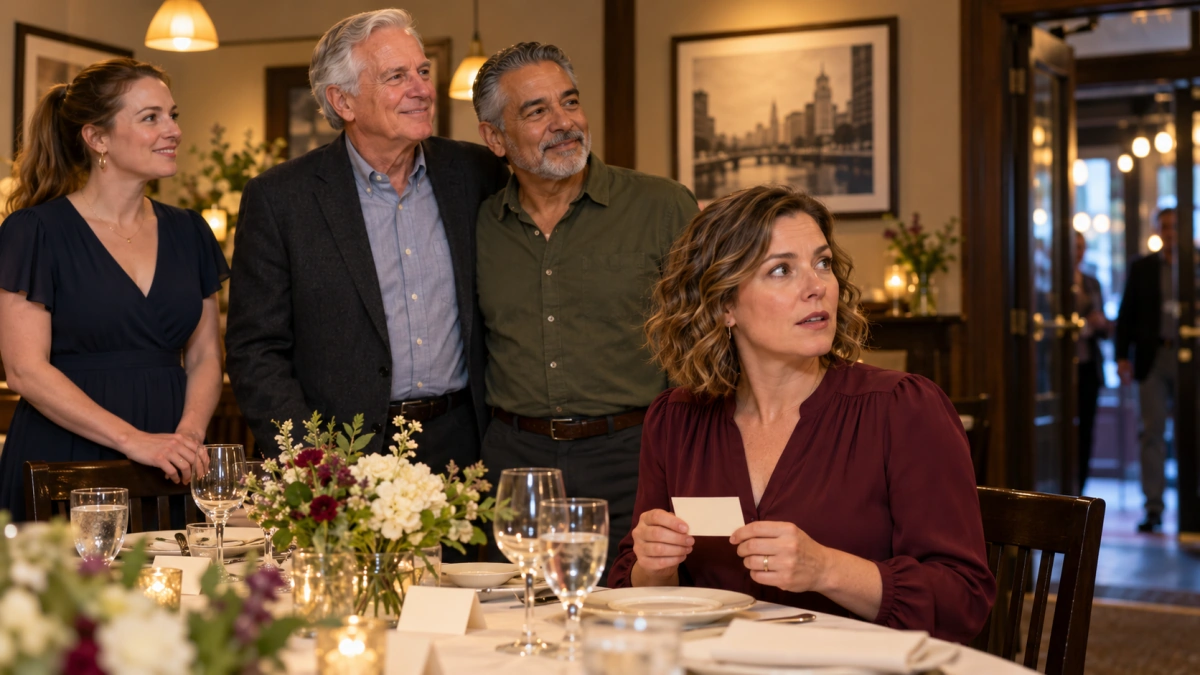
I was moving the last place card when my father walked into his retirement dinner holding a man's hand.
Not helping him through the doorway. Not greeting an old friend. Their hands rested together until they saw me, and then Dad let go.
That small retreat hurt before I understood why.
"Morgan," he said. "This is Rafael."
I looked down at the card I'd written that afternoon: CALVIN'S GUEST. At forty, I had organized enough dinners to know you asked for a guest's name. Somehow, when Dad said he was bringing someone, I had pictured a woman from his walking group and stopped listening.
Rafael had a neatly trimmed gray beard and an olive shirt beneath his coat. He extended his hand.
"It's good to meet you."
Behind me, my younger sister Paige said his name with the ease of someone greeting a person she'd met before.
I turned. "You know each other?"
Her silence answered first.
We were in a small restaurant room in Milwaukee, waiting for eight other guests to arrive. Dad's charcoal jacket still had a loose thread at the cuff. I'd meant to cut it off before the photographs. Twelve years after Mom died, I was still managing details as though enough careful work could keep our family in its familiar shape.
"We should have talked before tonight," Dad said.
"About what, exactly?"
He glanced at Rafael, who didn't rescue him.
"About the fact that Rafael is my partner."
Outside the door, a server laughed with somebody at the bar. I heard the restaurant continue being ordinary while the place card bent between my fingers.
Then Rafael looked at it.
"My name will fit," he said quietly.
I put the card on the table before I tore it. "Of course. Let me fix that."
There was a pen in my purse under a parking receipt and a peppermint stuck to its wrapper. I drew a line through the words and wrote Rafael Ortiz beneath them. The result looked like a correction on a school assignment. I turned it over and started again.
Dad stood beside the chair meant for him, touching the loose thread on his sleeve. He was sixty-seven and had retired from the same building-supply company where he'd worked since before Paige was born. I had chosen the private room because it was small enough to feel intimate, not trapped.
"Would you like to hang your coat?" I asked Rafael.
"Thank you. I can manage."
He wasn't rude. I had offered help with a coat because I couldn't yet offer anything that mattered. He took the hook nearest the door, then asked the server whether the empty water glasses could be filled.
Paige came to my side. At thirty-six, she could still make me furious by speaking softly. "Can we step out for a minute?"
"How long?"
She looked at the corridor. "Just until the others come."
"How long have you known?"
"Six months."
I looked at her navy dress, the one I'd helped her choose for tonight. We had discussed shoes and the menu and whether Dad would tolerate a retirement cake with a joke on it. Six months of ordinary conversations with an unopened room behind them.
Before I could answer, Dad's former coworker arrived carrying a cardboard box. Behind him came Aunt Lorraine, then a couple from Dad's neighborhood. The room filled with coats and greetings. Paige moved away to welcome them. Dad introduced Rafael by name and said they had come together. Nobody asked for an explanation in the doorway.
I took my seat across from them. A server described the specials, and I concentrated on the difference between roasted potatoes and mashed potatoes as if it would be on a test. Rafael ordered fish. Dad ordered chicken, then changed his mind because the fish sounded good. I knew that small indecision. Seeing it accommodated by someone else's patient smile felt unreasonably intimate.
Lorraine asked where they had met.
"At a volunteer book sale," Rafael said. "He tried to carry more boxes than the cart."
"The cart had a bad wheel," Dad said.
"It did. So did your plan."
People laughed. I did too, a second late.
The coworker's box contained a desk clock and photographs of terrible office holiday sweaters. For twenty minutes we talked about Dad's job. He had once driven through sleet to deliver a missing hinge because a customer couldn't secure her front door. He had also mislabeled an entire shipment of cabinet handles, an error his friends apparently intended to keep alive forever.
This was the dinner I had planned. It was happening a few feet away from me, and I kept missing it because I was counting years. Mom died twelve years ago. Paige had known six months. Rafael existed somewhere in the long stretch between those facts, and I couldn't stop trying to place him on a calendar.
When Dad went to wash his hands, I followed him into the corridor.
"Was there overlap?" I asked.
His face went still.
"Your mother died twelve years ago. Rafael and I started seeing each other two years ago. No."
The clarity should have relieved me. Instead it exposed how quickly I had reached for a story in which somebody must have betrayed her.
"I didn't know what else to think."
"You could have asked that without making it your first thought."
He looked through the open door, where Rafael was listening to a story about a warehouse forklift. "I'm sorry I left the conversation until tonight. That was unfair to you. It was unfair to him too."
"You could have called."
"I know."
"You called about the parking lot. Twice."
He closed his eyes briefly. "I know that too."
I wanted him to provide a reason so persuasive that I could stop feeling foolish. He didn't. A waiter passed carrying a tray, and we pressed ourselves against opposite walls to let him through.
"We're missing your dinner," Dad said.
I almost corrected him: the dinner I had made for him. Something in the possessive stopped me. We returned without resolving anything.
At the table, Rafael had shifted his chair so the server could reach the far end. He didn't look at me for a report. He asked Dad whether he wanted the lemon from his plate. Dad said yes. It was not a gesture performed to educate me. That made it harder to look away.
After the meal, the coworker asked for a few words from the retiree. Dad stood and thanked people for coming, named two colleagues who had helped him through difficult years, and said he was looking forward to not setting an alarm. He sat down. There was no revelation disguised as a toast, no demand that everyone demonstrate generosity on command.
I had brought a framed photograph of Mom, thinking we'd place it near the flowers. It stayed in my bag. Later I would wonder whether bringing it had been kind, or whether I'd appointed her an absent supervisor of every future family event. That night I could only feel its hard rectangular edge against my shin.
When the server offered to take a photograph, I passed over my phone automatically. Rafael stayed seated while the others gathered, giving Dad room to choose. Dad turned back and held out a hand.
"Will you join us?"
Rafael stood. Paige moved over. I moved too, making actual space before I knew how to make the emotional kind. The server took two pictures and returned my phone.
I opened the family message thread, thumb hovering over the attachment button. Then I locked the screen. A photograph could travel farther than the private room. I hadn't asked anybody, and tonight wasn't the time to decide on their behalf.
Outside, rain had begun. Rafael opened a plain black umbrella. Dad asked whether I was parked close. I said yes, though my car was three blocks away. He hugged me with one arm, unsure whether I would allow the other.
"Call me tomorrow," he said.
"I'll call Sunday."
It was Friday. I needed one day that nobody could interpret as a conversation waiting to happen.
Paige caught up with me beneath the restaurant awning. "I didn't mean to hurt you."
"You helped me make place cards."
"I thought he had told you his name."
"His name wasn't the only missing part."
Her eyes filled, and I resented that too. I didn't want to become the older sister who made her cry; I also didn't want her tears to end the conversation before mine could begin.
"He asked me to keep it private," she said.
"For six months?"
"Until he told you. I kept telling him he needed to."
I stepped out into the rain before answering. The water was cold enough to occupy my whole face. At my car I sat with my coat on and cried for reasons I could not yet sort without flattering myself.
At home I took Mom's photograph out of my bag. She was standing on a beach, hair blowing across one eye, mildly annoyed that Dad kept taking pictures instead of helping carry the cooler. I had remembered it as a perfect smile. On closer inspection it was an expression in motion.
I put it on the bookshelf where it usually stood. Then I ate a piece of toast over the sink, still wearing the maroon blouse I had chosen because it looked good in family photographs.
Saturday morning, I called my friend Tessa. She had known me since college and could be counted on not to mistake my first interpretation for the whole truth.
"He should have told you beforehand," she said after listening. "That part seems clear."
"Thank you."
"The part where a man at dinner means your mother wasn't loved seems less clear."
I stared at the cold coffee in my mug. "I didn't say that."
"You circled it for ten minutes."
I wanted to tell her she didn't understand our family. Instead I said I didn't know what this made Dad.
"Probably still Calvin. You can ask him how he describes himself. You don't have to solve him before lunch."
After we hung up, I cleaned the refrigerator. A jar broke when I knocked it against the shelf. Pickle brine ran into the vegetable drawer, and I spent half an hour extracting tiny pieces of glass. It was the sort of practical mishap I would once have called Dad about. I nearly did, then felt childish for treating a telephone call as a reward I could withhold.
When Paige texted asking to talk, I suggested the laundromat near her apartment. Her dryer was broken. We could fold things instead of sitting across from each other with no escape except forgiveness.
She arrived with two baskets and a packet of quarters. We loaded sheets into neighboring machines. A child rolled a plastic truck along the window ledge, making engine noises much larger than himself.
"You don't get to decide I was the unreasonable one before I knew anything," I said.
Paige shut the dryer door. "I didn't."
"It felt like everybody had rehearsed except me."
"I understand that. But keeping Dad's confidence wasn't rehearsing against you."
She told me he had brought Rafael to her apartment six months earlier, after asking whether they could stop by. She'd been surprised too. He had said he'd tell me soon. Every month she'd asked if he had. Eventually she stopped asking because she didn't want every visit to become a deadline.
"I should have refused to help with dinner if I knew you didn't know," she said. "I honestly thought he had at least said partner."
I remembered the phone call. Dad had said someone special. I had been looking at three restaurant menus and answering a work message. Had there been more? I couldn't honestly reconstruct the sentence.
"He still needed to make sure," I said.
"Yes. He did."
The dryer turned our mother's old yellow towels behind the glass. Paige had taken them when Dad cleared the linen closet. I hadn't wanted them until that moment, when they seemed like evidence my sister had been quietly receiving pieces of a life I didn't know was being divided.
"Did you ever ask whether Mom knew?"
Paige looked straight at me. "No. I asked when they started dating. Two years ago. Then I asked whether Rafael wanted coffee."
I folded a towel with the edges uneven. "That sounds easy when you say it."
"It wasn't all easy. I cried later. Mostly because Dad looked terrified to be in my kitchen."
We were quiet until the machine buzzed. Paige opened it, and warm damp air rolled between us.
"I wasn't keeping him from you," she said. "I was trying not to take his words away."
I helped her fold the sheets. We didn't hug in front of the spinning dryers. At the door she handed me one yellow towel. I shook my head, and she put it back without making it a symbol we had to interpret together.
On Sunday I went to Dad's house. He was replacing the porch light, standing on a stepladder he had promised to retire along with his job. I steadied it before saying hello. He climbed down, and for a moment we were simply two people who had done this a hundred times.
Inside, he made tea. Mom's blue mug was on the draining board, full of clean teaspoons. Nothing had been ceremonially removed for Rafael's arrival. Nothing had been preserved untouched either. A new green rug lay in the hall. I'd noticed it last winter and assumed a neighbor had recommended it.
"Rafael chose the rug?" I asked.
"I did. He said the old one was trying to kill us."
I sat at the kitchen table. "I need you to understand how awful it felt to be the only one who didn't know."
"You weren't the only one. Lorraine didn't know. Most people at dinner didn't. But you were my daughter, and I should have spoken to you privately."
He had practiced that sentence, perhaps. I was grateful he had found a better use for rehearsal than pretending the evening had gone well.
"Why didn't you?"
He looked toward the window. "I kept waiting for the conversation to feel less frightening. Then I told myself a dinner would make it ordinary. There would be other people, and we'd have something to do. I used ordinary as a hiding place."
The honesty left me without the argument I'd prepared.
"Did Rafael know I didn't know?"
"Not until we were driving there. I said I wasn't sure how clearly I'd explained. He asked me what that meant. We argued in the car. He nearly asked me to take him home."
I pictured the umbrella, the offered hand, the calm request for a place card bearing his name. Not someone arriving to disrupt a family. Someone deciding whether to walk into a room where his own partner had failed to prepare a chair for him.
"You owe him an apology too."
"I know. I've given him one. It's not yours to supervise."
I sat back. The correction was mild and necessary. Dad poured more tea, missing the cup slightly. He wiped the spill himself.
"Do you think of yourself as gay?" I asked.
"I do now. It took a long time to say that without following it with an explanation."
I looked at Mom's mug. He followed my eyes.
"I loved your mother. Our marriage wasn't something I performed to get you and Paige. There were things about myself I didn't understand, and things I was afraid to understand. I'm not going to rewrite all those years as a lie. I'm also not going to use them to pretend this part of me isn't real."
"Did she know?"
He took a breath. "We talked about many things. Some belonged to our marriage, not to an account I can give you now. I can tell you I didn't have an affair with Rafael or anybody else. I can tell you your mother mattered to me. I can't give you every private conversation so you can decide whether our life was valid."
My face burned. "That's not what I'm trying to do."
"It may not be what you mean to do."
Outside, a leaf blower started. We waited through its rising whine. Dad watched a squirrel work at the feeder, stubborn and practical, ignoring us both.
"I thought you were lonely," I said when it stopped.
"I was. Sometimes I still am. Having a partner doesn't fill every space. Neither did having a wife."
He told me about the volunteer sale, how Rafael had spent an entire morning sorting donated atlases because he liked the strange optimism of outdated maps. They had coffee afterward. Friendship first, then a date neither dared call a date until it was nearly over. Two years. An ordinary amount of happiness I had somehow treated as stolen from a dead woman.
Dad did not ask me to be delighted. He asked me not to make Rafael earn his place by reassuring me about Mom. "Talk to me about your hurt," he said. "Don't hand it to him as his admission fee."
Before I left, he asked if I could help move the clock from dinner onto the mantel. The old clock had stopped months earlier, and nobody knew where its key was. We carried it to the dining table. Dust outlined the space it had occupied, a clean little country surrounded by gray.
"Your mother hated the chime," Dad said. "Said it sounded like a very polite doorbell."
"Why did we keep it?"
"It was a wedding present from her aunt. We thought she'd notice if it vanished."
The aunt had died before I started kindergarten. We looked at the clock, then at each other. Dad laughed first, and I laughed too, not because anything was settled but because the clock had kept performing its ridiculous duty for decades after its audience disappeared.
He fetched a cloth. I wiped the mantel while he put the new clock on it. The desk clock looked too small, its modern face uncertain among candlesticks and a ceramic bird Paige had made at school. We tried it on the bookcase instead. Better. Dad plugged it in and asked whether the cord showed.
"A little."
"I can live with a little."
I almost offered to rearrange the books. That would have given me another hour in which I could feel useful without risking being known. Instead I wound the old cord around its base and asked what he wanted done with the broken clock.
"Garage for now. I'll decide later."
I carried it out while he held the door. The garage smelled of sawdust. Near the workbench stood two stools, one with a square of cloth stretched over the seat. I recognized the patterned fabric from Mom's old curtains.
"Rafael's showing me how to recover those," Dad said. "The frames are good."
I touched the cloth. For a moment I felt the familiar impulse to claim it, to ask why nobody had consulted me before cutting something connected to her. Then I remembered the curtains folded in a box for twelve years, serving nobody. Dad had lived with them too. His memories weren't a collection I owned because I missed the same person.
"She liked that pattern," I said.
"She did. I like it too."
We went back inside. He didn't thank me for allowing the stools, and I was glad. I hadn't allowed anything. I had simply managed not to turn another ordinary choice into a request for my permission.
At the kitchen door I asked whether I could take the retirement leftovers from his refrigerator. He looked surprised, then found a container. We divided the potatoes, standing shoulder to shoulder, and he reminded me to return the container because its lid actually fit.
That small parental instruction steadied me. I could be his daughter without being the keeper of his entire future. The idea was unfamiliar enough to feel like loss before it felt like relief. I put the potatoes in my bag and let it remain unfamiliar for now, without asking him to ease the change for me again.
When I left, he gave me the little bag of replacement bulbs I had asked him to order weeks earlier. Life had kept its unfinished errands. I put them in my car and sat for a minute before driving away.
Monday at work, I kept losing my place in an estimate. I managed a small commercial flooring office, where square footage and delivery dates usually offered relief from problems without measurements. My assistant asked if I needed coffee. I said yes, then thanked her when it came instead of pretending I had been concentrating all morning.
At lunch Lorraine called. She had seen something at dinner, she said, and wondered whether I knew what was going on. I walked outside between two delivery trucks.
"You should ask Dad what he wants to discuss," I said.
"I'm asking you."
"I know. I'm not speaking for him."
She said our family had been through enough surprises. I wanted to agree with the part that would make her my ally. Instead I said the surprise wasn't a reason to turn him into a subject everybody discussed except him.
Lorraine went quiet. Then she asked about my job, stiffly. We ended the call without a reconciliation or a rupture. I told Dad afterward only that she might call him. I did not provide a transcript for him to suffer through.
That evening I opened the dinner photographs. In the first, my expression looked like someone had just told me the parking meter was running. In the second, I was looking toward Dad. Rafael stood on his other side, neither hidden nor centered as the explanation for the event.
I sent Dad both pictures privately. Would you like me to keep these just between us? I asked.
For now, yes, he replied. Rafael likes the second one.
I saved them outside the album that automatically shared new photos with relatives. Not as evidence of a secret to protect forever, but because other people's visibility was not mine to schedule.
Two days later I asked Dad whether Rafael might be willing to meet me for coffee. I made clear that no was an acceptable answer. The reply came from Rafael himself, after Dad asked before sharing his number. Thursday at a bakery near his apartment would work. He had an hour before helping his friend repair a cabinet.
He arrived wearing the olive shirt under a rain jacket. Without the dinner table between us, I noticed his hands, broad and scratched at the knuckles. He taught woodworking classes at a community studio twice a week and spent more time repairing old chairs than making new ones.
"I should start with an apology," I said.
He pulled out his chair. "All right."
"I treated you like information about my father instead of someone standing in front of me. I'm sorry. You deserved a better introduction."
"Yes," he said. Not cruelly, not helpfully. Just yes.
The woman at the counter called an order, and we both turned, though it wasn't ours. I wondered how often he'd had to accept an apology without being allowed the simplest agreement that it was owed.
"Calvin tells me you built the shelves in his hall," I said.
"We built them. He did the measuring. Twice, after I asked him."
I laughed. "He hates measuring twice."
"I've noticed."
We talked about shelves for several minutes. I had expected the conversation to be too important for such details. Instead they gave us somewhere real to stand. Rafael preferred damaged furniture with one fixable flaw to flawless pieces built badly underneath. I told him about floors covered by beautiful rugs that concealed rotten boards. He nodded as if I had said something about work, which I had.
Then he put down his cup. "I want to be clear about something. I'm willing to get to know you. I'm not willing to keep attending things where I'm introduced as a friend so nobody has to be uncomfortable. I told your father that too."
"You shouldn't have to."
"And I don't need an interview about whether I deserve him."
I looked down. "I had questions."
"You can ask what I like to read. You can ask how my week went. The rest will happen by knowing each other, if we decide we want to."
I considered the questions I'd rehearsed, all designed to assure me Dad would be safe and Mom would remain important. None acknowledged Rafael might also have something to lose.
"What do you like to read?"
He smiled for the first time. "Books I don't have space for. That's the general category."
He read history, mystery novels, and gardening books despite having only a narrow balcony. He had a sister in Tucson who called during inconvenient hours because she forgot Wisconsin wasn't on her schedule. He hated soft pears. He had friends who knew Calvin and friends who hadn't met him yet. He was not waiting in an empty apartment to be accepted by our family.
Before leaving, he asked about my work again. Not my feelings about him. I told him about a school office that needed flooring replaced over a weekend. We compared the weight of old desks and agreed that whoever invented metal filing cabinets must never have carried one upstairs.
Outside, he checked the time and said he had to go. I thanked him for meeting. He said he was glad we had talked, and I believed he meant exactly that much, no more.
On Saturday Paige invited me over to make dinner. We burned the first pan of onions while arguing about whether I had always reorganized her cabinets. Apparently I had. We opened a window and started again.
I told her about coffee. She listened without saying she had known it would go well. Then she apologized for letting the place-card conversation pass without checking what Dad had said to me. I apologized for speaking as if her loyalty to him were evidence against her loyalty to me.
"I don't want to be your messenger," she said.
"I don't want you to be."
We meant it, though I knew we would have to catch ourselves later. Families don't stop using familiar shortcuts simply because they've finally named the ditch those shortcuts lead into.
We ate the second batch of onions with pasta. Paige asked whether I wanted to hear about a man she'd been seeing. I said yes, and for half an hour my sister had a life unrelated to our father, which felt like a courtesy long overdue.
The next week wasn't a transformation. Lorraine called Dad, and their conversation ended badly enough that he didn't want to discuss it. An old coworker sent him a kind note. Another never replied to his message. I didn't collect the responses into a scorecard or ask whether he regretted telling people. He hadn't invited me to manage the weather around him.
On Thursday he asked if I wanted to meet him and Rafael at the lakefront Sunday, then visit a used bookstore. They usually walked there before lunch when the weather held. The invitation contained no occasion to organize and no chair for me to assign.
I said yes. Then I almost asked whether Paige was coming, wanting someone to make the first few minutes easier. I stopped. They had invited me. I could arrive as myself.
Sunday was cold and clear. I saw them near the water, Dad's silver hair flattened by the wind, Rafael holding two paper cups. They were arguing about which way a sailboat would turn. Dad waved when he saw me. Rafael offered me the unopened cup, saying the vendor had made an extra tea by mistake.
"It's not a welcome ceremony," he said when I hesitated. "It's going cold."
I took it, grateful for the escape from my own importance. The cardboard warmed my fingers while a gull examined us for crumbs and found our little group deeply disappointing.
We walked. Dad asked about the school office job. Rafael pointed out a bench with a repaired slat and complained about the repair. I told him he should try taking a walk without inspecting the furniture. He said that sounded like a terrible waste of a walk.
At the bookstore Dad disappeared into transportation, where he could spend an hour reading about trains he had no intention of riding. Rafael found a shelf of atlases. I went to mysteries and picked up a paperback Mom had once recommended. Her name rose in me without an alarm.
When Dad came around the corner, I held it up. "Mom loved this one."
"She guessed the ending halfway through," he said. "Then accused me of reading too slowly so she couldn't talk about it."
We laughed, and Rafael asked whether it was worth buying. I said yes, probably, though he might solve it before we reached the car. He took it from me and read the back.
Nothing was restored to its old arrangement. Mom was still dead. Dad had a life I was only beginning to know. My sister had not betrayed me by respecting a confidence. There would be clumsy questions, private arguments, and people who stayed away.
At the register, Rafael bought the mystery. Dad bought a train book and pretended to be embarrassed. I bought an atlas with a torn spine, imagining a shelf where it might fit in my apartment.
Outside, Dad reached for Rafael's hand. This time he didn't let go when he saw me looking.
I tucked the atlas under my arm and asked where they usually went for lunch. Rafael named a place two blocks over. We waited for the light together, then crossed before it changed.
Read next
The Recording Mom Asked Us to Erase
The Brother Outside the Picture
The Letters Dad Never Read
My Sister Gave Away Dad’s Workshop Before He Moved Out—Then His Apprentice Arrived with the Missing Order Book
Reading notes
At a retirement dinner, a daughter meets her father’s partner and reconsiders the family life she thought she knew.
This is an original work of fiction. Characters and events are fictional. Explore public-domain books at Project Gutenberg or browse more stories on ReadStoryvia.