Original fiction
On this page
The Letters Dad Never Read
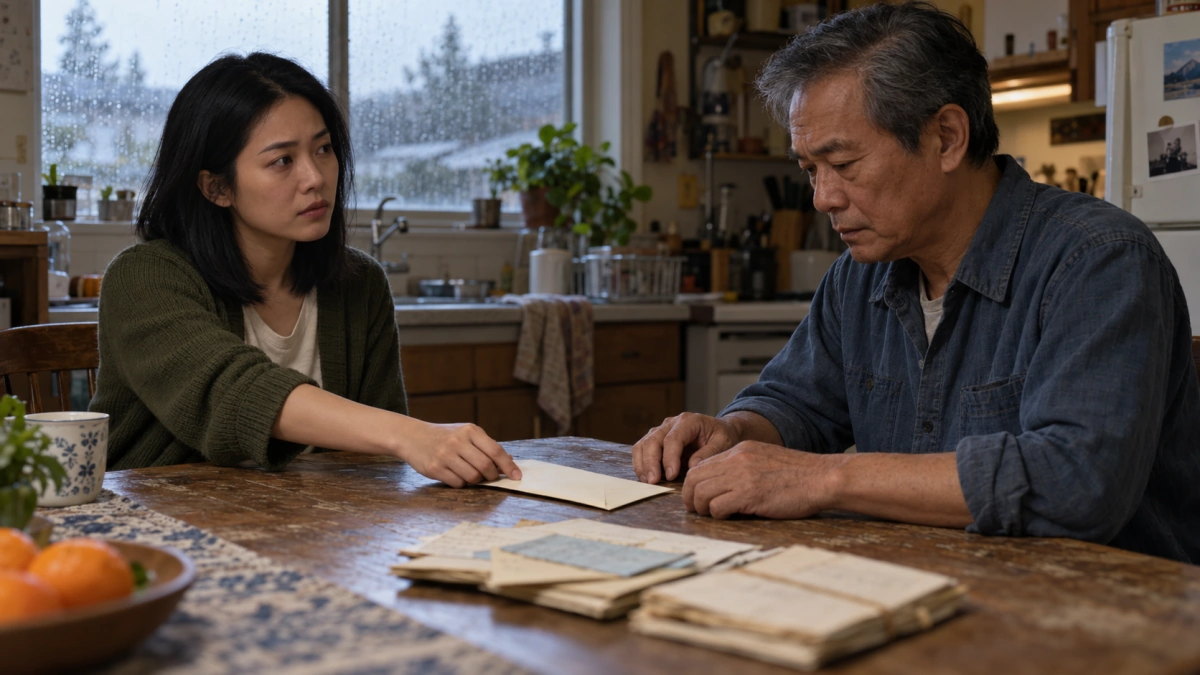
My father pushed the envelope back across the kitchen table without opening it.
“You already told me this,” he said.
I had not. That was the point.
Outside his Tacoma window, rain trembled on the bare branches. I was thirty-two, still wearing my olive cardigan from work, and the cream envelope between us had traveled through three apartments before coming home to him. Inside was a letter I had written at twenty-four, asking whether he would come to a small concert where I was going to sing alone for the first time.
He had never come. He had never mentioned the invitation.
“Tell me what I said, then.”
Dad rubbed a pale thread from the cuff of his faded blue work shirt. His salt-and-pepper hair was flattened on one side, as though he had slept in his shop again. He could make a ruined chair look loved instead of new. He could hear a loose spring under three layers of fabric. But that afternoon, he would not look at a sheet of paper.
I had found eleven of my letters in a tin under his bed while helping him search for a spare house key. Their envelopes were open. Their pages were folded with care.
“Read this one,” I said. “Just the first part.”
“Linh.”
“You told Aunt Mai I stopped writing. You said I got busy.”
He reached for his glasses, put them on, and took them off again.
My mother had been dead for six years. Until that moment, I had thought the silence belonged to grief, or stubbornness, or something wrong with me.
Dad laid both hands flat on the table.
“If I read it,” he said, “you will know something I should have told you before you ever sent it.”
I waited for an affair, a debt, a second life. The tin had made ordinary things seem dangerous. Even the bowl of small oranges near his elbow looked like something arranged to hide a stain.
He turned the page toward the window. “Dear Dad,” he read. Then he stopped.
The next sentence was not hard, I thought. I had written that the room held only forty people, that he could sit near the door if he wanted. I remembered choosing those words so he would not feel trapped by the invitation.
“Go on.”
“I know what it says.”
“Then say it.”
He tried the first word twice. His face changed, not into the face of a man caught lying, but into the face of someone standing on a stair that was no longer there.
I took the paper before he could tear it. He had not tried to, but his fingers had curled hard against the edge.
“Is it your eyes?”
“No.”
“Have you had a stroke?”
“No, con. Not that.”
He used the Vietnamese word for child so gently that I almost let it carry us past the answer. Then he said, in English, “Long things. English on paper. I cannot follow all of it. Not the way you think.”
The clock above the stove made a small click. I had heard him argue about a delivery in English that very morning. He ordered parts, joked with neighbors, talked to customers about stains and fabric. I had mistaken those things for proof of something he had never claimed directly.
“You read the paper.”
“The Vietnamese paper.”
“Your invoices.”
“Same words. Same boxes. Sometimes I ask.”
He stood and went to a drawer. When he returned he brought a Vietnamese magazine with a bent cover. He read a paragraph aloud, with the easy pace I remembered from childhood stories. Then he put it down as though he had been made to show a passport in his own house.
“I wasn't testing that,” I said.
“I know. I am telling you what it is. Not everything. This one thing.”
There was relief in having a name for it, and then a fresh anger that the relief did not touch. “Why didn't you ask me?”
He looked at the letter. “Because it was from you.”
I hated how much that hurt. He had trusted strangers to help him with bills but not me with the thing I had sent because I trusted him.
Mom had read longer English mail with him, he said. At first she sat beside him and explained phrases. Later, when work ran late, she read it herself and told him what mattered. She liked to answer my college letters with little notes about their garden. Sometimes she told him to call me. Sometimes he did.
“Did she read mine out loud?”
“Some.”
“Did she tell you about the bus station?”
He shook his head.
At nineteen I had missed the last bus after a shift at a campus cafe. A man had followed me across a parking lot. Nothing had happened, which was how I had always told the story afterward. But I had written my father that I had been scared enough to sit in a bathroom until sunrise. I wanted him to tell me I had done the right thing by staying somewhere bright.
“Maybe she didn't want you to worry,” I said, and heard myself reaching to cover a dead woman with a kindness I could not verify.
“Maybe,” he said. “I don't know.”
It was the first answer that did not try to make someone look better.
He said he had learned some English in a night class when he first arrived. Then the upholstery shop offered more hours. Then I was born. He had kept the words that came with work: yardage, foam, pickup, balance, delivery. Spoken words gave him a face, a gesture, a chance to ask again without anyone watching a line on a page.
My letters gave him none of that. He knew enough to see their shape, not enough to be sure what I had asked. He feared answering the wrong question. Then the fear grew a second skin: I would ask what he had meant, and he would have to confess how much he had guessed.
“So you just didn't answer.”
“Yes.”
“For years.”
“Yes.”
He did not say he had done it for me. I was grateful for that much. I still wanted to throw every letter in his lap.
My phone lay beside the oranges. I picked it up, then put it down. “There are tools now. You can point the camera. It reads things out loud.”
“I know some.”
That was worse than if he had not known. I waited.
He had used a translation app for a warranty last winter. A coworker had shown him. The voice ran past too fast; the old crease in one page confused the camera. These were real problems, he said, but not the whole problem. He could have asked for help again. He could have pressed pause. He could have told me years before there was a phone that might help.
“It was easier to say later,” he said. “Then later had your whole life inside it.”
I pushed back my chair. “Don't make that sound beautiful.”
He lowered his head. “All right.”
I walked to the sink. The dish towel had a small hole where Mom once caught it on a drawer. He had kept that too. He kept things as though keeping them could count as an action toward the people who had made them.
“You let me think I wasn't worth an answer.”
He took a breath, but I held up my hand.
“I'm not done. You told people I stopped trying. That wasn't a reading problem.”
“No.”
“That was you.”
“Yes.”
The rain grew louder against the vent. I stood with my hands in cold tap water, though there was nothing to wash. When I finally turned around, he had moved the oranges off the table to make room for the other letters.
“Don't open them all,” I said.
His hand stopped.
For once he obeyed a small request before turning it into a larger hurt. I took the concert letter and left the rest. At the door, he asked if I wanted soup in a container. The old offer almost made me laugh.
“Not today.”
On the drive home, I pulled into a grocery store lot because I could no longer see the lines through the rain. I called my friend Rosa, who had been at that concert. She remembered the empty chair beside my coat. I had told her my father was busy with a rush order.
“I think I made him a better excuse than he made himself,” I said.
Rosa did not ask me to forgive him. She asked whether I had eaten. That was a question I could answer without opening another part of my life. She came over with noodles and sat on the floor while I put the concert letter in a clean folder.
I was a clinic scheduler, not a singer by trade. The concert had been a small thing. That was why the wound embarrassed me. There had been no major stage, no career he had ruined. Just a room above a bookstore and a father who had not come.
“You don't have to prove it was big enough,” Rosa said.
The next morning Dad called while I was making coffee. I let it ring. He left a message asking whether he could send a voice note later. He did not ask me to call him back right away.
At work I spent ten minutes explaining a change in appointment times to a patient who kept apologizing for needing it repeated. I told her the times were confusing because they had changed twice. Afterward I went into the supply room and cried among boxes of paper cups.
I had been so sure my father's silence meant one thing. Now it meant several things, and none canceled the others. Shame was not indifference. It could still cause the same lonely wait.
His voice note arrived at seven. He said he had called Aunt Mai. He had told her I had written and he had failed to answer. He had not told her about reading, because he wanted to ask me first whether I minded her knowing what had happened at the table.
I played that part twice. Then I wrote, “Your reading is yours to tell. My letters aren't yours to show.”
He answered with a short recording. “I understand.”
I did not know whether he did, but it was a place to start.
Three days passed before I went back. I wore a raincoat over the same cardigan, and carried no tin, no evidence. Dad had closed the shop early. Through the kitchen doorway I could see a chair upside down on a cloth. One wooden leg had been marked with blue tape.
“Customer thinks the seat is wrong,” he said when I looked at it. “It is the frame. Sit down and your weight moves it.”
He touched a joint under the rail. The chair gave a small, unhappy creak. He knew exactly where to place his hand.
I had come to help with a phone, and the chair reminded me how easy it was to let help become a verdict on a whole person. I asked him what he wanted to try, instead of reaching for his screen.
He wanted to hear the concert letter in English first. Not a summary, not a translation. He wanted to know what my own words sounded like.
“You can stop,” I said.
“You too.”
We took a clear photo under the lamp. The phone captured most of the page, but it turned the bookstore's name into nonsense and missed a line near the fold. I corrected it with him watching. Then I showed him how to slow the voice and pause between sentences.
The machine voice read my invitation in the same tone it might use for a weather notice. Dad listened with both hands wrapped around his empty cup.
When it reached the sentence about sitting near the door, he stopped it.
“You thought I would not want to be there?”
“I thought you might not like the crowd.”
“I didn't know you were singing alone.”
“I wrote it.”
“Yes,” he said. “You wrote it.”
I had expected the tool to make the scene easier. Instead it gave us a precise new way to hurt. The words were no longer hidden, and we could not pretend he had only missed the date.
He asked whether a recording existed. There was one, filmed badly by Rosa, with a thumb over part of the lens. I told him I would think about sharing it. He nodded. He did not reach for my phone.
We played the rest. After the invitation, I had written about a man I was dating, someone who laughed when I sang while cooking. I had asked how Dad knew he wanted to marry Mom. Seeing that question again made me feel as young as I had been when I asked it.
“I could answer that now,” he said.
“It wouldn't be the same answer.”
“No.”
He looked toward the stove. “But it would still be true.”
I allowed him that. He told me about Mom bringing a cracked teapot to his rented room because she disliked the instant coffee he served her. She had not brought tea. She had wanted a reason to come back with some. It was a story I had never heard, small enough that it might have been true without being polished by years of telling.
I laughed once. Then I cried, and he did not try to explain the crying away. We sat until the phone screen went dark.
Before I left, he asked me to teach him the app again. I had to leave for a shift. His face closed for a moment, and I recognized the old retreat before he did.
“It isn't a test of love if I can't stay,” I said.
He took his hand off the phone. “I will write the steps.”
He wrote them in Vietnamese on the back of a grocery receipt. I watched him form the accents with steady care. There was no child at that table, only two adults trying to stop using old roles as cover.
That weekend he called a local adult learning program. I had sent him two public listings after he asked, but he made the calls himself. The first offered help at times he could not manage. The second said someone would speak with him about goals before placing him with a tutor.
He almost did not go. On Tuesday he left me a message saying he was too old to sit beside people starting their lives. I listened in my car outside work, annoyed at once by his fear and my urge to rescue him from it.
“You can be scared,” I recorded back. “I can't be the reason you go. And I can't be the reason you don't.”
He went on Thursday. Later he told me the woman who met him asked what he wanted to read, not what grade he had finished. He said customer letters and his daughter's letters, then asked her not to use mine as lesson material without permission.
That detail made me sit down.
He had brought a fabric care sheet instead. He understood the work better than the sheet explained it. The tutor asked him to describe how he would clean a stain, and wrote down the words he used. The spoken and written versions did not always match. It was work, he said, not a revelation.
“I got tired,” he told me.
“I get tired reading insurance notices.”
“Not the same.”
“No. Not the same.”
I was learning that comfort could be another kind of refusal to listen. He did not need me to say difficulty was universal. He needed me to hear the particular thing he had been carrying and had made me carry without knowing it.
Aunt Mai called that Sunday. She apologized for telling me to write more. Dad had said work kept him from replying, and she had decided my silence afterward proved that young people gave up too easily.
“He never said he couldn't read English well,” she said.
“He didn't have to tell you that. He did have to stop blaming me.”
She was quiet. Then she said she had blamed me too. She did not ask for copies of the letters. I thanked her for that, and we talked about her broken oven for five minutes because a person could only bear so much repair in one call.
Dad's first tutoring session did not transform him. Neither did the second. He missed one after a delivery ran late, and told me so before I asked. I did not call to rearrange it for him. He made another appointment.
Meanwhile, I found that the reading problem had become a tempting answer to every old hurt. If I let it, I could turn all of childhood into a mystery with one key. It would be easier than remembering that he had also been impatient, loving, funny, vain, generous with labor, and poor at saying he was wrong.
One evening I asked about my college visit, when he had canceled the morning he was meant to drive down. He said he had known the date because Mom had told him. A restaurant needed its booths back, and he chose the job.
“I thought there would be another weekend.”
“There was. You didn't come then either.”
“No.”
The answer made me angrier than the secret had. It also gave me something solid. Not every absence was a locked room. Some were decisions he could name without a tool, a class, or a reason that made him smaller than himself.
I asked him to stop saying he had worked all those hours for me. Some of the money had paid our bills. Some had paid for a machine he wanted. Some had covered mistakes in his estimates. Those were not crimes, but neither were they gifts I had asked for.
He did not answer at once. Two days later he said, “I liked being the man who could fix what people brought. I stayed where I knew what to do.”
That sounded more like my father than any noble story about sacrifice.
In late March, a customer came to collect the chair with the blue tape. I was there dropping off oranges when she sat on it and shifted her weight. It held. Dad showed her the repaired joint, not just the new fabric. She asked whether he could send the care instructions by email.
“Yes,” he said. Then, after a pause, “If you write back with a long question, I may call. I do better talking.”
The woman said that was fine and asked about felt pads for the legs. The world did not open beneath him. I could see him waiting for it to happen anyway.
After she left, he laughed once, more from nerves than pride. “I said it before there was trouble.”
“You did.”
I did not clap. He would have hated that. We carried the old scraps out to the bin together, keeping the large pieces that might still be useful.
At home I watched Rosa's concert video for the first time in years. My voice was thin at the start. Someone coughed. A glass fell in the cafe below, and I glanced toward the stairwell as if Dad might still arrive.
I had remembered the whole night as an empty seat. The video showed more. Rosa laughing after the last song. The bookstore owner bringing me water. My own face, bright with relief, before I looked toward the door again.
I sent Dad one song, not the full recording. In the message I wrote that he could listen without sending a review. Ten minutes later he asked whether the word at the end of the second verse was “home.”
It was “hold.” I told him. He said he had listened again and could hear it now. It was an ordinary exchange about sound, and for once neither of us made it stand for everything.
Before April, we had a bad Sunday. I came over to return a drill, and he had set out the tin beside a pot of tea. He said his tutor thought practice helped when the subject mattered. He had decided we could work through two letters before lunch.
“I didn't agree to that,” I said.
“Only if you want.”
But he had already set my cup beside the pages, and the old invitation to be a good daughter had taken a new shape. This time, being good meant helping him get better. I could feel myself becoming cruel just to get free of it.
“My life isn't your workbook.”
He put the lid on the tin. Too fast. It hit the rim with a sharp sound, and we both stared at it. He said he had not meant to use me. I believed him. That was not the same as believing nothing had happened.
I left the drill on a chair and went home. Half an hour later he called. I expected another explanation of what he had meant. Instead he asked whether I wanted the tin returned to me.
“Not yet,” I said. “I want you to ask before you plan something with the letters.”
He repeated the request back in his own words, not because I was teaching him English, but because we had spent years hearing what we wished the other person had said.
The next week, I had my own apology to make. At dinner with Rosa, I described his trouble with a sentence, imitating the pause he had made. I stopped halfway through. The impression had turned his worst afternoon into a story I could perform for someone who loved me.
Rosa put down her fork. “You can be mad without doing that.”
I wanted to tell her she hadn't been at the kitchen table. That was true, and it was no defense. I called him the next evening and told him what I had done. He was quiet long enough that I checked the screen to see whether the call had dropped.
“Did she laugh?” he asked.
“No.”
“Good.”
I said I was sorry. He said he heard me. He did not give me the quick forgiveness I had been refusing to give him, and I discovered how badly I wanted an easier rule when I was the person waiting.
Two days later he sent a picture of a chair with a green seat. No message. I knew the chair. It had been Mom's favorite place to drink coffee, though she always said the back was too straight. He had finally softened the cushion without changing its shape.
I called to ask whether he was keeping it. He said yes. Then he said that, after Mom died, he had sometimes opened my letters just to see my handwriting. He could recognize when I was tired because my lines sloped down at the end. He knew which pen I liked by the blue mark on the envelope flap.
“I thought that was knowing you,” he said.
“It was knowing something.”
“Not enough.”
I sat on my own kitchen floor while we talked. There was a cupboard handle at eye level that I kept meaning to tighten. He asked whether I still sang while cooking. I told him I had stopped for a while, then started again when Rosa bought a small keyboard from a neighbor.
He wanted to know what I sang. I named a song he did not know. Instead of pretending, he asked me to send the title in a voice note. Later he sent back a few seconds of the tune, hummed badly but close enough that I could recognize it.
That was the first exchange I did not save as evidence of progress. I simply played it while I washed a pan. When I caught myself smiling, I did not punish myself for it. Feeling warmth toward him had never been the dangerous part. The danger had been treating warmth as proof that nothing still needed to change.
I told him that Sunday visits would stay short for now. He said he had bought too much tea, but it would keep. It was a joke with a little disappointment inside it, and I let both parts remain. We did not have to settle every feeling before hanging up.
In April, Dad asked for a letter he could answer. I said he already had eleven. He said he knew, and that was why he was asking which one I wanted him to start with.
I chose the one about the bus station. I did not send him a photograph. I brought the page in person and told him the parts I did not want scanned into any service. We could read those aloud together, or not that day. He chose to listen.
When I finished, he asked whether I had been hurt. I told him the same truth I had written: no one had touched me, and I had still been afraid. He rubbed his thumb along the table, then stopped himself.
“You did right to stay there,” he said. “I wish you had not been alone.”
I waited for him to tell me what I should have done first, where I should not have walked, how I could have called. He looked as though he wanted to. Instead he asked whether I wanted to say anything else.
I told him about the woman who opened the cafe at dawn and let me sit by the counter before her shift began. I had forgotten her red coat until that moment. Dad listened while I remembered.
He asked if he could answer on paper, with help. I said yes, as long as the words were his. He could write in Vietnamese. He could record a draft. English was not a toll he had to pay to reach me.
“I want to try both,” he said.
The reply arrived nine days later in a plain envelope. Inside was a page in Vietnamese and a shorter English page. He had marked the English with a note saying a tutor had helped him read his draft and check the wording. No one had written the apology for him.
He did not claim he had understood my fear back then. He said he had not known it because he had chosen hiding over asking. He said I had deserved a father who made the effort to know. He said he was sorry for telling Mai that I had stopped writing.
Then he answered the question I had almost forgotten I had asked at nineteen: what did he do when he felt far from home? He wrote about riding a bus past his stop in his first winter because he did not want to return to an empty room. He wrote about buying a pear he could not afford and eating it slowly at the kitchen sink.
It was not the story of a hero. I read it three times.
I put both pages in the folder with the concert letter. Then I called him. He answered with the television too loud and turned it off before I could speak.
“I got it,” I said.
“Was the English clear?”
“Yes. So was the other page.”
He let out a breath. I told him I was not ready for a whole afternoon, but I could come by Saturday for an hour. He asked whether I wanted him to cook. I said we could buy bread and make sandwiches. Nothing that would keep him at the stove while I sat alone.
Saturday came with a break in the rain. He had put two plates on the table and left the letters in the tin. Beside his chair lay a fabric care sheet with pencil marks in its margins. He closed it when I came in, not to hide it, but to make room.
We ate with the window open a little. A truck backed up down the street. Dad asked about work, and when I gave him the easy answer, he asked if I had time for the longer one.
I looked at the clock. There were forty minutes left. I told him about the woman whose appointment had changed twice, and the day I had cried in the supply room. I did not tell him everything. He did not pretend that I had.
When I left, he walked me to the gate. His next lesson was Tuesday. My next free Saturday was two weeks away. Neither date was a promise that we had become different people. They were places we could choose to be.
He had packed half the bread in a paper bag. I noticed he had not added the soup I used to take without wanting it. At the gate, he asked about the small keyboard. One key stuck, I said. He offered to look at it, then caught himself and added that he knew wood and fabric, not electronics.
We laughed. I said he could help me find a repair shop if I needed one. It was such a plain distinction, what he knew and what he did not, that I wanted to hold it between us in the clear air for a moment longer.
At my car, he held up one hand, then said my name instead of waving. I turned back. He wanted to know whether a short note now and a longer reply later would count as answering.
“If you actually send the longer reply,” I said.
“Then that is what I will do.”
I drove home with his first honest letter on the seat beside me, held down by my house keys, where I could see it whenever the road turned.
Read next
The Second Pickup Contact
The Key That No Longer Fit

Mom’s Moving Day
My Sister Gave Away Dad’s Workshop Before He Moved Out—Then His Apprentice Arrived with the Missing Order Book
Reading notes
Old letters reveal what a daughter misunderstood about her father, and what he still needs to explain.
This is an original work of fiction. Characters and events are fictional. Explore public-domain books at Project Gutenberg or browse more stories on ReadStoryvia.