Original fiction
On this page
The Recording Mom Asked Us to Erase
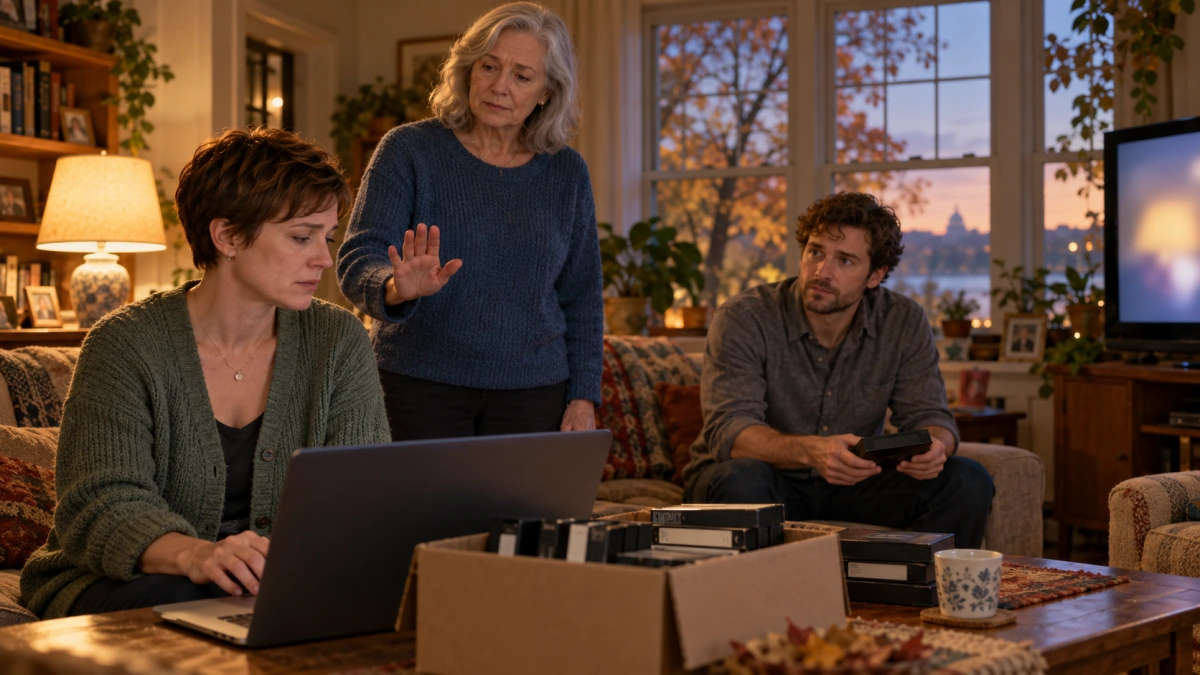
Mom asked me to stop the video before the cake hit the floor.
I had already reached for the volume. On the television, my father was laughing, alive again in our Madison kitchen, and for a second I wanted nothing except to hear him finish.
"Not this one," Mom said.
My brother Jonah leaned forward on the sofa. "It's the birthday cake. Everybody loves this one."
Everybody had included me. There I was on the screen, seventeen, laughing so hard that the camera shook. Behind Dad stood our mother, holding a platter with both hands. The cake leaned toward the edge like a house on a collapsing bluff.
In our living room, twenty years later, Mom gripped the back of a chair.
"Sadie. Stop it."
I paused. Her mouth remained open on the television. Dad's hand hovered near the platter. A blue plastic candle lay sideways in the frosting.
We were planning a home-movie evening for the first anniversary of his death. I was thirty-seven, old enough to know memory wasn't neutral, but apparently not old enough to stop treating my family's favorite joke as proof that we had been happy.
Jonah lifted the tape case. "We can't erase family history because it's embarrassing."
Mom looked at him, then at me in my sage cardigan, with my careful folders and invitation list.
"I'm not embarrassed about a cake."
The refrigerator started humming in the next room. Without the soundtrack, I noticed a kitchen towel tucked into the waistband of her younger self's skirt. I remembered that towel. I remembered none of the work around it.
Mom walked over and closed my laptop without slamming it.
"Before you show anyone," she said, "watch what comes before."
The laptop screen went black, but the paused television kept shining. I found the remote under a cushion and turned that off too. Suddenly the room was ordinary: the narrow bookcase, the fern with its browned tips, the box of tapes that smelled faintly of the basement where Dad had kept them.
Mom's silver hair brushed her blue sweater as she bent to collect our empty mugs. I stood to help. She handed me mine but left Jonah's on the table, a small decision I noticed only because I was looking for larger ones.
"I didn't mean we should show it against your wishes," Jonah said.
He had meant something close enough that none of us answered. He was thirty-four and had driven over after work with three bags of popcorn. The bags sat by his shoes, cheerful and absurd.
The anniversary was nine days away. I had invited twelve people, relatives and two neighbors, promising soup, old movies, and a chance to remember Allen without standing around a graveside in October wind. Mom had agreed to the soup. Somewhere between that conversation and my email, I had made everything else sound agreed upon too.
"We can choose another clip," I said.
"You can," she replied. "I'm going home."
It was her house. She had been living with a friend for three nights while the upstairs floors were refinished, and I had used the empty living room to connect the borrowed converter. Hearing her call somewhere else home stung in a way I had no right to make her comfort.
I offered to drive. She said she wanted the walk. Her friend's house was six blocks away, past the elementary school where she had worked in the office until retirement. Jonah held out her coat. She took it, thanked him, and left without the dramatic exit our silence seemed to expect.
He watched the porch through the window. "I thought she liked that tape."
"Did you ask?"
"Did you?"
We had been exceptionally good, since the funeral, at taking turns finding fault. I unplugged the converter instead of answering. Jonah picked up the popcorn and put it on the kitchen counter, where Mom would discover it later like evidence of a party that hadn't happened.
After he left, I opened the laptop again. Dad had labeled the tape SADIE 17 in block capitals. The digital transfer was one long file, not the collection of amusing moments we had watched at holidays. I dragged the cursor back eleven minutes.
The first image was a cupboard door. Someone had left the camera running on the counter. Mom crossed the frame carrying a grocery bag against her hip. Her hair was brown then, pinned badly at the back. She asked Dad whether he had picked up the ice.
"I was supposed to do everything?" he said from outside the frame.
She looked toward him. "Just the ice."
There was nothing startling in the exchange. That made it worse. I knew its rhythm like a song whose lyrics I had never considered. Request, exaggeration, retreat. Mom set down the bag and said she would send me when I finished getting dressed.
My younger voice objected from the hallway. Friends were coming. Why was I always the one?
Mom said never mind.
She filled two pitchers with water and placed them in the freezer. Then she took out the cake. It was not yet ruined. Three uneven layers, white frosting, little strawberries around the edge. My favorite. She rotated it, concentrating, and wiped the platter with the corner of her towel.
Dad came into view and aimed the camera properly. "Look at this engineering project."
I smiled reflexively at his voice. That was the difficult part: not discovering that he had been a stranger, but recognizing him. The quick delivery. The attention he could turn on a room like a lamp. The man who taught me to drive in snow, who waited outside my first apartment with a plunger because I had called crying about a clogged toilet.
On the screen, Mom asked him not to start.
"Can't joke with your mother," he told the camera.
The transfer continued through the doorbell, coats, paper plates, Jonah's too-large striped shirt. Dad announced that the cake had survived against all predictions. Mom lifted it to move it away from a wet patch on the table. He put one hand under the platter, tipped it slightly toward the lens, and said it was taking requests for its last words.
She told him to let go.
He did, abruptly. The cake slid. She caught the platter, not the cake. Frosting struck the chair, then the floor. The sound I remembered was laughter. What I hadn't remembered was her saying, very quietly, "I asked you."
I watched myself laugh. I watched Jonah laugh because I was laughing. Dad delivered the line that had become family shorthand whenever anything collapsed: "Patricia's structural warranty has expired."
My seventeen-year-old voice repeated it immediately.
I stopped the file and went outside to the porch. Across the street, a man was trying to persuade his dog away from a pile of leaves. I wanted some suitably terrible weather, something that would justify the pressure in my chest. Instead the evening was mild, and somebody was cooking onions.
I called Mom. She didn't answer. I typed an apology, deleted three versions explaining what I had intended, and sent: I watched before the cake. I'm sorry I laughed then and tried to show it now. You don't have to answer tonight.
Then I went back inside and watched after it.
There were nineteen minutes before someone switched the camera off. Most showed the table legs. Mom knelt in the lower corner, scooping frosting into a dustpan. I stepped over her arm to answer the door. Dad told the arriving guests they had missed the entertainment.
Nobody hit her. Nobody confessed to a crime. There wasn't a secret account or a hidden child waiting to replace the story we knew. There was a woman asking for a clean dishcloth, twice, while the rest of us discussed whether we should order pizza.
At the very end Jonah's small hand entered the picture with a spoon. He offered it to her. She laughed, really laughed this time, and told him that was probably not the tool they needed. I replayed that moment once, then caught myself selecting a saving detail as if it might acquit everybody.
I closed the file.
The next morning I drove to the bakery on Monroe Street where Mom sometimes bought rye bread. I bought two loaves and no cake. At her friend's house, she opened the door before I knocked. She was wearing walking shoes and holding her keys.
"I was going to the library," she said.
"I can come. Or leave the bread."
She considered me. "You can carry the bag."
We walked through streets bright with damp leaves. She asked about my landlord's broken washing machine, and I answered, though every ordinary sentence felt like walking around furniture in the dark. At the library she returned a mystery and spent ten minutes looking for another by the same author. I waited without manufacturing a meaningful conversation between the shelves.
Outside, she took the bag back.
"Your father didn't ruin every birthday," she said.
"I know."
"I'm telling you because you'll want to make it simple. You always did like putting things in the right drawer."
That was true. I had labeled digital folders by year, then occasion, then people. When Dad died, I'd organized the funeral lunch because tasks were easier than the terrible unfinished business of missing someone.
"Was it always like that?" I asked.
"Not always. Often enough that I knew when it was coming."
She shifted the bread against her coat. A cyclist rang a bell behind us, and we stepped aside. Mom looked grateful for the interruption, or perhaps I was.
"He could be kind," she continued. "He could be very kind when kindness felt like being the hero. Staying quiet while I finished something wasn't his favorite kind."
I wanted to ask why she hadn't told us. I heard the accusation hiding inside the question and let it pass.
Instead I said, "I don't remember anybody thanking you for the cake."
"You did the next morning. You asked if we could save the strawberries."
I laughed once, unwillingly. She smiled, then grew serious again. "You were seventeen. I'm not asking you to go back and become the grownup. I'm asking you to be one now."
Before we separated at the corner, Mom asked whether I had half an hour. Her friend's garden hose needed draining before the first freeze. We went around the side of the house, where a maple had dropped its leaves into a plastic wagon. Mom turned the faucet while I held the hose downhill. Water spread across the concrete, carrying a small brown beetle toward the grass.
"He would have had an opinion about this," I said.
"Several. One might even have been useful."
We coiled the hose together. I kept making the loops too small. She showed me how to let the rubber choose its curve, and I thought of all the instructions I had heard as criticism because I didn't want to admit she knew something I didn't.
Her friend Celia came out with gardening gloves and offered coffee. Mom said we had bread. Soon we were at the little patio table, eating slices torn unevenly from the loaf. Celia asked about the floors, then her phone rang inside and she excused herself. She didn't ask why my mother's eyes were swollen or turn my visit into an opportunity to mediate.
Mom brushed crumbs into her palm. "When your grandmother died, your father drove all night to bring me home. He never complained. There was a snowstorm outside Rockford. I remember watching his hands on the wheel and thinking I was safe."
I waited. She looked annoyed, though not with me.
"People act as if the bad part must have been hidden under everything good. Sometimes it was beside it. You could see both from the same chair."
"Did anyone ever say something to him?"
"Celia did once. About the way he corrected my stories. He told her she was taking things too seriously. Then he was very polite to her for months, which somehow made me feel like I'd caused trouble."
I remembered Dad describing Celia as touchy. I'd accepted that assessment without evidence. From inside came her voice telling someone that no, Tuesday would not work, but Wednesday might. A whole person, not the footnote my father had supplied.
"Would you have wanted us to argue with him?"
Mom considered the question long enough that I stopped hoping for an answer that would make me feel better.
"Sometimes I wanted someone to ask me what I was saying before he interrupted. Sometimes I just wanted help carrying the groceries. There wasn't one magic sentence you missed."
She rose to get a saucer for the crumbs. I stayed seated until she looked at me. Then I understood that waiting for perfect guidance was another way of leaving her to do everything. I took my own cup inside and asked Celia where the dishcloth belonged.
At the sink I saw a photograph tucked beside the window: Mom and Celia in rain jackets, grinning beside an enormous lake. I hadn't seen it before. Last spring, apparently, they had driven north for a weekend. Mom had mentioned a trip. I had asked whether she'd be lonely without Dad and moved on before she could tell me about the water.
"Was it cold?" I asked when she came inside.
She followed my glance. "Terribly. We ate breakfast wearing our coats."
"Did you like it?"
"Very much."
For the first time that morning her smile arrived without work behind it. She told me about a motel with crooked curtains and a waitress who brought extra potatoes. Nothing in the story required Dad's absence to be either tragedy or liberation. It was simply a weekend she had enjoyed. I listened until she finished, and when Celia corrected the name of the motel, Mom corrected her back. They disputed it cheerfully, without an audience being recruited to choose who was ridiculous.
Driving home, I realized I had known the details of Dad's final hospital stay better than the shape of Mom's ordinary summer. Grief had made a demanding subject of him. Habit had helped. Every call began with whether she was managing, as if her life were now maintenance of a space somebody else had left.
At a red light I put my phone in the glove compartment. I had wanted to send Jonah a description of the morning while it was fresh, turning Mom's words into material for our discussion. Instead I let them remain a conversation she had chosen to have with me. The light changed. Behind me someone tapped a horn, and I drove on, carrying bread crumbs on my coat and no solution that could fit inside a message.
That felt uncomfortable, but it also felt more honest than reporting that our mother had finally explained herself. She had never owed us an explanation before we respected her request. I was learning that belated understanding should change my behavior, not become a new price she had to pay for peace. The distinction stayed with me all afternoon, stubborn as bread caught between my teeth, refusing every convenient swallow.
That afternoon Jonah arrived at my apartment carrying Dad's old camcorder. He had found another cable and wanted to know whether I needed it. I told him what I had watched. He sat on the kitchen stool but kept his coat on.
"He didn't push it off the plate," he said.
"I didn't say he did."
"That's what it sounds like. Like we're building a case."
I opened my mouth to explain the difference between a case and a pattern. Then I noticed his fingers working the loose seam in his coat pocket. Dad used to call him every Sunday during football season. Since the death, Jonah still checked his phone when a particularly stupid play happened.
"I miss him too," I said.
His face changed, not softened exactly, but deprived of a job it had been doing.
"He carried me upstairs when I broke my ankle," he said. "Every night for a week."
"I remember."
"Mom shouldn't have to watch it. But I don't want to agree that everything was fake."
We sat with that. Through the wall, my neighbor practiced the same four piano measures, failing at the same place and beginning again.
"It wasn't fake," I said finally. "That doesn't make this funny."
Jonah put the cable on the counter. He asked me to send him the uncut transfer, then hesitated. "Would that be wrong now?"
"Having it isn't the same as making Mom watch it. Or putting it in the family group. We need to figure out what we're doing, not pretend a file can decide for us."
I didn't send it yet. He didn't demand it. We ordered sandwiches and talked about his leaking radiator until he was ready to ask whether Mom had mentioned him.
On Thursday, while her floors dried, Mom came to my apartment for dinner. I had made chicken soup from her recipe, which was mostly a list of ingredients and the phrase until it looks right. Mine looked wrong. The carrots were too large, the rice had absorbed nearly all the broth, and I had burned one piece of toast beyond any possible description as rustic.
I started making a joke about inherited engineering problems. The words reached my teeth before I caught them.
Mom saw. She didn't congratulate me for stopping. She asked for hot water to loosen the soup.
We ate at my small table. Afterward she washed the pot while I dried, then frowned at the arrangement and took the towel from my hands.
"You wash. It's your pot."
The absurd relief of being assigned a chore nearly made me cry.
She told me the cake had taken two evenings because the first filling split. Dad had been charming to the guests that day. He'd washed the serving plates after everybody went home. She remembered both things and did not offer them as opposing weights on a scale.
"I loved him," she said. "I also used to sit in the car after grocery shopping because I wasn't ready to hear what I'd bought wrong. Both are mine to remember."
I kept drying a plate that was already dry.
"Do you want me to erase that part of the transfer?"
She turned off the faucet. "I wanted the room to stop. That's what I wanted first. You all kept explaining the room to me."
The next words took her longer. She wanted no copies sent around for laughs. She didn't want cousins seeing her younger face frozen in that moment. She wasn't sure she wanted every trace destroyed. Some days she had needed the proof that she wasn't imagining the way a good afternoon could become a performance at her expense.
"But if Jonah keeps it," she said, "I don't want to spend the rest of my life wondering when somebody will bring out the greatest hits."
I put down the towel. "We can promise not to screen or share it. We can't honestly promise there were never other copies."
She nodded. Plain truth seemed to ease her more than an impossible assurance would have.
We called Jonah together, not to vote on her memory, but because he needed to hear her request from her. He listened, asked whether he could come over, and arrived without popcorn.
He apologized badly at first, saying he hadn't known she took it that way. Mom set her teacup down.
"I told you to stop. You knew that much."
Jonah stared at his hands. Then he said, "I kept going because I didn't want the tape to change. I'm sorry."
She accepted the second apology. She did not say everything was fine.
We talked about actual files. I had the transfer and one backup. Jonah had an older disc Dad had made, which included the cake excerpt. Mom had the original tape in the box. None of us would delete anyone else's copy or log into anybody else's account. Each would label their own version private and keep it out of shared family folders.
No screening, forwarding, posting, or making an amusing little excerpt. If either sibling wanted to revisit it privately, we would not involve Mom or spring a conversation on her afterward. If circumstances changed, we would talk before changing those boundaries.
It sounded formal only because our previous arrangement had been that the person holding the remote decided what everybody could bear.
Mom asked for the original tape back. Jonah looked alarmed until she said she wanted it with her papers, not in the trash.
"And I might change my mind about my copy," she added. "You'll still have yours."
Patricia approved Jonah's private transfer. Nobody reached across to erase anything in a gesture meant to prove love.
The harder problem was Saturday's gathering. My invitation had promised movies. Aunt Denise had already emailed that she wanted the camping footage where Dad chased a raccoon away with a saucepan. I told Mom we could cancel everything.
"I don't want to disappear from my own house because you planned too much," she said.
She wanted the twelve guests reduced to eight: the people nearby, not the cousins driving from Green Bay for what they imagined would be an event. She wanted the start moved earlier, while she still had energy. Soup was fine. Bread was fine. No cake. No television as the center of the room.
"Photographs?" I asked.
"Some. On the table, if people want to look. Not a slide show."
I wrote the revised message, then read it aloud. We were keeping the evening small and skipping movies; anyone making a long drive should feel free to join us another time. I didn't mention Mom's discomfort as the reason other people had to accept. It was our revised plan, not an accommodation they could negotiate with her.
Denise called within ten minutes.
"Your dad would hate everybody sitting around solemnly," she said.
I stood by my apartment window, watching Jonah help Mom into her coat. "We're not planning to be solemn. We're having soup."
"The videos were his favorite."
"We're not showing them this time."
I had expected defending Mom to feel brave. Mostly it felt awkward and repetitive. Denise sighed, complained about the weather, and asked whether she should bring rolls. That was the whole confrontation. Nobody delivered a speech and nobody was permanently transformed.
On Friday I went to Mom's house to put the furniture back after the floor crew finished. The living room smelled clean and unfamiliar. Pale rectangles marked the walls where pictures had hung. We moved the heavy sofa six inches, stopped, moved it back three, and argued about whether the new felt pads were scratching.
While searching for a missing pad, I found a photograph beneath the bookcase. Mom sat in a canoe, laughing into sunlight. Dad was only a shadow across the water, holding the camera. I brought it to her.
"That's before you were born," she said. "Lake Wingra. We rented the boat and forgot which dock was ours."
She studied it for a long time. Then she put it in the small stack she had chosen for the table.
There were pictures of Dad in his garden, Dad holding Jonah's hand outside school, Dad and Mom in matching paper hats at a restaurant. There was also a photograph of Mom beside a terrible lopsided snowman we had built when she was forty. Dad wasn't in it. I wondered whether to ask if it belonged with the others.
Then I remembered the invitation was to a house, not an exhibit devoted to a single man. I placed it in the stack.
Mom went upstairs to find a tablecloth. I stayed beside the bookcase with the photo of the canoe still in my mind. It didn't contradict the kitchen. The kitchen didn't reach backward and turn that sunlight false. I had wanted memory to behave like editing software, one clean selection replacing another. Instead I was beginning to understand how much room a life required.
Jonah came Saturday morning with vegetables and a bag of ice. He held the bag up before putting it in the freezer. Neither of us made the joke waiting there.
Mom was cutting celery. "The soup doesn't need ice," she said.
"I know. People might."
She pointed him toward the chopping board. For the next hour we worked without the old choreography in which Mom anticipated every need and we congratulated ourselves for carrying things when asked. Jonah found bowls. I checked the bathroom towels. When the soup needed tasting, Mom handed over the spoon and went to sit on the porch.
Through the screen door I saw her close her eyes in the sun. I didn't take a picture. Not every decent moment needed proof that we had improved.
Before guests arrived, Jonah asked to speak to me in the hall. He had watched the uncut file on his own after I sent it Thursday night. He had also found a different recording of Dad helping him build a birdhouse, taking the crooked nails seriously, letting him hold the hammer.
"I wanted to show you that one immediately," he said.
"You can tell me about it."
He nodded. "I think I wanted it to answer the other one."
The doorbell rang before I could reply. Our neighbor Ruth arrived with a pot of chrysanthemums too big for the little table. Mom laughed and told her it would have to stand on the floor. Denise brought rolls and, tucked under her arm, a disc in a clear sleeve.
I met her at the kitchen door.
"No movies," I said softly.
"It's just the camping trip."
"Not tonight."
She looked past me toward Mom, perhaps hoping to appeal to a higher authority. Mom was showing Ruth the new floor and did not turn around. I held out my hand, not for the disc, but for the rolls. Denise gave them to me. The disc went back into her handbag.
For a few minutes the gathering felt deliberately wrong. People looked at the dark television, then at the photographs, unsure where to put their attention. Dad had always supplied a running commentary. Without him, and without his recorded replacement, we heard the spoon scrape the pot and the little wheeze in Ruth's laugh.
Then Jonah dropped a stack of napkins. Denise bent to help him. Somebody asked Mom about the mystery novel she'd brought home, and she described the detective so scornfully that even I wanted to read it.
We ate with bowls balanced on our knees. Dad's old chair was occupied by Ruth, who needed its higher seat. I had wondered whether Mom would leave it empty. She had moved a lamp beside it because Ruth liked to knit while listening. That practical kindness unsettled me more than a ceremonial empty chair would have.
Denise picked up the photograph of Dad in the garden. She told us how he used to bring tomatoes to her office in a shoe box, dirt still under his nails. Mom smiled and said he always forgot the box. Jonah recalled finding half a dozen in the garage, all labeled with shoe sizes none of us wore anymore.
We laughed. Mom laughed too. I didn't inspect her face to certify that this laughter was permitted. She was sitting beside me, participating, not standing behind a platter while the rest of us decided what her expression meant.
Later Ruth asked whether we had found any old movies during the cleanup. The room tightened by a fraction.
"We have them," Mom said. "Tonight I'd rather hear people."
Ruth nodded and asked Jonah about his radiator. The conversation moved, imperfectly but without injury, into the present.
After the guests left, there were still dishes. There were always dishes. Mom carried two bowls to the kitchen, and Jonah gently took them from her without performing a rescue. He told her to choose the leftover containers she wanted. I cleared the table, folding the photographs into their envelope rather than leaving them beneath dirty spoons.
One roll had fallen behind the couch. The chrysanthemums had shed dirt on the new floor. Mom complained about both, and I found the broom. Her ability to be irritated seemed like a gift we had almost mistaken for ingratitude.
When everything was put away, she brought out the original tape. I had returned it that morning in its old case. Across a new paper sleeve she had written PRIVATE in her own handwriting.
"You don't have to keep asking me if I'm sure," she said.
I realized I had been about to.
She placed it in the desk drawer with her passport and the warranties for appliances. Not hidden, not displayed. A thing whose place she had chosen.
Jonah left first, carrying the trash and a container of soup. I stayed to move the chairs back. Mom told me to leave the lamp beside Dad's old chair. She liked it there now.
At the door I said, "I wish I'd noticed."
"So do I," she replied.
She didn't soften it for me. Then she touched my cheek, briefly, with her warm dry hand.
On my laptop at home, the uncut file remained in the private folder, outside the shared album. I checked the backup once, closed it, and did not press play. Beside the folder sat the photographs Mom had allowed me to scan, including the canoe and the snowman. Neither collection explained the other away.
The next afternoon she called to ask whether I wanted to walk to the library. Not to talk things through. Not to commemorate anybody. Her book was due, and she thought the bakery might still have rye.
I said yes. Before leaving, I put an empty bag by the door so I could carry the bread.
Read next
The Brother Outside the Picture
The Letters Dad Never Read
The Second Pickup Contact
My Sister Gave Away Dad’s Workshop Before He Moved Out—Then His Apprentice Arrived with the Missing Order Book
Reading notes
A mother asks her grown children to stop replaying a family video they remember very differently.
This is an original work of fiction. Characters and events are fictional. Explore public-domain books at Project Gutenberg or browse more stories on ReadStoryvia.