Original fiction
On this page
The Brother Outside the Picture
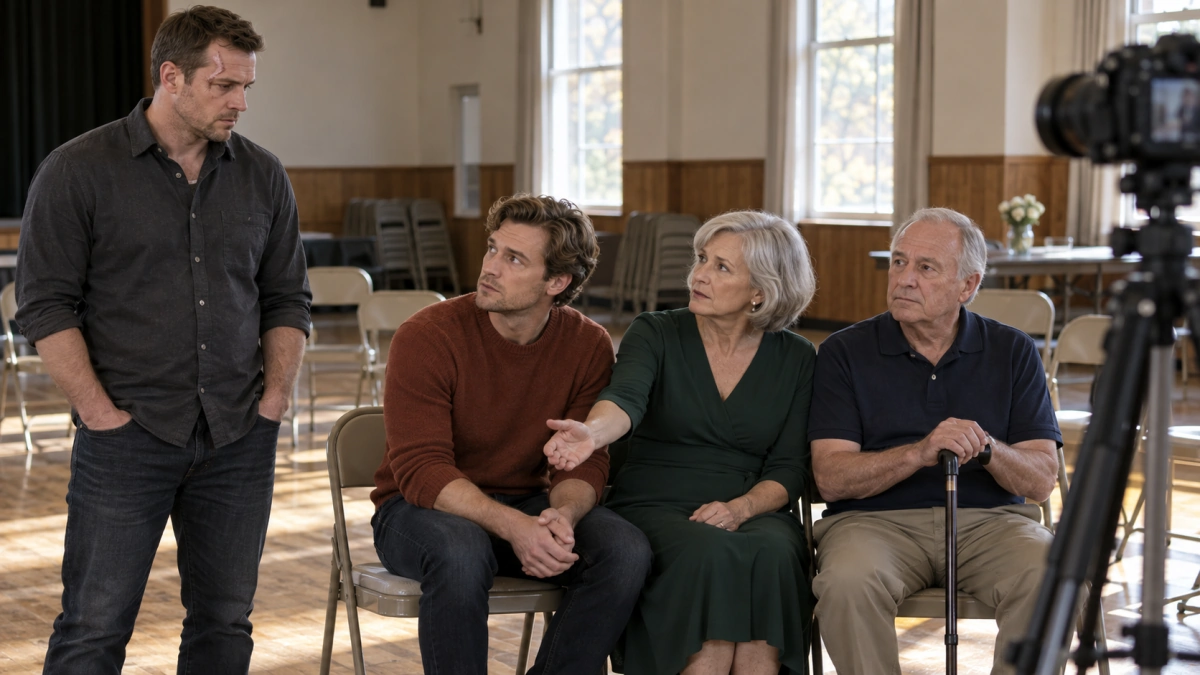
My mother told my brother to move out of the family picture.
Not to the back row. Not beside the cousins who had arrived late. Out.
“Just until we do the main one, Aaron,” she said, waving toward the beige folding chairs along the community hall wall.
I had driven into Ohio the night before, and I still wore the rust sweater I had pulled from my bag. Beside me, my father sat with his cane between his knees. My mother, Vera, smoothed the waist of her green dress as if that were what had gone wrong.
Aaron stood at the edge of the group in a plain charcoal shirt. At thirty-nine, he had the same broad shoulders I remembered, the same pale scar beside his left eyebrow. He looked at the space she had pointed to, then took one step toward it.
“Wait,” I said. “Why is he moving?”
The photographer lowered her camera. A cousin laughed because he thought I was making a joke.
“We've already explained he's away,” Mom said quietly.
I looked at Aaron. “Away where?”
A woman near the refreshment table answered before he could. “Overseas, isn't it? Your mother says the work keeps him traveling.”
Aaron worked at a warehouse twenty minutes from our parents' house. I knew that. I knew he had left school at seventeen after Dad's fall, when I was eleven. I knew more of what he had paid for than he liked me to mention.
What I did not know was that my family had found a way to make him absent while he stood in the room.
Mom touched my sleeve. “Caleb, please. Not in front of everyone.”
Aaron reached the chairs, picked up his jacket, and stopped waiting for anyone to tell him where to stand.
I followed him past the table of untouched cake. Behind us, someone began moving chairs, making the useful noise people make when they do not want to hear a family come apart.
“Aaron.”
“Don't leave your coat. You'll want it.”
“What did she mean, overseas?”
He put one arm into his jacket. “Depends who she's talking to. Sometimes Canada. Sometimes Europe. Never a place anyone asks me about.”
“How long?”
“I don't keep a chart.”
I deserved that. I had been away five years, first for a training program in Pittsburgh, then for work repairing medical equipment in western Pennsylvania. We talked most weeks. I knew his shifts, his old truck, the neighbor whose dog escaped under his fence. I had not asked what Mom said about him at church dinners or distant cousins' weddings. Why would I?
He pushed open the side door. Cold air came in over the smell of coffee. “I came because she said everybody was meant to be in it this time.”
“She said that to you?”
He nodded. “Asked me to trade a shift.”
There was something so exact about that cost that I could not speak. He had asked a coworker for a favor, pressed a shirt, and driven here because our mother had said the word everybody.
In the parking lot, a child dragged a mitten along a car window. Aaron stood beside his truck and searched for his keys, though I could see them in his hand.
“I'll come with you,” I said.
“You don't need a ride.”
“That's not what I mean.”
“I know what you mean. I don't want an escort.”
He opened the door. I put a hand on it, then took the hand away. He had spent years moving things for other people. I would not make his own door another thing he had to push against.
“Can I call later?”
“After six.”
He drove away without slamming anything. I stood in the space he left until the hall door opened behind me. Mom had put on her coat over the green dress. Her silver bob lifted in the wind.
“You made that awkward,” she said.
I turned so quickly she stopped walking. “He was invited.”
“Of course he was invited.”
“To carry tables?”
“Don't be ugly.”
I looked through the glass. Dad sat alone now, his cane leaning against his leg. The photographer was talking to my cousin Tessa. No one was smiling at the camera.
Mom said the portrait was for a family history display. She had told people Aaron's work took him abroad when he missed earlier gatherings. She had not wanted questions about why he never came. Then people repeated it, and explaining would have been embarrassing.
“For whom?” I asked.
She pulled her coat shut. “You know how people talk.”
I knew how our mother talked when she wanted the judgment to belong to someone else.
“He came today. You could have stopped.”
“There are people here who have heard one thing for years.”
“So you moved the person instead of changing the story.”
She looked past me toward the road. For a second, I thought she might call him. Instead she said I had no idea how much she had managed after Dad's injury.
I did have some idea. I remembered the hospital, the shower chair, the forms spread over our kitchen table. I remembered her taking cleaning shifts and sleeping in her clothes. None of that made the empty place beside her in a photograph necessary.
Back inside, the woman at the refreshment table introduced herself as Nora, a cousin of Dad's who had moved back to Ohio. She asked whether Aaron's flight had been delayed. I told her he lived nearby and worked locally. Her face went still.
“I must have misunderstood.”
“No,” I said. “You heard what you were told.”
Mom took a step toward us. Tessa arrived with the photographer before she could speak. Tessa was managing the display and wanted to know whether to finish the portrait. I told her I would not stand in it without Aaron's consent to how the family was represented. Mom said the room rental ended at four.
“Then we don't get a portrait today,” Tessa said.
It was such a plain answer that Mom seemed unable to hear it. She began straightening paper plates. Dad asked me to take him home. I carried his cane while he put on his coat, then handed it back before he stood.
In the car, he watched the hall shrink in the mirror. “Your mother shouldn't have done that.”
“Did you know about the story?”
He pressed his lips together.
“Dad.”
“I heard it once. She said it was easier.”
“And you let her.”
He rubbed the head of his cane. “Yes.”
There had been a time when I would have accepted his softness as innocence. Mom made the claims. Dad sat nearby, weary and kind, letting her words build walls he never had to touch.
He said he felt useless after the fall. His back never recovered enough for construction work. Compensation had helped with some bills, and later he found part-time counter work at a supply store, but the household had lost income just when every trip seemed to cost something. Aaron's warehouse pay had filled gaps no one wanted to name.
“I know,” I said. “I was there.”
“You were a kid.”
“So was he.”
Dad looked out the window. I did not ask him to answer at once. There were things he had spent twenty-two years not saying. I could wait through a stoplight without helping him avoid them.
“Yes,” he said finally. “He was.”
At the house, Mom was already in the kitchen. She had driven faster. The green dress was hidden under a cardigan, as if she had put the whole afternoon away. She asked whether I wanted a plate to take to the motel.
“I want to know why you told him to come.”
She opened the refrigerator. “I wanted him there.”
“Until someone could see him.”
The refrigerator hummed between us. She shut it without taking anything out. She said she had planned to make a smaller picture afterward, just us, with Aaron. The main portrait included families who had traveled, people she rarely saw. She did not want to spend the whole session explaining.
“You could have said, this is my son.”
“You make everything sound simple.”
“That part was.”
Dad lowered himself into a chair and said her name. Not loudly, but she stopped. He told her he had heard her say Aaron was in Europe last summer. He had known it was a lie. He had kept eating his dinner.
“Why bring that up now?” she asked.
“Because I should have brought it up then.”
She stared at him as though he had changed sides. I wondered how many times Aaron had stood in that kitchen while they argued over which version of his life would make them feel least ashamed.
At six I called him from my motel. He was cooking eggs. I could hear the pan. I asked whether I could come over. He said yes, but not to hold a meeting. I bought bread and went.
His house was a rented duplex with a narrow porch and a porch light that came on too early. Inside, a half-built model boat sat on a shelf. I had sent him the kit two Christmases before. I had never asked whether he liked it.
“It takes forever,” he said when he saw me looking. “That's the point.”
We ate eggs on toast. I apologized for not knowing. He put down his fork.
“You knew the job. You knew school. Don't act like you just found out I exist.”
I felt my face heat. He was right. Shock had made me want a clean role, the brother who arrived and saw everything. But I had known enough to ask better questions long before the portrait.
“I didn't know they were saying you lived abroad.”
“I know.”
“Did you want to tell me?”
He looked at the boat. “Sometimes. Then we'd be having a good call. You'd tell me something about work. I didn't want to spend it talking about Mom.”
There was another reason. He had told her to stop once, after a neighbor asked whether he was home on leave. She said she was proud that he worked so hard and did not understand why he was picking a fight over a harmless misunderstanding. He had not wanted to hear me suggest another calm talk.
I opened my mouth, then closed it. I had suggested exactly that before, about other things. I knew how to diagnose a broken monitor. With family, I kept prescribing patience because it cost me less than it cost him.
Aaron asked what I remembered about the year Dad fell. I remembered him quitting school. I remembered the warehouse bus leaving before dawn. I remembered his first paycheck buying groceries and a pair of winter boots for me.
“Do you remember what I said I wanted?”
I tried. A car, maybe. A room away from the house.
“To finish,” he said. “I wanted to finish school.”
I looked down at the plate. Somewhere along the way, I had turned his decision into a fixed feature of our lives, like the back steps or the road to the hospital. I knew it had cost him. I had stopped imagining he might still want what it cost.
He had tried evening classes twice. Once the shift changed. Once he left after missing enough sessions to feel ashamed walking back in. He had not asked me to know every detail. He wanted me to stop talking as though the story ended when I got my diploma.
“I can't go back and make you seventeen,” I said.
“I haven't asked you to.”
He took our plates to the sink. I followed, then stopped. Washing his dishes would be fine. Doing it so I could feel useful before he finished talking would not.
He said he liked parts of the warehouse job: the clear tasks, the crew, the day a difficult load finally fit. He disliked the wear on his knees, the rotating overtime, and the way supervisors called everyone a family when they needed a shift covered. He was not waiting for someone to rescue him from all work. He wanted more choices.
I asked what those might look like. He said he had been looking at local equivalency classes again. He wanted the credential first, then time to think. Maybe a maintenance program. Maybe not. He did not want his first free choice to become a plan the whole family could brag about.
“Don't announce it,” he said.
“I won't.”
“And don't buy me a computer without asking.”
I laughed, then saw he meant it. I had already been thinking about what equipment I could afford. He had caught me turning his next step into my gift before I had even asked what he owned.
We made one practical agreement. If he wanted, I would help compare class times and transport. I could also come home one weekend a month to take Dad to appointments Aaron had been covering. That was not tuition, not repayment for his life, just a piece of time I could actually return.
“Ask Dad too,” he said. “I'm not his schedule.”
On Monday I called Dad. He had assumed Aaron would drive him to a specialist in two weeks. Aaron had not agreed. Dad admitted that when I asked. We arranged for me to take a day off, and Dad said he would check other ride options for later visits. I wrote the date down, then called Aaron with the single fact, not a speech about what it meant.
He said, “Thanks. That helps.”
Mom called three times while I drove back to Pennsylvania. I answered at a rest stop. She wanted to know what Aaron had said about her. I told her to ask him what he wanted her to hear.
“He won't answer.”
“He answered when I called after six.”
“You don't understand. He gets so cold.”
I watched a man try to fold a map in the wind. “He was warm enough when you needed him to trade a shift.”
She cried then. Not loudly. She said she had feared people would think they were bad parents because one son had not finished school. She worked, she cared for Dad, she did what she could. She had liked being asked about my training, where there was an answer she could give without seeing pity in someone's face.
I believed she had felt all of that. I also knew how easily pity could become a person she blamed for feeling it.
“Aaron isn't the proof that you failed,” I said. “But moving him out of the picture was something you chose.”
She said she knew. I asked what she meant by knowing. She said she would call the people who had been at the hall. I told her not to explain his private plans or turn his school years into a speech without asking him.
For two days, nothing happened that I could see. Then Tessa sent me a message asking whether she should use an old photograph for the display. I told her to ask Aaron about any picture containing him. She did.
He chose one taken at a lake when we were kids. Mom had wanted a posed shot, but this one showed us muddy, holding a fishing line with nothing on it. Aaron had one hand behind my neck to keep me from stepping backward into the water. He said he liked the light. Tessa printed it without adding a caption about sacrifice.
Mom's first attempt at correction went badly. She called Nora and said there had been confusion about Aaron's travels, that he had always put family before himself. Nora asked whether Aaron actually lived nearby. Mom said yes. Then she began telling the story of Dad's injury.
Nora stopped her gently. “Vera, did you tell me he was overseas when he wasn't?”
Mom told me about that question later. She sounded offended at first, then tired. She had finally said yes. Nora said she was glad to know the truth and would not repeat the old story. She did not ask for the family medical history.
“I thought I had to explain everything,” Mom said.
“You had to correct what you said.”
“I did.”
“Keep doing it.”
Aaron did not suddenly start coming to Sunday dinner. He told Mom he needed a while without invitations that came wrapped in urgency. He still spoke to Dad, though less often. Dad told me the silence hurt. I said I believed him. I did not ask Aaron to fix it.
The specialist visit took most of a day. Dad needed a new treatment plan, not a miracle. I drove, took notes when he asked, and bought lunch afterward. He wanted to talk about Aaron, but I asked whether he had anything to say directly to him.
He looked at his soup. “I let him think needing him was the same as thanking him.”
“Tell him that.”
“Will he listen?”
“I don't know.”
That was the most useful answer I could give. For years our family had treated Aaron's availability as a guarantee. We were all learning what life looked like when his answer might be no.
A week later Aaron called about the classes. He had found a program with an evening option, but intake fell during his shift. He could use paid time if he asked early enough. He wanted someone to look at the schedule with him, not make the call.
We shared a screen for twenty minutes. I almost suggested the fastest route. He pointed to the slower one, with fewer evenings each week. He wanted to keep building his boat and seeing his friend Mel, who bowled on Thursdays. School was meant to enter his life, not swallow the parts that already belonged to him.
“That looks better,” I said.
“For me,” he said.
“For you.”
He had a working laptop. His internet was fine. What he needed was a quiet room two nights a week and the confidence that Dad would not call with an errand every time he sat down. I could not give him confidence, but I could stop treating his open evenings as family property.
At work, he asked about a more predictable schedule. His supervisor offered no promise, only a possible swap with a worker who wanted mornings. Aaron spoke to the worker himself. They agreed to try it for a month, subject to approval. There was no promotion hidden inside the change, no raise that made all the old losses worth it. There was Tuesday evening.
I went home the next month. Aaron met me at a diner after his intake appointment. He had been asked about reading, math, and what he hoped to do. He felt rusty and angry with himself for feeling rusty. I said I was proud, then winced.
“You can be,” he said. “Just don't make that the whole meal.”
So I asked about the boat. He had broken a thin piece near the bow and was trying to repair it instead of buying another kit. We argued over whether the instructions were clear. It was the first argument in weeks that neither of us feared.
At the counter, I tried to pay for both lunches. He said we could split. I put my card away and left cash for my half. I could help without making every ordinary thing a debt I had to settle.
Mom wanted another portrait. She told me this by phone, in the careful voice she used now when she could not tell whether a request would sound like a demand. She had spoken with the photographer, who could return for a smaller fee. Mom would pay it. She wanted to invite Aaron, but asked if I thought he would come.
“I think he can answer for himself.”
She did ask. He said no to the hall, no to the large group, and no to being presented as the noble son whose sacrifice had made everyone else possible. He would consider a picture with me, somewhere else, if the photographer was willing.
Mom told him she understood. Then she asked whether she could be in one too. He said not yet. She cried after the call, Dad told me. She did not call back to change his answer. For once, her hurt stayed hers to manage.
Tessa organized a small evening gathering to finish the history display. Aaron did not attend. He told her she could say where he lived and what he did, but not announce school. Mom stood beside the old lake picture and corrected the story when a cousin asked whether Aaron was still traveling.
“He wasn't abroad,” she said. “I told people that because I was ashamed of questions I didn't want to answer. He works here. He's my son. I should never have made him sound absent.”
I heard it from the other side of the table. There was no applause, only an awkward pause and then a question about whether the cake had nuts. Public truth did not have the shape of a grand scene. It made a small space in the air where the lie had been.
Later Mom asked me whether she had done all right. I said she had told the truth. She waited for more. I helped carry the empty trays instead. I would not turn Aaron's absence into a grade I could award her.
Dad wrote Aaron a note. He asked me to read it first. I said no, not because he should write perfectly, but because I was not the gate between them. He mailed it. Aaron later told me he had read it and put it in a drawer. He had not answered yet.
“Was it a good note?” I asked.
“It was his,” Aaron said. “That's different.”
Before we booked the photograph, Aaron and I went back to the hall to pick up a box Tessa had left for him. It held some childhood things from the display, including a paper boat he had made in school. He turned it over, careful with the brittle folds, and laughed at how much glue he had used.
The hall was empty except for a man sweeping near the stage. Without the families and the cake, the room looked smaller. Aaron stood by the row of folding chairs where he had picked up his jacket. I asked if he wanted me to carry the box to the truck. He said not yet.
“I should have said something before I walked away,” he said.
“You didn't owe them a performance.”
“I'm not talking about them. I'm talking about what I wanted.”
I leaned against the wall and waited. He said he had wanted to tell Mom that he had spent his break getting the shirt pressed. That he had checked his teeth in the truck mirror. That he had been glad to come, which was the part that still made him feel foolish.
I said I had been glad too. He looked at me. I had not said it before. In all my anger, I had told him how wrong everyone else had been and forgotten to say I wanted him beside me.
“I wanted you in the picture,” I said. “Not because of the boots or the bills. Because you're my brother.”
He nodded once. We carried the box out together, one hand under each side because the bottom was weak. At the truck, he took it from me and set it on the seat. The little boat sat on top, its bow bent but still holding.
That night I called Mom and told her I would not be the person reporting Aaron's mood after every visit. She said she only wanted to know whether he was all right. I said she could send him a message that did not require an answer. She could also wait when he asked her to wait.
“What if waiting makes it worse?”
“I don't know,” I said. “But rushing him made it worse already.”
She did send a message. Aaron showed it to me later, because he wanted to, not because I asked. It said she was sorry she had asked him to trade the shift and then treated his presence as a problem. It did not explain her fear of pity. It did not say she hoped he could understand what she had been through.
“That's new,” he said.
“Yes.”
He put the phone away and asked whether I remembered the creek behind our old school. We had tried to launch paper boats there after rain, only to watch them fold under the first small wave. He thought the boat in the box might have been built for one of those attempts. I remembered chasing one through the mud while he shouted that the bank was slippery.
For once, the memory did not end with a list of what he had done for me. We argued about whose boat had lasted longer. Neither could prove it. We let the question stay open, and talked until his dinner timer rang, then said goodnight without making another plan we could not keep.
In June, the photographer met us at a public park. Her name was Beth. She had kept the fee small because we only wanted a few files, but Aaron paid his half before I could offer. He wore the charcoal shirt again. I wore a blue shirt this time, which he said made me look like someone selling a house.
Beth asked where we wanted to stand. I looked at Aaron. He looked at a low stone wall near the trees and said we could sit there, if that worked for her. It did.
At first, we sat too far apart. Beth told us the space between us looked like a place reserved for another person. Aaron slid over two inches and said that was the family resemblance: stubborn men negotiating in inches. I laughed. She took the picture before I could stop.
We tried a few serious ones, then gave up. In the one we chose, Aaron was looking at me, not at the lens. The scar beside his eyebrow caught the light. I could see the man who had bought my boots, and the boy who had wanted a diploma, and neither was all of him.
He asked Beth not to send the files to anyone else. She agreed. He sent one to Tessa for the display and one to Mom, with a message saying she could keep it but not post it. Mom replied that she would. She did not add a plea to be included next time.
On the walk back to our cars, I asked whether he wanted to get dinner. He had plans with Mel. I said another time. He smiled, small and real, at how easily that could be said.
His first class was the following week. He had bought a notebook with a stiff cover. There were no speeches about starting over. He was not starting from nothing. He was bringing twenty-two years of work, habits he liked, habits he would have to fight, and a mind that had never stopped asking how things fit together.
He called after class, annoyed about a problem he had understood until he tried it alone. I wanted to help. He asked instead if I could just stay on the phone while he drove home. So I told him about a machine at work that had failed for the least interesting reason possible: a loose cable no one had checked.
He laughed. Then he told me about a woman in class who had erased a whole page so hard she tore it, and how the teacher gave her another sheet without making the room stop. He liked that. I liked hearing what he noticed when no one was asking him to make himself smaller.
We did not talk about Mom that night. We did not talk about what he had given up for me. At a red light, he said he might need help with the next set of problems, but he would try them first. I said I would be around Sunday afternoon if he wanted.
The photograph arrived as a print two weeks later. I put mine by the door, at eye level, where I would see it leaving for work. Aaron hung his above the model boat. The bow was repaired, a faint seam still visible if you knew where to look.
Mom kept hers on the mantel. I saw it during a visit, separate from the old formal portraits. She had not replaced the lake picture or hidden Dad's cane. She asked whether Aaron liked his class. I told her that was something she could ask him, when he wanted to talk.
She nodded and did not reach for the phone. Outside, Dad was trying to water a plant without bending too far. I took the hose when he asked, not before. We stood for a while in the small patch of sun beside the steps.
That evening Aaron sent me a picture of a finished homework page, face down, with his dinner beside it. The message said he had stopped while there was still time to eat the food hot. I sent back a picture of my own plate.
I looked again at our print before the call came. There was room around both of us: the wall, the trees, a strip of grass Beth had not cropped away. Aaron had chosen that version over the closer shot. He said he liked knowing where we were. I liked that he had been the one who got to choose it himself.
Then he called to argue about a baseball game. I answered, and let my brother tell me something that had nothing to do with what he owed anyone.
Read next
The Letters Dad Never Read
The Second Pickup Contact
The Key That No Longer Fit
My Sister Gave Away Dad’s Workshop Before He Moved Out—Then His Apprentice Arrived with the Missing Order Book
Reading notes
A family portrait exposes the public story that has kept an older brother out of the picture.
This is an original work of fiction. Characters and events are fictional. Explore public-domain books at Project Gutenberg or browse more stories on ReadStoryvia.