Original fiction
On this page
No Seat for My Mother
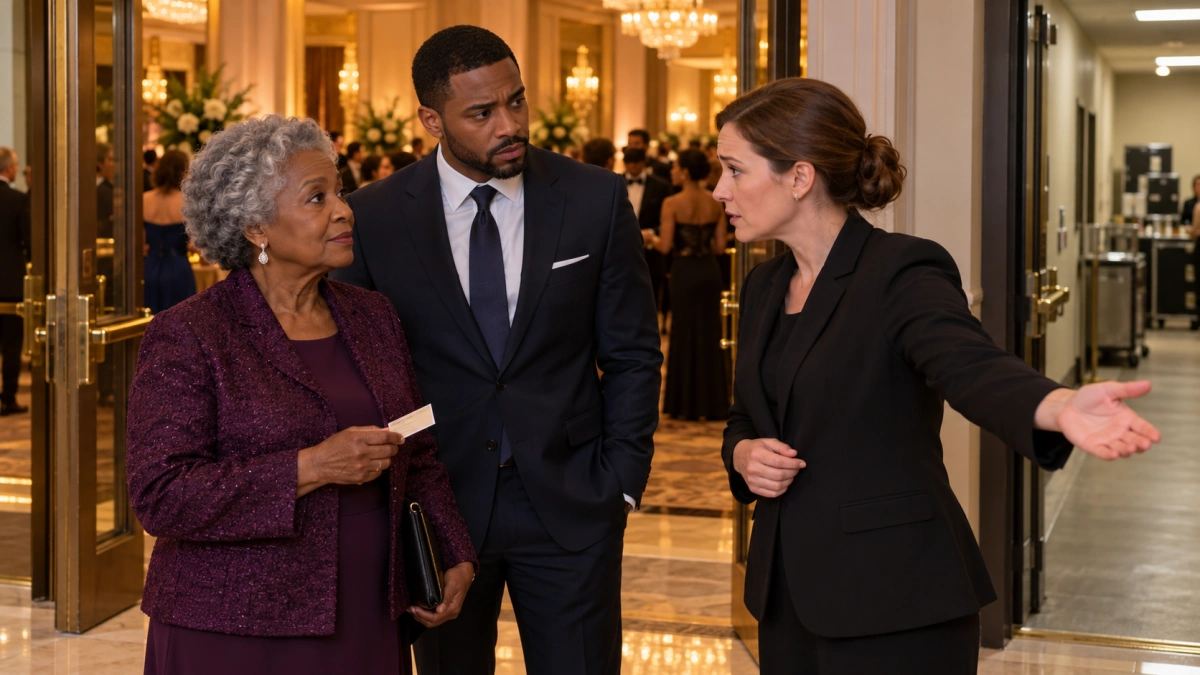
The woman in the black blazer looked at my mother's plum jacket, then pointed past the coat check toward a door marked for deliveries.
"Service check in is around the back. They'll give you an apron there."
My mother held out the ticket I had bought her. She did not laugh to make the woman comfortable. At sixty two, Harriet Cole had retired from a school cafeteria after thirty one years of feeding children who sometimes thanked her and sometimes dropped their trays without looking up. Tonight her silver natural hair caught the light from the ballroom chandeliers. She had asked me twice whether her jacket was dressy enough.
"I'm here with my son," she said.
I was standing right beside her in the dark suit she had helped me choose. On my lapel was a ribbon identifying me as an honoree. Beyond the open ballroom doors, our nonprofit's largest donor was waving me toward a photographer.
The staff woman glanced at my ribbon. "Of course. Let me find somewhere she can wait while we sort this out."
Somewhere. Not a chair at the table listed on her ticket. Not the reception where everyone else was being handed glasses of sparkling water.
My mother lowered her hand. That was the movement I noticed: the ticket disappearing against her side, as though she had brought an embarrassing document into the wrong office.
"Check both tickets," I said. "We'll wait here."
The donor, Vivian Beck, had stopped waving. My director was already crossing the foyer with the tight smile she used when a conversation might cost money.
My mother touched my wrist.
"Before you decide anything," she said, "ask me what I want."
I nearly told her I knew what she wanted. That was the first mistake I managed not to make that evening.
Instead, I turned toward her. "What do you want?"
"I want my ticket checked. Then I want a minute."
The woman in the blazer introduced herself as Felicity Nash, the hotel event supervisor. Her brown hair was pulled so tightly back that a loose strand at her temple looked accidental. She took the ticket without touching my mother's fingers and scanned its square code. Her device produced a small green light.
She scanned mine. Another green light.
"Dinner admission," she said, reading the screen. "Both of you."
"That's what I bought," I said.
Our director, Denise Porter, arrived as Felicity started explaining that an agency had sent replacement servers and that their arrival instructions had changed. Denise was a white woman who had spent eighteen years persuading city officials to consider teenagers worth the inconvenience. I respected her. I also knew that when she was frightened, she tried to move difficult things out of sight.
"Let's get you somewhere comfortable," she told my mother.
"Here is comfortable enough for one minute," Mom said.
A server passed us carrying clean glasses. He was a young Black man wearing a white shirt and a black waistcoat. He looked at Mom, looked at Felicity, and kept walking. I wondered how much of his night was spent pretending not to recognize things.
Felicity offered to fetch the seating chart. Mom said yes. Nobody needed to fetch her somewhere else.
Vivian reached us before the chart did. Her charcoal dress was plain in the deliberate way expensive things could be plain. Her brown hair ended precisely at her chin. She knew my mother existed; I had talked about her during a donor breakfast, describing the cafeteria kitchen where I did homework before Mom's shift ended. Vivian had called it an inspiring origin story. I had disliked that phrase without understanding why.
"Harriet," she said warmly. "We finally meet. Julian talks about you all the time."
Mom shook her hand. "He talks when he's nervous."
It was the smallest joke, and I loved her for deciding who would receive it.
Vivian looked between us. "A ticket mix up?"
"The tickets are valid," Mom said. "The mix up happened before anyone looked at them."
Felicity returned carrying a printed floor plan. There were two seats at table fourteen under my purchase number. My honoree ribbon entitled me to a reception photograph, not a different dinner ticket. Nothing in the rules excluded guests from the main entrance. Felicity said this carefully, and I was grateful she did not invent a policy to protect her first assumption.
"I made a mistake," she told Mom. "You should have been welcomed here. I'm sorry."
Mom nodded once. "Thank you for saying what happened."
Then Vivian touched my elbow. "Come take the photograph. We'll put this behind us."
The invitation was gentle. It also seemed to make my mother a spill somebody had finally wiped off the floor.
"Mom asked for a minute," I said.
Vivian released my elbow. Across the foyer, the photographer lifted his camera, saw nobody approaching, and lowered it again.
We moved to a bench beside a large arrangement of white flowers. Mom sat. I stayed standing until she patted the space next to her. Her ticket rested flat on her knee, the corner softened where she had held it too tightly.
"Don't make me the reason twenty children lose their bus," she said.
"That isn't your responsibility."
"I didn't say it was. I said don't make me the reason in your head. You'll resent me later and call it something else."
Our organization ran after school workshops and summer placements for Louisville teenagers. I coordinated the east side program, where a rented van carried students from two schools to our workshop. Vivian's family foundation had funded transportation for three years. An unsigned proposal on Denise's desk would extend that help through the following year.
Mom knew these details because I called her when budgets frightened me. I wished, suddenly, that I had called about other things more often.
"I want to see you receive your award," she said. "I don't want to walk into that room while people are congratulating themselves for letting me."
"We can leave."
"We can. But you offered that before you offered to sit still."
So we sat still. A woman in a green dress asked whether the bench was taken. Mom moved her purse. They spoke about the rain, which had stopped just before we parked. For ninety seconds there was no lesson happening. There were two women discussing wet shoes.
When Mom stood, she smoothed the sleeves of her plum jacket. "I want dinner. I paid for this jacket, and you paid for dinner. But I won't do that family photograph. I don't know that woman yet."
She meant Vivian, who had suggested earlier that donors and honorees pose together like a family. I had repeated the suggestion to Mom because it sounded harmless at my kitchen table.
"I'll tell them," I said.
"Tell them your part. I'll tell them mine."
At the ballroom doors, Felicity waited with a younger employee. She did not announce us or escort us like visiting royalty. She simply said table fourteen was to the left, near the musicians, and asked whether we wanted water before we went in. Mom requested still water. I watched Felicity ask another arriving guest the same question.
That helped more than a parade would have.
Our table included two volunteer tutors, a local shop owner, a city employee, and Denise's husband. There was a place card for Mom. Someone had spelled Harriet with one r. She corrected it herself with the pen from her purse and began asking the tutor beside her about his students.
I could not stop watching the entrance.
"Julian," Mom said quietly, "your soup is getting cold."
I picked up my spoon.
The soup tasted of roasted carrots and ginger. Mom would have liked more pepper. She asked for it, received it, and passed the mill to the tutor, whose name was Luis. He told her his afternoon students refused to believe he had once failed algebra. She said children could smell a tidy story and preferred the messy version.
I was laughing when Denise asked me to step outside.
She did not take me back to the service corridor. We stood by a window overlooking the hotel's circular driveway, where a valet was guiding an elderly man around a puddle.
"Vivian feels you rebuffed her," Denise said.
"My mother was still deciding whether to stay."
"I know. Felicity explained."
"Did she explain it to Vivian?"
Denise pressed her lips together. "Vivian doesn't understand why the photograph has become a point of conflict."
"It hasn't become one. Mom doesn't want it."
"Could you explain that warmly?"
I looked through the window. The valet held an umbrella over the elderly man while rainwater ran off the awning onto his own shoulders.
"How many times do I have to make a no sound like a thank you?"
Denise flinched. I regretted how sharply I had said it, but not the question.
"That's fair," she said after a moment. "I am trying to get us through tonight. That's not an excuse."
She had not asked me to apologize to Vivian. She had approached close enough that I could feel the shape of the request. I told her I would speak to Vivian, but not to bargain away Mom's decision.
"And my acceptance speech isn't going to ambush anyone," I added.
Relief moved across Denise's face so quickly that it hurt.
"It also isn't going to thank people for treating my mother as a guest."
"Understood."
Back inside, a student named Aaliyah was testing the microphone. She had helped repair donated bicycles during our summer program and was presenting my award. Her aunt was taking pictures from the front row. Aaliyah saw me and mouthed, Are you okay?
I gave her a thumbs up. Then I lowered my hand because she deserved an answer, not a signal designed to end a question.
"Rough start," I told her when she stepped down. "Better now."
"My aunt got lost in the parking garage. She says hotels do that so you can't escape paying for dessert."
We laughed. I asked whether she had eaten. She said three rolls and no vegetables, with the frankness of someone reporting an inventory.
Mom caught my eye from table fourteen. She was holding the pepper mill while Luis demonstrated something with his fork. She looked interested, not rescued.
Vivian stood beside the silent auction display. A framed weekend cabin photograph leaned behind her shoulder. She listened as I said we would not be taking the family photograph.
"Harriet wants to enjoy dinner," I said. "I'd like to do that with her."
"I only meant to welcome her."
"I believe you."
"Then I don't understand the distance."
For a second I saw how easily I could spend the evening making Vivian understand herself as generous. I had done versions of that at breakfasts, on tours, beside checks awaiting signatures. Most of those moments were ordinary courtesy. Some were not. Until tonight, I had rarely separated them.
"She doesn't owe closeness because you offered it," I said.
Vivian looked past me toward the tables. "I wasn't asking for a debt."
"Then let her choose."
An auction volunteer approached with a question about a bid. Vivian answered it politely, and I waited. I wanted to remember that: she could be affronted with me and considerate to someone else. Nobody had turned into a different species because the evening was difficult.
When the volunteer left, Vivian said, "Your work matters to me. I hope you know that."
"I do. That's why I thought I could say this plainly."
We had reached something that was not agreement. She inclined her head. I went back to dinner.
The awards began after the plates were cleared. Aaliyah described the first bicycle she had fixed, whose chain kept slipping because she had followed an online video for the wrong model. I had spent an entire afternoon letting her discover the mismatch instead of pretending I knew the answer. She made that sound like wisdom. Mostly I had been busy with a flooded storage closet.
Then she said I never made her feel expensive to teach.
I stopped thinking about Vivian.
The award was a glass rectangle that reflected the stage lights into my eyes. I thanked Aaliyah, my coworkers, our volunteers, and the students who let us try again after we disappointed them. I thanked Mom for making room for my homework beside the cafeteria flour bins, and for reminding me that a welcome was something people experienced, not something an institution announced.
I did not describe the foyer. Mom looked up at me without smiling on command.
When I returned to our table, she tapped the glass award with one fingernail. "That'll show dust," she said.
"I'll keep it at work."
"Then somebody else will dust it. Very strategic."
For the first time that night, I felt the uncomplicated pleasure I had hoped to give her.
After dessert, Felicity asked whether she could speak with us. She stayed at the edge of the table until Mom nodded.
"I spoke with our banquet manager," she said. "The agency instructions really were confused. But nothing instructed me to decide who was staff by looking at them. That part was mine."
Mom put down her spoon.
Felicity continued. "I won't ask you to explain your evening to our team. We're reviewing entry procedures tomorrow. Every arrival gets a greeting and a question, and nobody gets redirected before we check why they're here."
"What happens to the replacement servers?" Mom asked.
Felicity seemed surprised. "They'll have a designated contact. And the same front desk if they arrive at the wrong door."
"Good. There's nothing shameful about their door either. But I didn't belong there tonight."
"I understand."
"Maybe you're beginning to. That's enough for this conversation."
I could have hugged my mother. Instead, I asked whether she wanted coffee.
She did, with milk. Felicity brought it and then returned to work. No one applauded. At a nearby table, someone dropped a fork. The musicians started a song my father used to whistle while washing the car.
He had died nine years earlier, and grief still sometimes arrived disguised as an ordinary tune. Mom looked toward the little dance floor. Two couples were moving cautiously under the lights.
"Your dad always rushed this part," she said.
"The dancing?"
"The asking. He'd already have my hand before I said yes."
I held out my hand and kept it still.
She laughed, actually laughed, and took it.
I was not a good dancer. She instructed me to stop staring at my feet, then complained when I stepped on hers. We made one slow circuit. Nobody photographed us that I noticed. If somebody did, it was not the picture we had been asked to perform.
On the way out, Vivian was saying goodbye beside the coat check. Mom thanked her for supporting the workshops. Vivian thanked Mom for coming. They shook hands again. Neither pretended the conversation was a new friendship.
Felicity opened the main door because she happened to be standing beside it. She opened it for the couple behind us too.
In the car, Mom unfastened the clasp at her neck and leaned her head back.
"You tired?" I asked.
"Very. You?"
"Angry. Still."
"You can be angry tomorrow. Drive carefully tonight."
I brought her home by the slower road, avoiding construction. Her porch light had burned out. She refused to let me climb a damp chair to replace it in my dress shoes. We stood beneath the dark fixture while she found her key.
"Did I make it worse?" I asked.
"You made parts harder. You made parts better. That's a normal amount for one son."
She kissed my cheek and went inside with her plum jacket over her arm.
Monday brought a transportation invoice, two students who needed replacement helmets, and a voicemail from Denise asking me to come upstairs. I listened to it twice before leaving my desk.
Vivian's foundation had decided to consider a smaller gift for the next year. The current year's signed grant would remain unchanged. There was no demand that I be disciplined, no written condition requiring an apology. There was a courteous email about strategic priorities and a request for a revised proposal focused on equipment rather than transportation.
"How much smaller?" I asked.
"Twelve thousand less than we requested. Nothing was guaranteed, but we had built the working plan around the full amount."
Twelve thousand was not a van falling off a cliff. It was months of trips, drivers' hours, the difference between a workshop existing on paper and students actually reaching it.
"Do you think it's because of Saturday?"
Denise rubbed the bridge of her nose. "I think Saturday affected her confidence in the relationship. I also think we cannot prove what portion of this decision belongs to that. Both things can be true."
I sat down. For a moment I wanted a cleaner villain, somebody who would put an ugly condition in writing and relieve me of uncertainty.
"I'm not asking you to fix it personally," Denise said.
"I know."
"I'm saying that because I suspect you don't know."
She was right. I had already started calculating what I could take from savings. My savings would not fund a transportation program. They could merely make my own next emergency harder. I put my phone facedown before I opened the banking app.
We called our operations manager, Tessa, who arrived with a pencil behind her ear and no patience for imaginary money. She said we needed a base plan that used only committed funds, then alternatives with actual prices attached.
"No one writes 'community partnerships' in a blank space and calls it twelve thousand dollars," she warned.
We spent the afternoon making a plan none of us liked. We would keep both school pickup routes during the fall, reduce the spring open workshop from four afternoons to three unless funding improved, and postpone buying new display cabinets. The cabinet money was unrestricted; most other funds were not. We could not borrow from the summer meals grant because it happened to have cash in the account.
Tessa called two transport providers for written estimates. I called the schools to ask about later pickup times, not to announce cuts we had not finalized. Denise called our board chair. Nobody told a story about my mother to make the calls more moving.
At five, Aaliyah appeared in my doorway carrying a wheel with a bent spoke.
"You look like a computer that won't load," she said.
I took the wheel. "That's accurate."
We worked on it together until the room emptied. When she asked whether the spring program was happening, I told her yes, though the schedule was not settled. I did not promise four days. She said Thursday was the one she needed because she watched her cousins on Wednesdays.
I wrote that down before I forgot it inside a budget column.
Mom called that evening while I was reheating rice. I told her about the smaller proposed gift. She was quiet long enough that I heard her television switch off.
"Don't do the thing," I said.
"What thing?"
"Offer your pension."
"I was going to ask whether you ate."
I apologized. She let me, which was worse than being scolded.
Then she asked about Thursday. I told her about Aaliyah and the cousins. Mom said a room full of children always contained schedules adults had not bothered to learn. She did not offer to solve it. She asked what our actual next step was.
"Ask the students before we set the reduced schedule."
"That sounds like work you know how to do."
The next morning, I wrote to Vivian. I thanked her for considering continued support and attached the revised proposal Denise had approved. In a separate paragraph, I said I would welcome a conversation about the gala if she wanted one. I did not attach my mother as evidence. I did not apologize for her absence from a photograph.
Vivian replied two days later. She would meet me for coffee, without a photographer or a proposal presentation. I almost made a joke about the photographer. I deleted it.
We met at a place near her office where I could afford my own drink. She arrived before me and had not ordered for me. That small courtesy lowered my shoulders.
"I've been thinking about what you said," she began. "I heard you tell me that my welcome had a price."
"I said she didn't owe closeness."
"I know. I'm telling you what I heard."
She wrapped her hands around her cup. Her nails were unpainted. I had seen those hands sign checks larger than my annual salary. Here they looked like hands warming themselves.
"I thought I was helping you move through an uncomfortable moment," she said. "When you didn't come, I felt publicly corrected."
"We were still in the uncomfortable moment. My mother hadn't moved through it."
Vivian looked down. Outside, a delivery cyclist leaned his bicycle against the window and checked an address.
"I didn't think about how quickly I was asking her to be finished," she said.
I let that sit. I had an urge to reward the sentence with reassurance, to say she was wonderful for reaching it. Instead I drank my coffee.
She asked whether Mom would speak with her. I said I would pass along the request, but I would not deliver a yes. Vivian nodded.
Then she said the foundation's smaller allocation would stand. There were other priorities, including a commitment she had made before the gala. She acknowledged that her reaction had shaped the conversation with the foundation committee, though she would not say it explained the whole decision.
It was not the confession or the reversal I had privately rehearsed. It was information I could use.
"We appreciate the equipment support if it's approved," I said. "Transportation still needs solving. Those aren't the same line."
"I understand."
I hoped she did. I no longer needed to turn the hope into certainty before I left.
Mom declined coffee with Vivian. She dictated a short message while I washed dishes at her house: Thank you for asking. I am glad we can leave the evening with a better understanding. I do not need another meeting.
"Can I send exactly that?" I asked.
"That's why I said it slowly."
She was peeling apples for a pie she intended to take to a neighbor after surgery. One long strip of peel hung from her knife. She had not become an emblem. There were still apples to keep from bruising.
The hotel sent a letter describing its revised arrival procedure and offered to refund our tickets. The nonprofit had received the ticket proceeds after event costs, so the hotel proposed covering the refund itself. I read the explanation twice to make sure nobody was quietly taking money from our program.
Mom accepted reimbursement for the parking charge, which had been added incorrectly, but declined a complimentary future dinner. She wanted no second performance of the night. I accepted the ticket refund only after Denise confirmed how it would be funded, and put it toward the credit card charge I had used to buy the tickets. It was not new income. It simply undid that purchase.
Felicity called once to ask whether Mom had received the letter. Mom said yes. She also told Felicity that replacement workers needed clear instructions they could actually find on their phones. Felicity said the agency contact sheet had been rewritten and the front desk briefed. Mom did not offer to inspect it for free.
The hardest conversation happened with my own staff. At the planning meeting, Omar asked whether I had considered what a confrontation might do to the route. He drove it twice a week, and his question came from a place I could not dismiss as cowardice. His niece rode in that van.
"Yes," I said. "But considering it didn't tell me what my mother should accept."
"I'm not saying she should accept anything. I'm asking whether there was another way."
I wanted Denise to answer. She kept her eyes on me, leaving me the discomfort I actually owned.
"Probably," I said. "There are always sentences I could have said better. I don't think there's a version where I should have hurried her into a picture."
Omar rolled his pencil between his palms. "I wouldn't want my niece told she cost us a van."
"Neither would I."
"Then we shouldn't let the kids hear that version."
We agreed to explain schedule changes through the funding facts we could document, without turning my mother or Vivian into classroom characters. It wasn't secrecy. If somebody asked about the gala, I would answer honestly. But we would not teach students that one woman's refusal was a bill they had to pay.
Afterward, Omar stayed to stack chairs. He said his father had once been asked to move a delivery truck while waiting outside a restaurant for his anniversary dinner. His father had moved it because it really was his truck, borrowed from work that evening. Then the restaurant had tried to seat him beside the kitchen.
"He left," Omar said. "My mother wanted the steak. They argued about that longer than about the waiter."
We both laughed, not because the story was funny, exactly, but because mothers were allowed to want dinner without standing for every mother in America.
I told Mom that part later. She asked whether Omar's parents had found another restaurant. I hadn't asked. She said I should.
There was another cost I had not expected: I kept looking for the foyer in places where it wasn't. At a grocery store, a clerk asked Mom whether she needed help finding anything, and I stepped closer before I noticed the clerk asking everyone. Mom waited until we reached the freezer aisle to tell me to stop escorting her through her own life.
"I know a rude question," she said. "I also know a helpful one. Sometimes I know before you do."
I apologized beside the frozen peas. She handed me a bag because I was taller and it was on the upper shelf.
That Saturday we replaced her porch bulb. This time I brought a ladder. She held it, though I told her she didn't have to. She said she had not retired from knowing when a ladder was wobbling.
While I worked, she described the first banquet she had attended with my father. He had bought a suit on credit and worried about the monthly payments every time he wore it. She had borrowed earrings. Nobody insulted them. They simply spent the evening afraid of doing something wrong.
"I thought being older would cure that," she said. "Then I found myself asking you about this jacket."
I climbed down and tested the switch. The porch lit up, revealing a spiderweb stretched across one corner of the fixture.
"You looked beautiful," I told her.
"I looked like myself. That's what I wanted you to say."
I brushed away the web with a folded newspaper. She stopped me before I knocked loose the tiny nest behind the gutter. We stood looking at the porch, two people disagreeing mildly about what needed fixing and what should be left alone.
The next staff meeting went better. Omar had found a route adjustment that saved mileage without making students wait outside. Tessa checked it against the driver's paid time. The saving was small. We wrote it down anyway, because small was a number we could defend, and because nobody was arriving with a giant check to end the conversation for us.
Over the following month, our contingency became less elegant and more real. A local repair shop agreed to sponsor one recurring trip, not the whole route. A board member gave an unrestricted contribution smaller than the cabinet postponement. The schools adjusted one pickup time. We still reduced the spring schedule, but student responses persuaded us to keep Thursdays.
Before the revised schedule began, Denise took down the photograph from the gala website that showed me standing alone beside Vivian. She asked first. I said the picture was accurate, but the caption calling us one big family wasn't. We replaced it with Aaliyah holding her repaired bicycle, after she and her aunt approved the use. Her crooked wheel stayed visible.
I watched teenagers arrive on that first Thursday carrying backpacks, snacks, and private reasons the day mattered. Aaliyah wheeled in a bicycle she had promised to fix for her aunt. Nobody knew which budget compromise had brought them through the door. They should not have to know.
At the end of the afternoon, I found Mom in the workshop kitchen helping Luis locate a working kettle. She had come to collect me for dinner, not to volunteer. When he started explaining where we stored the cups, she said, "I'm a guest today," with such cheerful precision that he laughed and fetched two himself.
She had worn the plum jacket again. I told her I liked it.
"You were worried about it at the hotel," she said.
"I was worried about everything."
"The jacket was doing its job."
We walked outside together. The evening air smelled of rain on warm pavement. My car was parked beyond the van, whose sliding door Tessa was checking before the next morning's route. I lifted a hand to her. She lifted the inspection clipboard back, which was her version of affection.
Mom waited while I unlocked the passenger door. She could have opened it herself; the lock stuck in damp weather, and she knew the trick. Tonight she let me do it.
"Where are we eating?" she asked.
"Somewhere with pepper."
"And chairs?"
I looked at her, uncertain whether she wanted me to laugh.
She laughed first. Then she got in, set her purse beside her feet, and asked me to turn up the song on the radio.
Read next
The Car Behind the Restaurant
The Missing Storefront Deposit
The Zero-Dollar Bill
My Cousin Sold My Mother’s Funeral Flowers for “Charity”—Then the Florist Recognized the Delivery Address
Reading notes
An honored worker must respond when his mother is directed away from a dinner she has a ticket to attend.
This is an original work of fiction. Characters and events are fictional. Explore public-domain books at Project Gutenberg or browse more stories on ReadStoryvia.